Poland
Emanuel Ringelblum
Historian of the Jews in Poland, activist of the Joint and Jewish Social Self-Help, founder and head of the Oyneg Shabes archive (1940–1943)
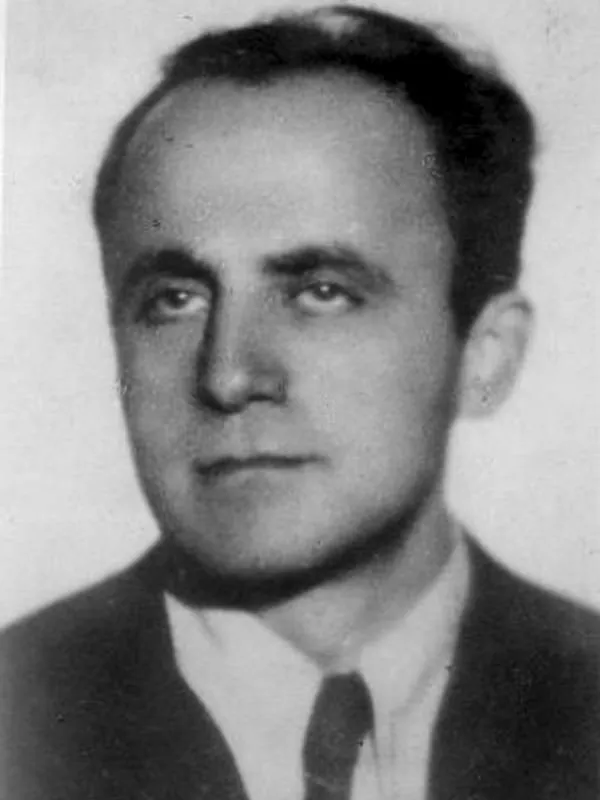
- Born:
- 21 November 1900, Buczacz (Austria-Hungary)
- Died:
- 10 March 1944, Warsaw
- Author:
- Łukasz
- Photo:
- autor nieznany, domena publiczna, Wikimedia Commons

Emanuel Ringelblum was a historian, teacher and social activist, before the war one of the most gifted scholars of the history of the Jews in Poland. During the German occupation he created in the Warsaw Ghetto an underground archive, code-named Oyneg Shabes, in which several dozen collaborators spent nearly three years gathering documents, testimonies and studies on the life and destruction of Polish Jewry. Two of the three hidden parts of the collection were found in the ruins of the ghetto after the war. Today they are among the most important sources for the history of the Holocaust, and UNESCO has inscribed them on its Memory of the World Register. Ringelblum himself did not live to see the end of the war: in March 1944 the Germans discovered his hiding place on the “Aryan side” of Warsaw and murdered him together with his wife, his son, several dozen Jews in hiding and the two Poles who looked after the shelter.
Youth in Galicia
He was born on 21 November 1900 in Buczacz, a small Galician town on the Strypa, then in Austria-Hungary. He was the son of Fayvish Ringelblum, a grain merchant, and Munia, née Heler; he had a brother and two sisters. His mother died when he was 12. He studied first at a cheder, then at a Polish-language gymnasium. After the outbreak of the First World War in 1914 the family, fearing Russian pogroms, moved to Nowy Sącz. There they lived in poverty, and Emanuel earned extra money by private tutoring. He finished the gymnasium in Nowy Sącz in 1919 and passed his school-leaving examinations in 1920.
Already in Buczacz he belonged to a Zionist youth organisation. In Nowy Sącz he joined the Marxist Zionist party Poale Zion, and after its split in 1920 its left wing, Left Poale Zion. He remained with it for the rest of his life: he sat on the leadership of the party’s youth organisation, Yugnt, wrote for the party press and helped to shape the party’s cultural programme. From the movement he took an attachment to Yiddish, to folk culture and to a secular Jewish national identity, as well as the left-wing views he held until his death.
Historian of Warsaw’s Jews
In 1920 he came to Warsaw to study medicine, but was not admitted because of the numerus clausus in force at the University of Warsaw, which limited the number of Jewish students. Embittered, he thought of emigrating. In the end, in 1922, he began studying history in the university’s Faculty of Philosophy. He attended the seminars of Marceli Handelsman, and his principal mentor was the historian of Polish Jewry Ignacy Schiper. In 1927 he defended his doctorate on the history of the Jews in medieval Warsaw. His book Żydzi w Warszawie od czasów najdawniejszych do ostatniego wygnania w r. 1527 (The Jews in Warsaw from the Earliest Times to the Last Expulsion in 1527), published in 1932, was the first monograph on the largest Jewish community in Poland to be based on such rich sources.
In the interwar period he published more than a hundred and twenty studies and articles, among others on the Jews in the Kościuszko Uprising, on Jewish physicians, printers and books, and on attempts at the “productivisation” of the Jews in the reign of King Stanisław August. He wrote in Polish and in Yiddish. In 1923, with his friend Rafał Mahler, he founded a circle of young historians at the Jewish Academic House, from which grew the Warsaw historical section of the Vilna-based YIVO Institute for Jewish Research. He co-edited its journal, published from 1934 as Bleter far Geshikhte. He was a champion of social history: he was interested in the history of ordinary people, not only of elites, and believed that a community’s history should be written jointly by professional scholars and its own members, by collecting testimonies, letters, diaries and folklore. He treated the history of the Jews as part of the history of Poland.
He earned his living teaching history. After a year in Jewish secondary schools in Wilno (Vilnius) he taught for ten years in Warsaw gymnasia, chiefly at the private Yehudia girls’ gymnasium. He married Judyta Herman, a teacher of Polish and an activist of Left Poale Zion; in 1930 their son Uri was born. The husband of one of his sisters was the historian Artur Eisenbach, after the war director of the Jewish Historical Institute.
With the Joint and at Zbąszyń
From the late 1920s he worked with the American Jewish relief organisation, the American Jewish Joint Distribution Committee, known as the Joint, first in the network of interest-free loan funds it financed, for which he edited the journal Folkshilf, and from 1938 full-time, after giving up teaching.
In the autumn of 1938 the Joint sent him to Zbąszyń. At the end of October Germany had driven some fifteen thousand Jews with Polish citizenship across the border, and several thousand of them were stranded in this small border town; among the expellees was the family of Herschel Grynszpan, whose assassination attempt in Paris gave the Germans the pretext for Kristallnacht. For several weeks Ringelblum directed relief for some six thousand expellees: he helped to organise them by trade and to set up in the camp a post office, a security service and legal aid for those seeking to emigrate. At the same time he collected their accounts of persecution in the Reich and began writing a report on the situation of the Jews in Nazi Germany. The experience of Zbąszyń, where for the first time he combined social relief with documenting injustice, he would repeat on a far larger scale in the ghetto.
September 1939 and the first year of occupation
In August 1939 he was in Geneva for the 21st Zionist Congress. On hearing of the Molotov–Ribbentrop Pact he immediately set off home through Italy, Yugoslavia and Hungary and reached Warsaw just as Germany invaded Poland. Although he was repeatedly offered the chance to leave, he stayed in the city. During the siege and the bombing he joined the relief for the homeless and the starving organised by the Joint, and after the capitulation of Warsaw he became one of the pillars of Jewish self-help. The Coordinating Commission of Jewish social organisations, set up in September 1939, became in 1940 Jewish Social Self-Help (PL), the only Jewish welfare organisation tolerated by the authorities of the General Government. Ringelblum headed its Social Work Section, which supervised the network of house committees that organised supplementary feeding, childcare and neighbourly help in the tenement blocks.
From the first weeks of the war he kept notes. In October 1939 he began collecting material on the situation of the Jews under occupation, drawing on the accounts of refugees and expellees who passed through the self-help offices in their thousands. From May 1940 he drew more and more collaborators into this work: writers, teachers, economists, rabbis and activists of various parties, from the Orthodox Agudah to the Bund and the communists. In November 1940 he and his family found themselves inside the sealed ghetto, whose creation he had earlier described in his notes.
Oyneg Shabes
The formal beginning of the ghetto’s underground archive is taken to be a meeting in Ringelblum’s flat at 18 Leszno Street on Saturday, 22 November 1940. The group adopted the code name Oyneg Shabes (“Joy of the Sabbath”), because it usually met on Saturdays, most often in the self-help offices in the Main Judaic Library building on Tłomackie Street. Ringelblum directed the substantive work; the archive’s secretaries and organisers were Hersh Wasser (PL) and Eliyahu Gutkowski, and the inner circle included, among others, the director of the Joint’s Polish branch, Yitzhak Giterman, the teacher Abraham Lewin (PL), the rabbi and historian Shimon Huberband (PL) and the writer Rachel Auerbach. In all, 50–60 people worked with the archive. It operated in strict secrecy and independently of the Judenrat.
They collected everything that might be of use to future historians: the occupier’s decrees and the Jewish Council’s announcements, underground newspapers, posters, ration cards, tram tickets, concert invitations, even sweet wrappers. Ringelblum, true to his idea of social history, wanted above all to record the experience of ordinary people. Oyneg Shabes ran questionnaires and competitions, conducted interviews, and commissioned diaries and studies on hunger, smuggling, the Jewish police, the situation of women and children, religious and cultural life, the fate of the Jewish small towns in the provinces, and Polish–Jewish and German–Jewish relations. Ringelblum himself kept a chronicle of the ghetto, published in Polish in 1983 as Kronika getta warszawskiego (Chronicle of the Warsaw Ghetto).
Relations with the chairman of the Judenrat, Adam Czerniaków, were poor. Ringelblum and the self-help activists accused the Council and the police under its authority of corruption, of favouring the rich and converts, of burdening the poor with taxes and of using Polish instead of Yiddish. His harsh judgements of Czerniaków were not always fair; after the chairman’s suicide in July 1942 he noted that it had been a sign of weakness and that Czerniaków ought to have called for resistance.
Archive of the Holocaust
From the turn of 1941 and 1942 news reached the ghetto of mass murder in the east, and then at the extermination camp at Chełmno on the Ner, from which Szlama Ber Winer escaped; he was questioned by the archive’s collaborators. Oyneg Shabes turned into a centre for documenting the Holocaust. Reports prepared in the ghetto were passed through the Polish underground to London. When in June 1942 the BBC broadcast news of the murder of the Jews in Poland, Ringelblum wrote that the archive had fulfilled a great historic mission. In the spring of 1942 he joined the Anti-Fascist Bloc and later helped to create the Jewish Combat Organisation (ŻOB): he was a member of its finance committee and a friend of its leader, Mordechai Anielewicz. He also kept in touch with the right-wing Jewish Military Union and worked with the Jewish National Committee.
During the Great Deportation in the summer of 1942 the Germans deported to Treblinka and murdered some 265,000 inhabitants of the ghetto and killed more than 10,000 in the ghetto itself; among the victims were many of the archive’s collaborators. Ringelblum survived, formally employed in Bernhard Hallmann’s German carpentry workshop at 68 Nowolipki Street. He tried to pull people out of the Umschlagplatz and to save the archive. On 3 August 1942 the first part was hidden in the cellar of the school at 68 Nowolipki by the teacher Israel Lichtenstein and two of his pupils, Dawid Graber and Nachum Grzywacz. The second part was buried there in February 1943, the third on 4 April 1943 under 34 Świętojerska Street.
On the “Aryan side”
At the end of February or the beginning of March 1943 Ringelblum, his wife and son got out of the ghetto and hid in the underground shelter “Krysia” on the property of the market gardener Mieczysław Wolski at 81 Grójecka Street in the Ochota district. It was the largest Jewish hiding place in occupied Warsaw: in 1942–1944 some 40 people hid there. Contact with them was maintained by Adolf Berman of the Jewish National Committee, and part of the costs was covered by the Council to Aid Jews, Żegota.
On the eve of Passover, 18 April 1943, Ringelblum went back into the ghetto to spend the festival there and see to the archive’s affairs. The next day the Ghetto Uprising broke out. He was caught and deported to the labour camp at Trawniki. When Żegota learnt of this, in August 1943 its courier, the railwayman Teodor Pajewski (PL), and Shoshana Kossower (PL) bribed a guard and brought him out of the camp to Warsaw disguised as a railwayman. Ringelblum returned to “Krysia”. He turned down proposals that he should live openly, which his “Aryan” looks made possible, or be smuggled abroad, because he did not want to leave his family and wished to go on writing.
In the bunker he wrote his last works, above all the long essay “Polish–Jewish Relations during the Second World War”, as well as sketches on the fate of the Jewish intelligentsia and, together with Berman, a study of cultural life in the ghettos. The essay on Polish–Jewish relations, published in Polish in 1988, is an attempt at an honest reckoning: Ringelblum writes in it about the indifference, the blackmailers (szmalcownicy) and the antisemitism of part of Polish society and the underground, but also about those who rescued Jews at the risk of their own lives. Elsewhere he wrote that across the walls and the barbed wire “Poles and Jews joined hands” to resist the plan to starve the ghetto.
Death
On 7 March 1944 the Germans discovered “Krysia”. Polish studies usually hold that the hiding place was betrayed by 18-year-old Jan Łakiński, who was later shot on the sentence of a Home Army special court; according to another version, the denunciation came from Wolski’s former girlfriend. The Jews in hiding, together with Wolski and his nephew Janusz Wysocki, were taken to Pawiak prison. Ringelblum, suspected of links with the underground, was tortured. According to the account of a Pawiak prisoner, the writer Yechiel Hirshaut, the Jewish prisoners tried to get him into a work detail and so save him, but he would not leave his wife and son. A few days after the arrest, probably around 10 March 1944, Ringelblum, his wife Judyta, his son Uri, the other inhabitants of the shelter and their Polish protectors were shot in the ruins of the ghetto.
The archive and remembrance
Of the three hidden parts of the archive, two were found. On 18 September 1946, on the initiative of Hersh Wasser, one of the three Oyneg Shabes collaborators who survived the war, ten metal boxes were dug out of the ruins of the house at 68 Nowolipki. In December 1950 workmen unearthed two milk churns containing the second part at the same spot. The third, hidden on Świętojerska Street, could not be found despite searches, including one in 2003 on the grounds of the Chinese embassy that now stands there. The surviving collection, comprising some 1,700 units and more than 25,000 sheets, is held by the Jewish Historical Institute, which has borne Ringelblum’s name since 2009. In 1999 the archive was inscribed on UNESCO’s Memory of the World Register, and its full scholarly edition runs to several dozen volumes.
In 1948 Ringelblum was posthumously awarded the Officer’s Cross of the Order of Polonia Restituta. Since 1961 a street in Warsaw’s Koło district has borne his name. The story of the archive was told by the American historian Samuel Kassow in his book Who Will Write Our History?, on which a 2018 documentary film of the same title was based. Thanks to Ringelblum, the destruction of Warsaw’s Jews is told not only from German files and the perpetrators’ reports, but above all in the voice of its victims, in the language in which they spoke, wrote and recorded what they saw, knowing that they themselves would most probably not survive.
Sources
Often appears with
People who appear in the same events.