- Category:
- Politics
- Front:
- Balkans
- Date:
- 3 December 1944
- Author:
- Natalia
- Tags:
- Greece, United Kingdom, resistance, communism
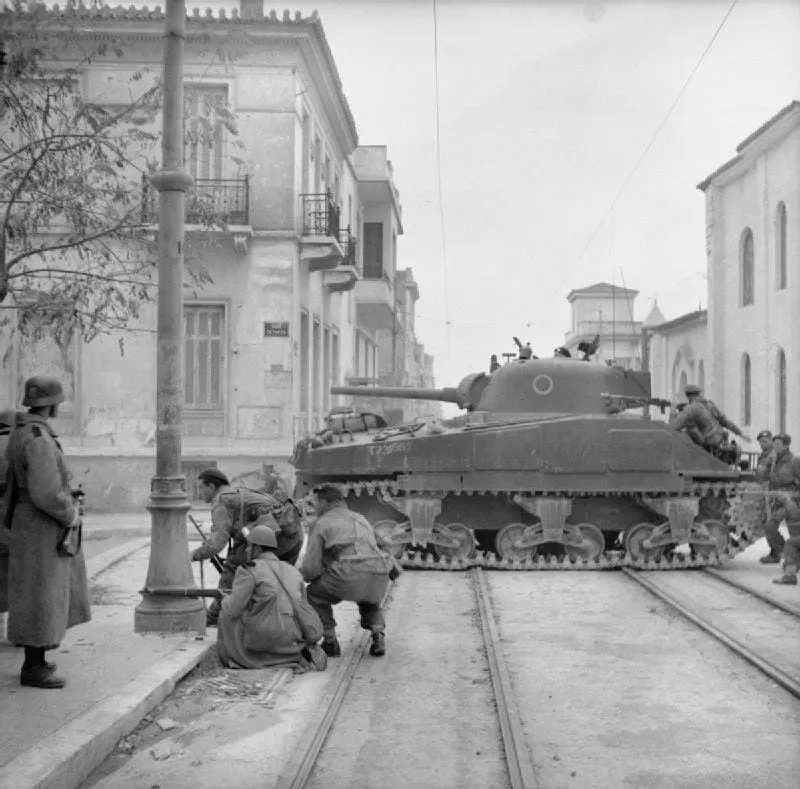
On Sunday 3 December 1944, less than two months after the liberation of Athens, shots were fired into a crowd in the centre of the Greek capital. Tens of thousands of supporters of the left-wing National Liberation Front (EAM) – estimates range from several tens of thousands to as many as 200,000 people – were marching on Syntagma Square to protest against the disbanding of the ELAS partisan army and to demand the punishment of collaborators. When the head of the procession reached the front of the parliament building, Greek policemen and gendarmes opened fire on it, shooting among other places from the police headquarters building. At least 28 demonstrators were killed and about 148 wounded – these are the figures given by most studies, although some accounts speak of heavier losses. The next day fighting began in Athens and Piraeus, which the Greeks call the Dekemvriana (“the December events”). It lasted more than five weeks and pitted the former partisans against the government of national unity, backed by British troops.
A popular chronology describes the day with the statement that “British troops and police fired on unarmed demonstrators”, while the crowd carried the flags of Greece, the United States, Britain and the USSR and chanted “Viva Churchill, Viva Roosevelt, Viva Stalin”. The picture of the flags and of the cheers for all three great allies is confirmed by the accounts of participants and witnesses – the demonstrators were stressing in this way that they were acting as members of the anti-Hitler coalition, not against it. The wording about British troops firing, however, needs to be made more precise. According to the consistent findings of historians, the fire in Syntagma Square was opened by the Greek security forces – the city police and the gendarmerie – and not by British soldiers, although British tanks and patrols were stationed nearby, and London’s political responsibility for the course of events remains a matter of dispute. It is also disputed who fired first: the British liaison officer Christopher Montague Woodhouse later maintained that this could not be established, whereas the Life magazine photographer Dmitri Kessel, who was in the square, reported that the police fired without provocation. No known testimony suggests that the demonstrators were armed. The chronology’s second statement – that the clashes were confined to Athens and the rest of the country remained relatively calm – is broadly accurate, but it too needs a qualification.
The dispute over disarming the partisans
The roots of the crisis went back to the occupation. The strongest organisation of the Greek resistance was the National Liberation Front, set up in 1941 on the initiative of the Communist Party of Greece (KKE), and its armed wing, ELAS. In 1944 EAM controlled most of mountainous Greece, and in March it set up in the mountains a Political Committee of National Liberation, which the government-in-exile in Cairo saw as a rival centre of power. After the Lebanon Conference in May 1944 and long bargaining, however, EAM joined the government of national unity of Georgios Papandreou, taking six ministerial portfolios. On 26 September at Caserta representatives of the government, ELAS and the rival organisation EDES agreed to place their forces under the government and, through it, under the British Lieutenant General Ronald Scobie. British predominance in Greece was also accepted by Stalin when, on 9 October in Moscow, Winston Churchill presented him with his “percentages” proposals for dividing influence in the Balkans at the Moscow Conference.
After the German withdrawal in the autumn of 1944, however, the Greek state existed mainly in Athens. In the provinces power was exercised by EAM committees and ELAS units, which – as in Salonika – dealt with collaborators and political opponents, often without trial. The government had few forces at its disposal: the re-formed police and gendarmerie, in which many men from the occupation period served, and two formations of the army in exile – the Sacred Band and the 3rd Greek Mountain Brigade. The brigade, decorated for the fighting at Rimini, arrived in Athens from Italy in November under the command of Colonel Thrasyvoulos Tsakalotos; both units had been purged of the left after the mutiny in the Greek armed forces in the Middle East in the spring of 1944 and were loyal to the government and the monarchy. The left also pointed out that members of the collaborationist Security Battalions had not been brought to account – many of them, detained by the British, were being held in barracks, and some were finding their way into the new security formations. Also active was the royalist Organisation X of Colonel Georgios Grivas, which EAM accused of collaborating with the occupier.
In November negotiations were held within the government on the demobilisation of the partisans and the creation of a new national army. Papandreou, on the advice of the British ambassador Reginald Leeper, proposed disbanding all partisan units except for numerically equal contingents of ELAS and EDES, while retaining the Sacred Band and the Mountain Brigade. EAM concluded that under such an arrangement the armed force of the state would be in the hands of the right, and demanded the simultaneous demobilisation of all formations, the brigade included. The negotiations broke down. On 1 December Scobie issued a proclamation calling for the partisan units to be disbanded – their weapons were to be handed in by 10 December – and the government announced the dissolution of the civil guard subordinate to EAM and the transfer of policing duties to a new National Guard. On 2 December the six ministers linked to EAM resigned from the government. The KKE leadership, headed by the party secretary Georgios Siantos, decided that the demand to disband ELAS must be resisted. EAM called a rally in central Athens for 3 December and a general strike for 4 December.
Sunday in Syntagma Square
The government at first permitted the rally, but on the evening of 2 December withdrew its permission. Accounts differ on how clearly the ban reached the organisers; in any case EAM did not call off the demonstration. On the morning of 3 December columns from the working-class districts and suburbs set off towards the centre, along University Street (Panepistimiou) among others. They included men, women and young people, carrying banners demanding the punishment of collaborators and the withdrawal of “Scobie’s order”, as well as the flags of Greece and the Allied states. Greek police units were deployed around the square, and British tanks and patrols stood in the vicinity.
As the demonstrators approached the Tomb of the Unknown Soldier in front of the former royal palace, where parliament sat, shots rang out. According to most accounts, the firing came from the police headquarters building on the square, from the windows of other buildings and from the ranks of policemen in the street. A member of Organisation X, fifteen years old at the time, recounted years later that the signal to open fire was given with a handkerchief from a window by the head of the Athens police, Angelos Evert, and that the gunmen had orders to open fire when the procession reached the tomb; this testimony, however, remains the account of a single person. The bodies of the dead were left lying on the pavement, and pictures of people lying in the square and of demonstrators raising bloodstained flags went round the world – some of them taken by Kessel for Life. According to the most frequently cited figures, at least 28 people were killed and 148 wounded. The great majority of the dead and wounded were civilians, while the government side claimed that shots had also come from the crowd. In the end order in the square was restored by British patrols.
The next day Prime Minister Papandreou offered Scobie his resignation, but the British general did not accept it and persuaded him to stay in office. For EAM the massacre was proof that the government and the British had decided to deal with the left by force; for the government and the British, it was proof that EAM was reaching for power through the street. From then on both sides treated the conflict as a struggle over who would govern post-war Greece.
Fighting in Athens and Piraeus
During the night of 3–4 December and the following morning, ELAS units and EAM militias in Athens and Piraeus attacked police stations and Organisation X positions; most of the district stations were taken. On 4 December, the day of the general strike, the funeral procession of the victims of Syntagma Square passed through the streets; according to many accounts it too came under fire, and the number of victims that day is disputed. A conflict that had begun as a clash between the left and the Greek security forces turned within a few days into open fighting between ELAS and the British army.
The decision was taken by Churchill personally. During the night of 4–5 December he sent Scobie a telegram instructing him to hold Athens and not to hesitate to act “as if you were in a conquered city where a local rebellion is in progress” – preferably without bloodshed, but with bloodshed too if that proved necessary. The content of the telegram quickly leaked to the American press and caused a storm. British tanks, artillery and RAF aircraft went into action against the districts held by ELAS, and the 3rd Greek Mountain Brigade and government units fought alongside the British.
In the first half of December the advantage lay with ELAS. Around 12 December EAM controlled most of Athens, Piraeus and the suburbs, and the British and government forces were squeezed into the centre of the city, in an area the partisans ironically called “Scobia” (after the general). British garrisons around Athens were cut off; at Kifisia near Athens ELAS overran an RAF headquarters and took several hundred airmen prisoner. London rushed reinforcements from Italy – first the 4th Indian Infantry Division, then further units – and command of operations in Attica was taken over, alongside Scobie, by General John Hawkesworth, brought in from the Italian front. From the second half of December the British, with their superior firepower, began to drive ELAS out of one quarter after another, house by house.
The fighting was cruel for the civilian population. Shelling and bombing of working-class districts claimed many victims. The OPLA organisation and other EAM formations carried out executions of real and alleged collaborators and of political opponents – including people with no connection to the occupier, among them Trotskyists and anarchists. As it withdrew from Athens, ELAS took thousands of hostages, many of whom died during the winter march; on the government and British side, in turn, over ten thousand people suspected of links with EAM were arrested, some of whom were shipped to camps in the Middle East. After the fighting in Athens ended, mass graves of ELAS’s victims were found. Estimates of the total losses of the Dekemvriana vary widely; they speak of several thousand killed on both sides, many of them civilians.
The rest of the country
The statement that relative calm prevailed outside Athens is true of most of Greece. In Salonika, Patras, Volos and other towns ELAS avoided open fighting with the small British detachments; there were only isolated incidents, and in some places the British and the partisans maintained a cool neutrality. The exception was Epirus. In the second half of December ELAS units, in which Aris Velouchiotis played a key role, attacked the EDES forces of General Napoleon Zervas. EDES was routed, and at the end of December Zervas and the remnants of his men were evacuated by the British to Corfu. Thus in the last days of the year the only significant non-communist partisan organisation on the mainland disappeared, and the conflict, though decided in the capital, was not confined to it alone.
The international echo
The fighting between British soldiers and units that only a few weeks earlier had been fighting the Germans caused a shock in the Allied countries. In the House of Commons Churchill’s government had to defend itself against the charge of suppressing a democratic resistance movement in the interests of King George II, whose return was deeply unpopular in Greece. The American press was overwhelmingly critical of the British, and the statement by Secretary of State Edward Stettinius on 5 December about non-interference in the internal affairs of liberated countries – formally concerning Italy – was also read as distancing Washington from London’s policy in Greece; President Franklin Delano Roosevelt, according to those close to him, privately condemned the British intervention but went no further in public. Joseph Stalin, on the other hand, kept to the October agreement: the Soviet Union gave EAM no support at all, and Pravda was practically silent about the events in Athens throughout December. Some historians attribute to Soviet guidance the earlier caution of the KKE leadership, which in the autumn had made no attempt to seize power although it had the strength to do so.
The course of events
On Christmas Day 1944 Churchill flew to Athens accompanied by the Foreign Secretary, Anthony Eden, Field Marshal Harold Alexander and the Minister Resident, Harold Macmillan. On 26 December, in a city under fire, he convened a conference of representatives of the Greek parties, including delegates of EAM and the KKE, chaired by Archbishop Damaskinos. The talks produced no agreement, but they convinced Churchill that a regency was the way out. Under British pressure George II agreed that, until the question of the constitution was settled, the office of regent should be held by Damaskinos, who assumed it on 31 December. At the beginning of January 1945 Papandreou stepped down, and General Nikolaos Plastiras became prime minister.
By the beginning of January the reinforced British forces had driven ELAS out of Athens and Piraeus. On 11 January 1945 a truce was signed, which came into force on 15 January, and on 12 February at Varkiza the government and EAM concluded an agreement providing for the disarmament of ELAS, an amnesty for political offences (excluding common crimes) and a plebiscite on the monarchy. In practice the amnesty provisions were not honoured: in the months that followed a wave of repression by right-wing bands and the state apparatus fell upon the left, known as the “White Terror”.
The Dekemvriana is often described as the first open armed clash between a Western power and a communist resistance movement in Europe – and while the war with Germany was still going on. It settled that Greece would remain in the British, and later Western, sphere of influence, but it deeply divided society. The memory of the massacre in Syntagma Square and of the terror on both sides became one of the foundations of Greek political divisions for decades, and the mutual wrongs of December 1944 and of the months after Varkiza led in 1946 to the outbreak of the Greek Civil War, which ended in 1949 with the defeat of the communists. In a wider perspective the events in Athens were for many observers one of the first signs of the break-up of the wartime coalition and of the division of Europe that was to follow victory over Germany.
Sources
Meanwhile
(04)Elsewhere, within a week.
- 5 December 1944 · MediterraneanThe capture of RavennaOn 4 December 1944 Canadians and Bulow's partisans entered Ravenna, and its Byzantine monuments survived. The front in Romagna came to a halt on the rivers.
- 30 November 1944 · Western FrontXXII Corps in EuropeIn autumn 1944 the headquarters of US XXII Corps reached Europe. In 1945, under General Ernest Harmon, it fought with the Fifteenth Army, then occupied Bohemia.
- 28 November 1944 · Western FrontThe port of Antwerp openedOn 28 November 1944, 85 days after Antwerp's liberation, the first Allied convoy entered the port. The supply crisis of the armies in the west began to ease.
- 8 December 1944 · PacificThe bombardment of Iwo JimaOn 8 December 1944 B-29s, B-24s and cruisers struck Iwo Jima. From then on B-24s from the Marianas bombed it every day until the landing in February 1945.
Related events
(04)The same battle, people or subject.
- 28 December 1944 · BalkansChurchill in AthensFrom 25 to 28 December 1944 Churchill and Eden were in strife-torn Athens. A conference of Greek parties brought no truce but did agree on a regency.
- 15 January 1945 · BalkansThe Athens truceOn 15 January 1945 a truce between ELAS and the British came into force, ending the Dekemvriana – the battle for Athens that the Greek left had lost.
- 26 September 1944 · BalkansThe Caserta AgreementOn 26 September 1944 at Caserta the Papandreou government, ELAS and EDES put the partisans under the government and British General Scobie before liberation.
- 9 October 1944 · DiplomacyThe Moscow Conference of 1944On 9 October 1944 Churchill flew to Moscow. Talks with Stalin brought the percentages agreement on the Balkans, a clash over Poland and a pledge on Japan.