United Kingdom
Anthony Eden
Foreign Secretary (1935–1938, 1940–1945, 1951–1955), Secretary of State for War (1940), Prime Minister of the United Kingdom (1955–1957)
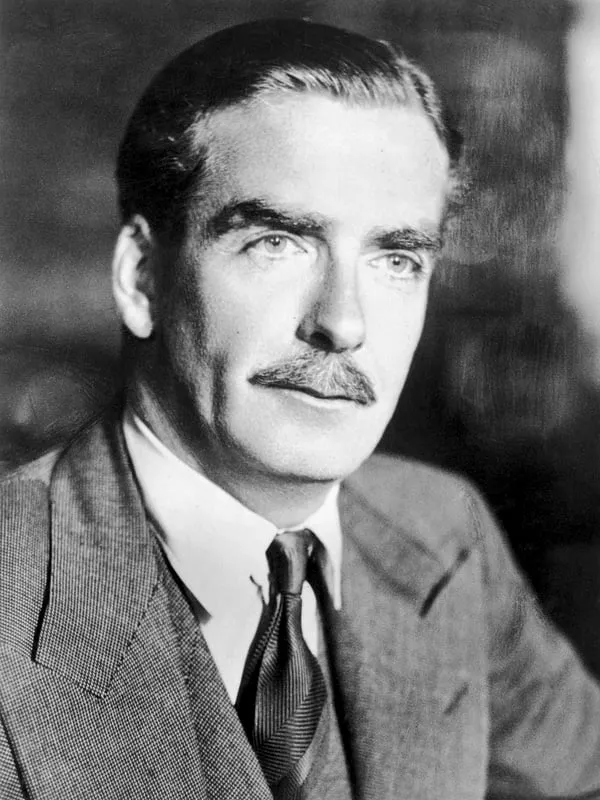
- Born:
- 12 June 1897, Windlestone Hall (County Durham, United Kingdom)
- Died:
- 14 January 1977, Alvediston (Wiltshire)
- Author:
- Łukasz
- Photo:
- Walter Stoneman, domena publiczna, Wikimedia Commons

Anthony Eden was one of the youngest Foreign Secretaries in British history and one of the few members of the government who left office before the war in protest at concessions to the dictators. A veteran of the Great War, in which two of his brothers were killed, in the 1930s he believed in the League of Nations and collective security, and in February 1938 he resigned after a dispute with Neville Chamberlain over policy towards Italy. In May 1940, as Secretary of State for War, he called on the British to join the Local Defence Volunteers, and from December 1940 until the end of the war he ran the Foreign Office alongside Winston Churchill, Polish affairs included. For fifteen years after the war he was regarded as Churchill’s heir, but his brief premiership was brought to an end by the failure of the Suez expedition in 1956.
Home and trenches
Robert Anthony Eden was born on 12 June 1897 at Windlestone Hall in County Durham, the third of four sons of Sir William Eden, a baronet from an old landed family and an eccentric, hot-tempered watercolourist and collector, and of Sybil Grey, of the family of the Earls Grey of Northumberland. He was educated at Sandroyd School and, from 1911, at Eton College. On holidays on the Continent he learned French and German.
The Great War took two of his brothers. The elder, John, was killed in Flanders in October 1914, and sixteen-year-old Nicholas died as a naval cadet aboard the battlecruiser Indefatigable at the Battle of Jutland in 1916. Anthony volunteered and in the autumn of 1915 was commissioned as a second lieutenant in the 21st Battalion of the King’s Royal Rifle Corps, raised from the farm labourers of County Durham. In May 1916 the battalion went to Flanders. That summer Eden brought a badly wounded sergeant back in from no man’s land, for which he received the Military Cross. He fought on the Somme, at Messines and at Ypres; at 19 he was the youngest battalion adjutant on the Western Front, and in May 1918, aged 20, he became the youngest brigade major in the British Army. In March 1918, during the German Spring Offensive, he was on the Oise near La Fère. As he learned in 1935 in conversation with Hitler, on the other side of the line at that time was a corporal named Adolf Hitler.
After demobilisation in 1919 he read oriental languages, Persian and Arabic, at Christ Church, Oxford, and graduated with first-class honours in 1922.
A young Conservative
In 1922 he lost the election in the mining constituency of Spennymoor, but a year later, newly married to Beatrice Beckett, daughter of the owner of the Yorkshire Post, he won the seat of Warwick and Leamington, which he held without a break until 1957. From 1926 he was parliamentary private secretary to the Foreign Secretary, Austen Chamberlain, and from then on he specialised in international affairs. Like many of his generation who had been through the trenches, he hated war and believed in the League of Nations.
In August 1931, in Ramsay MacDonald’s National Government, he became Under-Secretary of State at the Foreign Office, and in December 1933 Lord Privy Seal, responsible in the government for League of Nations affairs and the Disarmament Conference. In February 1934 he had talks with Hitler in Berlin. In March 1935 he called on him again, together with the Foreign Secretary John Simon, just after Germany had reintroduced universal military service. Hitler spoke to them then about the naval agreement that London concluded with Germany three months later. From Berlin Eden went on to Moscow, where he became the first British minister since the revolution to hold talks with Joseph Stalin and Maxim Litvinov, and on the way back, at the beginning of April, he visited Warsaw, where he was received by Marshal Józef Piłsudski and the Foreign Minister, Józef Beck.
Foreign Secretary
In June 1935 Stanley Baldwin appointed him Minister for League of Nations Affairs with a seat in the Cabinet. That summer Eden tried to head off Italy’s attack on Ethiopia by offering Benito Mussolini a compromise at the expense of Ethiopian territory; the Duce rejected it and later called Eden “the best-dressed fool in Europe”. When in December the Hoare–Laval Pact, which would have handed Italy a large part of Ethiopia, came to light and the Foreign Secretary, Samuel Hoare, had to go, the thirty-eight-year-old Eden took his place on 22 December 1935. The League’s sanctions, however, did not extend to oil and failed to stop the war in Abyssinia. In March 1936, after the remilitarisation of the Rhineland, Eden ruled out British military assistance to France and looked for a basis for negotiation in Hitler’s offer. During the Spanish Civil War he defended the policy of non-intervention, even though Germany and Italy openly flouted it, and in September 1937 he brought about the Nyon Conference, which put an end to attacks by “unknown” submarines in the Mediterranean.
When Neville Chamberlain became Prime Minister in May 1937, the two men began to drift apart. Chamberlain ran foreign policy himself, through unofficial channels, and wanted an agreement with Mussolini that would detach him from Hitler. Eden held that Italy must first honour its earlier commitments and withdraw its “volunteers” from Spain. In January 1938, while Eden was away, the Prime Minister gave a cool reply to Franklin Delano Roosevelt’s proposal to convene an international conference. On 20 February 1938 Eden resigned. He was succeeded by Lord Halifax.
After his resignation Eden did not, despite the later legend, become the leader of the opposition within the Conservative Party. A group of younger MPs, dubbed the “Glamour Boys” by the party whips, gathered round him, but he himself avoided an open clash with the government. After the Munich Agreement he abstained rather than vote against the government. In the country, however, he was very popular, and many believed that it was Munich that had made him resign.
War
On 3 September 1939 Chamberlain brought Eden back into the government as Dominions Secretary, but without a seat in the War Cabinet. In December Eden welcomed the first Canadian troops at Greenock, and in February 1940 he greeted soldiers from Australia and New Zealand in the Middle East. He was not considered a candidate for the premiership when Chamberlain’s government fell in May 1940. Churchill, who became Prime Minister on 10 May, appointed him Secretary of State for War the next day. In that post, on 14 May, he announced the formation of the Local Defence Volunteers, later the Home Guard. He lived through the defeat in France and the evacuation from Dunkirk, during which, on behalf of the government, he sent the defenders of Calais the order to fight to the end, so as to tie down the Germans and cover the Expeditionary Force. In the summer of 1940 he supported sending tanks to Egypt despite the threat of an invasion of the British Isles, and in the autumn he visited the troops in the Middle East.
On 22 December 1940, when Halifax left to become ambassador in Washington, Eden returned to the Foreign Office and joined the War Cabinet. In early 1941 he travelled with the Chief of the Imperial General Staff, General John Dill, to Cairo, Athens and Turkey and came out in favour of sending troops to Greece, a venture that ended in defeat in April. On 30 July 1941, the day the Sikorski–Maisky Agreement was signed in London, he handed General Władysław Sikorski a note in which the British government declared that it did not recognise any territorial changes made in Poland since August 1939. In the same month he secured full recognition of the Czechoslovak government-in-exile. In Moscow in December 1941 Stalin demanded that he recognise the Soviet Union’s frontiers of June 1941, and with them the annexation of eastern Poland and the Baltic states. Eden refused to commit himself, and the treaty of alliance he signed in London with Vyacheslav Molotov on 26 May 1942 contained no territorial provisions.
On 17 December 1942, following a note from the Polish government delivered by its Foreign Minister, Edward Raczyński, Eden read out in the House of Commons a joint declaration of the Allies condemning the German extermination of the Jews. The House stood for a minute’s silence in memory of the victims. From November 1942 he was also Leader of the House of Commons, the minister responsible for managing the government’s business in Parliament. When in April 1943 the Germans announced the discovery of the Katyn graves, the British government, Eden included, pressed the Polish government not to inflame its dispute with the Soviet Union. Eden took part in the conference of foreign ministers in Moscow in October 1943 and accompanied Churchill to Tehran, to Moscow in October 1944 and to Yalta. At these meetings Britain pressed Prime Minister Stanisław Mikołajczyk ever harder to accept the Curzon Line as Poland’s eastern frontier. Eden also handled London’s difficult dealings with General Charles de Gaulle, and at Yalta he won an occupation zone in Germany for France. In the spring of 1945 he led the British delegation to the founding conference of the United Nations in San Francisco, and in July he was at Potsdam until the general election handed power to Labour. In June 1945 his eldest son, Simon, an RAF navigator, went missing over Burma.
Churchill’s heir
In opposition Eden was Churchill’s deputy and in practice ran the day-to-day work of the Conservative Party, but Churchill had no intention of stepping down. Eden’s first marriage broke up, and in 1952 he married Clarissa Spencer-Churchill, Winston’s niece. After the Conservative victory of 1951 he took over the Foreign Office for the third time. In 1953 a botched bile-duct operation nearly killed him, and from then on he was often ill. The greatest success of this term was the Geneva Conference of 1954, which ended the French war in Indochina. After France rejected the European Defence Community, Eden toured the capitals of Western Europe in September 1954 and brought about the agreements that admitted West Germany to NATO and to the Western European Union. It was then that he was made a Knight of the Garter.
On 6 April 1955 he succeeded Churchill as Prime Minister and in May won a general election, increasing the Conservative majority. His government, however, is remembered for one thing only. When in July 1956 the Egyptian president, Gamal Abdel Nasser, nationalised the Suez Canal, Eden, who saw him as a new Mussolini and did not want to repeat the mistakes of the 1930s, came to a secret understanding with France and Israel. Israel attacked Egypt on 29 October, and the British and French, posing as “peacemakers”, landed troops along the canal at the beginning of November. Under pressure from the United States, which threatened sterling, and from the United Nations, Eden had to halt the operation after a few days. The Suez Crisis discredited him all the more because he had denied in the House of Commons any collusion with Israel. On 9 January 1957, officially on grounds of ill health, he resigned, and was succeeded by Harold Macmillan.
Lord Avon
Eden also gave up his seat in the Commons. In 1961 he was created Earl of Avon and took his seat in the House of Lords. Between 1960 and 1965 he published three volumes of memoirs, in which he denied the Suez collusion, and in the 1970s he appeared in Thames Television’s documentary series The World at War. He lived in Wiltshire and bred cattle. He died at Alvediston on 14 January 1977.
Significance
Throughout his career Eden was a diplomat of the trench generation: he believed in negotiation and collective security, yet he carried within him the fear that the democracies were always “a lap behind” the dictators. In the 1930s he himself took part in the concessions to Hitler and Mussolini, but his resignation in February 1938 made him a symbol of opposition to appeasement and prepared his place at Churchill’s side. During the war he was the Prime Minister’s closest collaborator in foreign policy, although Churchill conducted the most important talks with Roosevelt and Stalin himself. To Poland he was a sympathetic interlocutor, but on the crucial questions of the frontiers and Katyn he put the alliance with the Soviet Union first. The irony of his life is that the lesson of the 1930s, which he had witnessed, led him in 1956 into the error that wiped out his achievements. Historians usually rank him among the least successful British prime ministers of the twentieth century, but also among the century’s outstanding foreign secretaries.
Sources
Mentioned in battles
(07)Often appears with
People who appear in the same events.
On the timeline
(92)The 40 most important of 92 events. All tagged “Anthony Eden” (5) →