- Category:
- Military operations
- Front:
- Pacific
- Date:
- 22 June 1945
- Author:
- Łukasz
- Battle:
- The Battle of Okinawa
- Tags:
- United States, Japan, civilians, Joseph Stilwell
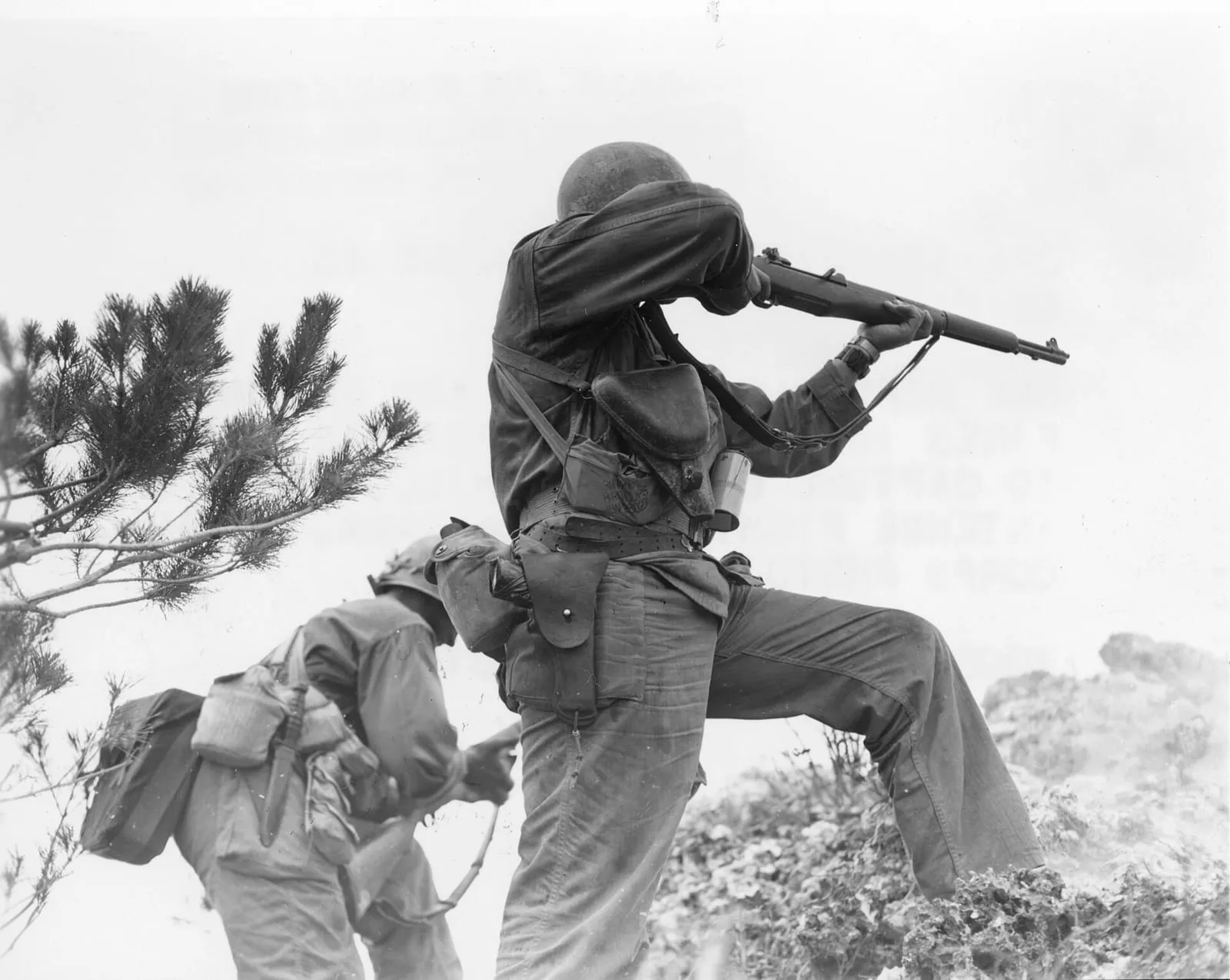
On 22 June 1945 the US Tenth Army raised the flag to mark the end of organised fighting on Okinawa. The day before, its commander, Marine General Roy Geiger, had announced that the island had been secured, and in the early hours of 22 June the commander of the Japanese Thirty-Second Army, General Mitsuru Ushijima, and his chief of staff, Lieutenant General Isamu Chō, took their own lives in the headquarters cave near the village of Mabuni at the southern tip of the island. After 82 days the bloodiest battle of the Pacific war came to an end – a struggle in which more than 12,000 Americans, some 100,000 Japanese soldiers and tens of thousands of the island’s civilian inhabitants were killed.
Many war chronologies state under this date that “the Japanese defeat on Okinawa is now complete”. This needs some precision. Organised resistance by the Thirty-Second Army ceased on 21 June, and on that day Geiger announced the capture of the island; the suicide of Ushijima and Chō is usually dated to the early morning of 22 June, although some sources, especially Japanese ones, give 23 June. The flag-raising ceremony took place on 22 June, but fighting with broken units went on for another week – until 30 June – and the last Japanese garrisons in the Ryukyu Islands signed their surrender only on 7 September 1945.
The last line on the Kiyan Peninsula
At the end of May the Thirty-Second Army withdrew from Shuri Castle, where for nearly two months it had held up the American advance. Moving by night in torrential rain, General Ushijima took some 30,000 soldiers to the southern tip of the island – the Kiyan Peninsula. The withdrawal plan was prepared by his operations officer, Colonel Hiromichi Yahara, the author of the whole concept of the island’s defence, based on fortifications inland rather than fighting on the beaches. On the new line the Japanese soldiers were to hold out to the end, using a natural fortress: a belt of limestone ridges and cliffs, riddled with caves that had been prepared for defence beforehand.
The line rested on three heights. In the west, above the town of Itoman, rose Kunishi Ridge; in the centre and east, the steep massifs of Yaeju-dake and Yuza-dake, with sheer faces on their northern side. Behind them, all the way to the sea, stretched a labyrinth of hills and ravines in which not only the remnants of the Thirty-Second Army had taken refuge, but also tens of thousands of civilians fleeing the fire from the north. The Japanese army no longer had heavy artillery in its former numbers; it was short of ammunition, food and medicine, and many units consisted of sailors without infantry training, service troops and mobilised Okinawans from the Bōeitai auxiliary units.
The Americans reached the new line at the beginning of June. In the west, in the sector of Geiger’s III Amphibious Corps, the 6th Marine Division was still fighting on the Oroku Peninsula against the sailors of Rear Admiral Minoru Ōta, who held out there from 4 to 13 June; before his death, on 6 June, Ōta sent Tokyo his famous telegram about the sacrifice and suffering of the island’s inhabitants. In the east, General John Hodge’s XXIV Corps, with the 7th and 96th Infantry Divisions, was closing in on the Yaeju-dake massif. Supply was still hampered by rain and mud, and the American soldiers were exhausted by the fighting at Shuri.
Kunishi and Yaeju-dake
The heaviest fighting of June was for Kunishi Ridge. The 1st Marine Division, attacking it, had to cross an open valley swept entirely by fire from caves and positions on the slopes. On the night of 11–12 June the 7th Marines carried out a night attack – rare in the Pacific war – and took part of the ridge, but by day the units on the crest were cut off. For several days Sherman tanks carried ammunition, water and replacements up to the crest inside their hulls, and brought the wounded back. The ridge was cleared only around 17 June, after fighting that, according to veterans’ accounts, was no less ferocious than the battles at Shuri.
In the east the infantry of XXIV Corps assaulted Yaeju-dake. The Americans advanced by a method they called “blowtorch and corkscrew”: flamethrower tanks, demolition charges and infantry flamethrowers destroyed cave entrances one by one, while artillery and warships deluged every hill with shells before the attack. By 17 June both divisions had broken the Japanese line, and the Thirty-Second Army disintegrated into isolated groups, pushed back into the area of Hill 89 near Mabuni and the ridges around the villages of Makabe and Medeera.
In these days General Simon Bolivar Buckner, commander of the Tenth Army, called on Ushijima to surrender. According to American and Japanese accounts, the letter was dropped behind the Japanese lines around 10–11 June; in it Buckner wrote that Ushijima, “like myself, an infantry general”, must understand that further resistance was hopeless. Colonel Yahara later recalled that the letter reached headquarters only on 17 June. Ushijima left it unanswered – surrender was unthinkable to him.
The death of General Buckner
On 18 June Buckner went to a forward observation post on Mezado Ridge to watch the attack of the 8th Marines – a fresh regiment of the 2nd Marine Division committed to battle only a few days earlier. A Japanese shell struck the coral rock right beside him; fragments of rock and shell pierced the general’s chest, and he died shortly afterwards at an aid station. Buckner was the highest-ranking American officer killed by enemy fire in the entire war. Together with Lieutenant General Lesley McNair, killed in Normandy in July 1944, he was posthumously promoted by Congress in 1954 to the rank of (four-star) general. A day later, on 19 June, the commander of the 96th Infantry Division, Brigadier General Claudius Easley, was killed by machine-gun fire in the front line.
Command of the Tenth Army passed to the senior officer on the island – Roy Geiger, commander of III Amphibious Corps. He was the first and only Marine officer to command a field army in combat. In Washington, however, it was decided that the army should be commanded by an Army general, and on 23 June, after organised fighting had ended, command was taken over by General Joseph Stilwell, the former commander of American forces in China, Burma and India, who had been recalled from that theatre in the autumn of 1944.
The last days of the Thirty-Second Army
Ushijima knew the battle was lost. In a farewell signal to Imperial General Headquarters he announced a final battle in which, as he wrote, he would apologise to the Emperor with his own death. On 18 June he issued his last order: the surviving soldiers were to break through the American lines in small groups to the north of the island and wage guerrilla warfare there, and all were to fight to the end. This order, which ruled out surrender, meant that the fighting in the south did not end with the commander’s death but went on for many more days in scattered pockets of resistance.
Even so, the last days saw something not encountered before in the Pacific: thousands of Japanese soldiers – especially mobilised Okinawans, but regulars too – gave themselves up. The Americans ran a large-scale propaganda campaign: they dropped millions of leaflets and, through loudspeakers, some of them on ships, called on people in Japanese and Okinawan to come out of the caves. According to American figures, several hundred soldiers surrendered on 19 June and nearly a thousand on 20 June.
On 21 June units of the 6th Marine Division reached the south coast of the island near Ara Point, and soldiers of the 7th Infantry Division were closing in on Hill 89, inside which the Thirty-Second Army’s headquarters was located. That afternoon Geiger announced the end of organised resistance. Admiral Chester Nimitz released the news in a Pacific Fleet headquarters communiqué.
The suicide of Ushijima and Chō
In the early hours of 22 June, with American soldiers already on top of the hill above the cave, Ushijima and Chō took leave of their staff officers. According to the accounts of survivors, later written down by Yahara and by American historians, the two generals went out onto a rock ledge above the sea and committed ritual suicide, seppuku; accounts of how they died differ in detail, and according to some of them a staff officer finished both men off with a sword. Chō, who throughout the battle had pressed for offensive action – he had been the main advocate of the failed counter-offensive of 4–5 May – is said to have left a note in which he wrote that he was departing “without regret, shame or obligations”. The date of their death is given variously: the American official history and most studies give 22 June, some Japanese sources 23 June, the day on which Okinawa holds its annual Memorial Day for the war dead (Irei no Hi). The Americans found the bodies of both generals and buried them near the cave. A few days earlier, on 20 June, Ushijima had been promoted to full general – the highest rank in the Japanese army.
Colonel Yahara did not follow his commander in death. Ushijima forbade him to commit suicide, ordering him to survive and tell the truth about the battle. Disguised as a civilian, Yahara hid among the refugees and was identified by the Americans in July – he was the highest-ranking officer of the Thirty-Second Army to survive the battle. His memoirs remain one of the most important sources for the history of the Japanese defence of the island.
The flag and the mopping-up
On the morning of 22 June a ceremony was held at Tenth Army headquarters at which the flag of the United States was raised to the sound of the national anthem, marking the end of organised fighting. From 23 June the Tenth Army’s two corps, deployed in line across the southern part of the island, swept the ground northwards, destroying the last caves and positions. According to the official history of the US Army, nearly 9,000 Japanese soldiers were killed and about 3,000 surrendered during this operation, which ended on 30 June. Isolated groups hid in caves for many weeks more. On 2 July the American command officially declared the Ryukyus operation over, and on 7 September, after Japan’s surrender, the Japanese commanders on the remaining islands of the archipelago signed the instrument of surrender before General Stilwell near Kadena airfield.
The tragedy of the civilian population
The last weeks of the battle were the most terrible for the island’s inhabitants. Tens of thousands of refugees were crowded into the small area of Okinawa’s southern tip, sheltering in the same caves as the soldiers. They died from artillery and naval fire, from the flamethrowers and demolition charges with which the Americans destroyed the caves, often not knowing who was hiding inside. Japanese soldiers drove civilians out of their hiding places, took their food and – according to eyewitness accounts and the findings of historians – killed people suspected of spying, as well as mothers with crying babies, so that they would not give away a hiding place. On the cliffs near Mabuni and at Cape Kiyan many individuals and whole families committed suicide, throwing themselves from the rocks into the sea or killing themselves with grenades. Some had succumbed to years of propaganda about American cruelty, others acted under pressure from the military; the extent of that pressure and the army’s role in the “mass suicides” remain the subject of dispute in Japan to this day.
The symbol of those days became the schoolgirls of the Himeyuri unit, nurses from two girls’ schools in Naha who had been sent to a cave field hospital. On 18 June the unit was disbanded and the girls were left to fend for themselves on the battlefield. The next day, in a cave near the village of Ihara where some of them were sheltering, 46 schoolgirls and 5 teachers were killed, according to the Himeyuri Peace Museum, when American soldiers attacked the cave. Of the 240 people mobilised for the field hospital, 136 died according to the museum, most of them in the week after the unit was disbanded. A similar fate befell the boys of the Tekketsu Kinnōtai units, mobilised as signallers and army auxiliaries; one of the survivors was the future prefectural governor Masahide Ōta, who hid in the south of the island long after the fighting had ended.
At the same time, in the last weeks the Americans brought tens of thousands of civilians out of the caves and took them into their care, placing them in camps in the central and northern parts of the island. Estimates of the civilian death toll for the whole battle vary: from about 40,000 according to American wartime figures to about 94,000 according to Okinawa Prefecture; together with the islanders mobilised into the military, more than 120,000 Okinawans died according to the prefecture.
The toll of the battle
In 82 days of fighting on land, from the landing of 1 April, the Americans lost, according to official figures, more than 12,000 killed and missing – about 4,900 sailors, about 4,700 soldiers of the Army and about 2,900 Marines – and about 36,000 wounded. Tens of thousands of men were withdrawn from the fighting because of sickness and combat fatigue. At sea, mainly as a result of kamikaze attacks, 36 warships and auxiliaries were sunk and more than 360 damaged; as late as the beginning of June the fleet was still losing ships off the island, and a typhoon damaged dozens of Third Fleet vessels.
Japanese losses are estimated at some 77,000–110,000 soldiers killed, including mobilised Okinawans. More than 7,000 soldiers and some 3,400 Okinawan conscripts from the auxiliary units were taken prisoner – the first time in the Pacific war that such numbers had surrendered. The Imperial Navy lost the remnants of its strength in the waters around the island, with the battleship Yamato at their head, and its air arms, according to analyses of Japanese documents, some 1,400–1,500 aircraft.
What Okinawa brought
The capture of Okinawa gave the Americans a base just 550 kilometres from Kyushu. Even while the fighting on the island was going on, airfields were being developed from which fighters and bombers flew against targets in southern Japan, and from the beginning of June the carriers struck the Kyushu airfields from which the kamikaze took off. In the plans for Operation Downfall Okinawa was to become the main staging base for the first phase of the invasion – Operation Olympic, the landing on Kyushu set for 1 November 1945.
The cost of taking the island weighed on the decisions being made in Washington. On 18 June, the day of Buckner’s death, President Harry Truman gathered the Joint Chiefs of Staff and the Secretaries of War and the Navy at the White House to decide on the invasion of Japan. According to the minutes of the meeting, the President said he hoped to prevent “an Okinawa from one end of Japan to the other”, and then approved the Olympic plan, deferring the decision on the second phase – the landing on the Kantō Plain. Casualty forecasts were based largely on the experience of Iwo Jima and Okinawa, and intelligence was watching the Japanese concentrate ever more troops and aircraft on Kyushu.
Some historians believe that it was the experience of Okinawa – fanatical resistance to the last man, the kamikaze, the deaths of tens of thousands of civilians – that settled the readiness to use the atomic bomb, which in June 1945 had not yet even been tested. Others point out that the decision stemmed from many factors: the wish to end the war quickly, the calculation of casualties, policy towards the Soviet Union and the sheer momentum of the Manhattan Project. The atomic bombings of Hiroshima and Nagasaki in August 1945 and the Soviet entry into the war against Japan meant that the invasion of Kyushu never took place, and Okinawa remained the last great land battle of the Pacific war.
For the Okinawans themselves the end of the fighting did not mean the end of the war. The island came under American military government, which lasted until 1972, and American bases built on land seized in 1945 operate there to this day. The memory of the “typhoon of steel”, of the civilian victims and of the Japanese army’s role in their deaths became the foundation of modern Okinawa’s identity. Every year on 23 June, ceremonies honouring all the victims of the battle – regardless of nationality – are held in the peace park at Mabuni, near the cave where Ushijima died.
Sources
Meanwhile
(03)Elsewhere, within a week.
- 18 June 1945 · PolandThe Trial of the SixteenOn 18–21 June 1945 a Soviet military court in Moscow tried the leaders of the Polish Underground State, seized by deceit, including Okulicki and Jankowski.
- 16 June 1945 · Far EastThe Japanese retreat in ChinaIn June 1945 the Japanese, on Tokyo’s orders, abandoned the corridor won in Operation Ichi-Go. The Chinese retook Nanning and Liuzhou, and Guilin in July.
- 28 June 1945 · PolandThe Provisional Government of National UnityOn 28 June 1945 the Provisional Government of National Unity was formed in Warsaw under Osóbka-Morawski, with Gomułka and Mikołajczyk as deputies.
Related events
(04)The same battle, people or subject.
- 13 June 1945 · PacificThe death of Admiral ŌtaOn 13 June 1945 Rear Admiral Minoru Ōta and his staff killed themselves in the Oroku tunnels. On 6 June he had sent a famous telegram on the Okinawans’ fate.
- 1 April 1945 · PacificThe landing on OkinawaOn 1 April 1945 General Buckner's Tenth Army landed on Okinawa almost unopposed. The Japanese were waiting in fortifications in the south of the island.
- 14 August 1945 · PacificThe last raids on JapanOn 14 August 1945 over a thousand US aircraft struck Japan in the last great B-29 operation; air combat still went on on 15 and 18 August.
- 2 June 1945 · PacificStrikes on Kyushu airfieldsOn 2–3 June 1945 fighters from the Ticonderoga (Air Group 87) and Halsey's other carriers struck kamikaze airfields on Kyushu. They did not stop the attacks.