Japan
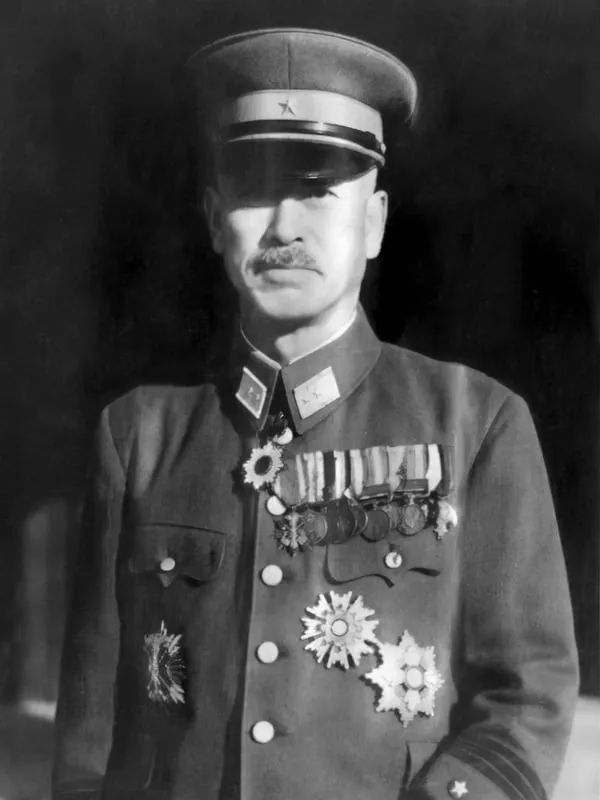
Mitsuru Ushijima
Commander of the 36th Infantry Brigade (1937–1939) and the 11th Division (1939–1941), Superintendent of the Military Academy (1942–1944), commander of the 32nd Army on Okinawa (1944–1945), General (1945)
- Born:
- 31 July 1887, Kagoshima (Japan)
- Died:
- 22 June 1945, Mabuni, Okinawa (Japan)
- Author:
- Natalia
- Photo:
- autor nieznany, domena publiczna, Wikimedia Commons

For most of his career Mitsuru Ushijima was less a front-line commander than an educator of the Imperial Army’s officers: he headed three of its most important schools in turn, including the Military Academy. He went down in history, however, as the commander of the Japanese 32nd Army in the Battle of Okinawa, the bloodiest battle of the Pacific War. For nearly three months his troops held off the American Tenth Army in a system of caves and tunnels in the south of the island, and Ushijima himself took his own life in the headquarters cave near Mabuni once the battle was lost. Calm and universally respected by his subordinates, he was regarded by American historians as one of the ablest Japanese generals of the war. In Japan, and above all on Okinawa itself, opinion of him remains divided: the defence he commanded drew the island’s civilian population into the fighting and ended in the deaths of tens of thousands of its inhabitants.
A Satsuma samurai’s son
Mitsuru Ushijima was born on 31 July 1887 in Kagoshima on Kyūshū, the fourth son of an army lieutenant who came from the samurai of the former Satsuma domain and later served as an officer in the new imperial army. His father died soon after his son’s birth, and his mother returned with the children to her native Kagoshima. One of his elder brothers, Shōzō, later became governor of Ibaraki Prefecture. Mitsuru grew up in a milieu in which the Satsuma tradition – and the figure of Takamori Saigō, with whom he was later compared – was very much alive; from childhood he practised the Jigen-ryū school of swordsmanship.
After secondary school in Kagoshima he entered the military cadet school in Kumamoto in 1901, and in 1908 graduated with distinction from the Military Academy (20th class), as one of its three best graduates. In 1916 he graduated from the Army War College; Tomoyuki Yamashita was on the same course.
In 1918, during the Siberian Intervention in the Russian Civil War, he served on the staff of the Japanese expeditionary force in Vladivostok, where he was responsible for moving troops and supplies. For this service he received the Order of the Golden Kite. On his return he was an instructor at the Infantry School, and in 1924, as a major, he commanded a battalion.
Educator and an officer of no faction
Ushijima spent the 1920s and 1930s alternating between schools and staffs. From 1925 he spent three years running military training at his old secondary school in Kagoshima – part of the reform of the War Minister Kazushige Ugaki, who brought officers into secondary schools and universities. In 1928, as a lieutenant colonel, he took command of the 23rd Infantry Regiment; in 1930 he became chief of staff of the Shimonoseki fortress; and in 1932, as a colonel, commandant of the army’s elite school at Toyama.
This was a time when young officers were swept up by ultranationalist slogans and conspiracies, and the army was torn by factional struggle. According to his Japanese biographers Ushijima forbade his subordinates to engage in politics and openly criticised the writings of the radical ideologue Ikki Kita; from 1933 to 1936, while working in the War Ministry, he carefully avoided ties with any faction. At the time of the 26 February Incident in 1936 he was away on official business in China. After the mutiny was crushed he was given command of the 1st Infantry Regiment, disgraced by its part in the revolt, which was transferred to northern Manchuria as a punishment.
War in China
After the Marco Polo Bridge Incident in July 1937 Ushijima, promoted to major general, took command of the 36th Infantry Brigade of the 6th Division, made up of regiments from Kagoshima and Miyakonojō. In the summer and autumn of 1937 the brigade fought in northern China, where Ushijima – as his biographers emphasise – commanded from the front line, heedless of the risk. In November the 6th Division was moved to the central front, where after the Battle of Shanghai it took part in the advance on the capital of Chiang Kai-shek. In the Battle of Nanjing in December 1937 Ushijima’s brigade, according to Japanese biographies, cut off the line of retreat of part of the Chinese forces and took many prisoners.
His part in the capture of Nanjing links his name to the Nanjing Massacre. Soldiers of the 6th Division were among the units that committed atrocities in the city and its surroundings, and the divisional commander, General Hisao Tani, was convicted for them after the war by a Chinese tribunal and executed in Nanjing in 1947. Ushijima’s personal responsibility was never the subject of proceedings – he died before the trials began – and the fate of the prisoners taken by his brigade remains unresolved in the literature.
The brigade spent the winter in the Wuhu area on the Yangtze, and in the summer of 1938 it fought in the Battle of Wuhan, capturing Huangmei in August. In March 1939 Ushijima returned to Japan as commandant of the preparatory officers’ school and of the Toyama school; in August he was promoted to lieutenant general. In December 1939 he took command of the 11th Division, which guarded the border between Manchukuo and the Soviet Union in the Hulin area. Some accounts also credit him with fighting in Burma; Japanese and English-language sources, however, confirm no service of his in Burma at all – at that time the 11th Division was stationed in Manchuria, and in October 1941 Ushijima returned to military education.
Superintendent of the Military Academy
The outbreak of the Pacific War found him serving as commandant of the army school at Gongzhuling in Manchukuo. According to his Japanese and American biographers he received the news of the attack on Pearl Harbor with dismay: he believed that war with America would prolong the war in China and weaken Japan against what he considered its real enemy, the Soviet Union. In April 1942, with the backing of Generals Kenji Doihara and Otozō Yamada, he became Superintendent of the Military Academy, the most important institution training officers for the army.
At the height of the euphoria after the capture of Singapore he warned cadets and instructors not to overrate the early successes and not to underestimate the natural resources and industry of the United States. He later took pride in being the only officer to have headed the army’s three main schools. He was regarded as a born educator – composed and warm, forbidding officers to beat their subordinates and considering anger a base emotion.
The 32nd Army on Okinawa
In August 1944, after the fall of Saipan, Ushijima was appointed commander of the 32nd Army, responsible for the defence of the Ryukyu Islands. He replaced the ailing General Masao Watanabe. His chief of staff was the hot-tempered, offensive-minded Lieutenant General Isamu Chō, and his chief of operations the cool and methodical Colonel Hiromichi Yahara. In keeping with the custom of Japanese commanders, Ushijima left his staff free to plan while taking responsibility upon himself.
The authorities had already begun evacuating the elderly, women and children to Kyūshū and Formosa, but it was going slowly: the influx of troops gave the inhabitants a false sense of security, and the sinking of the Tsushima Maru in August 1944, with hundreds of schoolchildren on board, made people afraid to travel by sea. According to Japanese studies, some 80,000 people were evacuated from Okinawa and about 30,000 from the Yaeyama Islands. Ushijima approved guidelines drawn up by Yahara under which inhabitants unfit for combat were to move to the mountainous north of the island just before the battle, while the rest were to work on the fortifications and support the army. According to the same sources, some 85,000 people reached the north – roughly a third of the planned number. Tens of thousands of inhabitants were mobilised to build fortifications and into auxiliary units, and secondary-school boys and girls into signal corps and as nurses.
At the end of 1944, as Imperial General Headquarters prepared for the decisive battle in the Philippines on Leyte, the 32nd Army’s best formation, the 9th Division, was taken from Okinawa and moved to Formosa. Ushijima then adopted Yahara’s plan: instead of defending the beaches, the army was to dig in inland, in caves and tunnels in the limestone hills of the south around Shuri Castle, and bleed the Americans for as long as possible. Beneath the castle the army headquarters was carved out – a network of tunnels about a kilometre long, into which Ushijima moved in March 1945. Biographers note that he himself helped with the digging and ordered that the civilians working on the fortifications be paid.
The Battle of Okinawa
When the Americans landed on the Hagushi beaches on 1 April 1945, the 32nd Army, as planned, offered no resistance on the shore. The fighting on the Shuri line proved extremely costly for the Americans, but Imperial General Headquarters, the superior command on Formosa and the navy all considered such a defence too passive; they demanded the recapture of the airfields from which the Americans were supporting the fleet under attack by kamikaze. Ushijima twice gave in to Chō’s urging: in mid-April he agreed to a night counter-attack, and on 4–5 May to a general counter-offensive, which Yahara opposed. The attack collapsed within a day, costing the 32nd Army, by various estimates, between 5,000 and 7,000 men and much of its artillery. On 5 May Ushijima admitted that Yahara had been right and, according to Yahara’s memoirs, entrusted him with the further conduct of the defence.
When both flanks of the Shuri line had been broken and the army faced encirclement, Ushijima on 22 May approved Yahara’s proposal to withdraw to the Kiyan Peninsula at the southern tip of the island, against the wishes of commanders who wanted to die at Shuri. The withdrawal, carried out from 26 May at night, in rain and under fire, was militarily efficient – some 30,000 soldiers reached the new positions – but it had terrible consequences for the civilians. The south of the island was crowded with refugees who had taken shelter in the same caves as the army and now found themselves in the middle of the final battles. The wounded in the cave hospitals were often left behind – according to many accounts, after being given poison or grenades. The army headquarters moved to a cave on Hill 89 near Mabuni.
Mabuni
On 10–11 June the Americans dropped over the Japanese positions a call to surrender, in which General Simon Bolivar Buckner Jr. called Ushijima a master of infantry tactics; when it reached headquarters, Ushijima ignored it. On 18 June he sent farewell signals to Tokyo and issued his final order to the troops: communications had ceased, and every man was to fight to the end under the orders of his nearest superior. Chō added an appeal not to surrender. The order prolonged the fighting of the shattered units, among whom thousands of civilians were still hiding. According to Japanese sources Ushijima was promoted to general (taishō) with effect from 20 June – the last officer of the Japanese army to receive that rank.
Ushijima and Chō committed seppuku in the headquarters cave on Hill 89 in the early hours of 22 June 1945 (according to some Japanese sources, on 23 June), after a farewell dinner with the staff. Eyewitness accounts differ in the details, including the date and the course of events. Ushijima forbade Yahara to die and ordered him to survive so as to tell the truth about the battle; the colonel was taken prisoner and later wrote his memoirs. On 22 June the Americans announced the end of organised resistance on the island. Earlier, around 13 June, the commander of the naval troops, Rear Admiral Minoru Ōta, had taken his own life in his underground headquarters on the Oroku Peninsula.
Assessment
The Americans, who paid an enormous price for Okinawa, rated their opponent highly; the military commentator Hanson Baldwin considered Ushijima the best Japanese general of the Pacific War. The defence in depth, similar to the one Tadamichi Kuribayashi conducted on Iwo Jima, delayed the capture of the island by many weeks and convinced American planners that an invasion of the Home Islands would be very bloody.
On Okinawa he is remembered differently. The battle cost the lives of – by various estimates – between about 40,000 and about 94,000 civilians; some of them died in mass suicides into which they were driven by soldiers and propaganda, others at the hands of Japanese soldiers who drove them out of the caves or killed them as supposed spies. Ushijima issued no orders for such acts, but as commander he was responsible for a strategy that turned the island into a battlefield to the last soldier, for the mobilisation of the inhabitants and for the withdrawal into a south crowded with refugees. Okinawan historians in particular draw attention to these decisions. The general’s grandson, the teacher Sadamitsu Ushijima, has for years given lessons on Okinawa about how the army failed to protect the island’s inhabitants. Okinawa Prefecture marks 23 June – the date traditionally accepted in Japan for his death and the end of organised fighting – as Memorial Day (Irei no hi).
Sources
Commanded in battles
(01)Often appears with
People who appear in the same events.