- Category:
- Military operations
- Front:
- Eastern Front
- Date:
- 27 January 1944
- Author:
- Łukasz
- Battle:
- Siege of Leningrad
- Tags:
- Red Army, Wehrmacht, Soviet Union, Andrei Zhdanov
At 8 p.m. on 27 January 1944 twenty-four salvoes from 324 guns thundered over the Neva, and flares lit up the sky above Leningrad. That day the command of the Leningrad Front announced, in an order to the troops and the inhabitants, that the city had been completely freed from the enemy blockade and from the barbaric shelling of the German artillery. The siege, which had lasted 872 days since the last land routes were cut on 8 September 1941 – one of the longest and bloodiest sieges of a great city in history – was over.
The people who came out onto the streets and embankments that evening were those who had survived. Of the more than three million inhabitants of pre-war Leningrad and its suburbs, an estimated 600,000 or so remained in the city. Hundreds of thousands had been evacuated, hundreds of thousands had died of hunger, cold and disease, and more than ten thousand had been killed by bombs and shells.
The order and the salute
Permission for the celebration was given in Moscow by Joseph Stalin. On 21 January, when the troops of the Leningrad Front had pushed the Germans back from the southern suburbs, the front commander, General of the Army Leonid Govorov, and a member of his military council, the first secretary of the Party in Leningrad Andrei Zhdanov, asked the Supreme Commander for permission to issue their own order to mark the complete liberation of the city and to fire a salute from 324 guns. Stalin agreed.
This was an exception in Soviet wartime practice. At that time victories were celebrated with artillery salutes only in Moscow, and the orders announcing them were signed by Stalin himself as Supreme Commander. The order of 27 January 1944 was signed by Govorov together with the members of the front’s military council, Zhdanov among them. No other front commander was granted such a privilege during the war. The order was read out on Leningrad radio.
In the recollections of Leningraders that evening returns as the moment when, for the first time in two and a half years, people wept for joy. The poet Olga Bergholz, whose voice on the radio had accompanied the inhabitants throughout the siege, became one of the symbols of that survival.
How the siege was lifted
The ring around the city had already been breached a year earlier. In January 1943, in Operation Iskra, the Leningrad and Volkhov Fronts met on Lake Ladoga and punched a narrow land corridor through to Leningrad near Shlisselburg. Within a couple of weeks a railway line was built along the lake shore, and trains carrying food and ammunition began to reach the city. The corridor, however, was within range of German artillery, and the German 18th Army still stood on the heights at Pulkovo, in Pushkin and in Peterhof, a dozen or so kilometres from the centre. From these positions heavy and railway guns could shell every district. That is why in Soviet tradition 18 January 1943 is the day the siege was “broken”, while its “complete lifting” is dated only to 27 January 1944.
The issue was decided by the Leningrad–Novgorod offensive, which began on 14 January 1944. The 2nd Shock Army struck from the Oranienbaum bridgehead west of the city, and the 42nd Army from Pulkovo. On 19 January Soviet troops took Ropsha and Krasnoye Selo, and in the evening the leading units of the two armies met, cutting off part of the German forces on the Gulf of Finland. On 20 January General of the Army Kirill Meretskov’s Volkhov Front recaptured Veliky Novgorod.
The German command of Army Group North under Field Marshal Georg von Küchler began withdrawing the threatened units. On 21 January the Germans abandoned the salient at Mga, which since 1941 had cut the city off from the Kirov Railway, and the 67th Army occupied the station that same day. On 24 January Soviet troops entered Pushkin, the former Tsarskoye Selo, and Pavlovsk, and on 26 January Krasnogvardeysk, that is Gatchina. The front moved several dozen kilometres away from the city. The last German shells fell on Leningrad in the second half of January, and the German siege batteries, abandoned in the retreat, fell into the hands of the Red Army.
The fighting continued. Troops of the Volkhov Front and the 54th Army were still clearing the line of the October Railway from Moscow to Leningrad, through Tosno, Lyuban and Chudovo; it was recovered in its entirety on 29 January. While the guns of the salute were firing in Leningrad, Soviet units were already advancing on Kingisepp, Luga and Narva.
The city in January 1944
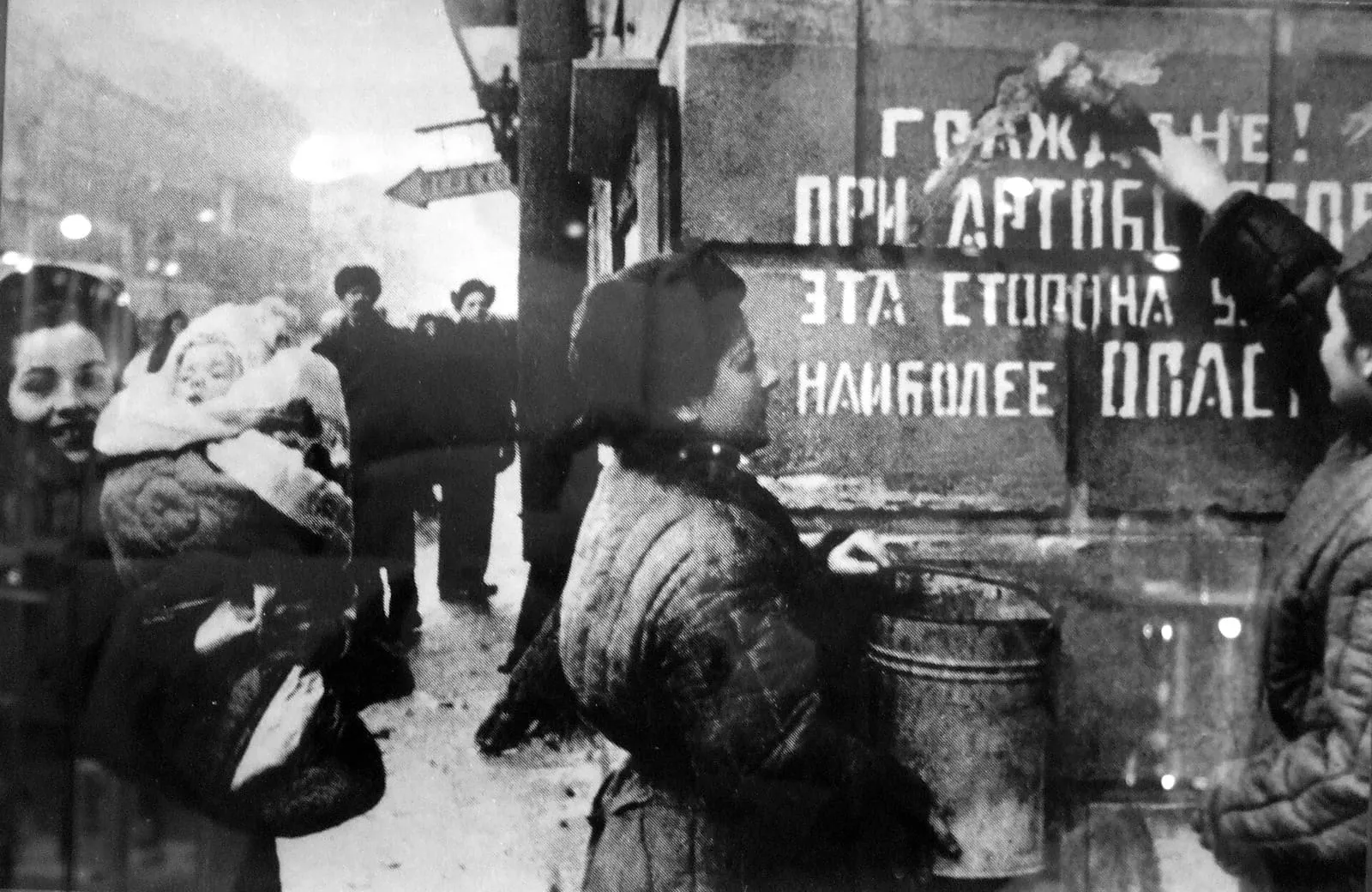
The Leningrad that lived to see the end of the siege was a depopulated and maimed city. According to Soviet figures, about 150,000 artillery shells and more than 100,000 bombs, the vast majority of them incendiaries, fell on it during the siege. According to the same figures, they killed nearly 17,000 inhabitants and wounded almost 34,000. Thousands of houses, schools, hospitals and factories were destroyed or damaged. Signs hung on the walls of buildings: “Citizens! During shelling this side of the street is the most dangerous.”
The worst was already in the past. The city had come through the great famine of the winter of 1941–1942, when in January and February 1942 an average of more than three thousand people died every day, thanks to evacuation, supplies across Lake Ladoga and a drastic reduction in the number of mouths to feed. From the spring of 1943, after the corridor along the lake was opened, food rations approached the levels in force in other cities of the USSR. Those who remained worked mainly in the armaments industry, in air defence, growing vegetables in squares and parks, and clearing rubble. The schools, only some of which had functioned during the hardest winter, were working normally again, as were some of the theatres and the Philharmonic, where in August 1942 Dmitri Shostakovich’s Seventh Symphony had been performed.
The liberation of the tsarist residences outside the city revealed the scale of the destruction left by the occupiers. The palaces at Peterhof, Pushkin, Pavlovsk and Gatchina, occupied by the Germans in the autumn of 1941, had been burnt and wrecked. From the Catherine Palace at Tsarskoye Selo the Germans had already removed, in 1941, the Amber Room, whose fate remains unknown to this day. The Soviet Extraordinary State Commission documented this destruction, and its findings were later presented at Nuremberg.
The evacuations
Without the evacuations the death toll would have been far higher. The first stage, from the end of June to the end of August 1941, before the ring closed, covered, according to Soviet figures, nearly 490,000 Leningraders, including children and workers moved together with their factories, as well as refugees from the Baltic states and the Leningrad region. Many children were then sent to the south of the region, straight into the path of the German advance, and some of them had to be brought back.
The second stage took place in the autumn of 1941 and the winter of 1942 across Lake Ladoga: by water, by air and above all along the Road of Life over the ice of the lake. From January to April 1942 about 554,000 people were taken out by this route, many of whom, utterly exhausted, died at the stations on both shores of the lake and on the trains heading into the interior. The third stage, in the summer of 1942, saw a further 450,000 or so people taken across the lake by ship. In all, between June 1941 and August 1942 about one and a half million people were evacuated from Leningrad, according to Soviet returns, together with more than a hundred industrial plants and museum collections, including those of the Hermitage.
How many lives the siege claimed
The exact number of dead is not known, and for decades it was a political matter. At the Nuremberg trial the Soviet side stated, on the basis of the findings of the Extraordinary State Commission, that 632,253 people had died in Leningrad, only about 3 per cent of them from bombs and shells and the rest from hunger, cold and disease. Researchers consider this figure too low, since it does not include, among others, unregistered deaths, refugees from the surrounding areas who found themselves in the city without ration cards, or evacuees who died on the way. The estimates of historians, including the Leningrad researchers Gennady Sobolev and Valentin Kovalchuk, range from about 800,000 to more than a million civilian victims. Most of the dead were buried in mass graves in the Piskaryovskoye Cemetery.
The often repeated figure, found in Western war chronicles too, of “about two million” dead, “mainly from hunger and disease”, conflates two different groups. The American historian David Glantz estimates that between 1.6 and 2 million soldiers and civilians together died in the whole Battle of Leningrad. In that reckoning the civilian victims, who did indeed die mainly of hunger, are joined by the soldiers of the Leningrad and Volkhov Fronts and the Baltic Fleet killed in 1941–1944 in the fighting for the city and to break the ring – and they died mainly in combat. Hunger alone killed, depending on the estimates adopted, from about 600,000 to more than a million people.
Memory and the Leningrad Affair
As early as 30 April 1944 an exhibition entitled “The Heroic Defence of Leningrad” opened in the city; after the war it became a museum. In 1945 Leningrad was awarded the Order of Lenin, and in his order of 1 May 1945 Stalin named it among the hero cities. Before long, however, the memory of the siege became inconvenient. The story of a city that had survived largely thanks to its own tenacity and its local authorities, rather than thanks to Moscow, did not fit the cult of Stalin.
In 1949–1950, in the Leningrad Affair, the leading officials who had run the city during the siege were arrested and shot, among them Alexei Kuznetsov, as was the former head of Gosplan Nikolai Voznesensky. The repression affected thousands of people. The Museum of the Defence of Leningrad was closed in the early 1950s, its director was arrested and part of its collections destroyed. Zhdanov had died in 1948, before the purge began.
The memory returned after Stalin’s death. In 1960 the memorial at the Piskaryovskoye Cemetery was opened, in 1965 Leningrad formally received the title of Hero City with the Gold Star, and the siege museum was revived in 1989. The diary of eleven-year-old Tanya Savicheva, who recorded the dates on which one family member after another died, became one of the best-known testimonies of the war. In Russia 27 January is a Day of Military Glory, marked every year in St Petersburg.
Place in the war
The end of the siege closed the longest battle on the Eastern Front. Hitler’s plan to starve Leningrad into submission and raze it to the ground, rather than take it by storm, ended in failure, though it cost the lives of hundreds of thousands of civilians. Throughout the siege the city produced weapons and ammunition and tied down substantial German and Finnish forces, and its defence became a symbol of Soviet resistance.
The liberation of Leningrad also changed the situation on the northern flank of the front. The Baltic Fleet could make freer use of Kronstadt, and the Soviet armies that had stood outside the city for two years moved west. At the end of January Küchler, who wanted to pull the 18th Army further back, was dismissed, and command of Army Group North passed to Walter Model. By 1 March 1944, when the offensive was brought to a close, the Germans had fallen back to the previously prepared Panther Line, running from Narva via Lake Peipus to Pskov. At Narva months of fighting began for the gateway to Estonia.
North of the city, on the Karelian Isthmus, Finnish troops were still in place. They were pushed back only by the June offensive of 1944, after which Finland concluded an armistice with the USSR in September 1944.
Sources
Meanwhile
(04)Elsewhere, within a week.
- 24 January 1944 · PoliticsThe Belgian social pactIn occupied Belgium trade unionists, industrialists and officials secretly agreed a “social pact” – an outline of the post-war social security system.
- 30 January 1944 · PacificThe Homfreyganj massacreOn 30 January 1944 the Japanese shot 44 Indians accused of espionage at Homfreyganj in the Andamans, most of them Indian Independence League activists.
- 30 January 1944 · MediterraneanThe Battle of CisternaOn 30 January 1944 two Ranger battalions were ambushed near Cisterna. Of 767 men, six returned, and the attack from the Anzio beachhead stalled.
- 30 January 1944 · AfricaThe Brazzaville ConferenceOn 30 January 1944 de Gaulle opened a conference on the future of French Africa at Brazzaville. It promised reform but rejected even distant self-government.
Related events
(04)The same battle, people or subject.
- 19 January 1944 · Eastern FrontThe Leningrad–Novgorod offensiveOn 19 January 1944 the Red Army took Ropsha and Krasnoye Selo near Leningrad, and Novgorod the next day. The German 18th Army began retreating west.
- 18 January 1943 · Eastern FrontThe siege of Leningrad brokenOn 18 January 1943 the Leningrad and Volkhov Fronts met by Lake Ladoga. Operation Iskra cut a land corridor 8–11 km wide through to Leningrad.
- 2 February 1944 · Eastern FrontThe front at NarvaOn 2 February 1944 Soviet troops crossed the Narva and seized bridgeheads. A front formed on Estonia's border between the Gulf of Finland and Lake Peipus.
- 14 February 1944 · Eastern FrontThe Mereküla landingOn 14 February 1944 Soviet naval infantry landed at Mereküla behind the Narva front, and a rifle regiment crossed Lake Peipus. Both operations were crushed.