Siege of Leningrad
- Dates:
- 8 September 1941 – 27 January 1944
- Front:
- Eastern Front
- Location:
- Leningrad (today St Petersburg) and its surroundings: the southern suburbs from Peterhof through Pushkin and the Pulkovo Heights to Kolpino, the Oranienbaum bridgehead with Kronstadt, the left bank of the Neva and the southern shore of Lake Ladoga from Shlisselburg through Sinyavino and Mga to Volkhov, Tikhvin and the lower Volkhov, the Karelian Isthmus, and the ice of Lake LadogaOn the battle map →
- Sides:
- Nazi Germany (with the Spanish Blue Division)Wilhelm von Leeb, Georg von KüchlerSoviet UnionGeorgy Zhukov, Leonid GovorovFinlandCarl Gustaf Mannerheim
- Result:
- A Soviet victory bought at enormous cost. Army Group North failed to take Leningrad and, after its failed assault in September 1941, tried to starve the city into submission by blockade and shelling. For 872 days, during which, by various estimates, between about 630,000 and more than a million inhabitants died of hunger or were killed by shells, Leningrad was supplied only across Lake Ladoga and by air. On 18 January 1943 Operation Iskra broke through a narrow land corridor along the lake shore, and on 27 January 1944 the Leningrad–Novgorod offensive drove the Germans back from the city and ended the blockade.
- Author:
- Natalia
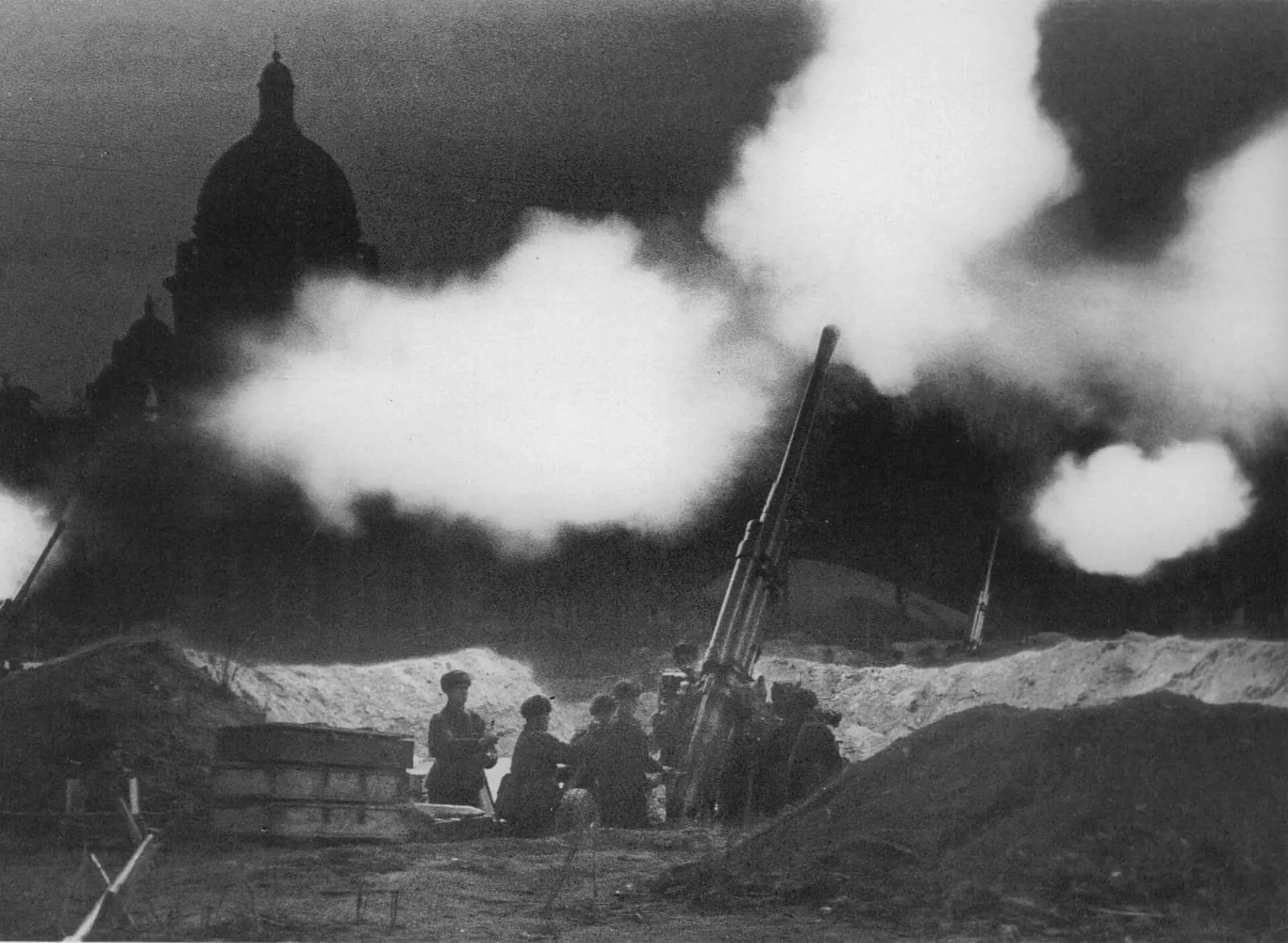
The Siege of Leningrad was the longest and deadliest blockade of a great city in the history of modern warfare. On 8 September 1941 the German 20th Motorised Division took Shlisselburg, a small town where the Neva flows out of Lake Ladoga, and severed the last land connection between the second city of the Soviet Union and the rest of the country. To the north, on the Karelian Isthmus, stood the Finnish forces of Marshal Carl Gustaf Mannerheim. Inside the ring were more than two and a half million civilians, hundreds of thousands of soldiers of the Leningrad Front and the main forces of the Baltic Fleet. Field Marshal Wilhelm von Leeb’s Army Group North tried in September to break into the city, but got stuck in its suburbs. Adolf Hitler then decided not to storm Leningrad but to surround it, shell it and starve it.
The first winter of the blockade, with a daily ration of 125 grams of ersatz bread for most inhabitants and frosts reaching thirty degrees below zero, killed hundreds of thousands of people. The city survived thanks to the route across Lake Ladoga: in summer for boats and barges, in winter for columns of lorries on the ice, which came to be called the Road of Life. Successive Soviet attempts to break the ring, from Tikhvin in 1941 to Sinyavino in 1942, cost hundreds of thousands of soldiers. Only in January 1943 did Operation Iskra break through a narrow corridor along the southern shore of the lake, and on 27 January 1944 the troops of General Leonid Govorov’s Leningrad Front and the Volkhov Front drove the Germans back from the city. Leningrad did not fall, but it paid a price that no other besieged city of the Second World War can match.
Name and dates
Russian historiography speaks of the “blockade of Leningrad” and places the military operations around the city within the broader concept of the Battle of Leningrad, counted from 10 July 1941 to 9 August 1944. In the West the name “Siege of Leningrad” became established, and colloquially, after the book by the American journalist Harrison Salisbury, “the 900 Days”. This round figure is an approximation: 872 days passed between 8 September 1941 and 27 January 1944, and some Russian studies, counting the first day differently, give 871.
The blockade in the strict sense began on 8 September 1941, when, after the fall of Shlisselburg, the city was cut off by land. The Germans had already cut the last railway line at Mga on 30–31 August, so some authors move the beginning of the blockade to the end of August. Some war chronologies record under 1 September that Leningrad was already “completely cut off” with the help of Finnish troops in the north. This is inaccurate: on 1 September the road across the narrow strip of land between the Neva and Lake Ladoga was still open, and the ring closed only a week later. On 18 January 1943 the blockade was broken but not lifted: the land corridor was only 8–11 kilometres wide and lay within range of German artillery, and the city’s suburbs remained in German hands. The end of the siege is therefore dated to 27 January 1944, when Leningrad celebrated with artillery salvoes its “complete liberation from the blockade”.
Background
Leningrad, the former capital of Russia and the cradle of the Bolshevik revolution, had more than three million inhabitants before the war and produced about a tenth of the USSR’s industrial output, and the Baltic Fleet was based at Kronstadt. In Directive No. 21 of December 1940 the capture of the city was one of the main objectives of the campaign, and Moscow was to come only after it. After the invasion of the USSR Army Group North advanced through the Baltic states, in July got stuck on the Luga and at Soltsy, in August reached the Gulf of Finland and took Novgorod and Chudovo, and at the end of the month arrived before Leningrad and cut the last railway line. On 28 August the Baltic Fleet abandoned Tallinn, losing dozens of ships on the way to Kronstadt.
From the north came the Finns, who since 25 June had been waging war on the USSR – a war they called the Continuation War. At the end of August they recovered Viipuri (Vyborg) and the lands lost after the Winter War, and on 31 August Mannerheim halted his troops on the Karelian Isthmus near the 1939 border, some 30 kilometres from the centre of Leningrad. East of Lake Ladoga the Finns reached the River Svir on 7 September, where the Germans wanted to link up with them by going round the lake from the south.
The German command, however, had no intention of taking responsibility for the city. As early as 8 July the Chief of the Army General Staff, General Franz Halder, noted in his diary Hitler’s “firm decision” to level Moscow and Leningrad to the ground so that their populations would not have to be fed through the winter. This fitted into the so-called Hunger Plan of State Secretary Herbert Backe, which assumed that food from the occupied territories of the USSR would go to the Wehrmacht and the Reich, and that millions of inhabitants of Soviet cities would be deprived of supplies. In August Hitler strengthened the offensive in the north at the expense of the Moscow axis. At the beginning of September the German staff expected the Red Army to abandon the city.
On the Soviet side feverish preparations had been under way since the summer. More than a million inhabitants dug anti-tank ditches along successive defence lines, and people’s militia divisions were formed from volunteers. The defence was directed by Marshal Kliment Voroshilov, from the beginning of September commander of the Leningrad Front, formed on 23 August, and by the First Secretary of the party in Leningrad, Andrei Zhdanov. The evacuation of the population, however, proceeded slowly. By 27 August fewer than 490,000 Leningraders had been sent away, and about 2.5 million civilians remained in the city, including some 400,000 children. According to a tally of 12 September, the city had food stocks for about a month.
Course of the siege
The closing of the ring and the September assault (8–25 September 1941)
On the morning of 8 September units of the 20th Motorised Division of General Rudolf Schmidt’s XXXIX Motorised Corps, supported by dive-bombers, captured Shlisselburg and reached the shore of Lake Ladoga. Opposite the town, in the Oreshek fortress on an island at the source of the Neva, a Soviet garrison held out throughout the blockade. On the same day the German air force carried out its first great raid on the city. Incendiary bombs started nearly two hundred fires in Leningrad, and one of them consumed the wooden Badayev warehouses, in which, according to Soviet figures, some 3,000 tons of flour and, depending on the source, anything from several hundred to about 2,500 tons of sugar were burned. In the memory of the inhabitants the fire grew into the cause of the famine, although these stocks would have fed the city for a few days at most.
From 9 September Leeb launched a general assault on the southern approaches. The main blow was delivered by General Georg-Hans Reinhardt’s XLI Motorised Corps from the area of Krasnogvardeysk (today Gatchina) towards Krasnoye Selo. On 12 September the Germans took Krasnoye Selo, in the following days Slutsk (Pavlovsk) and Pushkin, the former Tsarskoye Selo with the palaces of the tsars, and on 16 September the infantry of General Georg von Küchler’s 18th Army reached the Gulf of Finland at Uritsk and Strelna. The Soviet 8th Army, cut off from the main forces, held on along the coast around Oranienbaum (today Lomonosov), covered by the guns of Kronstadt.
In the worst days Joseph Stalin lost confidence in Voroshilov. On the evening of 11 September General of the Army Georgy Zhukov was appointed in his place; he flew into the city around 13 September (studies give dates from 9 to 13 September) and on 14 September took command of the Leningrad Front. Zhukov brought sailors, cadets and units from the Finnish isthmus to the threatened sectors, had naval guns dug into the ground, and threatened commanders and soldiers with execution for abandoning their positions without orders. At the same time, in case the city fell, the most important factories, bridges and the ships of the Baltic Fleet were prepared for demolition. The key heights at Pulkovo (PL), with their astronomical observatory, remained in the defenders’ hands.
The fate of the assault, however, was decided far from Leningrad. On 6 September, in Directive No. 35, Hitler ordered preparations for an offensive against Moscow and the transfer to Army Group Centre by the middle of the month of Colonel General Erich Hoepner’s 4th Panzer Group and VIII Air Corps. Leeb won a few days’ delay, but from 15 September his panzer divisions began to leave for the south. Around 19 September the front came to a halt on a line that in places ran only a few kilometres from the city’s built-up area: from Strelna and Uritsk across the Pulkovo Heights to Kolpino and the Neva. On 21–23 September the German air force bombed the ships at Kronstadt; the battleship Marat, hit by Stukas, settled on the bottom of the harbour, but her guns went on firing. On 24–25 September Leeb reported that a further advance was impossible, and his troops went over to the defensive.
At the beginning of October Zhukov was recalled to Moscow, which was threatened by the German offensive. Command of the Leningrad Front was taken over briefly by General Ivan Fedyuninsky, and from the end of October by General Mikhail Khozin.
The decision to starve the city
When the assault stalled, the German command put in writing what Halder had noted in July. A document of the Naval War Staff entitled “The Future of the City of Petersburg”, dated 22 September and circulated on 29 September 1941, stated that Hitler had decided “to have St Petersburg wiped off the face of the earth”, because after the defeat of Soviet Russia the continued existence of this great population centre was of no interest to Germany. The city was to be tightly encircled and razed to the ground by artillery fire and continuous air raids, and any requests for capitulation were to be rejected, because the problem of relocating and feeding the population “cannot and should not be solved by us”. On 7 October the High Command of the Wehrmacht, in an order signed by General Alfred Jodl, reiterated that Hitler would not accept the capitulation of Leningrad or of Moscow, even if it were offered, and that no German soldier was to enter the city.
German commanders later explained this decision by fear of bloody street fighting. More recent research, however, including that of the German historian Jörg Ganzenmüller, links the blockade to Germany’s entire policy of starvation towards the Soviet population. Some scholars describe the starvation of Leningrad as genocide, others as one of the Wehrmacht’s greatest war crimes. After the war, however, the American tribunal in the High Command Trial held the blockade itself to be permissible under the law of war of the time, and the prohibition of starvation of civilians as a method of warfare was introduced only by the 1977 Additional Protocol to the Geneva Conventions.
The Finns in the north
Finland’s role in the siege has been a matter of dispute for decades. Finnish troops closed the ring from the north, on the Karelian Isthmus and on the Svir, and the proximity of their front tied down the Soviet 23rd Army. According to German records, on 11 September President Risto Ryti told the German Minister that Leningrad ought to be “liquidated” as a large city and that the Neva would make the best frontier.
On the other hand, Mannerheim refused to take part in the assault, which General Alfred Jodl had urged at his headquarters in Mikkeli at the beginning of September. Finnish artillery and aircraft did not bombard the city, and the Finns did not allow German troops into their sector. Most Finnish historians therefore regard the siege as a German operation in which Finland played an auxiliary role. Some Russian historians, by contrast, among them Nikolai Baryshnikov, argue that the Finns took full part in the blockade and halted at the old border chiefly because of Soviet resistance and out of political caution. Also fighting on the German side at Leningrad was the Spanish Blue Division of General Agustín Muñoz Grandes.
Tikhvin and the Road of Life (October – December 1941)
Lake Ladoga became the only route to the city. Barges and tugs sailed under shellfire and air attack from landing stages on the eastern shore to Osinovets, from where goods went by rail to Leningrad. In the autumn of 1941, according to Russian figures, some 60,000 tons of cargo were carried in this way, and a few thousand tons by air – many times less than the city needed.
Hitler wanted to close this route too. In October, against Leeb’s objections, he ordered an advance through the forests and swamps beyond the Volkhov on Tikhvin, through which ran the railway to the landing stages on Lake Ladoga, and on to a junction with the Finns on the Svir. On 16 October Schmidt’s corps crossed the Volkhov, and on 8 November it took Tikhvin. Another German group reached the outskirts of the town of Volkhov. The railway to Lake Ladoga was cut, and Leningrad faced being cut off completely.
The offensive, however, exhausted itself in the frost. From 10–12 November the Soviet armies went over to the counter-attack in the Tikhvin offensive operation. At the head of the 4th Army stood General Kirill Meretskov, who in December took over the newly formed Volkhov Front. On 9 December the Red Army recaptured Tikhvin, and by the end of December the Germans had fallen back behind the Volkhov. It was the first Soviet victory at Leningrad: the Germans had not linked up with the Finns, and the ring now had only one gap, Lake Ladoga. The Leningrad Front’s attempts to break out across the Neva in the autumn of 1941 produced only a narrow bridgehead at Moskovskaya Dubrovka, known as the “Nevsky Pyatachok” (Neva Patch), on which, according to Russian estimates, several tens of thousands of soldiers were killed by 1943.
When the lake froze, a road route was marked out across the ice, which came to be called the Road of Life. On 20 November the first horse-drawn sledges crossed it, and during the night of 22 November the first column of lorries. At first the route barely functioned: lorries sank through holes in the ice and got stuck in snowdrifts. Only on 23 December did deliveries exceed the city’s daily consumption of flour. From January 1942, when the State Defence Committee sent Alexei Kosygin to Leningrad, the Road of Life became the city’s real lifeline.
The hunger winter of 1941–1942
After the ring closed, food rations were cut several times. The lowest were in force from 20 November to 25 December: workers received 250 grams of bread a day, and the other inhabitants, children included, 125 grams of bread adulterated with bran, oilcake and cellulose. Other rationed products were often not issued at all. People ate carpenter’s glue, leather belts, cats and dogs. The winter was one of the harshest on record, with frosts down to more than thirty degrees below zero. Electricity, heating and running water failed, and the trams and most factories came to a standstill. People fetched water from holes cut in the ice of the Neva and burned furniture and books in their flats.
Death from starvation became widespread in November. According to Soviet figures, nearly 53,000 people died in the city in December 1941, and some 200,000 in January and February 1942 together. People died in their flats, in queues and in the streets, and the bodies were dragged on sledges to the cemeteries, to mass graves. According to NKVD documents published in 2004, by December 1942 more than two thousand people had been arrested for eating the bodies of the dead or for murder committed for that purpose. The diary of eleven-year-old Tanya Savicheva, recording the dates of death of one member of her family after another, became one of the best-known testimonies of the blockade.
The city authorities – Zhdanov, Alexei Kuznetsov and Pyotr Popkov – opened hospitals for the emaciated and canteens with supplementary feeding, and from 25 December the rations began slowly to be raised. The poet Olga Bergholz read poems on the radio. At the same time the machinery of repression kept working: the NKVD made arrests for “defeatism” and deported Finns and Germans from Leningrad across Lake Ladoga, and the party apparatus was noticeably better supplied than the rest of the population.
In the spring of 1942 the exhausted inhabitants cleared the streets of rubbish, sewage and corpses to prevent epidemics; in April the trams started running again, and vegetable gardens were laid out in the parks. From January to April some 554,000 people were evacuated from the city along the Road of Life, and several hundred thousand more in the summer; many died on the way. By May 1943 the population had fallen to about 640,000.
1942: Lyuban, Sinyavino and the shelling of the city
On 7 January 1942 the Volkhov Front launched the Lyuban operation, which was to lift the blockade. The 2nd Shock Army drove deep into the German lines but in the spring was cut off in the forests beyond the Volkhov and destroyed in June, and its commander, General Andrei Vlasov, was taken prisoner and later went over to the German side. According to Krivosheev, the Volkhov Front lost more than 300,000 men in this operation, including some 95,000 killed and missing. On 16 January 1942 Leeb, at odds with Hitler, asked to be relieved, and Küchler took over Army Group North. In June 1942 General Leonid Govorov took over the Leningrad Front, which he commanded until the end of the war.
In the summer of 1942 Hitler returned to the idea of taking the city. After the fall of Sevastopol, Field Marshal Erich von Manstein’s 11th Army was transferred north with its heavy siege artillery, which was to take Leningrad and link up with the Finns in Operation Nordlicht (Northern Light). It was forestalled by the Soviet Sinyavino operation: from 19 August the Leningrad Front and from 27 August the Volkhov Front attacked the narrow German wedge between Lake Ladoga and Mga, with the heights at Sinyavino. Meretskov’s troops came within a few kilometres of the Neva, but in September Manstein had to use against them the divisions intended for the assault on the city, and by mid-October he had cut off and destroyed the Soviet force. The offensive failed, but it wrecked the German plans: the bled-white 11th Army did not attack Leningrad, and in the autumn its forces were sent to Stalingrad.
In 1942 the Germans stepped up their shelling of the city with heavy guns, including railway guns, and the inhabitants learned to walk on the safer side of the street. A fuel pipeline and a power cable were laid along the bed of Lake Ladoga. On 9 August 1942 the Leningrad Radio Orchestra performed Dmitri Shostakovich’s Seventh Symphony, the “Leningrad”, in the Philharmonic Hall, and it was broadcast through loudspeakers towards the German trenches as well.
Operation Iskra: breaking the blockade (January 1943)
After the German defeat at Stalingrad the Stavka decided on a new attempt at the same place, at the neck of the Shlisselburg–Sinyavino wedge, where the Leningrad and Volkhov Fronts were only a dozen or so kilometres apart. Preparations for Operation Iskra (“Spark”) were supervised on behalf of the Stavka by Zhukov and Voroshilov. On 12 January 1943, after an artillery preparation lasting more than two hours, the 67th Army of the Leningrad Front crossed the Neva over the ice, and the 2nd Shock Army of the Volkhov Front attacked from the east. On 18 January 1943 the soldiers of the two fronts met in the area of Workers’ Settlements No. 1 and No. 5, and on the same day the Red Army recaptured Shlisselburg. A land corridor 8–11 kilometres wide was created along the southern shore of Lake Ladoga.
In seventeen days a 33-kilometre railway line with a bridge over the Neva, called the “Road of Victory”, was built through the corridor, and on 7 February 1943 the first train from the interior arrived in Leningrad, although the line lay within range of German artillery. According to Krivosheev, the operation cost the Red Army some 115,000 men, including nearly 34,000 killed and missing. Attempts to follow up the blow – among them Operation Polar Star in February, in which the Spaniards of the Blue Division were also among the defenders at Krasny Bor, and the summer offensive towards Mga and Sinyavino – brought only small territorial gains at the cost of tens of thousands of dead. The Red Army took the Sinyavino Heights only in September 1943. The city was still under heavy artillery fire and remained so until January 1944.
The end of the blockade (January 1944)
By the winter of 1943–1944 the situation on the Eastern Front had been completely reversed. Army Group North, weakened by the transfer of divisions to other sectors and by the departure of the Spaniards, was preparing to withdraw to the fortified Panther Line on the Narva and Lake Peipus. It was forestalled by the Leningrad–Novgorod operation. The Baltic Fleet ferried General Fedyuninsky’s 2nd Shock Army by night across the Gulf of Finland to the Oranienbaum bridgehead; it attacked from the west on 14 January 1944, and a day later the 42nd Army struck from the Pulkovo area. On 19 January the two armies met at Ropsha, encircling and destroying part of the German forces that had been shelling the city. At the same time, on 20 January, Meretskov’s Volkhov Front liberated Novgorod. On 21 January the Germans abandoned Mga, on 24 January the Red Army took Pushkin and Pavlovsk, and on 26 January Krasnogvardeysk. In the last days of January the Red Army also cleared the main Leningrad–Moscow railway line.
On 27 January 1944 the Military Council of the Leningrad Front announced that the city had been “completely liberated from the blockade” and from artillery fire. In the evening Leningrad celebrated the victory with a salute of 24 salvoes from 324 guns. Contrary to custom, the order to the troops was signed not by Stalin but by Govorov. Küchler, who tried to save his troops by retreating, was dismissed on 31 January and replaced by Colonel General Walter Model. By 1 March 1944 three Soviet fronts had pushed Army Group North back 200–300 kilometres, to the line of the Narva and Lake Peipus. The Finnish front on the Karelian Isthmus, still a few dozen kilometres from the city, was broken by the Red Army in June 1944, and on 20 June it took Viipuri.
The retreating Germans left ruined suburbs behind them. The palaces at Peterhof, Pushkin, Pavlovsk and Gatchina were looted and burned, and as early as 1941 the Amber Room had been removed from the Catherine Palace at Tsarskoye Selo; its fate remains unknown to this day.
Losses
The number of victims of the blockade is still not known precisely, and for decades the dispute over it was a political matter. At the Nuremberg trial the Soviet side stated, on the basis of the findings of the Extraordinary State Commission, that 632,253 people had died, only about 3 per cent of them from bombs and shells and the rest from hunger, cold and disease. For a long time this figure was official in the USSR, and attempts to challenge it were blocked. The Leningrad historians Gennady Sobolev and Valentin Kovalchuk estimated as early as the 1960s that the victims of hunger alone numbered at least 800,000. Present-day estimates usually range from about 600,000–700,000 to more than a million civilian dead; Western and German studies most often cite a figure of about a million, and in 2022 the Russian prosecutor’s office gave 1.09 million. To this must be added tens of thousands of evacuees who died on the way or shortly afterwards. According to Soviet figures, some 17,000–21,000 people were killed by bombs and artillery shells in the city itself, and some 34,000 were wounded. About 420,000 inhabitants and about 70,000 soldiers lie in mass graves in the Piskaryovskoye Cemetery.
Military losses were also enormous. According to the tallies of the Russian historian Grigoriy Krivosheev, in the whole Battle of Leningrad, from July 1941 to August 1944, the Red Army and the Baltic Fleet lost more than a million men killed, missing and captured, and some 2.4 million wounded and sick. German and Finnish losses were many times smaller. According to various estimates, Army Group North lost several hundred thousand killed, wounded and missing at Leningrad in 1941–1944, but precise figures for the siege alone do not exist, because its armies were fighting on other sectors at the same time.
Significance
The Siege of Leningrad was a defeat for German strategy in the north. Hitler neither took nor destroyed the city, did not link up with the Finns and did not seize the base of the Baltic Fleet, while the 18th Army spent more than two years in the trenches around a city it could neither take nor abandon. At the same time the blockade also tied down huge Soviet forces, and the successive attempts to break it, from the Neva bridgehead to Lyuban and Sinyavino, were among the bloodiest and most ineptly conducted operations of the Red Army.
Above all, however, the blockade was a crime against the civilian population, in which hunger became a deliberately used weapon. In the scale of civilian deaths, no other siege of modern warfare can compare with it. In the USSR it became one of the pillars of the myth of the Great Patriotic War: in his order of 1 May 1945 Stalin called Leningrad a hero city (the city received the formal title in 1965), and 27 January is a day of military glory in Russia. From the outset, however, memory was managed. In 1949–1950, in the Leningrad Affair, Stalin had Kuznetsov and Popkov, among others, shot, the Museum of the Defence of Leningrad was closed, and for decades it was forbidden to write about the hunger, the cannibalism, the repression and the mistakes of the command. Only from the end of the 1980s did opened archives and published diaries make it possible to show the blockade in all its horror. In Germany, where for a long time after the war the image of a “normal” military operation prevailed, the siege has come to be seen as one of the Wehrmacht’s greatest crimes only in recent decades.