Soviet Union
Andrei Zhdanov
Secretary of the Central Committee of the All-Union Communist Party (Bolsheviks) (1934–1948), First Secretary of the party in Leningrad (1934–1945), member of the Politburo (1939–1948)
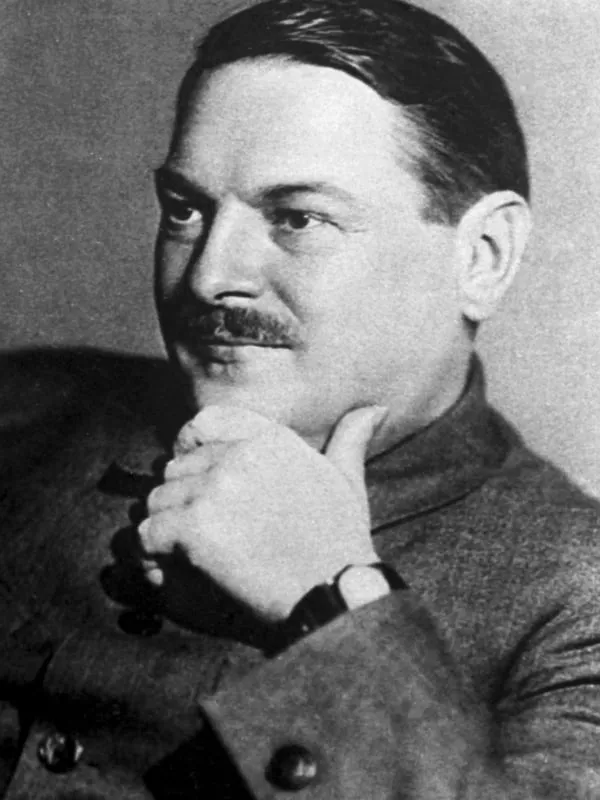
- Born:
- 26 February 1896, Mariupol (Yekaterinoslav Governorate, Russian Empire)
- Died:
- 31 August 1948, Valdai (Novgorod Oblast, USSR)
- Author:
- Łukasz
- Photo:
- ТАСС, domena publiczna, Wikimedia Commons

Andrei Zhdanov belonged to Joseph Stalin’s innermost circle from the mid-1930s until his death in 1948. As party boss in Leningrad he carried out the purge of the city after Kirov’s murder and signed lists of the condemned during the Great Terror. In 1939–1940 he was the Kremlin’s man for Baltic affairs: he sat on the military council of the forces that invaded Finland, signed the Moscow Peace Treaty and, in June 1940, came to Tallinn to stage the coup that ended Estonia’s independence. During the war he directed the defence of besieged Leningrad, and afterwards he gave his name to the Zhdanovshchina, a campaign against writers, composers and Western influence, and helped to create the Cominform. For several years he was regarded as a possible successor to Stalin.
Youth and revolution
He was born on 26 February (14 February by the Julian calendar) 1896 in Mariupol on the Sea of Azov. His father was an inspector of elementary schools, and his maternal grandfather was rector of the Moscow Theological Academy. After his father’s death in 1909 the family moved to Tver Governorate, where Andrei finished a technical secondary school (Realschule). In 1915 he joined the Bolshevik party. In 1916 he was called up into the army. He graduated from the school for ensigns in Tiflis, and from February 1917 he served in the 139th Reserve Infantry Regiment in Shadrinsk in the Urals, where after the February Revolution he became chairman of the local Bolshevik committee. After the October Revolution he built up Soviet power in the district, and during the Civil War he was a political worker in the Red Army and a party activist in Tver, where he edited newspapers and headed the provincial executive committee.
From Nizhny Novgorod to the Kremlin
In 1922 he was sent to Nizhny Novgorod, renamed Gorky in 1932, and from 1924 to 1934 he was first secretary of the party organisation there. During the first Five-Year Plan the region became one of the centres of industrialisation, with a car plant built with the help of the Ford company. Zhdanov, a candidate member of the Central Committee from 1925 and a full member from 1930, supported Stalin in every clash with the opposition. At the 17th Party Congress in February 1934 he became Central Committee secretary responsible for ideology. In August that year he opened the First Congress of Soviet Writers, where he repeated Stalin’s words about writers as “engineers of human souls” and proclaimed socialist realism the obligatory method of literature.
Leningrad and the Great Terror
On 1 December 1934 the Leningrad party chief Sergei Kirov was shot dead in the Smolny. Zhdanov came to the city together with Stalin, and in December he replaced the murdered Kirov as first secretary of the regional and city committees. In February 1935 he became a candidate member of the Politburo. Leningrad was the first city in which the terror took on a mass character. In the spring of 1935 Zhdanov and the head of the Leningrad NKVD, Leonid Zakovsky, carried out the deportation of so-called “former people”, that is, people of noble and bourgeois origin. According to surviving reports it affected some 11,000 people. At the same time former supporters of Zinoviev and Trotsky were expelled from the party.
On 25 September 1936, while on holiday in Sochi, Zhdanov and Stalin jointly signed a telegram to the Politburo demanding that the head of the NKVD, Genrikh Yagoda, be replaced by Nikolai Yezhov. This opened the bloodiest phase of the Great Purge. Zhdanov, who was named in the indictment at the first Moscow trial among the alleged targets of the terrorists, belonged to the small group of leaders who approved lists of people to be shot. According to the compilations of the Memorial society he signed 176 such lists. In the autumn of 1937, as Stalin’s envoy, he carried out purges in Bashkiria, Tataria and Orenburg Oblast. He was one of the few regional chiefs who survived the terror in post. In 1938 he became chairman of the Supreme Soviet of the Russian SFSR and head of the Central Committee’s new Department of Propaganda and Agitation. At the 18th Congress in March 1939, when Stalin had decided that the purge had served its purpose, Zhdanov delivered a report on abandoning mass purges in the party, which, he said, had been exploited by “enemies”. At the same congress he became a full member of the Politburo.
The man for the Baltic
In the spring and summer of 1939, while Moscow was holding talks with Britain and France on an alliance against Germany, Zhdanov published an article in Pravda on 29 June in which, stressing that it was his “personal” view, he argued that the British and French governments did not want an agreement with the USSR on equal terms. In hindsight this was one of the first public signals of the shift that led to the Molotov–Ribbentrop Pact.
As party boss in Leningrad and a member of the military council of the Leningrad Military District and of the Main Military Council of the Navy, Zhdanov had an interest in pushing the border further from the city and expanding the Soviet presence on the Baltic. In the autumn of 1939 he helped to prepare the war with Finland. The order of 29 November to the district’s troops, signed by Kirill Meretskov and Zhdanov, assured them that the Red Army was entering Finland as the “liberator” of the Finnish people, and some historians link the shots at Mainila, which provided the pretext for the invasion, to material in his archive. He was present at the conclusion of the treaty with Otto Kuusinen’s puppet government. When the Winter War brought defeats, he joined the military council of Semyon Timoshenko’s new North-Western Front, and on 12 March 1940, together with Vyacheslav Molotov, he signed the Moscow Peace Treaty. On that occasion he rejected the request of Risto Ryti that the inhabitants of the ceded part of Karelia be allowed to stay in their homes.
In June 1940, after the Soviet ultimatum and the Red Army’s entry into Estonia, Stalin sent him to Tallinn as the Central Committee’s plenipotentiary. Zhdanov arrived on 19 June by special train, called on President Konstantin Päts and, in his report to Moscow, mocked Päts’s assurances of loyalty. He put together the membership of a new government, instructed local communists to organise rallies and on 21 June, under the cover of Soviet armoured cars, carried out a “people’s” coup, after which Päts had to appoint Johannes Vares prime minister. Until August he supervised the rigged elections and Estonia’s incorporation into the USSR. After the war the US congressional committee investigating the annexation of the Baltic states, the so-called Kersten Committee, named him among those responsible for the aggression.
Besieged Leningrad
The defeats of the Winter War and the failure of the policy towards Hitler, with which he was publicly associated, weakened Zhdanov’s position. In September 1940 he lost direct control of propaganda to the men of his rival Georgy Malenkov, and after the German invasion in June 1941 he was not included in the State Defence Committee. As a member of the military councils of the North-Western Direction and, from August 1941, of the Leningrad Front, he was in the city throughout the siege, first at the side of Georgy Zhukov and then of the front’s successive commanders. He directed the mobilisation of the population, arms production, evacuation and supply, including across the ice of Lake Ladoga on the Road of Life.
Assessments of this role are mixed. Soviet propaganda made him a hero of the defence, though Stalin himself was sparing in his recognition. Critics hold the city authorities, and therefore Zhdanov, responsible for the belated evacuation and the lack of food stocks when the ring closed in September 1941. During the blockade, which lasted until January 1944, between about 650,000 and more than a million inhabitants died, according to various estimates, the overwhelming majority of them from hunger. In 1944 Zhdanov received the rank of Colonel General. After the armistice with Finland in September 1944 he headed the Allied Control Commission in Helsinki, which supervised the fulfilment of the armistice terms by the government of President Carl Gustaf Mannerheim, until the peace treaty of 1947. He handed over the leadership of the Leningrad party to his protégé Alexei Kuznetsov.
The Zhdanovshchina and the Cominform
At the end of 1945 Stalin brought him to Moscow. As Central Committee secretary Zhdanov was responsible for ideology and relations with communist parties abroad, and in 1946, when Malenkov had temporarily fallen from favour, he was regarded as the second man in the party. In August 1946, after the Central Committee resolution on the Leningrad journals Zvezda and Leningrad, he delivered a speech in which he called Mikhail Zoshchenko “the scum of literature” and described the poetry of Anna Akhmatova as that of “half nun, half harlot”. Both were expelled from the Writers’ Union. The campaign, named the Zhdanovshchina after him, extended to theatre, film, philosophy and science. Under the banner of the struggle against “cosmopolitanism” and “kowtowing to the West”, the careers of artists and scholars were destroyed, and its victims also included writers and artists of non-Russian nations, among them Jews and Ukrainians. In February 1948, after a three-day conference with musicians in the Kremlin, a Central Committee resolution condemned Dmitri Shostakovich, Sergei Prokofiev and other composers for “formalism”.
In September 1947 Zhdanov led the Soviet delegation to the conference of communist parties at Szklarska Poręba in Poland, which set up the Cominform, the successor to the Comintern, dissolved in 1943. In his report he announced that the world had split into two camps: an “imperialist and anti-democratic” camp led by the United States and an “anti-imperialist and democratic” camp led by the USSR. This “Zhdanov Doctrine”, the Soviet answer to the Truman Doctrine and the Marshall Plan, became the ideological foundation of the Cold War and accelerated the Stalinisation of Central Europe, Poland included.
Fall and death
Zhdanov’s position waned as quickly as it had risen. He suffered from severe heart disease and, according to Nikita Khrushchev’s memoirs, drank heavily. In July 1948 Malenkov returned to the Central Committee secretariat, and when Yugoslavia was condemned at the Cominform meeting in Bucharest in June, Stalin was displeased with Zhdanov’s milder tone. In July Zhdanov went for treatment to the Central Committee sanatorium at Valdai, where he died on 31 August 1948. He was buried with honours by the Kremlin Wall, and his native Mariupol was renamed after him. The cardiologist Lydia Timashuk, who diagnosed a heart attack that the other doctors refused to acknowledge, wrote complaints about the matter to the authorities. A few years later these served as one of the pretexts for the so-called Doctors’ Plot, in which mainly Jewish doctors were accused of murdering Zhdanov and other leaders.
His death struck at his associates. In the Leningrad Affair of 1949–1950 hundreds of officials from Zhdanov’s circle were arrested. Kuznetsov and the chairman of Gosplan, Nikolai Voznesensky, were shot in October 1950. Malenkov and Lavrentiy Beria were behind the intrigue. Zhdanov’s son, the chemist Yuri Zhdanov, was married from 1949 to 1952 to Stalin’s daughter Svetlana Alliluyeva.
Significance
For forty years Zhdanov lent his name to towns, universities, factories and warships in the USSR. Mariupol was called Zhdanov from 1948 to 1989. Only in January 1989 did the Central Committee of the CPSU revoke the acts commemorating him, declaring that he had been one of the organisers of the mass repressions of the 1930s and 1940s against innocent citizens. For the history of the Second World War he matters as one of the executors of Soviet expansion in 1939–1940: the war with Finland and the annexation of Estonia, in which a coup staged by Moscow was turned into a “people’s revolution”. The Kremlin repeated the same scenario – a façade of legality, satellite parties and rigged elections – in Central Europe after 1944, and Zhdanov, the ideologue of the two camps, gave it its theoretical framework after the war.
Sources
Mentioned in battles
(05)Often appears with
People who appear in the same events.