- Category:
- Military operations
- Front:
- Eastern Front
- Date:
- 18 January 1943
- Author:
- Łukasz
- Battle:
- Siege of Leningrad
- Tags:
- Red Army, Wehrmacht, Soviet Union, Georgy Zhukov
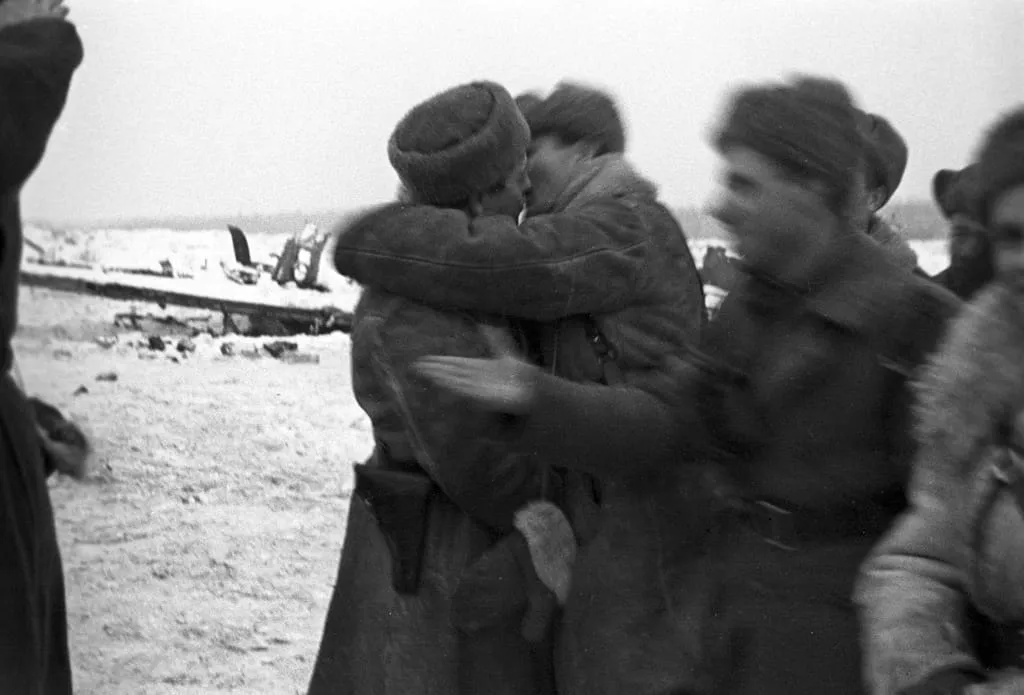
At half past nine on the morning of 18 January 1943, near Workers’ Settlement No. 1 in the peat bogs along the southern shore of Lake Ladoga, the leading units of the 123rd Rifle Division of the Leningrad Front’s 67th Army met soldiers of the 372nd Rifle Division of the Volkhov Front’s 2nd Shock Army. Two hours later, at Settlement No. 5, more divisions of the two fronts linked up, and in the afternoon the Red Army cleared the Germans out of Shlisselburg, the small town where the Neva flows out of Ladoga, whose capture in September 1941 had begun the blockade. After 497 days Leningrad once again had a land connection with the rest of the country.
Under 18 January it is usually recorded that the besieged defenders of Leningrad joined up with the troops coming to their relief. That description is accurate; it only needs the scale to be added. Operation Iskra (“Spark”) broke the blockade but did not lift it: the corridor was a mere 8–11 kilometres wide, lay within range of German artillery on Sinyavino, and German troops still stood in the southern suburbs of the city, shelling it with heavy guns. Under 10 January, in turn, one can read that the Red Army “resumed its offensive in the north”. On that day the Stavka sent its representative, General of the Army Georgy Zhukov, to the Neva, but the attack itself began on 12 January.
The bottleneck
From September 1941 Leningrad had been cut off by land. Army Group North had severed the last railway line at Mga and on 8 September 1941 had taken Shlisselburg. The only supplies reaching the city from the rest of the country were those carried across Ladoga: by barge and ship in summer, by lorry over the ice in winter along the Road of Life. The first winter of the blockade brought mass death from starvation. According to various estimates, between some 630,000 and more than a million inhabitants died or were killed over the whole siege, with the greatest number of victims at the turn of 1941 and 1942.
All earlier attempts to break the ring had failed. In the winter of 1941–1942 General Kirill Meretskov’s Volkhov Front recaptured Tikhvin, but in the Lyuban operation its 2nd Shock Army was surrounded and destroyed. In the summer of 1942 the Sinyavino offensive forestalled a German assault on the city, but ended in another defeat: by October Field Marshal Erich von Manstein’s Eleventh Army had cut off and smashed the troops that had driven into the German positions.
Between the two Soviet fronts there remained a wedge of land the Germans called the “bottleneck”. It ran from Shlisselburg and the shore of Ladoga southwards, through the workers’ settlements of the peat diggings (numbered 1 to 8), to the heights near Sinyavino and the railway junction at Mga. At its narrowest point, by Ladoga, less than 16 kilometres separated the Leningrad Front on the western bank of the Neva from the Volkhov Front to the east. The terrain favoured the defenders: forest, swamp and peat bog, which even in winter did not freeze everywhere, and above them the Sinyavino Heights, rising a few dozen metres above the plain – the only dry, open ground in the area, from which the whole battlefield could be seen. Over a year and a half the Germans had turned this strip into a network of bunkers, trenches and fortified strongpoints in the brick buildings of the settlements.
The plan for Iskra
Preparations for a new attempt began in November 1942, as the encirclement of the Sixth Army was being prepared at Stalingrad. At the beginning of December the Stavka approved the plan for Operation Iskra. The most important change compared with the summer of 1942 concerned where the blow would fall. Instead of encircling the whole German force at Sinyavino and Mga, the two fronts were to strike closer to the shore of Ladoga, at the narrowest point of the bottleneck, so as not to expose their flanks to counter-attacks from the south. The aim was to defeat the Germans in the area of Lipka, Gaitolovo, Moskovskaya Dubrovka and Shlisselburg, punch a corridor some 10 kilometres wide, and only in a second stage, after a short rest, attack towards Mga. The plan was more cautious than its predecessors, and for that very reason realistic.
Lieutenant General Leonid Govorov’s Leningrad Front committed Major General Mikhail Dukhanov’s 67th Army, which was to force the frozen Neva on the sector between Shlisselburg and Moskovskaya Dubrovka. From the east attacked Lieutenant General Vladimir Romanovsky’s 2nd Shock Army of Meretskov’s Volkhov Front, re-formed after its destruction in 1942, with part of the 8th Army on its left flank. Support came from the 13th and 14th Air Armies, the aviation and artillery of the Baltic Fleet, and the artillery of Leningrad. According to the Russian casualty study edited by Grigory Krivosheev, the two fronts committed some 303,000 men to the operation. According to the same figures, the shock groups had about 4,900 guns and mortars of 76 mm calibre and above, more than 600 tanks and 809 aircraft, most of them fighters, since in earlier battles the Luftwaffe had held air superiority.
Coordination was entrusted to two representatives of the Stavka. Marshal Kliment Voroshilov, who in September 1941 had failed to defend the approaches to the city, was responsible for the Leningrad Front, and from 10 January Zhukov, the Deputy Supreme Commander, was also present. Preparations went on throughout December. In the rear of both fronts troops rehearsed assaults on fortifications and crossings over the ice, and artillery, engineers, ski brigades and motor-sledge battalions were brought up at night or in bad weather so as not to betray the direction of the attack. The start date was moved from 1 January to 12 January, because the ice on the Neva was still too thin.
On the other side stood Colonel General Georg Lindemann’s German Eighteenth Army, part of Field Marshal Georg von Küchler’s Army Group North. On a front some 450 kilometres long it had 26 divisions and almost no reserves. In the autumn of 1942 it had lost Manstein’s Eleventh Army and several divisions, which went south and to Army Group Centre. The bottleneck was held by General Ernst von Leyser’s XXVI Army Corps, numbering some 60,000 men according to Russian estimates. Its divisions – the 1st, 170th, 223rd and 227th Infantry Divisions – had been sitting for a year and a half in well-developed fortifications.
Across the ice of the Neva
On the night of 11 to 12 January Soviet bombers attacked German headquarters, artillery positions, airfields and communications centres. At 9.30 a.m. on 12 January the artillery of both fronts opened fire. On the western side of the bottleneck the preparation lasted 2 hours 20 minutes, on the eastern side 1 hour 45 minutes, and it ended with a salvo of Katyusha rocket launchers. Even before it had died away, the infantry of the 67th Army set off across the ice of the Neva, 500–700 metres wide at this point. Beneath the high, iced-over left bank, the soldiers climbed the escarpment with ladders and ropes, cutting steps in the ice.
The greatest success was achieved by Major General Nikolai Simonyak’s 136th Rifle Division – Simonyak was a veteran of the defence of the Hanko peninsula – together with the neighbouring 268th Division. Near Mariino they broke through the first German line and by evening had formed a bridgehead some 5–6 kilometres wide and up to 3 kilometres deep. Engineers built a crossing over the Neva for tanks. Further south, near Gorodok and Power Station No. 8, the attack stalled after taking the first trenches, and in the north, opposite Shlisselburg, it collapsed entirely. The Volkhov Front had a harder day. The 2nd Shock Army drove 2–3 kilometres in between the strongpoints at Lipka and Workers’ Settlement No. 8, but their garrisons – a few hundred men in bunkers – could not be dislodged and struck at the attackers’ flank.
Lindemann reacted quickly. That very night he sent battle groups from the 96th Infantry Division to the threatened sectors, one of them supported by Tiger heavy tanks of the 502nd Heavy Panzer Battalion, the only German armoured unit in the battle. Tigers had been fighting near Leningrad since the autumn of 1942, when they were used for the first time ever, near Mga. In the following days battalions from other sectors of the front arrived on the battlefield – from the 1st and 61st Infantry Divisions, the 5th Mountain Division and the SS Police Division. On 13 January cloud and snow hung over the battlefield, Soviet aircraft could not fly, and the attacks of both fronts brought nothing but losses. From 14 January the Red Army advanced slowly, taking the strongpoints in the workers’ settlements one by one. Men of the 12th Ski Brigade crossed the ice of Ladoga and attacked Lipka from the rear. From 15 January there was fighting for Shlisselburg itself. By the evening of 17 January the spearheads of the two fronts were only 1.5–2 kilometres apart, on the sector between Settlements No. 1 and No. 5.
During this fighting the Red Army captured its first intact Tiger. The tank, which had become stuck in a peat bog and been abandoned by its crew, was towed to the rear, and trials at a proving ground near Moscow made it possible to prepare Soviet troops for encounters with the new German tank.
18 January
On the morning of 18 January the two fronts closed the gap. At 9.30 a.m. units of the Leningrad Front’s 123rd Rifle Division and the Volkhov Front’s 372nd Rifle Division met at Workers’ Settlement No. 1, and at 11.45 a.m., at Settlement No. 5, Simonyak’s division linked up with the 18th Rifle Division of the 2nd Shock Army. A German battle group from the 61st Infantry Division, which was supposed to hold the corridor between the settlements, found itself encircled. It was given permission to break out to the south and, abandoning its guns and heavy equipment, fought its way through the forests to Sinyavino on the night of 19 to 20 January. On the afternoon of 18 January Soviet troops cleared Shlisselburg and Lipka. Throughout the blockade a small Soviet garrison had held out in the Oreshek fortress on an island where the Neva leaves the lake. Now it found itself behind its own lines.
That evening the radio announced in Leningrad that the blockade had been broken. People who had survived the starvation winter of 1941–1942 gathered around the loudspeakers in the streets. The poet Olga Berggolts, the voice of Leningrad radio during the siege, spoke to listeners that night about a city that had lived to see this moment after almost a year and a half. The Sovinformburo communiqué was issued during the night of 18 to 19 January. On the same day, 18 January, the Presidium of the Supreme Soviet of the USSR conferred on Zhukov the rank of Marshal of the Soviet Union. He was the first to receive that rank during the war; the decree was published the following day.
The corridor and the Road of Victory
On 19–21 January Soviet troops wiped out the remnants of the encircled Germans in the forests by Ladoga and tried to push on south onto the Sinyavino Heights. Lindemann, however, had managed to bring up the SS Police Division and the 11th, 21st and 28th Divisions, and the capture of Workers’ Settlement No. 6 proved to be the limit of what Iskra could achieve. After 21 January the front line barely moved, and on 30 January the operation was officially ended. The Red Army had won back a strip of land a dozen or so kilometres long and 8–11 kilometres wide – flat, waterlogged and entirely visible from the German positions on the heights.
As early as 18 January the State Defence Committee, chaired by Joseph Stalin, ordered a railway line to be built through the corridor from Polyany station to Shlisselburg and on across the Neva within 20 days. Railway troops and thousands of workers laboured on it in the frost and under fire. The 33 kilometres of track were laid directly on the frozen peat, and a makeshift trestle bridge was thrown across the Neva at Shlisselburg. Construction was completed in 17 days. On 6 February 1943 the first train left Volkhovstroy, and on 7 February it pulled into the Finland Station in Leningrad. The line was named the “Road of Victory”; the railwaymen called it the “corridor of death”: trains ran mostly at night, without lights, and German artillery repeatedly wrecked the track. Even so, in the following months it was the railway, not Ladoga, that carried most of the traffic into the city, and in February the food rations in Leningrad were raised to the level in force in the country’s other large industrial centres.
The cost
According to Krivosheev, Iskra cost the Red Army 115,082 men, including 33,940 killed, missing and died of wounds, the rest being wounded and sick. The Volkhov Front, which attacked the most strongly fortified strongpoints, lost almost twice as many men as the Leningrad Front. The losses of the German Eighteenth Army in January 1943, according to its own reports as cited by Russian historians, amounted to some 22,600 men, including about 6,100 killed and missing, though some of these losses were suffered by divisions on other sectors. The most severely bled were the 61st, 96th, 227th and 1st Infantry Divisions. The ratio of losses was typical of the battles for the bottleneck: those attacking across swamps and open ice paid many times more than the defenders in their bunkers.
The Stavka judged the operation a success, but had no intention of stopping there. At the end of January Govorov, who had been promoted to colonel general on 15 January, and Meretskov received the Order of Suvorov 1st Class, and the 136th and 327th Rifle Divisions were redesignated the 63rd and 64th Guards Rifle Divisions.
Place in the war
The breaking of the blockade came in weeks when the Eastern Front was cracking along its whole length. At Stalingrad the troops of the Don Front had been crushing the encircled Sixth Army since 10 January, an army the airlift could no longer sustain; on the Don the Hungarian army and the Italian Alpine Corps were being smashed; and the First Panzer Army was withdrawing from the Caucasus. Against this background the events by Ladoga seemed modest, and they were indeed soon overshadowed by the surrender at Stalingrad. For Leningrad and for both sides on the northern front, however, they meant a great deal.
For the inhabitants it was the end of the worst. The city, to whose outskirts the Germans had advanced in August 1941, was no longer dependent on what barges and lorries could carry across the ice. Leningrad, however, was still a front-line city. Heavy artillery fire from the area of Krasnoye Selo, Pushkin and Strelna continued throughout 1943, killing people in the streets, and the population, decimated by starvation and evacuation, had fallen by the spring of 1943 to about 640,000 – almost five times fewer than before the war. The city’s party leadership, headed by Andrei Zhdanov, could nonetheless begin planning the reconstruction of the industry that was working for the front.
For the Germans Iskra meant the end of their hopes of taking the city and linking up with the Finns on the Svir. The Eighteenth Army, exhausted and without reserves, was no longer able to retake the bottleneck, and at the turn of January and February Hitler agreed to shorten Army Group North’s front by evacuating the Demyansk pocket. In Helsinki, where since 1941 people had counted on the imminent fall of Leningrad, the January news, together with the defeat at Stalingrad, strengthened the conviction that Germany would not win this war, and prompted the Finnish leaders to make their first cautious attempts to find a way out of the Continuation War.
Zhukov, a marshal since 18 January, considered Iskra’s gains insufficient and in February launched the far more ambitious Operation Polar Star, intended to encircle and destroy the Eighteenth Army. It ended with modest gains, including those won in bloody fighting against the Spanish Blue Division at Krasny Bor. Further attacks on Mga and Sinyavino in 1943 cost tens of thousands of lives, and the Red Army took the Sinyavino Heights only in September. The blockade thus continued, though in a different form: the city now had a land link with the rest of the country but remained under fire. It was finally lifted only by the Leningrad–Novgorod offensive, after which, on 27 January 1944, Leningrad proclaimed its complete liberation from the blockade. 18 January 1943 was the day on which the siege ceased to be a ring, and in St Petersburg it is still marked today as the anniversary of the breaking of the blockade.
Sources
Meanwhile
(04)Elsewhere, within a week.
- 16 January 1943 · Western FrontRAF raids on Berlin in January 1943On the nights of 16/17 and 17/18 January 1943 RAF Lancasters and Halifaxes bombed Berlin after a 14-month gap. Damage was slight, second-night losses heavy.
- 16 January 1943 · DiplomacyIraq declares war on the AxisOn 16 January 1943 Nuri al-Said’s government declared Iraq at war with Germany, Italy and Japan from midnight, and Iraq joined the United Nations.
- 15 January 1943 · MediterraneanThe offensive on TripoliOn 15 January 1943 the Eighth Army attacked Rommel’s position at Buerat. Montgomery gave himself ten days to take Tripoli, some 320 km away.
- 14 January 1943 · DiplomacyThe Casablanca ConferenceOn 14 January 1943 at Anfa near Casablanca, Churchill, Roosevelt and their chiefs of staff began talks. They chose Sicily and a stepped-up bombing of Germany.
Related events
(04)The same battle, people or subject.
- 19 November 1942 · Eastern FrontOperation Uranus beginsOn 19 November 1942 the Red Army hit the Romanians on the 6th Army's flanks. In three days the front broke and the pincers were closing west of Stalingrad.
- 10 January 1943 · Eastern FrontOperation RingOn 10 January 1943, after its ultimatum was rejected, the Don Front attacked the Stalingrad pocket. Pitomnik fell on 16 January and Gumrak on 22 January.
- 31 January 1943 · Eastern FrontPaulus surrendersOn 31 January 1943 men of the 64th Army captured Field Marshal Paulus and his staff in a Stalingrad department store basement. The southern pocket fell.
- 2 February 1943 · Eastern FrontThe end of the Battle of StalingradOn 2 February 1943 General Strecker's northern pocket surrendered and the Battle of Stalingrad ended. A day later the Reich announced the Sixth Army's defeat.