Equipment
The Mitsubishi G4M "Betty"
The Japanese navy's twin-engined bomber of enormous range: it sank Prince of Wales and Repulse, but with no armour it burned after a few hits.
- Role:
- torpedo bomber
- State:
- Japan
- Maker:
- Mitsubishi
- First flight:
- 23 October 1939
- Built:
- about 2,435
- Author:
- Łukasz
- Updated:
- 1 November 2026
The Mitsubishi G4M, called “Betty” by the Allies, was the Japanese navy’s most important bomber. It took off from airfields on land but fought above all against ships: it carried a torpedo or bombs over distances that in 1941 seemed impossible for a twin-engined aircraft. In the first days of the Pacific war it sank two great British ships and changed thinking about war at sea. That same range, however, was achieved at the expense of protecting the crew, and once the Allies had enough fighters the G4M became one of the easiest aircraft of the war to shoot down.
Range above all
The Japanese navy was preparing for a war against the American fleet across the vast spaces of the Pacific and needed bombers that could reach the enemy far from their own bases. In 1937, shortly after the older G3M had gone into action in China, it ordered a successor from Mitsubishi. The requirements spoke of a range of close to 4,800 kilometres and of two engines, although the firm’s designers thought it would be more sensible to build a four-engined machine. Kiro Honjo’s team designed an aircraft with a thick, cigar-shaped fuselage and wings holding huge fuel tanks. These had no rubber linings, and the crew had no armour: every kilogram was saved for fuel.
The prototype took to the air on 23 October 1939. The navy then lost a good deal of time by ordering some of the machines converted into a heavily armed escort aircraft for bomber formations; thirty of these G6Ms were built and, when the idea failed, converted into transports. The first production G4M1s left the factory in April 1941, and in the summer, during the raids on Chongqing, they passed their first combat test over Sichuan.
The first weeks of the war
In December 1941 the navy had about 120 bombers of this type, based on Taiwan and in Indochina. On 8 December G4Ms and G3Ms escorted by Zero fighters destroyed on the ground roughly half of the modern American aircraft during the attack on Clark Field, which weighed on the whole Philippine campaign. Two days later, on 10 December, aircraft from the airfields near Saigon found the British Force Z in the South China Sea. At about 12.20 twenty-six G4Ms of the Kanoya group struck with torpedoes, and the battleship Prince of Wales and the battlecruiser Repulse went to the bottom. They were the first capital ships sunk by aircraft on the open sea while manoeuvring and firing back.
In the months that followed, the navy’s bombers moved further south from each captured airfield. From Kendari they flew over Darwin, from Rabaul over Port Moresby, and in May 1942, during the Battle of the Coral Sea, they attacked Rear Admiral Crace’s cruisers and reported sinking a battleship that was not there at all.
The “one-shot lighter”
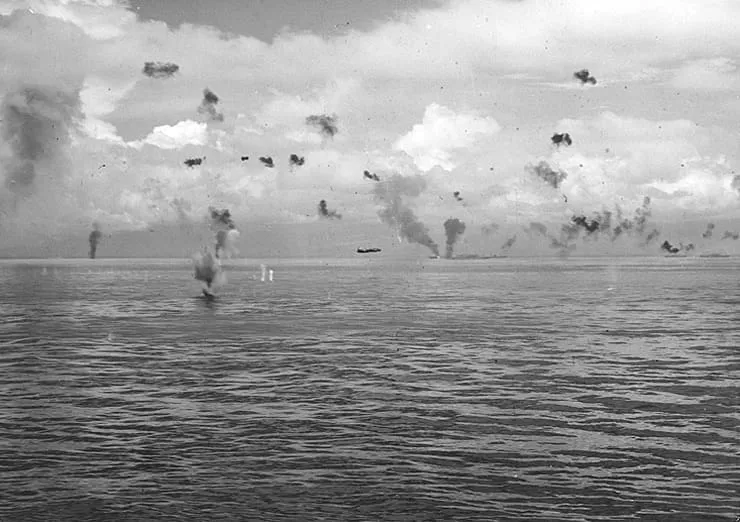
The G4M’s weakness came to light once fighters and radar appeared on the other side. On 7 August 1942, the first day of the landing on Guadalcanal, 27 bombers escorted by Zeros came over the invasion fleet, and the next day more than twenty machines with torpedoes attacked the transports low over the water. The first raid did little damage, and of the second, broken up by the ships’ fire and the Wildcats, only a few machines returned. American pilots called the G4M the “one-shot lighter”, because the tanks in its wings caught fire from the first hits; Japanese crews spoke of their aircraft as the “flying cigar”, and not only because of its shape.
The G4M remained dangerous where it could take the enemy by surprise. On 12 November 1942 torpedo bombers attacked the transports off Guadalcanal just before the great naval battle, and at dusk on 29 January 1943, coming in by the light of flares dropped by a reconnaissance aircraft, off Rennell Island they crippled the heavy cruiser Chicago with torpedoes; the next afternoon another strike sent her to the bottom. These successes, though, cost more and more experienced crews.
On 18 April 1943 Admiral Isoroku Yamamoto and his staff were flying on an inspection in two G4Ms. The Americans, who had read the signal with his itinerary, sent sixteen P-38 fighters against them. Both bombers were shot down over Bougainville; Yamamoto was killed, while his chief of staff, Vice Admiral Matome Ugaki, survived the crash of the second machine into the sea.
New versions and last tasks
From mid-1943 units received the G4M2, with more powerful engines and better defensive armament, but still poorly protected. Only the G4M3 of 1944 had protected tanks and armour, at the expense of range, and few were built. In October 1944 bombers of the special “T” unit attacked American carriers at night during the raids on Formosa, and the crews’ exaggerated reports allowed Tokyo to announce the sinking of eleven carriers, although in reality not one had gone down.
In the last year of the war the G4M became the carrier of a suicide weapon. Slung under its fuselage was the Ohka, a small rocket glider with more than a tonne of explosive, steered by a suicide pilot. The first mission, on 21 March 1945, ended in disaster: according to most accounts all eighteen heavy, slow bombers were shot down before they could release their missiles. A few weeks later, off Okinawa, Ohkas hit their first ships, but the carrier bombers were still lost in great numbers.
The G4M’s last flight of this war was a peaceful one. On 19 August 1945 two bombers painted white with green crosses carried to Ie Island the Japanese delegation that was flying to Manila to settle the terms of surrender. About 2,435 G4Ms of all versions were built, and close to 2,450 with the G6M escorts.
Sources
Battles
(03)- 8 December 1941 – 8 May 1942Philippines campaign (1941–1942)From 8 December 1941 to May 1942 Japan conquered the Philippines. The defenders of Bataan and Corregidor held out longer than planned but were taken prisoner.
- 4–8 May 1942Battle of the Coral SeaOn 4–8 May 1942 carriers fought carriers for the first time in the Coral Sea. The Americans lost Lexington, but Japan called off the landing at Port Moresby.
- 12–15 November 1942Naval Battle of GuadalcanalFrom 12 to 15 November 1942, in two night actions and a series of air strikes, the Americans sank two Japanese battleships and most of a Guadalcanal convoy.