1942–1943: Guadalcanal and New Guinea
Naval Battle of Guadalcanal
- Dates:
- 12–15 November 1942
- Front:
- Pacific
- Location:
- British Solomon Islands Protectorate: the waters around Guadalcanal – the strait between Guadalcanal, Savo Island and the Florida Islands (Ironbottom Sound), the channel through the Solomons to its north-west (the Slot) and the coast near TassafarongaOn the battle map →
- Sides:
- United StatesWilliam Halsey, Daniel Callaghan, Norman Scott, Willis LeeJapanIsoroku Yamamoto, Hiroaki Abe, Nobutake Kondō, Raizō Tanaka
- Result:
- American victory. The Japanese failed to bombard Henderson Field with their battleships or to carry the main body of the 38th Division to Guadalcanal. They lost the battleships Hiei and Kirishima, a heavy cruiser, three destroyers and eleven transports; the Americans lost two light cruisers and seven destroyers, and two of their admirals were killed during the night of 12–13 November.
- Author:
- Łukasz
Name and dates
The Naval Battle of Guadalcanal is the name given in American and Polish literature to a series of naval and air actions fought from 12 to 15 November 1942 in the waters around Guadalcanal, at the climax of the Guadalcanal campaign. The Japanese call it the Third Battle of the Solomon Sea (Dai-sanji Solomon kaisen), after the battles of Savo Island and of the Eastern Solomons. Some accounts treat it as two separate battles: the first, on the night of 12–13 November, and the second (PL), on the night of 14–15 November.
The battle fell into four distinct stages: the Japanese air attacks on the American transports on 12 November and the night clash between cruisers and Abe’s battleships in the early hours of 13 November; the day-long American air attacks on the damaged battleship Hiei on 13 November and on the cruisers and the transport convoy on 14 November; the night duel of the battleships on 14–15 November; and finally the destruction, on the morning of 15 November, of the transports beached at Tassafaronga. All dates and times are given in local Guadalcanal time. Japanese records used Tokyo time, two hours behind, and some American studies date the first battle to 13 November because the fighting began after midnight – which explains the differing dates found in the literature.
Background
Since the landing of 7 August the Americans had held a beachhead on Guadalcanal around Henderson Field. The aircraft based there, known as the Cactus Air Force, controlled the waters around the island by day, so the Japanese brought in reinforcements by night aboard fast destroyers and cruisers, which the Americans dubbed the “Tokyo Express”. These runs could carry men but not heavy guns, vehicles or large stocks of food. In October, therefore, the Japanese pushed through one large convoy of transports under cover of a night bombardment of the airfield by battleships. The 2nd Division, brought in by that convoy and by the night runs, was nevertheless defeated in the Battle for Henderson Field, and the accompanying Battle of the Santa Cruz Islands, although it ended with the sinking of the carrier Hornet, did not give the Japanese command of the sea.
At the beginning of November the Americans went over to the offensive on Guadalcanal west of the Matanikau River and near Koli Point, while the 2nd Raider Battalion set out on its long patrol behind Japanese lines. The Japanese high command, however, had not given up on retaking the airfield. For its next offensive, Lieutenant General Harukichi Hyakutake’s 17th Army needed the rest of the 38th Infantry Division together with its artillery, ammunition and food. Admiral Isoroku Yamamoto, commander of the Combined Fleet, assigned eleven large transports to the task; they were to carry some 7,000 soldiers from Shortland to Guadalcanal. The convoy escort, a dozen or more destroyers, was entrusted to Rear Admiral Raizō Tanaka, the most experienced commander of the “Tokyo Express”.
The slow transports could reach the island only if American air power had first been paralysed, so Yamamoto’s plan repeated the October pattern. Vice Admiral Hiroaki Abe’s force – the battleships Hiei and Kirishima, the light cruiser Nagara and eleven destroyers – sailed on 9 November from the base at Truk atoll. The battleships had been loaded with special incendiary fragmentation shells for destroying aircraft on the ground; the bombardment of Henderson Field was planned for the night of 12–13 November. The following night the airfield was to be shelled by the cruisers of Vice Admiral Gun’ichi Mikawa’s 8th Fleet from Rabaul, and the transports were to land the troops during the day. The whole operation was covered from a distance by Vice Admiral Nobutake Kondō, commander of the 2nd Fleet, with the carrier Jun’yō, cruisers and a second group of warships.
American intelligence, which could read part of the Japanese radio traffic, warned at the beginning of November of preparations for a new major operation. Vice Admiral William Halsey, who had become commander in the South Pacific in October, nevertheless decided to reinforce the island’s garrison. Rear Admiral Richmond Turner led two groups of transports with reinforcements and supplies to Guadalcanal, covered by the cruisers and destroyers of Rear Admirals Daniel Callaghan and Norman Scott. Scott had already won the Battle of Cape Esperance, the first night battle in which the Americans had beaten the Japanese. Overall command, however, went to Callaghan, who was senior to him by a few days, even though he had spent the preceding months as chief of staff to Halsey’s predecessor, Vice Admiral Robert Ghormley, and had no experience of night fighting.
Halsey had only one carrier at his disposal, the Enterprise, which had been damaged at Santa Cruz and was sent to sea from Nouméa on 11 November with repair crews still on board. She was accompanied by two new battleships, the Washington and the South Dakota, under Rear Admiral Willis Lee. These ships, however, were too far away to reach Guadalcanal by the night of 12–13 November.
Course of the battle: the air attacks of 12 November
Turner’s transports reached Lunga Point on 11 and 12 November and unloaded under attack from Japanese aircraft flying from Rabaul and from the airfield at Buin on Bougainville. On the afternoon of 12 November Mitsubishi G4M torpedo bombers attacked. The ships’ anti-aircraft fire and fighters from Henderson Field shot down most of them, and no transport was seriously damaged. One burning bomber, however, crashed into the superstructure of the heavy cruiser San Francisco, Callaghan’s flagship; a dozen or more sailors were killed (24 according to American studies), and the auxiliary command post was destroyed.
The same day American reconnaissance aircraft spotted Abe’s approaching force. In the evening Turner sent the transports away to the south-east and left all the escorts fit for battle in the strait to bar the way to the Japanese battleships. Callaghan had two heavy cruisers (San Francisco and Portland), the light cruiser Helena, two anti-aircraft cruisers, Atlanta and Juneau, and eight destroyers – thirteen ships in all, and not a single battleship. Against two Japanese battleships with their 356 mm guns, the odds were plainly unequal.
Course of the battle: the night of 12–13 November
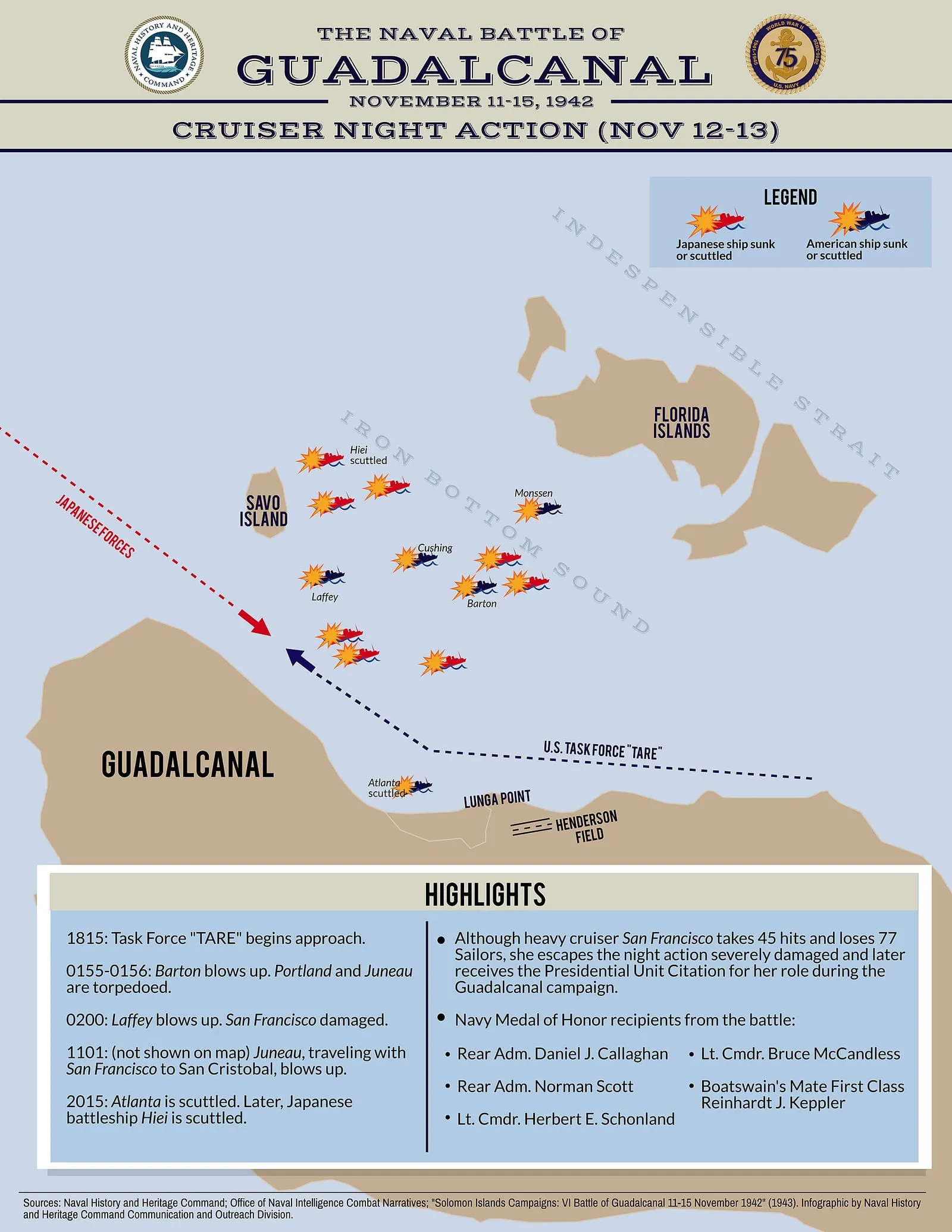
Abe’s force approached Guadalcanal through heavy rain squalls that broke up its formation into several groups. The ships entered the strait from the west, past Savo Island, at about 1.25 a.m. on 13 November. The Americans were steaming in a single long column, with destroyers at the head and the rear and the cruisers in the middle. Five ships had the new SG radar, but none of them was at the head of the column; Callaghan had not chosen one as his flagship, and he had issued no battle plan to his captains. The radars detected the Japanese the moment they entered the strait, but the reports reached the admiral late and in confusion, and he tried to fight the battle by eye from the bridge.
The two formations closed on each other almost blindly and ran into one another. At 1.48 a.m. the destroyer Akatsuki and the Hiei switched on their searchlights and illuminated the Atlanta at a range of about 3 km. Ships on both sides opened fire at the same moment; Callaghan then gave the order “Odd ships commence fire to starboard, even ships to port”, which could not be carried out in any sensible way by a column that had already broken apart. There followed an action that the American historian Richard B. Frank described as unequalled in the whole war for its ferocity, short range and chaos. Ships passed one another at a few hundred metres, and the destroyer Laffey crossed just ahead of the Hiei’s bow, raking her bridge with gunfire and machine guns. Abe was wounded and his chief of staff killed.
The Atlanta, struck by a torpedo and by dozens of shells – including, it is believed, some from the San Francisco – lost power; Rear Admiral Scott was killed on her bridge. The Hiei, together with the Kirishima and two destroyers, shelled the San Francisco at close range. Callaghan, the ship’s captain, Captain Cassin Young, and most of the staff officers were killed on her bridge. The cruiser survived partly because the Japanese battleships’ first salvoes were fired with shells meant for bombarding the airfield rather than armour-piercing rounds. The Japanese destroyers, well trained in night exercises and armed with long-range Type 93 torpedoes, sank in turn the destroyers Barton, Laffey, Cushing and Monssen. Torpedoes also hit the Portland, jamming her rudder, and the Juneau, which withdrew with a broken keel.
The American ships concentrated their fire on the Hiei, lit up by her own searchlights. According to some studies the battleship took about 140 hits from the cruisers’ and destroyers’ guns; they did not penetrate her belt armour, but they wrecked her superstructure, communications and steering gear. The Akatsuki sank within minutes, and the Shiratsuyu-class destroyer Yūdachi was disabled. After some 40 minutes of fighting, at 2.26 a.m., Abe and the senior surviving American officer, Captain Gilbert Hoover of the Helena, ordered their ships to withdraw.
The Japanese still had the undamaged Kirishima, the Nagara and several serviceable destroyers on the scene, whereas on the American side only the Helena and the destroyer Fletcher remained fully fit for action. The way to the airfield lay open. Abe nevertheless gave up the bombardment. Part of the special ammunition had been expended, his ships were scattered, communications from his badly damaged flagship were failing, and at dawn aircraft from Henderson Field were bound to appear over the strait. At 3 a.m. Yamamoto called off the landing planned for 13 November and turned Tanaka’s transports back to Shortland.
Course of the battle: 13 November – the Hiei and the Juneau
Dawn revealed several crippled ships of both sides in the waters off Savo. The Portland, which despite her jammed rudder could still fire, finished off the wreck of the Yūdachi. The Hiei, her rudder also jammed, circled slowly north of the island. Throughout the day she was attacked by Marine and Navy Grumman TBF Avenger torpedo bombers and Douglas SBD Dauntless dive bombers from Henderson Field and the Enterprise, as well as by B-17s from Espiritu Santo. Abe transferred to a destroyer, and an attempt to have the Kirishima take the battleship in tow was abandoned for fear of submarine attack. On the evening of 13 November, after destroyers had taken off her crew, the Hiei sank north-west of Savo, probably scuttled by her own men as well. She was the first Japanese battleship lost in the war. At around 8 p.m. the wreck of the Atlanta, which could not be saved, was also scuttled off the coast of Guadalcanal.
The most tragic episode, however, took place far from the strait. The damaged ships – the San Francisco, the Helena, the Juneau and two destroyers – were making for Espiritu Santo when, at about 11 a.m., the Japanese submarine I-26 fired a spread of torpedoes at the San Francisco. One of them struck the Juneau where she had been damaged during the night; her magazine exploded and the cruiser sank in less than a minute. Captain Hoover, fearing further attacks on the crippled ships, did not stop to search for survivors. He reported the sinking to a passing bomber, but the message did not lead to a rescue operation. More than a hundred survivors from a crew of nearly 700 were left in the water with no boats and only a few rafts; most of them died of wounds, exhaustion and dehydration or were taken by sharks. They were found only after eight days, and ten survived. Among the dead were the five Sullivan brothers from Iowa, who had enlisted together on condition that they serve together; their deaths contributed to a more cautious policy of assigning brothers to the same ship. Halsey relieved Hoover of his command, although he later admitted that he had judged him too harshly.
According to official figures the first night cost the Americans 1,439 dead, including the Juneau’s crew; Japanese losses are estimated at 550–800 men. Callaghan and Scott – the only American admirals killed in a surface action during the war – were posthumously awarded the Medal of Honor. Tactically the action was won by the Japanese, who sank two cruisers and four destroyers for the loss of a battleship and two destroyers. Strategically, however, Henderson Field had been saved and the landing put back by a day. Yamamoto, angered by Abe’s withdrawal and the loss of the Hiei, removed him from command; in March 1943 Abe was placed on the retired list.
Course of the battle: 13–14 November – the destruction of the convoy
The Japanese did not abandon the operation but postponed it by a day. On the afternoon of 13 November Tanaka’s transports again sailed from Shortland. The task that Abe had failed to carry out passed to Mikawa’s cruisers: on the night of 13–14 November two heavy cruisers, the Suzuya and the Maya, under Rear Admiral Shōji Nishimura, shelled Henderson Field for about half an hour while the rest of the force covered them off Savo. The bombardment damaged a number of aircraft and installations but did not put the airfield out of action; the only interference the Japanese met came from American PT boats out of Tulagi.
At dawn on 14 November aircraft from Henderson Field and from the Enterprise, which was some 370 km south of Guadalcanal, caught Mikawa’s force as it withdrew. The heavy cruiser Kinugasa was sunk (more than 500 of her crew were killed), and the Maya, the Chōkai, the light cruiser Isuzu and the destroyer Michishio were damaged. The airmen then turned on the convoy, which was approaching Guadalcanal down the channel through the Solomons that the Americans called the Slot. All day Navy and Marine Avengers and Dauntlesses, supported by B-17s, shuttled between the airfield and the convoy, returning for bombs and fuel, and the few Japanese escort fighters could not stop them. By evening six transports had been sunk, and a seventh, badly damaged, turned back and also went down.
Tanaka’s destroyers, at risk to themselves, picked survivors out of the water; several thousand soldiers were carried back to Shortland, and according to Japanese figures some 450 were killed. Tanaka nevertheless pressed on towards Guadalcanal with the four surviving transports and four destroyers, counting on Kondō finally managing to bombard the airfield that night.
Course of the battle: the night of 14–15 November – the battleship duel
Kondō’s force – the battleship Kirishima, the heavy cruisers Atago (the flagship) and Takao, the light cruisers Nagara and Sendai and nine destroyers – approached Guadalcanal on the evening of 14 November. Halsey, who no longer had any other surface forces nearby capable of barring the Japanese way, detached both battleships and four destroyers from the Enterprise and sent them into the strait as Task Force 64 under Lee. It was a force thrown together in haste: the battleships had been operating together for only a few days, and the destroyers – Walke, Benham, Preston and Gwin – came from four different divisions and had been chosen because they had the most fuel. By sending battleships into narrow waters full of Japanese torpedo destroyers, Halsey was breaking pre-war doctrine; he judged, however, that losing the airfield would be worse than risking the ships. Lee, a gunnery and radar specialist, was one of the few American admirals who truly understood the new technology.
At about 11 p.m. the American battleships’ radars picked up the Japanese near Savo, and at 11.17 p.m. the Washington and the South Dakota opened radar-directed fire on the Sendai group, which turned away under a smokescreen. Kondō, who on the strength of air reports expected only cruisers, threw the Nagara and the destroyers into the fight. Within a quarter of an hour their gunfire and torpedoes had shattered the American screen: the Preston and the Walke were sunk, the Benham lost her bow (she had to be scuttled the next day), and the Gwin was put out of action. The destroyers had nonetheless done their job: they drew the Japanese torpedoes that might otherwise have hit the battleships. The Washington’s secondary armament set the destroyer Ayanami ablaze.
At that point the South Dakota suffered a series of electrical failures that knocked out her radar, radios and most of her guns. Forced to turn to avoid the burning destroyers, the battleship was silhouetted against them, and around midnight she was caught in searchlights and fired on by the Kirishima, the Atago and the Takao. She took 26–27 hits, which wrecked her communications and fire control; 39 of her crew were killed. None of the torpedoes fired at her struck home and her armour held, but at 0.17 a.m. the South Dakota withdrew from the battle without informing Lee.
The Japanese, preoccupied with the South Dakota, failed to notice the Washington, which had been tracking a large target on radar but holding her fire because she was not sure it was not her own consort. When the searchlights lit up the South Dakota, the doubt vanished. A few minutes after midnight the Washington opened fire at a range of about 8 km. Within a few minutes her radar-directed 406 mm guns had hit the Kirishima at least several times – according to some sources as many as twenty – in addition to a dozen or more hits from her secondary battery. The Japanese battleship lost her turrets, began to take on water below the waterline and, with her rudder jammed, circled helplessly to port. The Washington also fired on the Atago and then drew the Japanese off to the north-west, towards the Russell Islands, dodging their torpedo salvoes.
Kondō, believing that the way was now clear for the convoy, ordered a withdrawal at about 1 a.m. At around 2 a.m. the destroyer Uranami finished off the burning Ayanami. The Kirishima’s crew could not bring the fires and flooding under control; after destroyers had taken off her men, the battleship capsized and sank at about 3.25 a.m. on 15 November, some 20 km west of Savo. According to American studies, 242 Americans and 249 Japanese were killed that night. It was one of only two battleship-versus-battleship engagements in the entire Pacific war – the other was not fought until October 1944, in the Surigao Strait, during the Battle of Leyte Gulf.
Course of the battle: 15 November – the transports at Tassafaronga
Tanaka, with no hope of surviving a day at sea, ran his last four transports aground at Tassafaronga, west of the American positions, at about 4 a.m. and withdrew northwards with his destroyers. From 5.55 a.m. the ships were attacked by aircraft from Henderson Field, shelled by Marine field artillery and later, at close range, by the destroyer Meade, which on her way back also picked up survivors of the Walke and the Preston. The transports burned out. Of the whole convoy only some 2,000–3,000 soldiers got ashore, and according to Richard B. Frank they brought with them about 1,500 bags of rice and 260 cases of ammunition – enough for a few days. Most of the heavy equipment and food was lost.
Losses
Loss figures vary depending on whether airmen and the soldiers aboard the transports are included. The Americans lost two light cruisers (Atlanta and Juneau) and seven destroyers (Barton, Cushing, Laffey, Monssen, Preston, Walke and Benham); the cruisers San Francisco and Portland and the battleship South Dakota were badly damaged. According to Richard B. Frank, a total of 1,732 Americans were killed, including two admirals, and 36 aircraft were lost. For a long time the Navy did not disclose the full scale of these losses.
The Japanese lost the battleships Hiei and Kirishima, the heavy cruiser Kinugasa, the destroyers Akatsuki, Yūdachi and Ayanami and all eleven transports of the convoy; several cruisers and destroyers were damaged. Frank estimates Japanese losses at about 1,900 sailors and airmen killed and 64 aircraft. To these must be added the soldiers from the transports: Japanese figures speak of about 450 dead, but Frank considers this number probably too low. The Kinugasa was the last Japanese heavy cruiser sunk in the Solomons campaign.
Significance
The Naval Battle of Guadalcanal was the decisive engagement of the whole campaign. Tactically, both nights brought heavy losses to both sides, and the first actually ended in a Japanese success. Yet the Japanese achieved none of their objectives: their battleships never once bombarded the airfield, and the 38th Division reached the island without its equipment and supplies. The planned land offensive against Henderson Field could not take place. From then on the Japanese navy could bring only meagre supplies to Guadalcanal, aboard destroyers and submarines and, from the end of November, in drums dropped into the sea off the coast. One such run led on 30 November to the Battle of Tassafaronga – the last great victory of the Japanese destroyers in the campaign, which nevertheless did nothing to improve the position of the starving 17th Army. The Americans, by contrast, could bring in reinforcements freely; at the turn of 1942 and 1943 two fresh divisions arrived on the island and the exhausted 1st Marine Division was withdrawn.
In three days the Japanese navy lost two battleships, its first of the war, and more than ten transports that it could not easily replace. Yamamoto treated the two commanders differently: Abe lost his post, while Kondō, deputy commander of the Combined Fleet and a member of the “battleship clique”, kept his. On 12 December the Naval General Staff proposed abandoning the island, and on 31 December Emperor Hirohito approved the decision to evacuate it, which was carried out in February 1943 in Operation Ke.
On the American side the battle cemented the standing of Halsey, whose determination – sending his last ships, battleships included, into narrow waters – had brought victory; on 18 November he was promoted to full admiral, and he sent his old vice admiral’s stars to the widows of Callaghan and Scott. The duel between the Washington and the Kirishima demonstrated the advantage of radar in night fighting, although the first night had also shown how little new technology achieves without training, doctrine and reliable communications. The US Navy paid dearly for its lessons: the historian Eric Hammel wrote that on 12 November the Japanese had the better ships and the better tactics, but that after 15 November they made no further progress, while the Americans kept on improving. President Franklin Delano Roosevelt, on learning the outcome of the battle, concluded that “the turning point in this war has at last been reached”.
In a wider perspective, the November battle off Guadalcanal, fought in the same days as the Second Battle of El Alamein and just before the Soviet counter-offensive at Stalingrad, belongs to the group of engagements in the autumn of 1942 after which the initiative on all the main fronts passed to the Allies. In the Pacific it was Japan’s last great attempt to reverse the course of the struggle for the Solomon Islands; the Japanese fleet did not fight another battle on a similar scale until June 1944, in the Philippine Sea.