- Category:
- Military operations
- Front:
- Pacific
- Date:
- 7 August 1942
- Author:
- Natalia
- Battle:
- Guadalcanal campaign
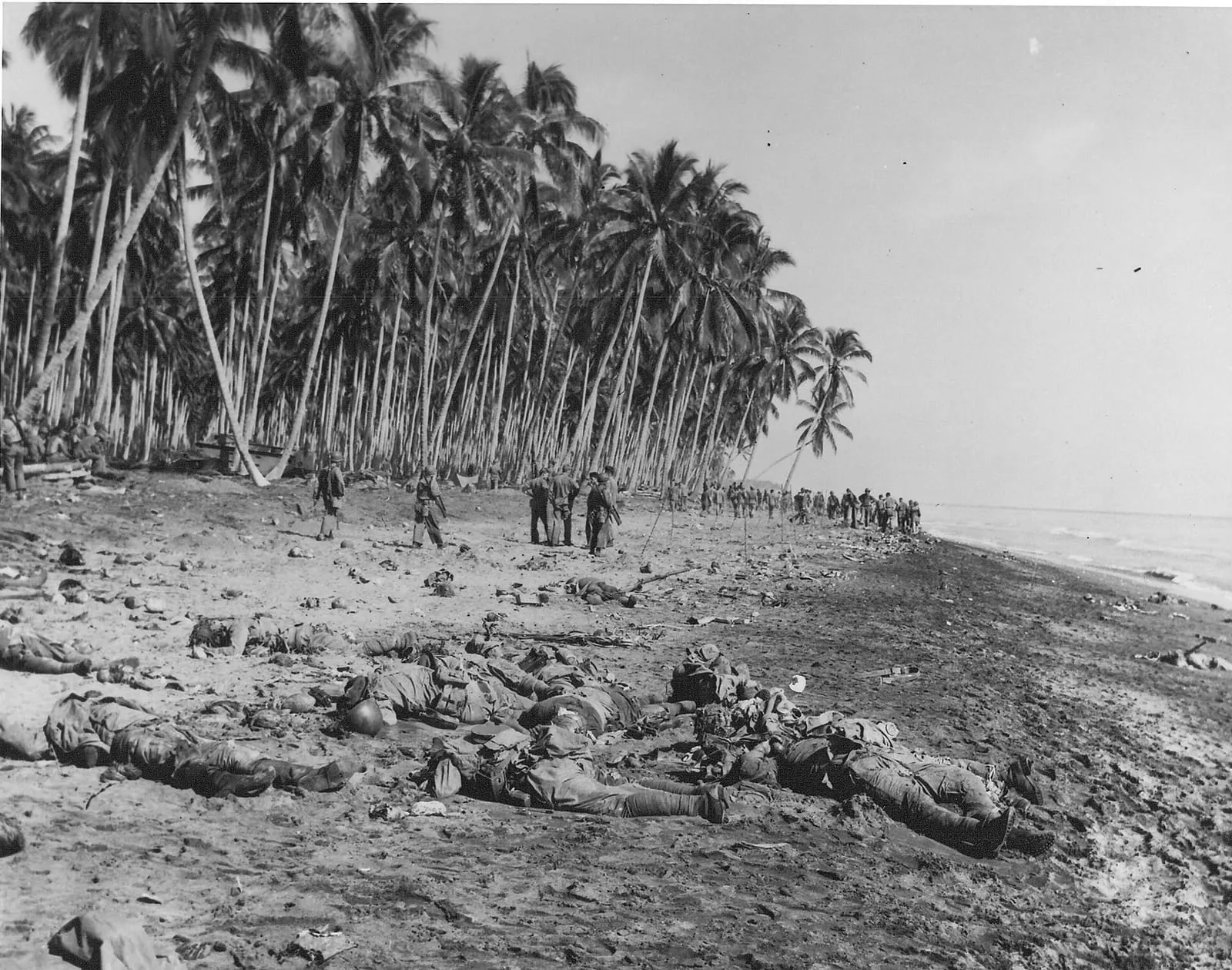
On the morning of 7 August 1942, eight months after Pearl Harbor, the United States went over to the offensive on land in the Pacific for the first time in this war. Before dawn an invasion fleet entered the narrow channel between Guadalcanal and the Nggela (Florida) Islands undetected, and within a few hours the men of Major General Alexander Vandegrift’s 1st Marine Division went ashore simultaneously on Guadalcanal, on Florida Island, on Tulagi and on the tiny islets of Gavutu and Tanambogo. The operation was code-named Watchtower. On Guadalcanal, where the Japanese were finishing the construction of an airfield, the landing met almost no resistance, and the next day the Marines took the airstrip. On Tulagi and the neighbouring islets, by contrast, the Japanese garrison fought almost to the last man. So began a six-month campaign that was to decide who would seize the initiative in the Pacific War.
The forces of Operation Watchtower
A directive of the American Joint Chiefs of Staff of 2 July entrusted the first phase of the offensive in the Solomon Islands to the navy. Admiral Chester Nimitz passed it to Vice Admiral Robert Ghormley, commander of the South Pacific Area, who directed the operation from a headquarters ship at Nouméa. At sea the whole expeditionary force was commanded by Vice Admiral Frank Jack Fletcher, who personally led the carrier group: Saratoga, Enterprise and Wasp, screened by the new battleship North Carolina, cruisers and destroyers. These were three of the four carriers the navy had in the Pacific after the Battle of Midway. The amphibious force was commanded by Rear Admiral Richmond Turner: some twenty transports and fast transports converted from destroyers, as well as a screening force of eight cruisers, three of them Australian, and a dozen or more destroyers. The screen was commanded by the British Rear Admiral Victor Crutchley, a Royal Navy officer seconded to the Australian navy, flying his flag in the heavy cruiser Australia. According to American figures, the whole armada numbered some 75 warships and merchant vessels.
On board were between 16,000 and 19,000 troops, depending on how they are counted. The core was the 1st Marine Division, the first division in the history of the Corps to leave the United States. One of its regiments, the 7th, was stationed on Samoa, so the division was made up with the 2nd Marine Regiment from the 2nd Division, Lieutenant Colonel Merritt Edson’s 1st Raider Battalion, the 1st Parachute Battalion and the 3rd Defense Battalion with anti-aircraft and coastal artillery. The forces on Tulagi and the surrounding islets were commanded by Vandegrift’s deputy, Brigadier General William Rupertus. The preparations were hurried: the division was reloaded in Wellington in July, and the landing rehearsals off the island of Koro in Fiji went badly. Supplies were cut from ninety to sixty days, and the troops, armed mainly with bolt-action Springfield rifles dating from the previous war, nicknamed the operation “Shoestring”.
On 31 July the fleet left the Fiji area and swung round in an arc to the west in order to approach Guadalcanal from the south. The last days before the landing brought a stroke of luck no one had counted on: low cloud and rain hid the task forces from the Japanese flying boats from Tulagi, which patrolled the area but spotted nothing. On the night of 6/7 August the ships rounded the islet of Savo to the west and split up: Group X-Ray headed for Guadalcanal, Group Yoke for Tulagi.
Dawn over the channel
Shortly after 6 a.m. the cruisers and destroyers opened fire on the shore, and carrier aircraft attacked targets on both sides of the channel. Airmen from Wasp destroyed fifteen Japanese seaplanes and flying boats at their moorings off Tulagi and Gavutu, including heavy Kawanishi H6Ks, some of them with engines already warming up for take-off. At 6.41 a.m. Turner gave the order “land the landing force”. Surprise was complete. The Tulagi garrison only had time to report to Rabaul that the enemy was overwhelmingly superior, that it was destroying documents and equipment and that it would fight to the last man.
Tulagi, Gavutu and Tanambogo
The first ashore were men of the 1st Battalion, 2nd Marines, who at 7.40 a.m. occupied a beachhead on neighbouring Florida Island without a fight, guided by Australians who had known the area before the war. At 8 a.m. Edson’s raiders and the 2nd Battalion, 5th Marines landed on the western shore of Tulagi. The coral reef prevented the boats from reaching the beach, and the men waded the last hundred metres through the water, but for the moment the Japanese held their fire. The island’s garrison consisted of men of the navy’s 84th Guard Unit under Commander Masaaki Suzuki and personnel of the Yokohama Air Group. They withdrew to the south-eastern end of the island, to a hill the Americans called Hill 281, and to a neighbouring ravine, where they had dozens of caves cut into the limestone rock and machine-gun positions. The raiders reached them at dusk and dug in. During the night the Japanese attacked their lines five times, partly hand to hand, but the line held. On 8 August, after reinforcements had landed, the Marines surrounded the hill and the ravine and, after a mortar bombardment, cleared the caves with explosive charges. By the afternoon organised resistance had ceased.
The heaviest fighting took place on Gavutu and Tanambogo, two coral hillocks joined by a causeway about half a kilometre long, where there was a seaplane base. The Americans believed they were defended by two hundred men at most. In reality there were several hundred: airmen, mechanics and naval troops, as well as Japanese and Korean construction labourers. Because there were not enough aircraft to support all the landings simultaneously, the assault on Gavutu was scheduled only for midday. Some 400 men of the 1st Parachute Battalion, which despite its name landed from boats, came under crossfire from both islets; roughly one in ten was killed or wounded in the first few minutes, and the battalion commander, Major Robert Williams, was also wounded. After two hours the paratroopers fought their way to the top of the hill on Gavutu. A night attack on Tanambogo by a single company, made in the belief that the islet was weakly defended, failed: the boats, lit up by the glare of fires, came under heavy fire and had to turn back.
Vandegrift sent to Gavutu the 3rd Battalion, 2nd Marines, which had been meant to remain in reserve on Guadalcanal. On 8 August the battalion completed the capture of Gavutu and in the afternoon, after a half-hour bombardment by the cruiser San Juan, attacked Tanambogo from boats and across the causeway, supported by two Stuart light tanks. One of them got stuck on a tree stump; Japanese airmen set it on fire and killed two of its crew before they themselves were killed by infantry fire. The commander of the defence, Captain Shigetoshi Miyazaki, blew himself up in his shelter. Throughout the evening the Marines blew up one cave after another, and the last resistance on Tanambogo ended at midday on 9 August.
According to American calculations there were about 880–900 Japanese defenders on Tulagi and the two islets. Almost all were killed; a few dozen men were taken prisoner, most of them Korean labourers, and a few dozen swam across to Florida Island. Various sources put Marine losses in this fighting at between about 120 and 145 killed, and at close to 250 men including the wounded. The ferocity of the defence was the first foretaste of what the fighting for every subsequent island in the Pacific would be like.
Red Beach and the airfield on the Lunga
On Guadalcanal everything turned out differently. At 9.10 a.m. the first boats carrying two battalions of Colonel LeRoy Hunt’s 5th Marines grounded on the beach designated Red Beach, a few kilometres east of Lunga Point, between it and Koli Point. Several thousand defenders had been expected, but there was no one on the beach. After the 5th Marines came Colonel Clifton Cates’s 1st Marines, the artillery of the 11th Marines and the defence units; by the evening of 8 August some 11,000 troops were on the island. The Japanese, most of them labourers of the construction units under Captain Kanae Monzen, had fled west beyond the Matanikau River after the morning naval bombardment and bombing.
The real enemy on the first day turned out to be the jungle, the heat and confusion. The 1st Marines were to reach a hill dominating the plain which from the sea had looked like a nearby “grassy knoll”; in reality it was Mount Austen, several kilometres away through dense jungle, and Vandegrift soon abandoned the objective. On the beach, meanwhile, piles of ammunition, food and equipment were building up, because too few men had been assigned to unload them, and landing craft waited for hours to discharge their loads. For the night the troops dug in about a kilometre short of the airfield.
On 8 August the Marines crossed the Lunga River and at around 4 p.m. took the airfield and the Japanese camps at Kukum. The Japanese had left behind an almost finished runway, lorries, road rollers, excavators, stores of rice and tinned food, a power station, a radio station and even an ice plant, which the Americans immediately christened the “Tojo Ice Factory”. The captured machinery and food were soon to prove invaluable. A few days later – on 12 August, according to Richard B. Frank – the airfield was named Henderson Field in honour of Major Lofton Henderson, commander of a Marine dive-bomber squadron, who had been killed at Midway leading an attack on the Japanese carriers. On the same day the first aircraft, a Catalina flying boat, landed there.
The response from Rabaul
The Japanese command at Rabaul reacted quickly, though at first it underestimated the scale of the landing. Before noon on 7 August a coastwatcher on Bougainville reported bombers flying south, so that fighters from the carriers were waiting for them in the air. At around 1 p.m. 27 twin-engined Mitsubishi G4M bombers escorted by 18 Zero fighters appeared over the fleet. Bombing from high altitude, they hit no ship and lost several aircraft. In this fight one of the best Japanese aces, Saburō Sakai, was seriously wounded in the head, yet still managed to fly his aircraft back to Rabaul, more than a thousand kilometres away. In the afternoon nine Aichi D3A dive bombers, sent with no chance of returning because their range did not allow them to fly back to base, hit the destroyer Mugford.
Before noon on 8 August more than twenty G4M bombers armed with torpedoes arrived, again with a fighter escort. They attacked Turner’s transports low over the water and suffered heavy losses from anti-aircraft fire. One burning bomber crashed into the transport George F. Elliott, which caught fire and was later scuttled, and a torpedo hit the destroyer Jarvis. The damaged Jarvis left on her own and the next day was sunk with all hands by Japanese aircraft. Over the two days, according to American figures, the Japanese lost 36 aircraft and the Americans 19, including 14 carrier fighters. The raids nevertheless delayed unloading, because the transports had to stop work and manoeuvre.
Vice Admiral Gun’ichi Mikawa, commander of the 8th Fleet, sent two transports with about 500 troops towards Guadalcanal on 7 August, but recalled them when it became clear that the Americans had landed in strength. He himself, however, assembled five heavy and two light cruisers and a destroyer, and on the evening of 7 August set off south-east to attack the Allied fleet in the channel by night.
Fletcher withdraws
On the evening of 8 August Fletcher reported to Ghormley that his fighter strength had fallen from 99 to 78, that many Japanese torpedo bombers were operating in the area and that his ships were running short of fuel, and he asked for permission to withdraw the carriers. Without waiting for a reply, he turned south. He believed that after the loss of Lexington and Yorktown the three remaining carriers had to be preserved for a clash with the Japanese carriers, and under the original arrangements he was to cover the landing for only two or three days. Turner concluded that without air cover he could not keep the transports off Guadalcanal and decided to leave the next day. He summoned Vandegrift and Crutchley, who came over in Australia, to a conference on his flagship. That same night Mikawa’s cruisers struck the screening force near Savo Island and sank four Allied heavy cruisers, but did not attack the transports.
On the afternoon of 9 August the transports sailed for Nouméa, taking with them more than half the supplies, the heavy equipment, including most of the guns and radars, and some of the men of the 2nd Marines who had not yet been put ashore. On the island there remained, counting captured Japanese rice, food for a dozen or so days and ammunition for a few days of heavy fighting. Vandegrift ordered two meals a day, and his engineers completed the airfield with Japanese road rollers and lorries. The Marines still remember the departure of the carriers as abandonment; Vandegrift never forgave Fletcher for it as long as he lived. Historians, however, especially John B. Lundstrom, defend the admiral’s decision, pointing to the real threat to the only carriers America then had in the Pacific. In those days the British coastwatcher Martin Clemens, who had watched the landing from hiding, came down from the hills to the American lines and placed his scouts from the local police at Vandegrift’s disposal.
Place in the war
The landing of 7 August was the first American land offensive of the Pacific War and the first operation since Pearl Harbor in which the Allies held the initiative. For the time being the success was fragile: some 11,000 troops on Guadalcanal and 6,000 on Tulagi, without aircraft and with incomplete supplies, were defending a narrow perimeter around the airfield. The Japanese command regarded the landing as a reconnaissance in force and, instead of immediately sending large forces to the island, sent them piecemeal, which was to prove a costly mistake.
For the next six months Guadalcanal was the scene of attritional fighting on land, at sea and in the air. The first Marine aircraft landed on Henderson Field on 20 August, and the next day, on the Ilu River, which the Americans called the Tenaru, the Marines smashed the first Japanese counter-attack. Then came the naval battles of the Eastern Solomons, Cape Esperance, the Santa Cruz Islands and the great Naval Battle of Guadalcanal in November, and on land the September fighting on the ridge named after Edson and the October battle for Henderson Field. Japan lost dozens of warships there, hundreds of aircraft with experienced crews and, according to various estimates, from 20,000 to more than 30,000 soldiers, a large proportion of them to hunger and disease. In the first days of February 1943 it evacuated the remnants of its forces from the island. Guadalcanal, together with the simultaneous fighting in New Guinea, closed the period of Japanese victories in the Pacific and began the long Allied march through the Solomon Islands towards Rabaul and beyond, towards the Philippines and Japan.
Sources
Meanwhile
(04)Elsewhere, within a week.
- 5 August 1942 · MilitaryPlanning Operation TorchIn August 1942 the Allies began planning a landing in North Africa. Patton moved from Washington to Eisenhower's headquarters in London.
- 9 August 1942 · PoliticsThe arrest of GandhiOn 9 August 1942, the day after the Quit India resolution, Gandhi and the Congress leaders were arrested. Riots, strikes and sabotage swept India.
- 11 August 1942 · MediterraneanThe sinking of HMS EagleOn 11 August 1942 U-73 torpedoed the carrier Eagle, escorting the Pedestal convoy to Malta. She sank within minutes; about 130 men were lost.
- 12 August 1942 · DiplomacyChurchill in MoscowOn 12 August 1942 Churchill flew to Moscow and told Stalin in the Kremlin that there would be no second front in France in 1942.
Related events
(04)The same battle, people or subject.
- 15 September 1942 · PacificThe sinking of USS WaspOn 15 September 1942 the Japanese submarine I-19 torpedoed the carrier Wasp, covering a convoy to Guadalcanal. 193 men died and the blazing ship was scuttled.
- 8 August 1942 · PacificThe Battle of Savo IslandOn the night of 8/9 August 1942 Mikawa's cruisers surprised the Allied screen of the Guadalcanal landing off Savo and sank four heavy cruisers.
- 13 October 1942 · PacificThe bombardment of Henderson FieldOn the night of 13–14 October 1942 the battleships Kongō and Haruna fired 973 shells at Henderson Field. The Guadalcanal airfield was nearly knocked out.
- 18 October 1942 · PacificHalsey takes command in the South PacificOn 18 October 1942 Nimitz relieved the exhausted Ghormley and gave the South Pacific to Vice Admiral Halsey. The news lifted morale on Guadalcanal.