Japan
Matome Ugaki
Chief of Staff of the Combined Fleet (1941–1943), commander of the 1st Battleship Division (1944) and the 5th Air Fleet (1945)
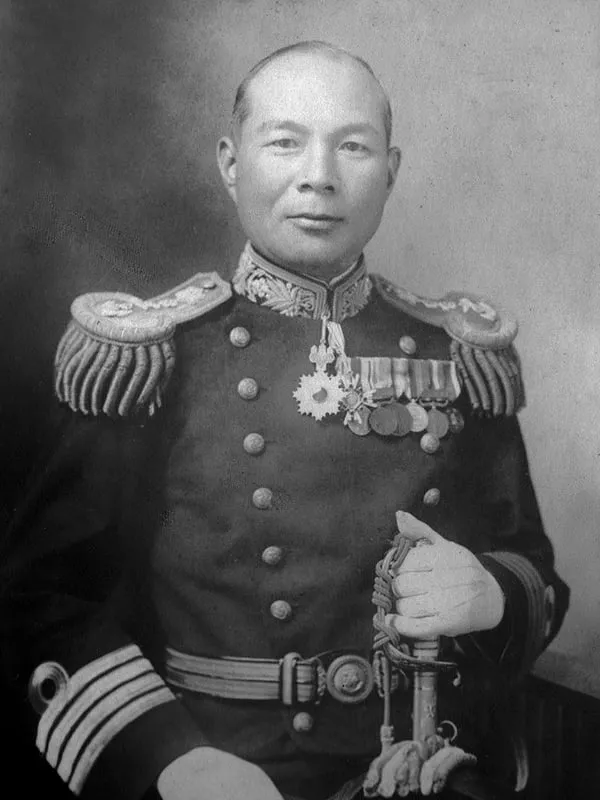
- Born:
- 15 February 1890, Akaiwa District, Okayama Prefecture (Japan)
- Died:
- 15 August 1945, Off Iheya Island near Okinawa
- Author:
- Łukasz
- Photo:
- autor nieznany, domena publiczna, Wikimedia Commons

For a year and a half Matome Ugaki was the closest associate of Admiral Isoroku Yamamoto: as Chief of Staff of the Combined Fleet he prepared with him the attack on Pearl Harbor, the expedition to Midway and the fighting for the Solomon Islands, and in April 1943 he was flying in the second aircraft when the Americans shot down the fleet commander over Bougainville. He survived the crash, only to command battleships at Leyte Gulf in the last year of the war and then the air force that hurled kamikaze pilots at the American fleet off Okinawa. A few hours after the Emperor’s broadcast announcing the surrender he flew the last suicide mission of the war himself, taking seventeen young airmen with him. His diary, kept from October 1941 to his last day, is one of the most valuable Japanese sources for the history of the Pacific War.
Gunner and staff officer
He was born on 15 February 1890 in Akaiwa District in Okayama (PL) Prefecture, into the family of a farmer and teacher. In 1912 he graduated from the Naval Academy at Etajima, ninth out of 144 cadets in his class; one of his classmates was Tamon Yamaguchi, later a carrier commander at Midway. In the First World War he served in the battlecruiser Ibuki, which in 1914 escorted convoys and hunted the German cruiser Emden in the Indian Ocean. He specialised in naval gunnery, and in 1924 he graduated from the Naval War College.
From 1928 to 1930 he was the navy’s resident officer in Germany. He then lectured at the Naval War College, became a captain in 1932, served on the staff of the Combined Fleet, commanded the training cruiser Yakumo and, in 1937–1938, the battleship Hyūga, which took part in the blockade of the southern Chinese coast. On 15 November 1938 he was promoted to rear admiral, and a month later he became head of the operations bureau of the Naval General Staff. According to the Pacific War Online Encyclopedia, he opposed at that time the alliance with Germany that Japan concluded in 1940 as the Tripartite Pact. In the spring of 1940 his wife died; it was a blow from which, his biographers wrote, he never fully recovered.
At Yamamoto’s side
In April 1941 Ugaki took over the 8th Cruiser Division, and on 1 August he became Chief of Staff of the Combined Fleet under Yamamoto. Although he recorded doubts about a war with the United States in his diary, as chief of staff he became one of the most ardent advocates of the plan to attack Pearl Harbor. On the staff he was known as the “Golden Mask”: stern and inscrutable towards his subordinates, he relaxed only when the fleet was in port. On 16 October 1941 he began to keep a diary, which he called Sensōroku.
In the first months of 1942 the Combined Fleet had nothing but successes, but Ugaki’s diary shows how quickly its staff began to fear the American carriers. After the raids on the Marshall and Gilbert Islands in February he wrote that Japan had been lucky the enemy had not struck at Tokyo straight away. In January he ordered the preparation of Operation K, a second raid on Pearl Harbor by flying boats. He also directed the war games aboard the battleship Yamato that tested the plan to seize Midway. When the umpires ruled that American land-based aircraft had sunk Japanese carriers, Ugaki arbitrarily reduced the losses so that the game could go on (preparations for the Battle of Midway). In June, after the loss of four carriers at the Battle of Midway, he calmly organised the fleet’s withdrawal and mourned in his diary Yamaguchi, who had gone down with his ship.
On 1 November 1942 Ugaki was promoted to vice admiral. During the fighting for Guadalcanal he was among the first naval officers to realise that the island could not be held, but for a long time he kept quiet so as not to antagonise the army.
The death of Yamamoto
In April 1943 Ugaki accompanied Yamamoto at Rabaul during Operation I-Go, the air offensive against the Americans in the Solomon Islands. On 18 April the two flew in two Mitsubishi G4M bombers to inspect forward airfields near Bougainville. The Americans, who had broken the Japanese code, sent P-38 fighters to meet them. Yamamoto’s aircraft came down in the jungle and everyone aboard was killed. Ugaki’s machine, badly damaged, ditched off Cape Moila; of all its crew and passengers only three men survived, among them the seriously injured Ugaki (death of Yamamoto). For the rest of his life he blamed himself for the admiral’s death, and Mineichi Koga became the new fleet commander. Ugaki spent many months recovering from his injuries and did not return to sea until February 1944.
Battleships
On 25 February 1944 Ugaki took over the 1st Battleship Division, made up of Yamato, Musashi and Nagato. When at the end of May the Americans landed on Biak off the coast of New Guinea, he argued that the island must be defended, and from 10 June he commanded the whole force of Operation Kon, which was to throw the Americans back. Two days later the operation was halted because the enemy’s attack on the Marianas proved more important. On 16 June Ugaki’s battleships joined the carriers of Vice Admiral Jisaburō Ozawa and took part in the lost Battle of the Philippine Sea. When in July hundreds of civilians on Saipan took their own lives rather than be taken prisoner, Ugaki wrote in his diary that it was a tragedy, but that if the whole nation showed the same determination, victory would be possible.
In October 1944 his division sailed as part of Vice Admiral Takeo Kurita’s fleet in the Battle of Leyte Gulf. On 24 October American aircraft sank Musashi in the Sibuyan Sea, and the next day Yamato and Nagato fought the escort carriers off Samar without achieving much. On 15 November the division was disbanded and Ugaki returned to the Naval General Staff.
Kamikaze
On 10 February 1945 Ugaki became commander of the 5th Air Fleet, which brought together the navy’s aircraft on Kyushu, with its headquarters at Kanoya air base. In March he sent a long-range suicide strike against the anchorage of the American fleet at Ulithi Atoll, in which one carrier was damaged. When on 18–19 March the American carriers struck Kyushu and the port of Kure, his aircraft counter-attacked and badly damaged, among others, the carrier Franklin, and on 21 March he sent manned Ohka missiles against them for the first time, without success.
The main battle of his life was Okinawa. Between 6 April and 22 June 1945 the 5th Air Fleet, together with the army air force, carried out ten mass kamikaze attacks under the code name Kikusui. The very first involved more than 160 naval aircraft in a single day (kamikaze off Okinawa). The attacks sank and damaged many American destroyers and smaller vessels, but no ship larger than a destroyer was sunk by a kamikaze strike alone, and Japan paid for them with the lives of young airmen and the loss of what remained of its air power. On 7 April his former flagship Yamato was sunk on a suicide run towards Okinawa. In his diary Ugaki described his pilots’ departures with a mixture of pride and grief, likening them to falling cherry blossoms. After the fall of Okinawa he prepared aircraft and explosive motor boats for the suicidal defence of Kyushu against the expected invasion.
The last flight
At noon on 15 August 1945 Ugaki listened to Emperor Hirohito’s broadcast announcing the acceptance of the surrender terms. In the last entry in his diary he noted that he had not yet received an order to cease fire and that he would lead an attack himself, following the airmen he had sent to their deaths. His friend Rear Admiral Takaji Jōjima tried to talk him out of it. Ugaki removed the rank insignia from his uniform, took the short sword Yamamoto had given him and at about five in the afternoon took off from Ōita airfield on Kyushu in a Yokosuka D4Y Suisei dive bomber, squeezed in beside the observer behind Lieutenant Tatsuo Nakatsuru, who was flying the aircraft. Eleven aircraft carrying 23 airmen took part in the mission.
Three aircraft turned back or made forced landings because of mechanical trouble. At 7.24 p.m. a last message came from Ugaki’s aircraft saying that it was diving on an American ship. The US Navy, however, recorded no successful suicide attack that day; the aircraft were most probably shot down by anti-aircraft fire or fell into the sea. The next morning the crew of an American landing ship found on the beach of the islet of Iheya near Okinawa the wreckage of a cockpit with three bodies; one of them matched the description of Ugaki. The Americans buried the dead in the sand. Seventeen young airmen died with the admiral.
Assessment
Ugaki’s flight provoked opposition from the start. The last commander of the Combined Fleet, Jisaburō Ozawa, condemned it as a breach of orders and forbade his officers to commit suicide. The navy did not posthumously promote him to admiral, giving as its reasons that he had attacked after the order to cease hostilities and that he had taken others with him instead of flying alone. The families of the airmen who died reproached him for dragging their sons with him when the war was already over. For some Japanese, however, he remained a symbol of loyalty to fallen subordinates.
For historians his diary matters most. Found after the surrender, it was published in Japan in 1952 and in 1991 in an English translation as Fading Victory, prepared from the papers of Gordon Prange. The American historian regarded it as a first-class source. Written day by day by a man at the very centre of command, it shows the Japanese navy from the euphoria of the first months, through Midway and Guadalcanal, to the despair of 1945 and the longing for death that Ugaki had long carried within him. He was an exceptionally intelligent officer with an excellent memory, respected as an authority on naval strategy, but also a man who to the end could not separate the defeat of the fleet from his own honour.
Sources
Mentioned in battles
(01)Often appears with
People who appear in the same events.
On the timeline
(16)1942
1943
1944
1945
March
April
June
August
- 14
- The Kyūjō incidentOn the night of 14–15 August 1945 War Ministry officers seized the Imperial Palace to stop the surrender broadcast. The coup collapsed by morning.
- The last raids on JapanOn 14 August 1945 over a thousand US aircraft struck Japan in the last great B-29 operation; air combat still went on on 15 and 18 August.
- 15
- Key eventHirohito's broadcastAt noon on 15 August 1945 radio aired Hirohito's recorded address accepting the Potsdam Declaration. The Japanese first heard their Emperor's voice.
- Victory over Japan DayOn 14–15 August 1945 news of Japan's surrender brought joy to New York, London, Sydney and Chongqing. For Poles it was the end of a war that brought no freedom.