1941–1942: The Japanese offensive in the Pacific
Philippines campaign (1941–1942)
- Dates:
- 8 December 1941 – 8 May 1942
- Front:
- Pacific
- Location:
- The Philippine archipelago: above all the island of Luzon (Manila, Lingayen Gulf, the Bataan peninsula, Corregidor island), as well as Mindanao and the VisayasOn the battle map →
- Sides:
- JapanMasaharu HommaUnited States and the Commonwealth of the PhilippinesDouglas MacArthur, Jonathan Wainwright
- Result:
- Japanese victory. The American and Filipino forces surrendered on Bataan (9 April 1942) and on Corregidor (6 May 1942), and nearly 90,000 soldiers in all were taken prisoner. The defence delayed the Japanese timetable by about four months.
- Author:
- Łukasz
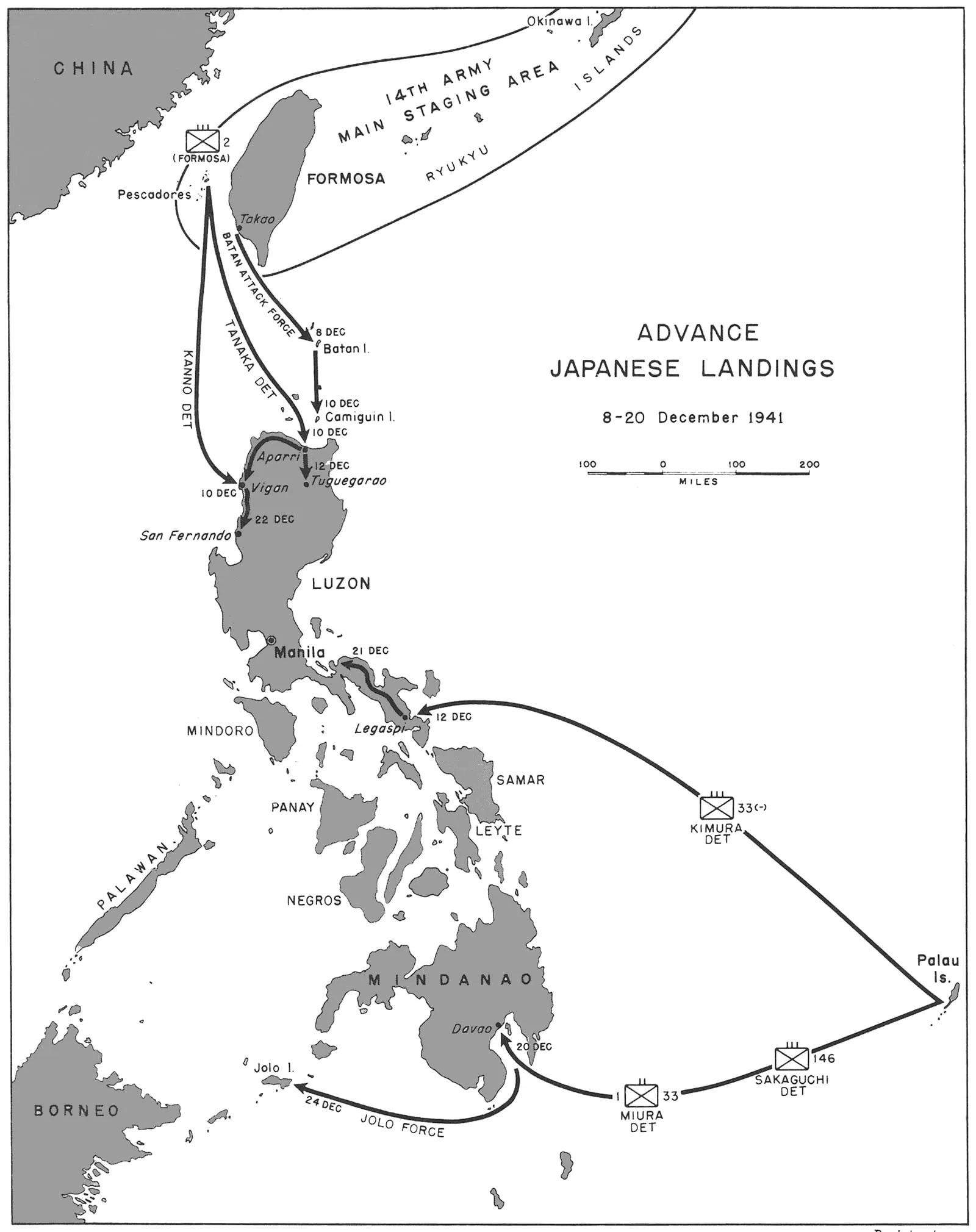
A few hours after the strike on Pearl Harbor, at noon on 8 December 1941, Manila time, Japanese bombers flying from Taiwan destroyed most of the American air force in the Philippines on the ground. Two weeks later Lieutenant General Masaharu Homma’s 14th Army landed in Lingayen Gulf on the island of Luzon and advanced on Manila. The commander of the American and Filipino forces, General Douglas MacArthur, abandoned his plan to defend the whole island and withdrew his troops to the Bataan peninsula. There, underfed, sick and without reinforcements, the soldiers held out for three months – longer than any other Allied force in the first months of the Pacific War. On 9 April 1942 Bataan surrendered, and the prisoners were driven on a march that went down in history as the Bataan Death March. On 6 May the fortress of Corregidor fell, and General Jonathan Wainwright, MacArthur’s successor, ordered the surrender of all forces in the archipelago. It was the greatest defeat in the history of the United States Army.
Name and dates
In Polish writing the campaign is called the Philippine campaign or the battle for the Philippines, with the dates added to distinguish it from the American recapture of the archipelago in 1944–1945. Its most important parts have names of their own: the Battle of Bataan (January–April 1942) and the Battle of Corregidor (5–6 May 1942).
The campaign began on 8 December 1941, Philippine time. Because the Philippines lie on the other side of the International Date Line, in Washington and Hawaii it was still 7 December. The first bombs fell on Luzon in the morning; the main raid on Clark Field came just after noon, some nine hours after news of Pearl Harbor had reached Manila.
The end of the campaign can be dated to 8 May 1942. Corregidor surrendered on 6 May; during the night of 7–8 May Wainwright, by then a prisoner, called on the remaining units over Manila radio to lay down their arms, and on 8 May he sent the order to surrender to General William Sharp, the commander on Mindanao and in the Visayas. Sharp surrendered on 10 May, and the last units on outlying islands went on laying down their arms until early June. Many soldiers, especially Filipinos, never surrendered at all and joined the guerrillas.
Background
The Philippines had been an American colony since 1898. Since 1935, as the Commonwealth of the Philippines, they had had their own government, under President Manuel Quezon, and a promise of independence in 1946. For Japan, the archipelago lay across the route between the home islands and the oil and rubber of Malaya and the Dutch East Indies. American airfields and the Asiatic Fleet’s base at Manila could cut that route, which is why the war plan adopted in Tokyo in the autumn of 1941 and approved at the Imperial Conference of 5 November provided for simultaneous attacks on Malaya and the Philippines.
For two decades American planners had not believed the archipelago could be held. The plan for war with Japan, known as War Plan Orange, in its WPO-3 version assumed that the garrison would withdraw to the mountainous Bataan peninsula and the island of Corregidor at the entrance to Manila Bay and hold out there for several months until the fleet could fight its way through to relieve it. After 1940 no one counted on early relief any longer, and the Rainbow 5 plan gave priority to Germany.
That changed in the summer of 1941. After the Japanese move into southern Indochina, Washington froze Japanese assets and on 26 July created the command of United States Army Forces in the Far East (USAFFE). At its head stood MacArthur, military adviser to the Philippine government since 1935. He persuaded General George Marshall and Secretary of War Henry Stimson that with the help of a new Philippine army and B-17 heavy bombers he could defend the whole of Luzon and even stop an invasion on the beaches. Washington began sending aircraft, tanks and men to the islands, expecting that by April 1942 the Philippines would become a bastion that would deter Japan.
Opposing forces
At the outbreak of war the US Army had about 31,000 soldiers in the Philippines, including nearly 12,000 Filipinos of the elite Philippine Scouts. The only fully trained major formation was the Philippine Division. The Commonwealth’s Philippine Army, mobilised from 1 September 1941, numbered about 100,000–120,000 men in ten reserve divisions once deployed, but it had obsolete rifles from the First World War, little artillery and barely a few weeks’ training. General Lewis Brereton’s Far East Air Force had 35 B-17 bombers and some 90 modern P-40 fighters in service, the largest concentration of Army air power outside the United States. Admiral Thomas Hart’s Asiatic Fleet had two cruisers, a dozen or so old destroyers and 29 submarines.
MacArthur divided his forces into Wainwright’s North Luzon Force, General George Parker’s South Luzon Force, Sharp’s Visayan–Mindanao Force and a reserve under his own command. These troops were to defend the beaches throughout the archipelago, and the supplies were stockpiled alongside them, not on Bataan.
Homma’s 14th Army, subordinate to General Hisaichi Terauchi’s Southern Army, had two divisions, the 16th and 48th, supported by tanks, artillery and numerous engineer units – about 43,000 men in all earmarked for the landings on Luzon. The army and navy air forces deployed on Taiwan numbered more than 500 aircraft, among them G4M bombers and Zero fighters with enough range to fly to Luzon and back. The Japanese plan provided for the capture of Manila and the completion of the main operations within about 50 days, after which the best division and most of the aircraft were to move on to Java.
December 1941
News of the attack on Pearl Harbor reached Manila at about 3.30 a.m. on 8 December. Brereton wanted to send his B-17s against the Japanese airfields on Taiwan at once, but for several hours could not obtain permission. MacArthur’s chief of staff, General Richard Sutherland, sent him away empty-handed, and MacArthur himself later claimed that no one had proposed such a raid to him. Who was to blame for the delay remains disputed: after the war Brereton and Sutherland blamed each other. The bombers took off in the morning to avoid being caught on the ground, and when permission for an afternoon raid finally came at about 11 a.m., they returned to Clark Field to refuel and load bombs. Japanese naval aircraft, held up in the morning by fog on Taiwan, arrived between 12.15 and 12.40 p.m. The radar at Iba detected them in time, but the warning did not reach Clark Field. Within an hour half of Brereton’s air force had been destroyed at Clark Field and Iba: according to the American official history, 18 of the 35 B-17s, 53 P-40 fighters and 3 P-35s. About 80 men were killed. The Japanese lost seven fighters. Over the following days the rest were destroyed, and on 10 December an air raid reduced the naval base at Cavite to rubble. Hart sent his surviving surface ships south, and in mid-December the last B-17s left for Australia. From the first day the defence of the Philippines was deprived of air cover.
The first landings were small and intended to seize airfields. On 8 December the Japanese occupied Batan Island in the Luzon Strait, on 10 December they landed at Aparri and Vigan in northern Luzon, and on 12 December at Legazpi at its south-eastern tip. On 20 December units of the 16th Army took Davao on Mindanao, and on the evening of 24 December they landed on the island of Jolo, taking its main town the following day. From there the road led to Borneo. MacArthur refused to be drawn into fighting these landings and waited for the main blow.
It came on 22 December. Before dawn some 43,000 soldiers of the 48th Division and part of the 16th Division began coming ashore on the eastern side of Lingayen Gulf, near Agoo, Caba and Bauang. Wainwright’s poorly trained Philippine divisions could not stop them. The toughest resistance was put up by the 26th Cavalry Regiment of the Philippine Scouts, which lost many men near Rosario and had to fall back. On 24 December about 7,000 soldiers of the 16th Division landed in Lamon Bay, east of Manila, where the South Luzon Force had almost no artillery. Manila was caught in a pincer.
On the evening of 23 December MacArthur decided to revert to WPO-3, and on 24 December the order to withdraw to Bataan took effect. That same day the USAFFE staff and President Quezon with his government moved to Corregidor, into the Malinta Tunnel. On 26 December Manila was declared an open city; even so, the Japanese bombed the port and its surroundings. Historians regard the withdrawal as one of the best-executed operations of the campaign: Wainwright delayed the Japanese on successive lines across the central Luzon plain, while the South Luzon Force passed through Manila and over the bridges at Calumpit, which were blown on 1 January. On 2 January 1942 the Japanese entered Manila, and on 6 January the last units withdrew through the Layac junction onto the peninsula.
The withdrawal came at a high price, however. For half a year supplies had been distributed to the units defending the beaches, and now they could not be gathered on Bataan in a few days. Thousands of tons of rice were left in depots on the plain. WPO-3 had provided for feeding 43,000 soldiers for six months, but some 80,000 soldiers and 26,000 civilian refugees ended up on the peninsula. As early as 6 January rations were cut by half.
The siege of Bataan
The Bataan peninsula, covered with jungle and cut by the Natib and Mariveles mountains, lent itself to defence. The first line ran from Abucay on Manila Bay across the slopes of Mount Natib to Mauban on the South China Sea. Parker’s II Corps held it on the eastern side and Wainwright’s I Corps on the western. Homma believed he faced the broken remnants of a beaten army and had only to finish them off. At the beginning of January the 48th Division and most of the aircraft were sent off to Java, and their place was taken by the 65th Brigade, a garrison unit made up of older reservists.
From 9 January the Japanese attacked the Abucay–Mauban line. They infiltrated across the almost impassable slopes of Mount Natib, which separated the two corps, and on 22–26 January the defenders fell back to a second line, from Orion to Bagac. There, over the following weeks, came the fighting known as the Battle of the Points and the Battle of the Pockets. Japanese battalions that had landed from the sea on the west coast of the peninsula were surrounded and destroyed by a scratch force of airmen, sailors, military policemen and Philippine Scouts. The pockets formed where the Japanese had broken into I Corps’ line were eliminated by mid-February. On 8 February Homma halted the offensive, and at the end of the month he pulled his troops back a few kilometres. The 14th Army had been bled white and decimated by malaria, and Homma had to ask Tokyo for reinforcements. Emperor Hirohito, displeased with the dragging campaign, twice pressed the Chief of the General Staff, Hajime Sugiyama.
But the defenders’ victory was only a reprieve. No relief could come. Supply convoys got no further than Australia, and attempts to smuggle food through the Japanese blockade on small ships and submarines brought in only crumbs. The soldiers ate the 26th Cavalry’s horses, mules, monkeys and lizards. In March rations fell to about 1,000 calories a day. Quinine ran short, and malaria, dysentery and beriberi put thousands of men out of action. The soldiers sang of themselves as the “battling bastards of Bataan”, with “no mama, no papa, no Uncle Sam”, and MacArthur, who visited the peninsula only once, was nicknamed “Dugout Doug”.
On 20 February Quezon left Corregidor by submarine, and on 22 February Roosevelt ordered MacArthur to move to Australia, where he was to take command of new Allied forces. MacArthur delayed, but finally, on the evening of 11 March 1942, he left Corregidor with his wife, his son and part of his staff in four PT boats commanded by Lieutenant John Bulkeley. After two nights crossing seas patrolled by Japanese warships he reached Mindanao, from where B-17s flew him to Australia on 17 March. On 20 March, on his way to Melbourne, he told reporters: “I came through and I shall return.” Command in the Philippines passed to Wainwright, promoted to lieutenant general. On Bataan his place was taken by General Edward King.
The fall of Bataan and the Death March
In March Homma received reinforcements: the 4th Division, a detachment of the 21st Division, heavy artillery and bombers. On 3 April 1942, Good Friday, after a bombardment lasting several hours, he struck the left flank of II Corps at the foot of Mount Samat. The starving defenders no longer had the strength to counter-attack. Within a few days the front collapsed, and the roads to the south of the peninsula filled with a mass of soldiers and refugees. On 8 April General King concluded that further fighting would mean a slaughter and, contrary to the orders of Wainwright, who had called for a counter-attack, surrendered on the morning of 9 April. Some 76,000 men went into captivity, including about 12,000 Americans. It was the largest surrender in the history of the United States Army. About 2,000 men managed to get across to Corregidor.
The Japanese had expected 25,000 prisoners at most and had prepared no transport, food or water for them. From 10 April columns of starving and sick men were driven on foot from Mariveles and Bagac to San Fernando, about 100 kilometres, and from there in closed goods wagons to Capas, and then on foot again to Camp O’Donnell. The guards beat the prisoners, denied them water and bayoneted or shot those who could not keep up. This Bataan Death March cost the lives, by the historian Stanley Falk’s cautious estimate, of 600–650 Americans and 5,000–10,000 Filipinos. Other estimates speak of as many as 18,000 Filipino dead. In the following months a further 1,500 or so Americans and from more than ten thousand to over 20,000 Filipinos died at Camp O’Donnell. Some prisoners managed to escape on the way and joined the guerrillas. News of the march reached the United States only in January 1944, from the accounts of escaped officers.
Corregidor
The island of Corregidor, known as “the Rock”, had been the main fortress guarding the entrance to Manila Bay since the early 20th century. Its coast guns were sited against warships, not against aircraft and artillery firing from the land. After the fall of Bataan the Japanese emplaced heavy guns at its southern tip and for almost a month shelled the island from a range of a few kilometres. Most of the batteries were silenced, and the garrison – some 11,000 men of the coast artillery, the 4th Marine Regiment and the navy – lived in the Malinta Tunnel, which also housed the hospital.
During the night of 5–6 May 1942 two battalions of the 61st Infantry Regiment landed at the eastern end of the island. Despite heavy losses during the crossing, they held their beachhead and brought tanks across. Wainwright, fearing a massacre of the wounded in the tunnel, raised the white flag at noon on 6 May. Homma agreed to accept the surrender only on condition that it covered all forces in the Philippines. Wainwright accepted this condition. During the night of 7–8 May he read out the order to lay down arms on a Manila radio station, and on 8 May his emissary carried it to Sharp on Mindanao. Sharp complied. Over the following weeks the remaining units surrendered, although many soldiers, especially Filipinos, took to the hills.
Losses
Casualty figures are incomplete and vary from source to source. According to American estimates, about 23,000 American servicemen and about 100,000 Filipino soldiers were killed, wounded, missing or taken prisoner in the campaign. On the American and Filipino side more than ten thousand were killed in action, while many soldiers of the Philippine Army, especially in the chaos of the last days, were never recorded in any rolls. Far more died in captivity: on the Death March, in the camps at O’Donnell and Cabanatuan, and later on the “hell ships” in which the Japanese carried prisoners to slave labour in Japan and Manchuria. Of the roughly 20,000–25,000 Americans taken prisoner in the Philippines, by various calculations little more than half survived.
Japanese losses were smaller, but heavy. According to Japanese figures cited in American literature, the 14th Army lost about 4,000 killed, about 7,000 wounded and several hundred missing, and at the height of the siege of Bataan tens of thousands of its soldiers were sick with malaria and dysentery.
Significance
The Philippines campaign was the greatest defeat in the history of the US Army and the largest surrender of its troops. Yet no other Allied force held out so long in the first months of the Pacific War. Singapore fell ten weeks after the first landing in Malaya, the Dutch East Indies after three months. In the Philippines the Japanese, who had planned to complete their main operations in 50 days, needed five months. This did not halt their advance on Java, but it tied down on Luzon forces and aircraft needed elsewhere, and for Americans and Australians it had enormous moral significance: the defence of Bataan and Corregidor became a symbol of resistance at a time when everywhere else brought only defeats.
The campaign also buried pre-war illusions. An air force without a radar warning network, fighter cover and dispersed airfields proved defenceless, just as it did that same week in Hawaii and in Malaya. The plan to defend the whole archipelago with a newly mobilised Philippine army proved unrealistic, and its abandonment at the last moment condemned the defenders of Bataan to starvation.
Japan conquered the Philippines, but never managed to subdue them. On Luzon, Mindanao and in the Visayas a strong guerrilla movement was active, keeping in touch with MacArthur’s headquarters in Australia. Homma, judged in Tokyo to be too slow and too lenient towards the Filipinos, lost his command in August 1942, and after the war an American tribunal in Manila convicted him of crimes committed by his troops, above all during the Death March. He was shot on 3 April 1946. MacArthur, who had promised to return, landed on Leyte in October 1944 and over the following months recaptured the archipelago. Wainwright, the highest-ranking American prisoner of the war, survived captivity in Manchuria and on 2 September 1945 stood behind MacArthur on the deck of the battleship USS Missouri as Japan signed its surrender.