Equipment
The Savoia-Marchetti SM.79 "Sparviero"
Italy's most numerous bomber of the war: a record-breaker of the 1930s, a bomber over Spain and Malta and, from 1940, Italy's most dangerous torpedo aircraft.
- Role:
- medium bomber and torpedo aircraft
- State:
- Italy
- Maker:
- Savoia-Marchetti
- First flight:
- 1934
- Built:
- about 1,300
- Author:
- Łukasz
- Updated:
- 1 November 2026
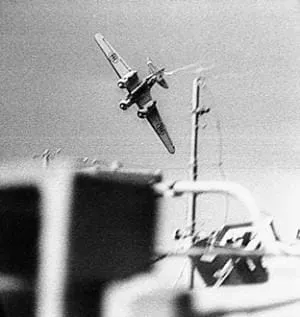
The Savoia-Marchetti SM.79 “Sparviero” (sparrowhawk) was the best-known Italian aircraft of the war and Italy’s most numerous bomber. The three-engined machine with a distinctive hump above the cockpit, which earned it the nickname il gobbo maledetto, “the damned hunchback”, began as the pride of Mussolini’s propaganda and a speed record-breaker. As an ordinary bomber it disappointed, because bombs dropped from high altitude seldom hit ships. As a torpedo aircraft, however, it was for three years a real threat to the British fleet in the Mediterranean.
From racer to bomber
In 1934 the Savoia-Marchetti company began building a fast eight-seat airliner that was to enter the race from London to Australia. It was not ready in time, but the prototype flew that autumn; sources give dates from 28 September to early October 1934. Its mixed wood-and-metal structure and three engines gave it high speed, and the military soon ordered a bomber version. In 1937–1939 specially prepared SM.79s set dozens of world records, took the first three places in the Istres–Damascus–Paris race and flew across the Atlantic to Brazil. Fascist propaganda presented them as proof that Italian aviation was the best in the world.
The combat test came in Spain. From the end of 1936 SM.79s flew with the Italian legionary air force (Aviazione Legionaria) on Franco’s side, often without escort, because Republican fighters rarely caught them. Over the three years of the civil war more than a hundred Sparvieros served in Spain and about twenty were lost. On 26 April 1937 three of them took part in the raid on Guernica, although their orders were to bomb the road and bridge east of the town. The Spanish experience confirmed the Italians in the belief that a fast bomber could defend itself, and the SM.79 became the mainstay of the bomber force of the Regia Aeronautica. When Italy entered the war on 10 June 1940, nearly six hundred were in service.
The bomber of 1940
On the morning of 11 June 1940 SM.79s from Sicily carried out the first raid on Malta. Throughout the summer and autumn it was they, without the Germans, who conducted the siege of the island, but as early as June they learned that even a few old Gladiators and the first Hurricanes could shoot them down. On 28 June, over Tobruk, Italian anti-aircraft gunners shot down by mistake the SM.79 carrying Marshal Italo Balbo, the governor of Libya; everyone on board was killed. In the east, Sparvieros from Rhodes bombed Haifa that summer, and some accounts also attribute to them the raid on Tel Aviv of 9 September 1940; in North Africa they supported Graziani’s advance into Egypt.
Against warships the Italian method, level bombing from several thousand metres in close formation, scored almost no hits. On 9 July 1940, at the battle of Punta Stilo, waves of SM.79s and SM.81s dropped hundreds of bombs without hitting a single British ship, and some of them attacked their own fleet by mistake. Attacks on convoys and fleet forces coming from Gibraltar ended the same way. The British offensive in Libya in the winter of 1940–41 destroyed a large part of the bomber wings in Africa on the ground and in the air.
The sparrowhawk with a torpedo
The Italians had experimented with torpedoes since 1936, but a separate torpedo unit was formed only on 25 July 1940. The first attack, on Alexandria on 15 August, scored no hits. On 17 September Captain Carlo Emanuele Buscaglia (PL) torpedoed the heavy cruiser Kent at night off Bardia, putting her out of service for a year. Attacking low over the water, the SM.79s achieved more than all Italian level bombing. In 1941, their best year, they sank nine ships and warships according to Italian figures, among them the destroyer Fearless on 23 July during Operation Substance, and damaged about thirty more. In March two Sparvieros also made an unsuccessful attack on the carrier Formidable before the battle of Cape Matapan.
In 1942 there were more torpedo aircraft, but the escort of the Malta convoys had become much stronger. In June, during Operation Harpoon, SM.79s sank the Dutch merchant ship Tanimbar and torpedoed the cruiser Liverpool for the second time, although according to Italian figures only three of more than a hundred torpedoes hit. In August the Italians sent about a hundred SM.79 and SM.84 torpedo aircraft against the Pedestal convoy; they sank the destroyer Foresight and the merchant ship Deucalion, while the rest of the losses were inflicted by submarines, motor torpedo boats and German Ju 88s. The crews paid a high price: by Italian reckoning the average torpedo aircraft was lost after three missions. Buscaglia, shot down off the Algerian coast in November 1942, was taken prisoner badly wounded.
After the surrender
On 8 September 1943 the Italian air force had only 61 SM.79s left, 36 of them serviceable. Those in the south joined the air force cooperating with the Allies as transports. In the north the air force of the Italian Social Republic formed a torpedo group from a few dozen Sparvieros and named it after Buscaglia, who meanwhile was flying on the other side and was killed in an accident in August 1944. The group attacked shipping off Anzio, and on 5 June 1944 ten SM.79s out of twelve reached Gibraltar; the British recorded no losses. The last missions were flown over the Adriatic in December 1944. In all about 1,300 SM.79s were built (Polish sources give 1,330), including twin-engined export versions for Romania, Brazil and Iraq; Yugoslavia bought the three-engined version. The last of them, converted into transports, served in the Italian air force until 1952.
Sources
Battles
(03)- 11 June 1940 – 20 November 1942Siege of MaltaFrom June 1940 to November 1942 Italy and Germany bombed and blockaded Malta. The island held out and became a base for attacks on Axis convoys to Africa.
- 27–29 March 1941Battle of Cape Matapan27–29 March 1941. Forewarned by Bletchley Park, Cunningham’s fleet damaged the Vittorio Veneto and at night sank three Italian cruisers and two destroyers.
- 10–15 August 1942Operation PedestalOn 10–15 August 1942 the Pedestal convoy fought its way to Malta. Five of 14 ships arrived, including the tanker Ohio, and their cargo saved the island.
In the chronicle
(17)1940
- 11 June 1940The siege of Malta begins
- 28 June 1940The death of Italo Balbo
- 1 July 1940Italian air raids on Palestine
- 9 July 1940The Battle of Calabria
- 19 July 1940The Battle of Cape Spada
- 1 August 1940Operation Hurry
- 9 September 1940The Italian air raid on Tel Aviv
- 13 September 1940The Italians invade Egypt
- 8 November 1940The Battle of the Kalamas