1940–1943: The war in the Mediterranean
Siege of Malta
- Dates:
- 11 June 1940 – 20 November 1942
- Front:
- Mediterranean
- Location:
- The Maltese Islands (Malta, Gozo and Comino), especially the Grand Harbour, Valletta and the airfields of Hal Far, Luqa and Ta’ Qali; the waters of the central Mediterranean between Sicily, Tunisia and Libya, and the convoy routes from Gibraltar and AlexandriaOn the battle map →
- Sides:
- United Kingdom (with Malta) and its alliesWilliam Dobbie, Lord Gort, Andrew Cunningham, Hugh Lloyd, Keith ParkItalyFrancesco Pricolo, Rino Corso FougierNazi GermanyHans Geisler, Albert Kesselring, Bruno Loerzer
- Result:
- British victory. Malta survived the air raids and the blockade, no invasion took place, and on 20 November 1942 the Operation Stoneage convoy broke the siege.
- Author:
- Natalia
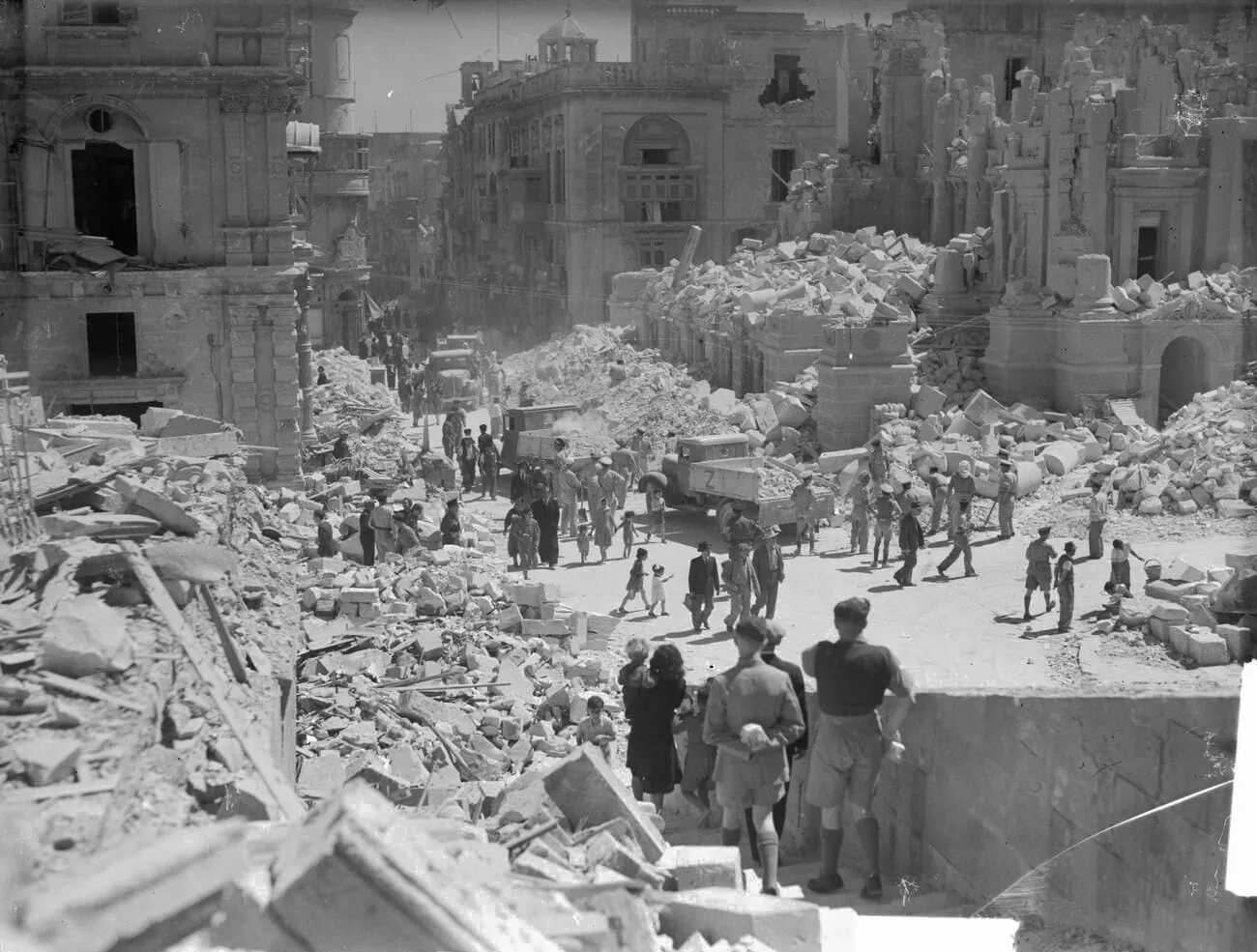
The siege of Malta lasted from the first raid by the Italian air force on 11 June 1940 – the day after Italy declared war on Britain and France – until the arrival of a convoy from Alexandria on 20 November 1942. For two and a half years this small British colony, lying less than a hundred kilometres south of Sicily, endured one of the heaviest and longest aerial bombardments of the Second World War, while its people and garrison lived under the threat of starvation and invasion. It was an unusual siege: the enemy never set foot on the island, and the ring around it was formed by aircraft, submarines and minefields.
At stake was control of the central Mediterranean. From Malta, British aircraft, submarines and surface forces attacked the convoys carrying supplies from Italy to Libya for the Italian army and, from 1941, for Erwin Rommel’s German Afrika Korps as well. The Axis powers therefore tried to bomb the island into submission, to starve it and, finally, to capture it. When they failed, Malta played an important part in the Axis defeat in North Africa, and in 1943 it became a base for the invasion of Sicily.
Name and dates
British writers speak of the “Siege of Malta” or the “Battle of Malta”. To distinguish it from the Great Siege of the island by the Ottoman Turks in 1565 and from the blockade of the French garrison in 1798–1800, the years 1940–1942 are often added. Since the award of the George Cross to the island in April 1942, it has also been known as “Malta G.C.”.
The siege is taken to have begun on 11 June 1940, the day of the first air raid. Most historians date its end to 20 November 1942, when the four ships of convoy MW 13 (Operation Stoneage), covered from airfields recaptured in Libya after the victory at El Alamein, reached the Grand Harbour without loss. Some authors extend the siege to December 1942, when further convoys arrived unhindered, or even to the surrender of the Axis forces in Tunisia in May 1943. The raids did not end in November 1942: according to Maltese records the last raid took place in July 1943, and from 11 June 1940 more than 3,300 air-raid alerts were sounded on the island.
The siege is usually divided into several phases: the Italian raids from June to December 1940; the first “blitz” by the German X Air Corps from January to May 1941; the period of the British offensive from Malta from the summer to December 1941; the heaviest bombing from December 1941 to May 1942; the struggle for the convoys in the summer of 1942; and the last Luftwaffe offensive in October and the breaking of the siege in November 1942.
Background
Malta, in British hands since 1800, had for decades been the main base of the Royal Navy’s Mediterranean Fleet and the only port with repair docks between Gibraltar and Alexandria. It lay on the route from Britain through the Suez Canal to India. The archipelago covers little more than 300 square kilometres, and the main island measures about 27 by 14 kilometres. In 1940 it was home to about a quarter of a million people, most of them crowded around the Grand Harbour, in Valletta and in the Three Cities on the far side of the harbour, where the naval dockyard stood. It was these few square kilometres that were to become the most heavily bombed part of the island.
The proximity of Italy had long made London doubt whether Malta could be defended at all. During the Italo-Abyssinian War of 1935–1936 the Admiralty had realised that a fleet in the Grand Harbour would be within range of Italian bombers based in Sicily, and it shifted the weight of its forces to Alexandria. By the outbreak of war Admiral Andrew Cunningham’s Mediterranean Fleet was already stationed in Egypt, leaving in Malta only the monitor HMS Terror, a few gunboats and some submarines. The Army and the Royal Air Force regarded the island as practically indefensible. Only in July 1939 was it decided to strengthen its anti-aircraft defences and send fighters, but little of this had been done by June 1940: the island had a few dozen anti-aircraft guns, a single radar set and not one fighter squadron. The garrison consisted of several British battalions together with the Maltese Royal Malta Artillery and King’s Own Malta Regiment.
Italy regarded the Mediterranean as mare nostrum, and Fascist propaganda portrayed the Maltese as an Italian people by culture and language. As early as the 1930s the Italian general staff had prepared studies for a landing on Malta, considering its capture a precondition for secure communications with Libya. In May 1940, as France was tottering, Prime Minister Paul Reynaud proposed keeping Mussolini out of the war through concessions, among which Malta was also mentioned. The British War Cabinet, after the dispute between Churchill and Halifax, rejected the path of concession. At the end of April 1940 the Chief of the Imperial General Staff, Edmund Ironside, sent to Malta as acting Governor and Commander-in-Chief the sixty-year-old Lieutenant General William Dobbie, a sapper and a deeply devout evangelical Christian whose faith and composure were to prove a great source of strength during the siege.
Course of the siege
The Italian raids (June – December 1940)
On 10 June 1940 Mussolini announced Italy’s entry into the war from the balcony of the Palazzo Venezia, counting on Britain to make peace after the fall of France. At 6.55 the next morning the first Savoia-Marchetti SM.79 bombers, escorted by fighters from Sicily, appeared over Malta. Bombs fell on the Grand Harbour, the dockyard and Hal Far airfield. Upper Fort St Elmo at the harbour entrance was hit, killing six gunners of the Royal Malta Artillery, among them sixteen-year-old Philip Busuttil. That day the Italians carried out seven or eight raids, depending on the source. More than a dozen civilians were also killed (eleven is the figure most often given, some accounts give more), and over a hundred people were wounded. In the following days thousands of inhabitants of Valletta and the Three Cities fled to the countryside.
For the first few weeks the RAF on the island was left with a handful of Gloster Sea Gladiator biplane fighters, assembled from crates left behind by the Navy. They were flown by volunteers, most of them pilots with no fighter experience. These aircraft gave rise to the legend of three Gladiators named Faith, Hope and Charity that defended the island single-handed. The legend needs to be treated with care: more machines took part in the fighting, although rarely more than three at a time, and the names were given to them only later. The fuselage of Faith has survived and is displayed in the war museum at Fort St Elmo. At the end of June a few Hurricane fighters on their way to Egypt were kept on the island; in August the aircraft carrier HMS Argus delivered another twelve, and No. 261 Squadron RAF was formed. An attempt to fly in further aircraft in November ended in disaster: launched too far from the island, the Hurricanes ran out of fuel and eight of the twelve came down in the sea.
The Italian bombing of 1940, usually carried out from high altitude, did little serious military damage. The Italians admitted losing 23 bombers and 12 fighters over Malta by the end of the year. Mussolini gave up the idea of a landing: his intelligence overestimated the strength of the defences, the navy feared the British fleet, and the Duce was convinced that after the fall of France the British would soon sue for peace anyway. On 9 July, at the Battle of Calabria off Punta Stilo, the Italian and British fleets clashed indecisively, but Cunningham concluded that the Italians were avoiding battle. The British soon understood that Malta could not only be held but also used for attack. Swordfish torpedo bombers, Maryland reconnaissance aircraft, Wellington bombers and submarines were sent to the island. Photographs taken by Malta-based reconnaissance aircraft paved the way for the attack on Taranto on the night of 11–12 November 1940, in which aircraft from the carrier Illustrious put three Italian battleships out of action.
The first German “blitz” (January – May 1941)
The defeat of the Italian army in Egypt and Libya during the British Operation Compass forced Hitler to come to his ally’s aid. In December 1940 the Luftwaffe high command sent General Hans Geisler’s X Air Corps, which specialised in attacking ships, to Sicily. On 10 January 1941, during the British convoy operation Excess, Ju 87 dive bombers hit the aircraft carrier HMS Illustrious with six bombs, killing 126 members of her crew. The badly damaged ship limped into the Grand Harbour. For almost two weeks the Germans tried to finish her off, while dockyard workers repaired her under the bombs well enough for her to sail for Alexandria on 23 January. This “Illustrious blitz” laid waste to the area around the dockyard and drove out the rest of its inhabitants.
In February Messerschmitt Bf 109 fighters appeared over the island, and their experienced pilots, led by Joachim Müncheberg, dominated the worn-out Hurricanes. The Germans destroyed aircraft on the airfields, and in March British warships and flying boats stopped using the island as an offensive base. Rationing was introduced, Maltese men aged 16 to 56 were called up for service, and thousands of miners and stonemasons dug shelters in the soft Maltese limestone, where the population spent more and more of its time. In four months the Luftwaffe dropped about 2,500 tonnes of bombs on Malta, far more than the Italians had in half a year, and destroyed more than two thousand buildings.
In the spring of 1941, however, Hitler needed his aircraft in the Balkans, for the Battle of Crete and in the east. In May most of X Air Corps left Sicily. The heavy losses suffered by the paratroopers on Crete convinced Hitler that large airborne landings were too costly, which was to matter for Malta’s fate. For the rest of the year the Regia Aeronautica once again fought the island alone.
Malta on the offensive (June – December 1941)
The British used the respite to strengthen the island and turn it into an offensive base. On 1 June 1941 Air Commodore Hugh Lloyd took command of the air forces on Malta and ordered low-level attacks on Italian shipping. Aircraft carriers brought more Hurricanes into the western Mediterranean, from where they flew on to the island under their own power, and the convoys of Operation Substance in the summer and Operation Halberd in the autumn delivered supplies to last many months. On 26 July the Italian special unit Decima Flottiglia MAS tried to force its way into the Grand Harbour with explosive motor boats and human torpedoes. The attack was detected by radar, and the coastal artillery destroyed the attackers: fifteen Italians were killed and eighteen taken prisoner.
The island was home to the 10th Submarine Flotilla under Commander George Simpson, equipped with small U-class boats. The most famous of its commanders was Lieutenant Commander Malcolm David Wanklyn of HMS Upholder, awarded the Victoria Cross, who was lost with his boat in April 1942. The Polish submarine ORP Sokół also served in the flotilla. Submarines, torpedo bombers and bombers, increasingly guided by decrypted enemy signals, sank a large proportion of the ships sailing to Libya in the second half of 1941. In October Force K, made up of two light cruisers and two destroyers, arrived in Malta. On the night of 8–9 November it destroyed the Duisburg convoy, sinking all seven of its merchant ships. In November, as the British opened Operation Crusader in Africa, the Axis forces lost most of the fuel shipped to them by sea. A run of misfortunes in December brought this period to an end, however: on 19 December Force K ran into a minefield off Tripoli, the cruiser Neptune sank with almost all hands, and the destroyer Kandahar had to be scuttled.
The heaviest bombing (December 1941 – May 1942)
The convoy losses forced the Germans to return. At the beginning of December 1941 Field Marshal Albert Kesselring became Commander-in-Chief South, and General Bruno Loerzer’s II Air Corps, which by March 1942 numbered about four hundred aircraft, was transferred to Sicily from the east. Kesselring set himself the aim of neutralising Malta. The raids fell mainly on the airfields, the harbour and the submarine base, but on such a densely built-up island the bombs also destroyed houses, churches and historic buildings. In January 1942 Malta suffered 263 raids. By the end of January only 28 remained on the island of the more than three hundred fighters that had passed through it since the start of the war.
The convoys stopped getting through. In March the four ships of convoy MW 10 left Alexandria. On 22 March its escort under Rear Admiral Philip Vian beat off a much stronger Italian force including the battleship Littorio at the Second Battle of Sirte, but the delay meant that the ships approached Malta within range of the German bombers. One sank on the way; a second, crippled just off the island, was later sunk in Marsaxlokk Bay; and the two that entered the Grand Harbour were bombed before they could be unloaded. Only a small part of their cargo reached the shore.
March and April 1942 were the hardest months of the siege. Between 20 March and 28 April the Germans flew almost twelve thousand sorties over Malta and dropped about 6,500 tonnes of bombs, nearly half of them on Valletta and the harbour area. It is often pointed out that more bombs fell on Malta in April than on London in the worst months of the German Blitz. On 7 April the Royal Opera House in Valletta was reduced to rubble. On 9 April a bomb pierced the dome of the Rotunda of Mosta, where several hundred worshippers were at prayer, and failed to explode, which the Maltese regarded as a miracle. Submarines had to lie on the bottom of the harbour by day, and at the end of April the 10th Flotilla was withdrawn to Alexandria. Kesselring reported that there was nothing left on Malta to bomb.
In March the first Spitfires flew in to the island from the carrier HMS Eagle. On 20 April the American carrier USS Wasp launched 47 more, of which 46 arrived, but the Germans had watched them come in and within a few days destroyed most of them on the ground and in the air. There were days when the island was defended by a single serviceable Spitfire, or by none. The lessons were learnt quickly. On 9 May Wasp and Eagle sent in more than sixty Spitfires, which were refuelled, rearmed and back in the air within a quarter of an hour or so of landing. The next day, in a great air battle over the island, the Axis air forces suffered heavy losses. From then on air superiority began to pass to the defenders, and at the end of May, when part of Kesselring’s forces was transferred to Africa and the east, the raids clearly slackened.
The siege also had a darker side at home. The colonial authorities interned a group of Maltese suspected of pro-Italian sympathies, and in February 1942 several dozen of them, including the nationalist politician Enrico Mizzi, were deported without trial to Uganda. A Maltese court questioned the legality of the decision, but the authorities legalised it by a special ordinance.
The George Cross (15 April 1942)
At the height of the bombing, on 15 April 1942, King George VI awarded the whole island the George Cross, Britain’s highest award for gallantry not in the face of the enemy. In his letter to Governor Dobbie he wrote: “To honour her brave people I award the George Cross to the Island Fortress of Malta to bear witness to a heroism and devotion that will long be famous in history.” It was the first time the decoration had been conferred on a community. The Cross was formally presented on 13 September 1942 in Palace Square in Valletta.
By then Dobbie was at the end of his strength. At the beginning of May 1942 he was replaced by the Governor of Gibraltar, General Lord Gort, former commander of the British Expeditionary Force in France. Gort introduced strict rationing of food, fuel and ammunition and expanded the network of Victory Kitchens, opened from January 1942 while Dobbie was still governor, which served the population modest meals. Cunningham left the Mediterranean in the spring of 1942 to head the British Admiralty Delegation in Washington, and the Mediterranean Fleet passed to Admiral Henry Harwood.
Herkules: the invasion that never came
At the end of April 1942 Hitler and Mussolini approved a plan to capture Malta, called Operation Herkules by the Germans and C3 by the Italians. It provided for an airborne landing by a German parachute division and Italian paratroopers under General Kurt Student, followed by a seaborne landing of several Italian divisions in Marsaxlokk Bay in the south-east of the island. Kesselring and the Italian Supreme Command under Marshal Ugo Cavallero regarded the capture of the island as a precondition for victory in Africa. Rommel was to take Tobruk first and then wait for Malta.
Hitler hesitated, remembering Crete. When Rommel captured Tobruk on 21 June 1942 after the Battle of Gazala and demanded permission to pursue the British into Egypt, Hitler and Mussolini gave it. Herkules was postponed until the Suez Canal had been taken, and the aircraft and supplies earmarked for the invasion went to Africa. Once Rommel had been halted at El Alamein the operation was never taken up, and in the autumn of 1942 it was finally abandoned. Many historians regard this decision as one of the Axis’s greatest strategic mistakes in the Mediterranean.
Hunger and the convoys (June – August 1942)
Once the bombs had ceased to be the greatest danger, hunger remained. In mid-June 1942 the British sent two convoys at once: Harpoon from Gibraltar and Vigorous from Haifa and Port Said. Convoy Vigorous, threatened by the Italian fleet with its battleships and attacked from the air, turned back to Alexandria. Convoy Harpoon lost most of its ships in fighting with aircraft and Italian cruisers, and on 16 June, just off Malta, the Polish destroyer ORP Kujawiak struck a mine and sank. Of the seventeen merchant ships in the two convoys only two reached Malta. The authorities calculated that food and fuel would last at most until the end of August or the beginning of September, after which the island would have to surrender.
At the beginning of July 1942, just after the fall of Tobruk, Kesselring resumed the raids, but the defenders’ air strength was now considerable. On 14 July Air Vice-Marshal Keith Park, a New Zealander who in 1940 had commanded No. 11 Fighter Group in the Battle of Britain, took over the air command on Malta. Instead of waiting for the enemy over the island, he ordered his fighters to intercept the raids over the sea before the bombers reached their targets. Within a few days the Germans stopped sending bombers by day. Among Malta’s pilots the Canadian George Beurling won fame at this time, scoring most of his victories over the island in the summer of 1942.
Salvation came with the August convoy of Operation Pedestal. Fourteen fast merchant ships, among them the American tanker Ohio with a British crew, passed through the Strait of Gibraltar on the night of 9–10 August 1942 under the cover of two battleships, three aircraft carriers, several cruisers and more than thirty destroyers. For four days the convoy was attacked by German and Italian aircraft, submarines and motor torpedo boats. On 11 August U-73 sank the carrier Eagle, and in the following days the cruisers Manchester and Cairo and the destroyer Foresight were lost and two more cruisers damaged. Nine of the fourteen merchant ships were sunk. Five reached the Grand Harbour. The last of them, the badly damaged Ohio, her deck almost awash, was brought in on 15 August, the Feast of the Assumption, held up on either side by destroyers. The Maltese called it the “Santa Marija convoy”. The fuel from Ohio allowed the aircraft and submarines to resume their attacks on Axis shipping, and the food postponed the spectre of surrender by several months.
The end of the siege (September – November 1942)
After Pedestal, Malta was dangerous once again. Beaufort torpedo bombers and submarines, guided by signals intelligence, hunted down the tankers bound for Rommel. At the turn of August and September the sinking of several of them deprived the Afrika Korps of the fuel it needed at the Battle of Alam Halfa. Kesselring made one last attempt. From 11 October 1942 the Luftwaffe again bombed Malta, but intercepted over the sea by Park’s Spitfires it lost so many aircraft that the offensive was called off after a week. According to British figures the Germans lost several dozen aircraft in it, and the defenders several dozen Spitfires and a dozen or more pilots.
The outcome of the siege, however, was decided in Africa. On 4 November the Axis forces began to retreat from El Alamein after the second battle there, and on 8 November the Allies landed in Morocco and Algeria in Operation Torch. The airfields in Cyrenaica were in British hands again, and aircraft could cover the convoys along the whole route. On 16 November the four ships of convoy MW 13 (Operation Stoneage) left Alexandria. On 18 November an Axis torpedo bomber hit the escorting cruiser Arethusa, killing 156 men, but the merchant ships came through without loss and on the night of 19–20 November 1942 entered the Grand Harbour. On the island this was taken as the end of the siege. Another convoy arrived at the beginning of December, and after that ships began to sail to Malta regularly.
Losses
Casualty figures vary with the source and with which periods and operations are included. According to the most frequently quoted figures, about 1,300 civilians were killed during the siege; Maltese lists covering the period up to 1943 give higher numbers, about 1,500 victims. Some 30,000 buildings were destroyed or damaged, among them more than five thousand houses destroyed completely, as well as churches, hospitals, the opera house in Valletta and the historic auberges of the Knights of St John. Total military and civilian deaths in 1940–1943 are often estimated at several thousand.
According to Stephen Bungay, the RAF lost 369 fighters in combat and 64 on the ground. According to the same author, the Axis air forces lost 357 German and 175 Italian aircraft over Malta. The historian James Sadkovich points out that the Italians flew not much fewer sorties against the island than the Germans, and that British memory of the siege wrongly overlooks their part. By his count, 23 of the 82 merchant ships sent to Malta were sunk. In the fighting for the island and its convoys the Royal Navy lost an aircraft carrier, several cruisers, a dozen or more destroyers and several dozen submarines, and with them many hundreds of sailors. On the routes to Africa, in large part as a result of attacks from Malta, the Axis lost hundreds of ships and thousands of men.
Significance
Malta was the key to the central Mediterranean. When its aircraft and warships were active, the Axis forces in North Africa did not receive enough fuel and ammunition; when the island was paralysed, as in the spring of 1942, supplies got through almost without loss and Rommel was able to advance to El Alamein. The failed attempt to starve the island and the abandonment of Herkules were among the decisions that sealed the Axis defeat in Africa. The siege also showed how great a force air power had become in war at sea: for two years it was aircraft from Sicily, not the Italian fleet, that cut the island off from the world.
Once the siege had been lifted, Malta went over to the offensive. Its aircraft and warships contributed to the Axis defeat in Tunisia in May 1943, and in July 1943 the invasion of Sicily was directed from headquarters in the Lascaris tunnels. In September 1943, after Italy’s surrender, the Italian battle fleet sailed to Malta to give itself up, and Cunningham signalled the Admiralty: “Be pleased to inform Their Lordships that the Italian battle fleet now lies at anchor under the guns of the fortress of Malta.” In 1945 Churchill and Roosevelt met on the island before the Yalta Conference.
For the Maltese the siege became a founding myth. The George Cross was placed in the island’s coat of arms and, after independence in 1964, on the national flag, where it remains to this day. The war also changed the islanders’ attitude to Britain: the siege they had survived together strengthened their bond with the Crown, but the effort and the losses also strengthened the demand for self-government, which Malta received in 1947.