Italy
Italo Balbo
Quadrumvir of the March on Rome (1922), Minister of Aviation (1929–1933), Marshal of the Air Force (from 1933), Governor of Libya (1934–1940)
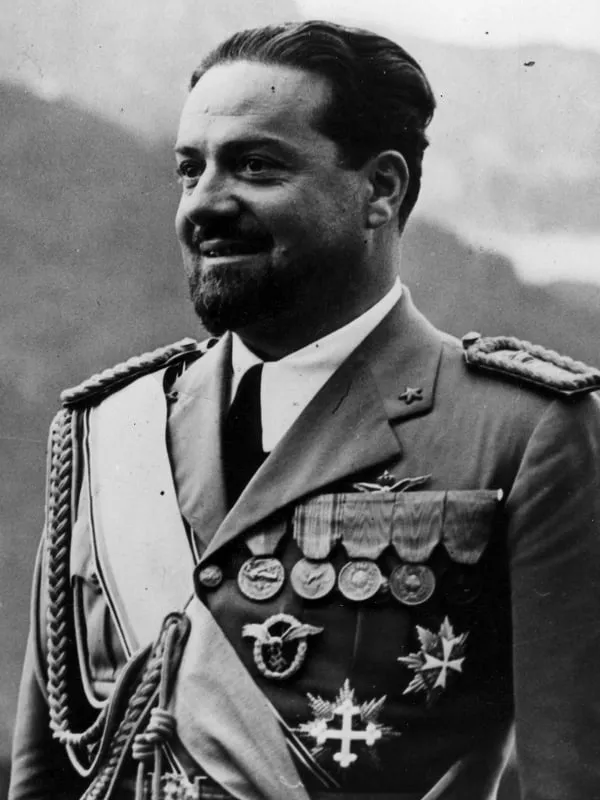
- Born:
- 6 June 1896, Quartesana near Ferrara (Kingdom of Italy)
- Died:
- 28 June 1940, Tobruk (Italian Libya)
- Author:
- Natalia
- Photo:
- autor nieznany, domena publiczna, Wikimedia Commons

Italo Balbo was the most popular and at the same time the least compliant of the leaders of Fascist Italy. In 1921–1922, as the ras of Ferrara, he led the squads that used terror to smash the socialist movement in the Po valley, and in October 1922, aged 26, he was the youngest of the four quadrumvirs of the March on Rome. He went on to build Italy’s military aviation, and his mass formation flights across the Atlantic made him a world celebrity whom Benito Mussolini came to fear. From 1934 he governed Libya, where he pursued mass Italian settlement at the expense of the local population. He opposed the alliance with Hitler and the anti-Jewish laws, but when the Duce decided to enter the war, he obeyed. Eighteen days later he was dead, shot down by Italian anti-aircraft fire over Tobruk.
Ferrara and the Great War
He was born on 6 June 1896 in Quartesana, a village outside Ferrara, the fourth of the five children of Camillo Balbo and Malvina Zuffi, both teachers. He was a poor pupil and failed to pass his school-leaving examinations. As a teenager he joined the republicans, followers of Giuseppe Mazzini, and in 1911 he ran away from home to join the expedition that Ricciotti Garibaldi was organising to help the Albanians fighting the Turks. He was stopped by the police, whom his father had alerted. In 1914, like Mussolini, whom he met at that time, he was among those who wanted Italy to go to war against Austria-Hungary.
In May 1915 he volunteered for the army, but he did not reach the front until 1917, as a second lieutenant of the Alpini. In 1918 he commanded an arditi assault unit in the “Pieve di Cadore” Alpine battalion in the fighting on the Grappa massif. For the last months of the war he received two silver medals and one bronze medal for military valour and the rank of captain. After the war he completed his education, and in November 1920 he graduated from the “Cesare Alfieri” Institute of Social Sciences in Florence with a thesis on Mazzini’s economic and social thought.
Ras of Ferrara
In the province of Ferrara, where half the working population were poor farm labourers organised in socialist leagues, class conflict was then fierce. The landowners were looking for protectors and found them in the Fascist movement. In February 1921 Balbo, a former republican with no settled occupation, took the post of secretary of the Fascist federation in Ferrara, with a salary paid by the landowners. Within a few months he had become one of the most dangerous squadristi leaders in Emilia and Romagna. His squads attacked the offices of the leagues, cooperatives and chambers of labour; they beat people, forced them to drink castor oil, and killed.
Together with Dino Grandi in Bologna, Balbo was the strongest of the local “ras”. When in the summer of 1921 Mussolini concluded a pact of pacification with the socialists, the two men led a revolt that forced him to abandon the agreement, and in November the movement turned itself into a party. In May 1922 Balbo brought tens of thousands of unemployed farm labourers into Ferrara and held the city until the prefect gave way. At the end of July he led thousands of Blackshirts to Ravenna, and then a “column of fire” that burned the offices of socialist and republican organisations in the provinces of Ravenna and Forlì.
In October 1922 Mussolini gave him one of the four seats in the quadrumvirate that was to direct the March on Rome. Alongside the party secretary Michele Bianchi, General Emilio De Bono and the monarchist Cesare Maria De Vecchi, he was the youngest and the most closely tied to the squads.
The Militia and the Minzoni affair
From January 1923 Balbo sat on the Grand Council of Fascism, and from February he was one of the commanders of the new Fascist Militia, into which the squads had been turned. On 23 August 1923 in Argenta two squadristi from his province beat to death Father Giovanni Minzoni, a Catholic social activist who had been drawing young people away from the Fascists. The investigation was closed, but in 1924, after the murder of Giacomo Matteotti, the republican daily La Voce Repubblicana published documents showing that Balbo had given orders for opponents to be beaten and had put pressure on judges. In November 1924 he had to resign his command of the Militia, and he lost the libel suit he brought against the newspaper. The reopened trial of Minzoni’s killers ended in 1925 with the acquittal of the accused, which historians regard as the result of the regime’s pressure on the court. In 1924 Balbo married Countess Emanuela Florio, with whom he had three children.
Creator of the air force
After a year at the Ministry of the National Economy, in November 1926 Balbo became Under-Secretary of State for Aviation, a ministry formally headed by Mussolini himself. He could not fly, but in 1927 he obtained a pilot’s licence. In 1928 he was made a general of the air force, and in September 1929, at the age of 33, he became Minister of Aviation. He organised the new Regia Aeronautica as an independent armed service and founded a research centre at Guidonia.
Above all, however, he made aviation the showcase of the regime. After flights by whole squadrons over the Mediterranean in 1928 and 1929, he personally led two expeditions across the Atlantic. Between 17 December 1930 and 15 January 1931 a formation of Savoia-Marchetti S.55 flying boats flew from Orbetello to Rio de Janeiro, not without accidents and loss of life. Between 1 July and 12 August 1933, to mark the tenth anniversary of the air force, 24 flying boats flew via Iceland and Labrador to Chicago, where the World’s Fair was under way, and on to New York. In Chicago a street was named Balbo Drive, New York held a parade, and President Franklin Delano Roosevelt invited Balbo to lunch and presented him with the Distinguished Flying Cross. In English the word “balbo” came to mean any large formation of aircraft. After his return, on 13 August 1933, Balbo became the first man to receive the rank of Marshal of the Air Force.
The records came at a price. Critics, including his successors, accused him of favouring spectacular flights over preparation for war and of giving inflated aircraft numbers. Mussolini himself pointed out to him that the more than 3,000 machines reported by the ministry was an exaggeration, and Balbo admitted that there were about 1,750 fully serviceable combat aircraft.
Governor of Libya
Balbo’s fame irritated Mussolini, who saw him as a possible rival, and his dislike was sharpened by the marshal’s close relations with the heir to the throne, Umberto. In November 1933 the Duce removed him from Rome by appointing him Governor of Tripolitania and Cyrenaica, which on 1 January 1934 were merged into a single colony, Italian Libya. According to contemporary accounts, the press was instructed to mention his name no more than once a month.
Balbo arrived in Tripoli on 16 January 1934, a few years after Pietro Badoglio and Rodolfo Graziani had bloodily crushed the rising in Cyrenaica. He announced a policy of reconciliation with the Arab and Berber population, built villages for them with mosques and schools, and in 1939 pushed through a measure granting some Libyans a limited “special Italian citizenship”. His main aim, however, was to make Libya Italy’s “Fourth Shore”. He built a 1,822-kilometre coastal highway from Tunisia to Egypt, named the Via Balbia. In October and November 1938 he personally led a convoy from Italy carrying some 1,800 settler families, roughly 20,000 people in all, for whom ready-made villages had been prepared. In January 1939 Libya’s four coastal provinces were formally incorporated into the territory of the Kingdom of Italy. Colonisation meant taking the most fertile land from the Libyans and reducing them to a source of cheap labour. Balbo’s rule also had a dark side for the Libyan Jews: in 1936 Jewish merchants in Tripoli who had kept their shops shut on the Sabbath, in defiance of his decree, were publicly flogged.
Against Germany and the racial laws
In Libya Balbo remained an independent voice within the regime’s leadership. From Ferrara, which had an old and well-assimilated Jewish community, he had brought friendships with Jews, among them the city’s long-serving mayor Renzo Ravenna. When Mussolini introduced the anti-Jewish laws in 1938, Balbo argued against them in conversations with the Duce, and at the meeting of the Grand Council of Fascism on 6 October 1938 he tried to soften their provisions. He never went as far as breaking with the regime, however. He publicly showed his friendship for Ravenna, who had been removed from office, but he did nothing to prevent the laws from being applied in full, including in Libya.
He was most outspoken in opposing the rapprochement with Germany. In March 1939, after Hitler’s seizure of the Czech lands, he is said to have told a meeting of the Grand Council that its members would end up as Germany’s bootblacks. In the summer of 1939, like Galeazzo Ciano, he believed that by concluding a pact with Moscow without consulting Rome Hitler had broken the Pact of Steel. On 7 December 1939, at the last meeting of the Grand Council before 1943, he supported the policy of non-belligerence, and according to some accounts even spoke of a possible rapprochement with Britain and France.
War and death
On 26 May 1940 Mussolini told Badoglio and Balbo that he had decided to enter the war. Both marshals argued that the army and the colonies were not ready. Balbo knew what he was talking about: there were fourteen divisions in Libya, more than 230,000 men in all, but they were almost entirely infantry, without lorries, with a few hundred tankettes and obsolete artillery, and the border with Tunisia was, as he wrote, “practically open”. Yet when Mussolini declared war on France and Britain on 10 June, Balbo, as Commander-in-Chief in North Africa, carried out his orders. From the very first days motorised British units from Egypt attacked the frontier posts. Balbo sent requests to Rome for tanks, motor vehicles and anti-tank guns, while at the same time, under pressure from Rome, he began to prepare an offensive against Egypt.
On 28 June 1940 he flew from Derna to Tobruk with two Savoia-Marchetti SM.79 bombers, piloting one of them himself. In the late afternoon the aircraft arrived over the airfield just as smoke was still hanging over the harbour after a raid by British Blenheim bombers. The anti-aircraft defences, which had not been warned of their arrival, opened fire. The old cruiser San Giorgio, moored in the harbour as a floating battery, fired first, followed by the guns on land. The second aircraft managed to avoid being hit; Balbo’s plane went down in flames as it came in to land. Nine people were killed, among them Balbo’s nephew Lino, his brother-in-law Cino Florio and Nello Quilici, editor of the Ferrara daily Corriere Padano. The marshal’s death was Italy’s most widely reported loss of the first weeks of the war.
Mussolini, who according to Badoglio received the news without visible emotion, paid him public tribute. He is also reported to have said that Balbo was the only man who would have been capable of killing him. Ciano wrote in his diary that Balbo “did not deserve such an end”, that he had not wanted the war and had opposed it to the last. The RAF commander in the Middle East, Arthur Longmore, had a wreath dropped over the Italian airfield with a card in which the RAF expressed its sympathy at the death of General Balbo, “a great leader and a gallant aviator”, whom he had known personally and “whom fate placed on the other side”. Balbo’s widow was convinced that her husband had been killed on orders from Rome, but historians, among them Balbo’s biographers Giorgio Rochat and Claudio Segrè, as well as Folco Quilici, the son of the journalist who died with him, have judged these rumours to be groundless: it was a tragic error by the anti-aircraft defences. Marshal Graziani succeeded Balbo in Libya.
Balbo was buried in Tripoli on 4 July 1940, with the intention of moving him to Italy after victory. He returned there only in 1970, when, after Muammar Gaddafi seized power, his family, fearing the destruction of the Italian cemeteries, brought his remains and those of his companions on his last flight to Orbetello.
Significance
Balbo is one of the most ambiguous figures of Fascism. His early death, his opposition to the alliance with Hitler and to the racial laws, and his fame as an aviator meant that after the war he was often portrayed as a “good Fascist” who might have restrained Mussolini or in 1943 taken the lead in Italy. Historians point out that in 1921–1922 it was he who directed one of the most brutal waves of violence that destroyed Italian democracy, that he bore moral and, according to some scholars, political responsibility for the murder of Father Minzoni, and that in Libya he pursued colonisation at the expense of its inhabitants. He was unable to prevent the war in 1940, and when it came, he waged it loyally.
On the road to the Second World War Balbo matters for two reasons. He helped to bring Fascism to power and built an air force that proved obsolete in 1940. He was also one of the few dignitaries who openly warned Mussolini against binding Italy’s fate to the Reich. His death over Tobruk in the first weeks of the war deprived the regime of the only leader with authority of his own, capable of standing up to the Duce, and deprived the army in Libya of an experienced commander just as Rome was beginning to prepare an offensive against Egypt. The dispute over the Chicago street that bears his name, which campaigners have sought to rename since 2017, shows how difficult it is to come to terms with his legend.
Sources
Mentioned in battles
(02)Often appears with
People who appear in the same events.