1936–1939: The Spanish Civil War
The Spanish Civil War
- Dates:
- 17 July 1936 – 1 April 1939
- Front:
- Spain
- Location:
- All of mainland Spain with the Balearic Islands, Spanish Morocco and the Canary Islands; the heaviest fighting around Madrid, in the Basque Country, Asturias, Aragon, on the Ebro and in CataloniaOn the battle map →
- Sides:
- Nationalists (aided by Germany, Italy and Portugal)Francisco Franco, Emilio Mola, José Sanjurjo, Hugo SperrleRepublicans (aided by the Soviet Union and the International Brigades)Francisco Largo Caballero, Juan Negrín, José Miaja, Vicente Rojo
- Result:
- Nationalist victory. The Second Republic fell, and General Franco ruled Spain as a dictator until his death in 1975.
- Author:
- Natalia
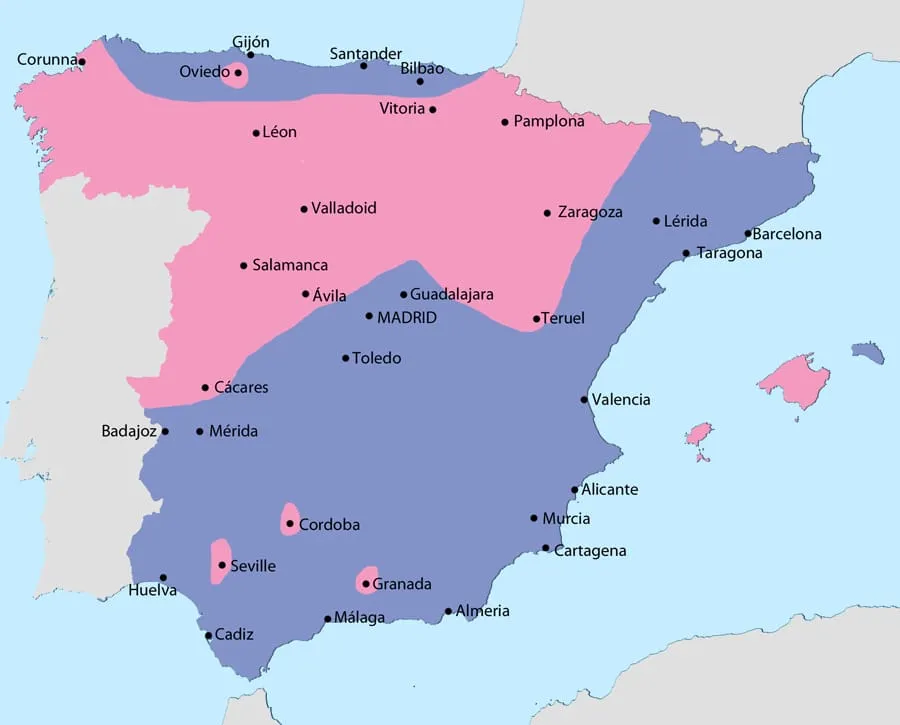
The Spanish Civil War began with a military coup against the Popular Front government in July 1936. The coup neither succeeded at once nor was it put down, and the country split into two zones. For two years and eight months the Nationalists, soon led by General Francisco Franco, fought the Republic, which was defended by socialists, communists, anarchists, liberal republicans, Basques and Catalans. From its first weeks the war ceased to be a purely Spanish affair. Germany and Italy sent the Nationalists aircraft, tanks, artillery and tens of thousands of troops. The Soviet Union sold arms to the Republic and sent it advisers, and the Comintern organised the International Brigades. Britain and France pursued a policy of non-intervention which in practice worked against the Republic. The war ended on 1 April 1939 in Franco’s complete victory, five months before the German attack on Poland. Estimates of its toll range from about 300,000 to 500,000 dead, including more than 150,000 people murdered away from the front by both sides.
Name and dates
In English the conflict is known as the Spanish Civil War; in Spain itself it is called the Guerra Civil Española. For decades the Francoists called it a “crusade” (Cruzada) or a “war of liberation”, and their own side “national” (nacionales) – hence the term “Nationalists” adopted in the literature. Their opponents they called “Reds”. The other side described itself as Republicans or Loyalists, and its enemies as rebels or fascists.
The war began on 17 July 1936, when the garrison of Melilla in Spanish Morocco rebelled in the afternoon. In Spain proper the rising broke out on 18 and 19 July, which is why Francoist tradition, and many chronicles after it, date the outbreak of the war to 18 July. Its end is taken to be 1 April 1939, the day of the last communiqué from Franco’s headquarters, which announced that “the war is over”. The fighting had stopped in the last days of March. After the war Republican guerrillas remained active in the mountains until they were finally broken up in the early 1950s.
Background
The Second Spanish Republic, proclaimed in April 1931 after the fall of the monarchy of Alfonso XIII, was a deeply divided state from the outset. The left wanted land reform in a country of great latifundia and millions of landless labourers, the separation of Church and state, a curb on the influence of the army, and autonomy for Catalonia and the Basque Country. The right, the Church, the great landowners and much of the officer corps saw these changes as an assault on traditional Spain. In 1933 the right won the election. When the Catholic party CEDA entered the government in October 1934, the left responded with a general strike and, in Asturias, an armed miners’ rising, which General Franco crushed on the government’s orders with colonial troops from Africa. The revolution of 1934 left both sides convinced that the other was ready to take up arms.
The election of 16 February 1936 was won by the Popular Front – a coalition of republicans, socialists and communists, also backed by the anarchists – by a narrow margin of votes but a clear majority of seats. Liberal republicans formed the government, and in May Manuel Azaña became president. The spring of 1936 brought a wave of strikes, land seizures by peasants, church burnings and street killings. By various counts, between about 300 and 400 people died in political violence between February and July. Falangists, Carlists and left-wing militants shot at one another, and the government was unable to restore order.
The military conspiracy was prepared from the spring by General Emilio Mola, whom the government had transferred to Pamplona. Its nominal leader was General José Sanjurjo, living in exile in Portugal, who had led a failed coup in 1932. Franco, sent by the government to the Canary Islands, hesitated for a long time. What finally decided matters was the killing of José Calvo Sotelo, leader of the monarchist right, who was shot on 13 July 1936 by a socialist from a police unit that had come to arrest him in revenge for the murder of a left-wing lieutenant of the Assault Guard. The conspirators did not plan for a long war. Mola expected the army to take control of the country within a few days and the resistance of the left to be broken by exemplary terror.
Course: the coup and the division of the country (July–September 1936)
On 17 July 1936, when the authorities uncovered the plot in Melilla, the officers rose prematurely. By the next day the rebels held the whole of Spanish Morocco, shooting officers loyal to the Republic and left-wing activists. On 18 July Franco issued a rebel manifesto in Las Palmas and flew in an aircraft chartered in England to Tetuán, where he took command of the best part of the army: the Spanish Foreign Legion and the Moroccan Regulares. On 18 and 19 July garrisons in Spain rose. General Gonzalo Queipo de Llano seized Seville in an audacious coup. Mola, supported by the Carlist requeté militias, took Navarre. Conservative Old Castile, León and Galicia quickly went over to the rebels. On 20 July Sanjurjo was killed when the aircraft that was to fly him from Portugal to Spain crashed on take-off.
In Madrid and Barcelona the coup failed. After a brief hesitation, the government agreed to distribute arms to the trade unions. In Barcelona anarchist workers of the National Confederation of Labour (CNT), together with the Civil Guard, which remained loyal to the Republic, defeated the rebel units by 20 July. On the same day in Madrid crowds and militias stormed the Montaña barracks. The Republic held the whole of the east and south-east of the country, Madrid, Catalonia, most of Aragon, Asturias, Cantabria and the Basque provinces of Biscay and Gipuzkoa. The rebels had roughly a third of the territory and about 11 of the 25 million inhabitants, but the advantage in professional troops: about half of the army in metropolitan Spain and the whole Army of Africa, some 35,000 strong. Most of the fleet, where the sailors mutinied against their officers, and most of the obsolete air force remained with the government.
The war began with mass killings on both sides. In the Nationalist zone the army, the Civil Guard and Falangist squads shot left-wing and trade union activists, teachers, freemasons, Popular Front politicians and anyone suspected of Republican sympathies. This was the White Terror, and it was largely planned: as early as his instructions of spring 1936 Mola had written of the need to terrorise the enemy. In August 1936 the poet Federico García Lorca was murdered near Granada. In the Republican zone the state lost control of the streets for several months. In Catalonia and Aragon the anarchists carried out a social revolution, collectivising land and factories, while left-wing militias and “revolutionary tribunals” killed priests, monks, landowners, right-wing activists and people deemed “fascists”. Several thousand priests, monks and nuns fell victim to this Red Terror in the first months of the war.
The rebels needed to move the Army of Africa across the Strait of Gibraltar, which was guarded by the Republican fleet. Franco turned to Rome and Berlin for help. Adolf Hitler decided to provide it on the night of 25–26 July at Bayreuth, without consulting the Foreign Ministry. Benito Mussolini sent bombers a few days later. From the end of July German Junkers Ju 52 transport aircraft, and to a lesser extent Italian ones, carried well over ten thousand armed soldiers from Morocco to Seville. It was the first airlift of such a scale in history and one of the most important foreign moves of the whole war: without it the coup might have ended in defeat.
In August columns of the Legion and the Regulares set off northwards from Seville. On 14 August they took Badajoz, where after the fighting they massacred anything from several hundred to several thousand prisoners and civilians – estimates vary widely. They linked up with Mola’s forces in the north and turned towards Madrid. In the north the Nationalists took Irun and San Sebastián in September, cutting the Republican north off from the French border. On 4 September a government under the socialist Francisco Largo Caballero was formed in Madrid with communist participation, and in November the anarchists joined it too.
Course: foreign intervention and the battle for Madrid (September 1936 – March 1937)
The war quickly became an international matter. The French prime minister Léon Blum, head of a Popular Front government, initially wanted to sell aircraft to the Republic, but under pressure from the right, the Radicals and London he proposed in August 1936 a general ban on arms deliveries to Spain. The Non-Intervention Agreement was signed by 27 states, including Germany, Italy, the Soviet Union and Portugal, and from September its observance was to be supervised by a committee in London. Germany and Italy never observed it, and from October the Soviet Union began openly breaking the ban. The embargo therefore hit above all the Republic, which, as the legitimate government, was entitled to buy arms abroad. The United States remained neutral and in January 1937 banned arms exports to Spain.
On the Nationalist side the army chose Franco as commander-in-chief on 21 September, and on 1 October 1936 in Burgos he also assumed the powers of head of state. His standing was strengthened by the decision to relieve Toledo before marching on Madrid; there, since July, cadets and Civil Guards under Colonel José Moscardó had been holding out in the Alcázar fortress. The relief on 27 September was a great propaganda victory, although it gave the defenders of the capital a few precious weeks. In October Joseph Stalin decided to help the Republic. Soviet T-26 tanks, I-15 and I-16 fighters, military advisers and NKVD officers began arriving in Spanish ports. The Republic paid for the aid in advance: some five hundred tonnes of gold from the reserves of the Bank of Spain were shipped to Moscow. The Comintern began recruiting volunteers for the International Brigades, which were formed at Albacete.
At the turn of October and November the Nationalists approached Madrid. On 6 November the government fled to Valencia, leaving the defence of the city to a Defence Council headed by General José Miaja, with Lieutenant Colonel Vicente Rojo as chief of staff. On 8 November the Nationalists attacked through the Casa de Campo, and from 15 November they fought for the University City. Militias, regular units, the first International Brigades, and Soviet tanks and fighters halted the assault by 23 November. The slogan “¡No pasarán!” (“They shall not pass!”) went round the world. In the same weeks at least two thousand political and military prisoners were taken from Madrid’s jails and murdered at Paracuellos and other places – the greatest crime committed in the Republican zone. The Nationalists and their allies bombed Madrid from the air; in November the German Condor Legion under General Hugo Sperrle entered the fighting. On 18 November 1936 Germany and Italy recognised Franco’s government.
When the frontal assault failed, Franco tried to encircle Madrid. At the Battle of Jarama in February 1937 the Nationalists sought to cut the road from Madrid to Valencia. Each side lost several thousand to well over ten thousand men, and the front barely moved. Earlier, on 8 February, the Nationalists, with heavy Italian participation, had taken Málaga. After its fall thousands were shot, and civilians fleeing along the road to Almería were shelled by warships and aircraft. In March the Italian expeditionary corps, the Corpo Truppe Volontarie under General Mario Roatta, attacked Madrid from the north. At the Battle of Guadalajara (8–23 March 1937) the motorised columns bogged down in mud and rain, and the Republicans, with the International Brigades and Soviet tanks, inflicted a heavy defeat on them. Among those fighting for the Republic were Italians of the Garibaldi Battalion, so at Guadalajara Italians fired on Italians. It was Fascist Italy’s most notorious defeat before the Second World War.
Course: the war in the north and the crisis of the Republic (March–October 1937)
After Guadalajara Franco abandoned the idea of taking Madrid quickly and turned against the isolated Republican strip in the north. On 31 March 1937 Mola’s offensive against Biscay began. On the same day Nationalist aircraft bombed the small town of Durango. On 26 April aircraft of the Condor Legion and the Italian Aviazione Legionaria bombed the Basque town of Guernica, killing, according to modern research, between about 150 and 300 people (the Basque government at the time gave a figure of 1,654 dead). The report by the British journalist George Steer and the painting by Pablo Picasso made the bombing of Guernica a symbol of air war against civilians. On 3 June Mola was killed in an air crash. On 19 June the Nationalists entered Bilbao.
In the Nationalist zone Franco concentrated all power in his own hands. By a decree of 19 April 1937 he merged the Falange and the Carlists into a single state party, with himself as its leader. On the Republican side, by contrast, an internal conflict broke out in the spring. During the May Days in Barcelona (3–8 May 1937) communists and government forces fought the anarchists and the anti-Stalinist Workers’ Party of Marxist Unification (POUM), in whose militia George Orwell had served. Several hundred people were killed. Largo Caballero was forced to step down, and on 17 May the socialist Juan Negrín, an advocate of a centralised state and a regular army who worked with the communists, became prime minister. The POUM was outlawed, and its leader Andreu Nin was abducted and murdered by NKVD agents.
The Republic tried to relieve the north with offensives in the centre and in Aragon. At the Battle of Brunete (6–25 July 1937), west of Madrid, Republican forces were halted after an initial success and thrown back. They lost some 25,000 men and many of their best units, and the Condor Legion for the first time won clear air superiority, thanks among other things to the new Messerschmitt Bf 109 fighters. At the end of August an offensive towards Zaragoza ended with the capture of the small town of Belchite, with no strategic effect. Meanwhile the Nationalists and the Italians took Santander (26 August), and on 21 October, after the fall of Gijón, the whole of the north was in their hands. Franco gained the industry of Biscay, the mines of Asturias and freedom to redeploy his troops. In the autumn the Republican government moved from Valencia to Barcelona.
Course: Teruel, Aragon and the Ebro (December 1937 – November 1938)
On 15 December 1937 the Republic attacked the Aragonese town of Teruel to forestall another offensive against Madrid. In one of the harshest winters of the century, with temperatures falling to well below –10 °C, the Republicans took the town on 8 January 1938. It was the only time in the war that they captured a provincial capital. Franco, however, threw his main forces and air power against Teruel and retook it on 22 February 1938. On 7 March the Nationalists launched an offensive in Aragon. The Republican front collapsed, and on 15 April Nationalist troops reached the Mediterranean near Vinaròs, cutting the Republic’s territory in two: Catalonia, and the central-southern zone with Madrid and Valencia. Negrín announced his “Thirteen Points”, a programme for peace without reprisals, but Franco demanded unconditional surrender. In the summer the Nationalists advanced on Valencia but were stopped on a fortified line in the mountains.
On 25 July 1938 the Republican Army of the Ebro crossed the Ebro and advanced towards Gandesa. The offensive was meant to restore the link between the two parts of the Republic and to convince the West that the Republic could still fight. The Battle of the Ebro, the longest and largest battle of the war, turned into a gruelling struggle for every hill under Nationalist artillery and air bombardment. It lasted until 16 November, when the last Republicans withdrew across the river. In it the Republic lost what remained of its experienced troops and equipment. Midway through the battle came the decision that sealed its fate politically: in September 1938 at Munich Neville Chamberlain, France, Hitler and Mussolini agreed to hand the Sudetenland to Germany without a fight. For Negrín, who had hoped that a war in Europe would force Britain and France to come to his aid, this was a disaster. On 21 September he announced at the League of Nations the withdrawal of the volunteers of the International Brigades, hoping that Germany and Italy would withdraw their troops. The Brigades were given a farewell parade in Barcelona at the end of October 1938, but the German and Italian soldiers stayed.
Course: the fall of Catalonia and the end of the war (December 1938 – April 1939)
On 23 December 1938 the Nationalists began the Catalonia Offensive. The exhausted Republican army could not stop it. Tarragona fell on 15 January, and on 26 January 1939 the Nationalists entered Barcelona without a fight. Nearly half a million soldiers and civilians set off for the French border. This exodus, known as la Retirada, ended in internment camps on the beaches of southern France and at Gurs. On 27 February Britain and France recognised Franco’s government, and President Azaña, already in France, resigned.
The Republic still held the central-southern zone with Madrid and Valencia, and some half a million soldiers. Negrín wanted to fight on, counting on the outbreak of war in Europe. On 5 March 1939 in Madrid Colonel Segismundo Casado, backed by some of the socialists and anarchists, overthrew his government and set up a National Defence Council, hoping for an “honourable peace”. Negrín and the communist leaders flew out of the country, and for several days Republican units fought one another in Madrid. Franco refused any terms. On 26 March the Nationalists launched their final offensive; on 28 March they entered Madrid, and within a few days they occupied Valencia, Alicante and the rest of the country. Thousands of Republicans waited in the port of Alicante for ships that never came. On 1 April 1939 Franco announced in his last war communiqué that the “Red” army had been disarmed and captured and that the war was over. On the same day the United States recognised Franco’s government.
Foreign aid
Foreign aid mattered in this war as much as Spain’s own forces. Italy was the most heavily involved: according to Italian figures some 75,000 Italian soldiers and airmen served in Spain at one time or another, and Italy sent more than 700 aircraft, artillery, tanks and submarines, which sank ships bound for Republican ports. Germany sent the Condor Legion, 5,000–6,000 strong at any one time and rotated every few months so that as many airmen as possible would gain combat experience. By various estimates 16,000–19,000 Germans passed through Spain, and the Legion lost some three hundred men. German instructors also trained Spanish officers and tank crews. Hitler exploited the war economically: arms deliveries were paid for in part with Spanish iron ore and pyrites. The Portugal of António de Oliveira Salazar served as a rear base for the Nationalists and allowed several thousand volunteers to be recruited.
The Soviet Union was the only great power to supply the Republic with arms in large quantities: according to various sources, between 630 and over 800 aircraft, about 350 tanks and more than a thousand guns. Some two to three thousand Soviet advisers, pilots and tank crews served in Spain, among them future marshals and generals of the Red Army. The aid came at a price: the gold of the Bank of Spain, the growing influence of the communists in the army and the state, and the activity of the NKVD, which hunted down Trotskyists and anarchists. The Republic also bought arms in Mexico, which openly supported it, and quietly, through front companies, in Poland too – mostly obsolete and expensive equipment. Until 1938 France opened the border from time to time for smuggled arms.
The International Brigades brought together some 32,000–35,000 volunteers in all from more than fifty countries, most of them from France, Germany and Austria, Italy and Poland. Many were communists; many were anti-fascists who saw Spain as the first front in the fight against Hitler and Mussolini. Estimates of the number of Poles who fought range from three to more than five thousand, most of them émigré workers from France and Belgium. They served mainly in the Jarosław Dąbrowski Battalion and later the XIII Jarosław Dąbrowski Brigade, hence the name “Dąbrowszczacy”. The Polish government regarded their service as illegal and stripped them of their citizenship. One of the Republican commanders was the communist Karol Świerczewski, known as General “Walter”. On Franco’s side several hundred volunteers from Ireland and other countries fought.
Losses
The death toll of the war remains disputed, and historians count different categories of the dead. The figure of “a million dead”, once the most often quoted, is greatly exaggerated. Demographers put excess mortality in 1936–1939 at about 350,000, and in 1936–1942, including post-war terror, hunger and disease, at about 540,000. By various estimates between about 100,000 and 200,000 soldiers were killed at the front. Air raids killed some 10,000–15,000 civilians, most of them in Barcelona, Madrid and the coastal cities, and the air forces of the Nationalists and their allies were far more effective than the Republican one.
The most terrible chapter of the war was the killing behind the lines. Historians, among them Paul Preston, estimate that the Nationalists killed at least a hundred thousand people during the war, and that another twenty to fifty thousand were executed after it – the estimates depend on who is counted. In the Republican zone, according to most studies, between about 38,000 and 50,000 people were murdered, including nearly seven thousand Catholic clergy, monks and nuns, most of them in the first months of the war. The difference lay not only in scale: in the Nationalist zone terror was part of the policy of the new state and continued long after the war, whereas in the Republican zone it was largely the work of militias which the government in time tried to rein in. After Franco’s victory hundreds of thousands of people ended up in prisons and labour camps, and some half a million Spaniards went into exile.
Significance
To contemporaries the Spanish Civil War was a prelude to, and a dress rehearsal for, a great war in Europe. For Germany it was a testing ground. The Luftwaffe, which Hitler had unveiled only in March 1935, tried out in Spain the Bf 109 fighter, the He 111 bomber and the Ju 87 dive-bomber, and learned close support of ground forces, communication with the front and operations against airfields. Wolfram von Richthofen, chief of staff and later commander of the Condor Legion, drew on this experience when he led the close-support aviation in Poland in September 1939. Fighter pilots, among them Werner Mölders, developed in Spain the loose formation of pairs and fours that became the Luftwaffe standard. Guernica showed what air war against cities could be, before Warsaw, Rotterdam and Coventry experienced it. The Soviet Union drew partly mistaken lessons from Spain: it broke up its independent armoured formations, a mistake that cost it dearly in 1941, and many of the Red Army’s “Spaniards” fell victim to the Great Purge.
The war drew Hitler and Mussolini together. Italy, which had just attacked Ethiopia, tied up troops and money in Spain, and the joint intervention led to the creation of the Rome–Berlin Axis in November 1936. It also diverted Europe’s attention from Germany: a few months after the remilitarisation of the Rhineland, the Western powers were arguing about Spain in the Non-Intervention Committee while Hitler went on rearming. Non-intervention was an early form of the appeasement of the dictators that led to Munich. Stalin, who saw that London and Paris preferred not to provoke Hitler, lost faith in collective security, which in August 1939 pushed him towards a pact with Germany.
Franco owed his victory largely to Germany and Italy, but he did not draw Spain into the Second World War. The devastated country was not ready to fight, and Hitler was unwilling to meet his colonial demands. Spain, which had joined the Anti-Comintern Pact on 27 March 1939, declared neutrality, changed it in 1940 to “non-belligerence”, and after Franco’s meeting with Hitler at Hendaye in October 1940 stayed out of the war. It did, however, send the volunteer Blue Division to the Eastern Front. For the defeated the war did not end: after 1940 thousands of Republican refugees from the camps in France ended up in German concentration camps, above all Mauthausen, where several thousand of them died, while others fought in the French Resistance and the Free French Forces. The dictatorship of Francoism lasted until Franco’s death in 1975, and the dispute over the memory of the war and the victims of the terror divides Spaniards to this day.