1940–1943: The war in the Mediterranean
Battle of Cape Matapan
- Dates:
- 27–29 March 1941
- Front:
- Mediterranean
- Location:
- The eastern Mediterranean between Sicily, Crete and the Peloponnese: the waters south of Crete near the islet of Gavdos (daytime action of 28 March) and the sea some 50–60 nautical miles south-west of Cape Matapan (night action of 28–29 March)On the battle map →
- Sides:
- United Kingdom and AustraliaAndrew Cunningham, Henry Pridham-WippellItalyAngelo Iachino, Carlo Cattaneo
- Result:
- British victory. The Italians lost the heavy cruisers Zara, Fiume and Pola and the destroyers Vittorio Alfieri and Giosuè Carducci, and the battleship Vittorio Veneto was damaged by a torpedo. Depending on the tally, between about 2,300 and 2,400 Italian sailors were killed, among them Admiral Carlo Cattaneo. The British lost one torpedo bomber and its three-man crew.
- Author:
- Natalia
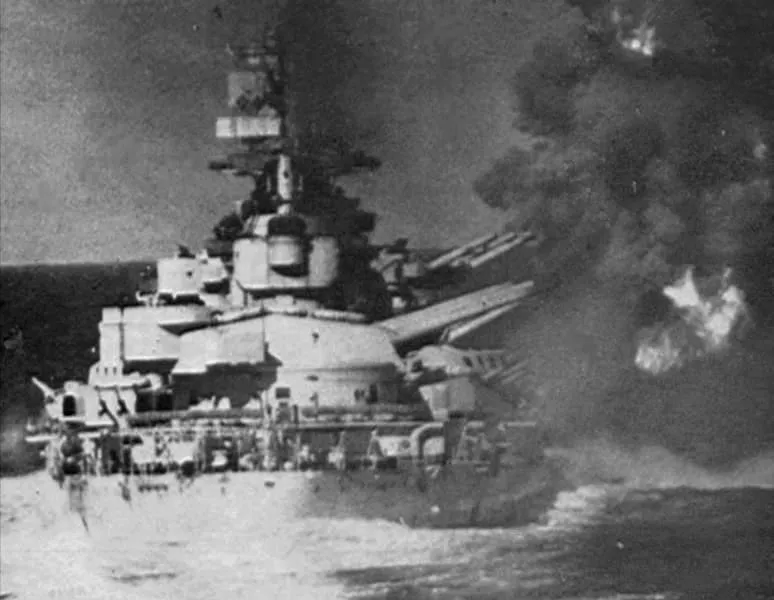
The Battle of Cape Matapan was the largest naval battle fought in the Mediterranean during the Second World War and the Italian navy’s heaviest defeat at sea. At the end of March 1941, under German pressure, the Italian fleet under Admiral Angelo Iachino put to sea to strike at the British convoys carrying troops to Greece. The British knew its intentions from decrypted signals, and Admiral Andrew Cunningham led three battleships and an aircraft carrier out of Alexandria. On the morning of 28 March, near the islet of Gavdos south of Crete, Italian cruisers and the battleship Vittorio Veneto fired on British light cruisers without hitting them. In the afternoon torpedo bombers from the carrier Formidable damaged the Vittorio Veneto, and at dusk they disabled the heavy cruiser Pola. That evening Iachino sent two other heavy cruisers and four destroyers back to help the Pola. He did not know that the British battleships were close behind him. On the night of 28–29 March Cunningham’s ships, guided by radar, closed to less than four kilometres of the Italians and within a few minutes turned the Zara and the Fiume into burning wrecks. By morning three Italian heavy cruisers and two destroyers had gone down, and some 2,300 Italian sailors had been killed. The British lost one aircraft.
Name and dates
The battle takes its name from Cape Matapan, today called Tainaron, the southernmost headland of the Peloponnese. The decisive night action was fought some 50–60 nautical miles south-west of it. The Italians call the whole battle the Battle of Cape Matapan, but its daytime phase, fought on 28 March south of Crete, they call the action off Gaudo, from the Italian name of the islet of Gavdos. In Greek literature it is known as the Battle of Tainaron.
The Royal Navy and most studies date the battle to 27–29 March 1941. On the afternoon of 27 March a British flying boat spotted Italian cruisers in the Ionian Sea, and that evening Cunningham’s fleet left Alexandria. On 28 March there was a day-long engagement of ships and aircraft, ending in a night action that began at about 10.27 p.m. The last Italian ships, the cruisers Zara and Pola, went down between 2.40 and 4.10 a.m. on 29 March. That same day the British broke off the rescue of survivors and sailed for Alexandria. Some Italian authors restrict the battle to 28 and 29 March, treating the sailing of the ships on 26 and 27 March as preparation. The times given are approximate: the British and the Italians kept their logs in different time zones, and accounts often differ by a quarter of an hour or so.
Background
A fleet that avoided battle
From Italy’s entry into the war in June 1940, the Regia Marina, the Italian navy, had on paper an advantage over the British Mediterranean Fleet. Its high command, Supermarina in Rome, nevertheless husbanded its battleships, which Italy could not replace, and avoided a decisive battle. The first encounters confirmed this pattern. Off Punta Stilo (the Battle of Calabria) on 9 July 1940 Admiral Campioni’s fleet withdrew after the battleship Giulio Cesare was hit, and off Cape Spada ten days later the Australian cruiser Sydney sank the Bartolomeo Colleoni. On the night of 11–12 November 1940 aircraft from the carrier Illustrious torpedoed three Italian battleships at Taranto. For the following months only one modern battleship, the Vittorio Veneto, and two old ships were able to put to sea.
In December 1940 Admiral Angelo Iachino succeeded Campioni in command of the fleet. The first major operation under his command ended in another humiliation: on 9 February 1941 the British Force H bombarded Genoa, and the Italian ships that sailed to meet it failed to find it. Meanwhile the Germans were becoming ever more deeply involved in the Mediterranean. In January 1941 the German X Air Corps (X. Fliegerkorps) arrived in Sicily; on 10 January it badly damaged the carrier Illustrious, and from February it bombed Malta. In February Erwin Rommel arrived in Tripoli with the first units of the Afrika Korps.
German pressure and the Greek convoys
In the spring of 1941 Hitler was preparing to attack Greece in order to drive the British out of the Balkans and rescue the Italians, who since the autumn of 1940 had been losing the war in Albania. Bulgaria joined the Tripartite Pact on 1 March, and the German 12th Army crossed the Danube. Britain decided to send an expeditionary force to help the Greeks. From the beginning of March convoys from Alexandria carried British, Australian and New Zealand troops to Piraeus as part of Operation Lustre, and on 7 March the first of them landed in Greece. By April some 58,000 troops had been transported in this way. The convoys sailed every few days, south of Crete or through the Aegean, and were easy targets for fast surface ships.
The Germans demanded that the Italian fleet strike at this shipping. At a conference in Merano on 13 and 14 February 1941 the commander-in-chief of the German navy, Grand Admiral Erich Raeder, reproached the Italian naval chief of staff, Admiral Arturo Riccardi, for passivity. The Italians attributed it mainly to a shortage of fuel. In March the German command passed to Rome an assessment according to which, after the attacks of X Air Corps, Cunningham had only one serviceable battleship and no aircraft carrier. This was untrue: the Illustrious, sent away for repairs, had been replaced by the new carrier Formidable, which reached Alexandria in March, and all three of the fleet’s battleships were serviceable. Supermarina, wanting to show its ally its will to fight, prepared a sortie against the convoys.
The Italian plan
The plan provided for simultaneous raids north and south of Crete. The ships were to attack any convoys they met, together with their escorts, if they had the advantage, and then return quickly to base. Supermarina committed almost all its serviceable ships: the battleship Vittorio Veneto, six heavy cruisers, two light cruisers and thirteen destroyers. Success depended on surprise and on air cover, which had been promised by the Germans of X Air Corps in Sicily and by Italian aircraft from Italy and Rhodes. The Germans were also to fly reconnaissance over Alexandria. To ease co-operation, German liaison officers were embarked in the flagship, together with an Italian radio intercept team that was to read British signals. The chief of staff, Riccardi, is said to have typed the operational orders himself for the sake of secrecy.
Bletchley Park reads the Italian signals
The surprise on which the plan rested did not exist. At the British codebreaking centre at Bletchley Park, Dilly Knox’s team had since the autumn of 1940 been reading some of the Italian navy’s signals enciphered on a version of the Enigma machine. Towards the end of March a young codebreaker, Mavis Lever (known after the war as Mavis Batey), decrypted a puzzling message: “Today’s the day minus three.” Further signals, including decrypted German air force messages about air cover, revealed the target and timing of the operation. By 25 March Cunningham knew that the Italian fleet would put to sea against the convoys south of Crete. He held back a convoy due to leave Piraeus, ordered a convoy bound for Greece to turn back and prepared the fleet to sail.
The British had to conceal the source of their knowledge, later known by the code name Ultra. On 27 March, therefore, a Sunderland flying boat was sent from Malta to the area where the Italian fleet was expected, so that it could find it “by chance”. Cunningham himself, knowing that the Japanese consul was watching ship movements in Alexandria, went ostentatiously ashore on the afternoon of 27 March with a suitcase and golf clubs, as if he meant to spend the night in town, and a reception aboard the flagship was announced for the evening. After dark the admiral returned unseen to the battleship Warspite, and the fleet put to sea.
Opposing forces
The Italians. Admiral Iachino flew his flag in the battleship Vittorio Veneto, commissioned in 1940: nine 381 mm guns and a speed of up to 30 knots. She was screened by four destroyers of the 13th Flotilla. Three cruiser groups were commanded by divisional admirals (ammiraglio di divisione, a rank corresponding to vice admiral): Luigi Sansonetti (3rd Division: the heavy cruisers Trento, Trieste and Bolzano with three destroyers), Carlo Cattaneo (1st Division: the heavy cruisers Zara, Fiume and Pola with four destroyers of the 9th Flotilla) and Antonio Legnani (8th Division: the light cruisers Duca degli Abruzzi and Giuseppe Garibaldi with two destroyers). The ships of the 1st Division, of the Zara class, were the best-armoured Italian cruisers and each carried eight 203 mm guns. No Italian ship had radar, and the Italian fleet was not trained for night fighting: its regulations assumed that heavy ships would avoid action in darkness, and the main guns were kept in the cruising position.
The British. Cunningham sailed from Alexandria with three old, reconstructed battleships of the Queen Elizabeth class: the Warspite, the Barham and the Valiant, each with eight 381 mm (15-inch) guns. They were slower than the Italians: the Warspite, whose condenser had become clogged with silt as she left harbour, could make only a little over 20 knots. With them sailed the carrier Formidable, carrying Fairey Albacore and Swordfish torpedo bombers and Fulmar fighters, and nine destroyers, including the Australian HMAS Stuart. From Greek waters came Force B under Vice Admiral Henry Pridham-Wippell, Cunningham’s second-in-command: the light cruisers Orion, Ajax, Gloucester and the Australian Perth, with three destroyers. The cruisers Orion and Ajax and the battleship Valiant had radar. British ships had trained for night fighting for years, and they had low-flash propellant charges and powerful searchlights. Support came from RAF aircraft based in Greece and from Swordfish flying from Maleme airfield on Crete.
Two convoys were also at sea: AG 9 from Alexandria to Greece and GA 8 from Greece to Alexandria, escorted by anti-aircraft cruisers and destroyers. Cunningham kept them well away from the area where he expected the Italians.
Course of the battle
26–27 March: putting to sea
The Vittorio Veneto left Naples on the evening of 26 March. During the night the ships from Naples, Messina, Taranto and Brindisi joined up in the Ionian Sea east of Sicily. That same night Italian explosive motor boats of the X MAS Flotilla attacked Suda Bay on Crete and disabled the British heavy cruiser York, but this success had no connection with the fleet operation. At about noon on 27 March the cruiser Trieste sighted a British Sunderland flying boat, and the intercept team aboard the flagship picked up its report of three cruisers and a destroyer east of Sicily. Surprise was lost, but the airman had seen only part of the fleet and misjudged its course. Supermarina therefore confirmed the operation, changing it in only one respect: it cancelled the raid north of Crete and ordered the whole fleet to concentrate near Gavdos on the morning of 28 March. The promised German reconnaissance over Alexandria was not flown because of the weather, and the promised fighter cover never appeared over the ships.
On the evening of 27 March, at about 7 p.m., Cunningham’s main force left Alexandria, and Pridham-Wippell’s force left Greek waters. The two admirals were to meet the next morning south of Gavdos – exactly where the Italians were heading.
The morning of 28 March: the action off Gavdos
At dawn on 28 March an IMAM Ro.43 reconnaissance seaplane was launched from the Vittorio Veneto, and at about 6.35 a.m. it spotted Pridham-Wippell’s four British cruisers. At almost the same time aircraft from the Formidable sighted Sansonetti’s cruisers, but their reports were contradictory, and for some time the British did not know how many ships, or of what kind, lay ahead of them.
At 8.12 a.m. the Trento, Trieste and Bolzano opened fire at a range of about 22–24 kilometres. Their 203 mm guns outranged the British 152 mm guns. Pridham-Wippell, in accordance with his orders, turned away to the south-east to draw the Italians on to the guns of Cunningham’s battleships. Over more than 40 minutes Sansonetti’s cruisers fired more than five hundred shells, but did not score a single hit. The Gloucester replied with a few salvoes, which fell short. At 8.55 a.m., with the range not closing, Iachino, suspecting a trap, ordered Sansonetti to break off the chase and turn to the north-west. Now the British followed the Italians, keeping out of range of their guns.
Iachino tried to turn the pursuit to his advantage. At about 10.30 a.m. he steered the Vittorio Veneto so that the British cruisers would be caught between the battleship and Sansonetti’s cruisers. At 10.56 a.m. the Vittorio Veneto opened fire at a range of about 23 kilometres. Only then did the British realise that they were facing a battleship: she had been sighted earlier from the bridge of the Orion but taken for a friendly ship. Pridham-Wippell laid a smokescreen and made off to the south under a hail of 381 mm shells. In about 20 minutes the Vittorio Veneto fired 94 rounds. The salvoes fell close, and the Orion was slightly damaged by splinters, but not a single shell hit its target.
The British cruisers were saved by aircraft. Cunningham, still several dozen miles away, launched six Albacores from the Formidable. At about 11.15 a.m. they attacked the Vittorio Veneto. The battleship evaded every torpedo, but had to turn sharply and cease fire. The escorting Fulmars also shot down one of the two German Ju 88s, the only aircraft that appeared over the Italian fleet that day. Iachino concluded that without fighter cover, and within range of British carrier aircraft and of aircraft from Greece, he could not continue. At 11.40 a.m. he ordered the whole fleet to turn about and make for base at full speed. He did not realise that the British battleships were less than a hundred miles behind him.
The afternoon of 28 March: a torpedo in the Vittorio Veneto
The faster Italians were drawing away, and Cunningham could catch them only if aircraft reduced the Italian battleship’s speed. In the afternoon a series of attacks fell on the Italian fleet. RAF Blenheim bombers from airfields in Greece bombed the cruisers from high altitude without hitting any ship, but they distracted the Italian anti-aircraft defences. At about 3.20 p.m. three Albacores and two Swordfish from the Formidable came in over the Vittorio Veneto, covered by two Fulmars that strafed the battleship’s deck. The leader of the strike, Lieutenant Commander John Dalyell-Stead, dropped his torpedo from less than a kilometre, almost dead ahead of the bow. A moment later his aircraft was shot down by anti-aircraft fire, and its whole three-man crew was killed. This was the only British loss of the entire battle.
The torpedo struck the Vittorio Veneto on the port side aft, abreast the outer propeller. The battleship took in about 4,000 tons of water, listed and stopped for a few minutes. Her crew managed to restart the engines and to steer by hand with the damaged rudder. From 4.42 p.m. the ship was under way again, at first at 15 and then at 19 knots. From then on Iachino’s overriding aim was to bring the battleship home. He formed the fleet into five parallel columns: the Vittorio Veneto with her destroyers in the centre, Sansonetti’s and Cattaneo’s heavy cruisers on either side, and their destroyers on the outside. He sent Legnani’s light cruisers away to the north.
Iachino could have recognised the danger earlier. Even before this attack, at about 2.25 p.m., the Italian flagship had intercepted a report from Rhodes of a British battleship, carrier and cruisers some 80 miles from the Italian fleet. It came from two Italian SM.79 torpedo bombers that had made an unsuccessful attack on the Formidable. A radio direction-finding fix passed on earlier by Supermarina, however, placed the British much further away, and Iachino concluded that the airman had mistaken Italian ships for the enemy. The officer in charge of radio intercept aboard the Vittorio Veneto warned that analysis of the radio traffic showed the whole British fleet to be nearby, but the admiral, as this officer recalled, heard him out without comment. Iachino was convinced that Cunningham had at most one battleship and was far away.
At about 6.20 p.m. the observer of the Warspite’s seaplane, Lieutenant Commander Bolt, gave a precise description of the Italian formation and confirmed that the battleship was moving slowly. Cunningham decided to pursue the enemy after dark as well. At dusk, around 7.30 p.m., six Albacores and two Swordfish from the Formidable and two Swordfish from Maleme attacked the Italian fleet. The Italians responded with smokescreens, searchlights and dense anti-aircraft fire, and the battleship suffered no further damage. At about 7.50 p.m., however, a torpedo hit the cruiser Pola, which had slowed down to avoid running into the Fiume ahead of her and was unable to take evasive action. It is not known for certain who dropped it: some British studies credit Lieutenant Grainger Williams of the Formidable, while Italian ones tend to credit the Swordfish of Lieutenant Michael Torrens-Spence from Crete. The explosion flooded the boiler rooms and engine room, killed stokers and engineers and cut off the ship’s power. The Pola lay stopped in the darkness, and her gun turrets could not be trained.
The decision of Iachino and Cattaneo
News of the damage to the Pola reached Iachino only at about 8.10 p.m. Admiral Cattaneo proposed sending two destroyers to her, but the two admirals’ signals crossed, and Iachino, convinced that destroyers could only take off the crew and scuttle the cruiser, ordered the whole 1st Division to turn back. At about 9 p.m. the Zara and the Fiume, with the destroyers Vittorio Alfieri, Giosuè Carducci, Alfredo Oriani and Vincenzo Gioberti, turned east to take the Pola in tow. Iachino ordered only that the Pola be abandoned if superior enemy forces appeared. Neither he nor Cattaneo knew that the British battleships were some 50 miles to the east and closing. The column was steaming in line ahead, with the destroyers astern instead of ahead, and the cruisers’ guns were not ready to fire. Iachino’s decision to send the cruisers remains controversial in Italy to this day.
Meanwhile Cunningham had sent Pridham-Wippell’s cruisers ahead, followed by Captain Philip Mack’s eight destroyers, which were to find and attack the Vittorio Veneto. At about 8.15 p.m. the radar of the Ajax and the Orion detected a stationary ship a few miles to port of their course. Pridham-Wippell passed its position to Cunningham but carried on in search of the battleship. At about 10 p.m. his radars detected further ships, which he took for Mack’s destroyers. They were Cattaneo’s cruisers. Neither the cruisers nor Mack’s destroyers ever found Iachino’s main force, which had altered course and steamed away to the west.
The night of 28–29 March: a few minutes of fire
Shortly after 10 p.m. the radar of the battleship Valiant detected the stationary Pola, which the British still believed to be the damaged battleship. Cunningham trained the guns of all three battleships on her. Then his chief of staff, Commodore Edelsten, looking through his binoculars, saw two large ships on the other side steaming on an opposite course, which a staff officer identified as Zara-class cruisers. The battleships turned towards them and took up a position parallel to the Italian column. The Italians, who could not see them, steamed on towards the Pola.
At about 10.27 p.m. the destroyer Greyhound illuminated the Fiume with her searchlight, and the battleships opened fire at a range of 2.6 to 3.5 kilometres – in naval gunnery terms, almost point-blank. Among those directing the Valiant’s searchlights was a nineteen-year-old midshipman, Prince Philip of Greece and Denmark, the future husband of Queen Elizabeth II. In three or four minutes the Warspite, Valiant and Barham fired more than a dozen salvoes into the Zara and several into the Fiume. The 381 mm shells tore apart turrets and superstructures, and both cruisers burst into flames without firing a single shot.
The Italian destroyers turned, trying to lay a smokescreen and make a torpedo attack. Cunningham, fearing torpedoes, drew the battleships away and left the destroyers to finish off the wrecks. The Alfieri, in which the flotilla commander, Captain Salvatore Toscano, was killed, and the Carducci were sunk before midnight by gunfire and torpedoes from the destroyers Stuart and Havock. The Oriani and the Gioberti escaped under cover of darkness and smoke, one of them damaged. The Fiume capsized and sank at about 11.15–11.30 p.m. The Zara burned for several more hours. At about 2.40 a.m. on 29 March she sank after an explosion caused, according to British accounts, by torpedoes from the destroyer Jervis and, according to Italian accounts, by charges set by her own crew. Admiral Cattaneo survived the sinking of his flagship but died in the sea.
At about 3 a.m. the Jervis came alongside the stationary Pola. Some of her crew had jumped into the water earlier and then, chilled to the bone, climbed back on board. The British found chaos aboard, which they took for a collapse of discipline. They took off about 250 men, including the captain, Captain Manlio De Pisa. Towing the cruiser to Alexandria as a prize was judged too dangerous within range of Axis aircraft, so at about 4 a.m. the Pola was sunk by torpedoes from the destroyers Jervis and Nubian.
Iachino saw the flashes of the night battle from about 40 miles away, but received no answer to his calls to Cattaneo. The damaged Vittorio Veneto reached Taranto on 29 March. Mack’s destroyers, which searched for her until late at night, made no contact and only after 2 a.m., on their way back, came upon the wrecks of the Zara and the Pola.
29 March: the survivors
At dawn the sea in the area of the night action was full of survivors, wrecked boats and bodies. British destroyers and cruisers picked up about 900 Italians, and together with the men taken off the Pola, depending on the tally, they took between about 1,000 and 1,160 sailors prisoner. Before noon on 29 March a German reconnaissance aircraft appeared over the force, and Cunningham, unwilling to expose his ships to air attack, broke off the rescue. As he steamed away he sent a signal in plain language to the Italian naval chief of staff, Admiral Riccardi, giving the position of the men still in the water and offering to let a hospital ship come. Riccardi thanked him and sent the hospital ship Gradisca, which reached the scene only on 31 March. She found mostly dead sailors in life jackets. She rescued 160 men, 13 officers and 147 ratings. Cunningham’s fleet, which according to British accounts was attacked unsuccessfully by German bombers on the way home, returned to Alexandria on 30 March.
Losses
The Italians lost the heavy cruisers Zara, Fiume and Pola and the destroyers Vittorio Alfieri and Giosuè Carducci. The battleship Vittorio Veneto was damaged, as was one of the two destroyers that escaped from the night action. The number of dead varies with the source. English-language studies most often give 2,303 killed, and the Italian navy’s own tally 2,331: 782 from the Zara, 813 from the Fiume, 328 from the Pola, 211 from the Alfieri, 169 from the Carducci and 28 from other ships. Some studies round the figure up to about 2,400. Among the dead were Admiral Cattaneo; the captains of the Zara and the Fiume, Captains Luigi Corsi and Giorgio Giorgis; and the commander of the 9th Flotilla, Salvatore Toscano. About a thousand Italian survivors, including the captain of the Pola, were taken prisoner by the British.
The British lost one Albacore torpedo bomber with Lieutenant Commander Dalyell-Stead’s three-man crew. Pridham-Wippell’s cruisers suffered minor damage from splinters of shells that fell close by. There were no direct hits.
Significance
Matapan was the Royal Navy’s greatest victory in the Mediterranean and the Italian fleet’s worst defeat of the whole war. In a single night the Italian navy lost an entire division of its best heavy cruisers. In the whole war the British lost four heavy cruisers; the Regia Marina lost three in one night. The American historian Vincent O’Hara called the battle “Italy’s greatest defeat at sea”, but stressed that it was not decisive. The Vittorio Veneto returned to service after a few months of repairs, and the Italian fleet continued to escort convoys to Libya.
The battle laid bare the weaknesses of the Italian navy: the lack of radar, unpreparedness for night fighting, the absence of aircraft carriers and poor co-operation with the air force. Iachino wrote after the war that the battle had curtailed the Italian fleet’s operations for a time not because of a moral shock, as the British believed, but because it had revealed Italian inferiority in co-operation between the fleet and the air force and the backwardness of Italian night-fighting technique. Benito Mussolini, who before the war had opposed the building of aircraft carriers, later agreed to the conversion of the liner Roma into the carrier Aquila, which never entered service, and forbade the fleet to operate beyond the range of its own fighter cover. Iachino remained in command of the fleet until 1943. Because the British kept the role of Bletchley Park secret for three decades, rumours of treachery in Supermarina long circulated in Italy. A few weeks after the battle Cunningham visited Bletchley Park to thank Knox’s team.
The strategic consequences mattered most. Knowing that the Italian fleet could venture so far east, the British had to keep their battleships at readiness. But after Matapan Italian surface ships did not appear again in the eastern Mediterranean, either when the Germans were occupying Greece in April 1941 or when, at the end of April and the end of May, the Royal Navy evacuated tens of thousands of troops from Greece and Crete. British ships suffered heavy losses at that time, but from aircraft, not from Italian surface ships. The convoys to Greece kept sailing, although as early as 31 March an Italian submarine sank the cruiser Bonaventure, which was escorting convoy GA 8.