1940–1943: The war in the Mediterranean
Operation Pedestal
- Dates:
- 10–15 August 1942
- Front:
- Mediterranean
- Location:
- The western and central Mediterranean: from the Strait of Gibraltar through the waters south of the Balearic Islands and Sardinia, the Skerki Bank, the Sicilian Narrows and the area off Cape Bon in Tunisia to the Grand Harbour at Valletta, MaltaOn the battle map →
- Sides:
- United KingdomEdward Neville Syfret, Harold BurroughItaly and Nazi GermanyAlbert Kesselring
- Result:
- A British strategic victory bought at heavy cost. Five of the 14 merchant ships reached Malta, including the tanker Ohio. The British lost an aircraft carrier, two cruisers, a destroyer and nine merchant ships, but the fuel and food delivered allowed the island to hold out and to resume its attacks on Axis shipping.
- Author:
- Łukasz
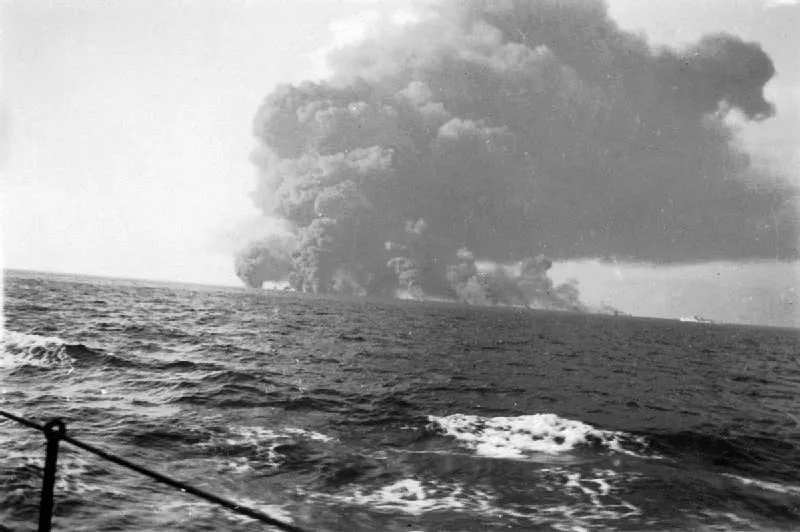
Operation Pedestal was the largest and most dramatic attempt to supply besieged Malta during the Second World War. During the night of 9–10 August 1942 fourteen fast merchant ships passed through the Strait of Gibraltar into the Mediterranean, surrounded by more than fifty warships of the Royal Navy: two battleships, three aircraft carriers, seven cruisers and more than thirty destroyers. Over the next five days the convoy was attacked by hundreds of Italian and German aircraft, by submarines and motor torpedo boats, and by minefields. Only five ships entered the Grand Harbour at Valletta. The last of them, the badly damaged American tanker Ohio with a British crew, was brought in on the morning of 15 August by destroyers lashed to her sides.
At sea it was a defeat, one of the heaviest suffered by the Royal Navy and the Merchant Navy in the Mediterranean. An aircraft carrier, two cruisers, a destroyer and nine merchant ships were sunk, and according to British figures more than four hundred seamen and airmen were killed (some authors give more than five hundred). Yet the fuel brought by Ohio and the cargo of the four other ships lifted the threat of Malta’s surrender and allowed its aircraft and submarines to resume their attacks on the convoys carrying supplies to Erwin Rommel, which is why historians agree in regarding Pedestal as a British strategic victory.
Name and dates
Pedestal means the base or plinth of a column or statue. The code name, chosen by the Admiralty, covered the whole undertaking, from the ships’ departure from Britain to their unloading in Malta. The convoy was designated WS 21S, a deliberately misleading label, since the letters WS normally denoted troop convoys sailing round Africa to Egypt. The Italians call the fighting the “Battle of Mid-August” (battaglia di mezzo agosto), on the model of the “Battle of Mid-June” fought in June. In Malta the convoy is remembered as Il-Konvoj ta’ Santa Marija, the “Convoy of Saint Mary”, because the last ships entered harbour in the days leading up to, and on the very day of, the Feast of the Assumption of the Blessed Virgin Mary.
The ships left the Clyde at the beginning of August; the date most often given is the night of 2–3 August, although some accounts speak of the evening of 1 August. Some chronologies record under 3 August that the convoy to Malta was decimated by the Luftwaffe and U-boats. That is a shorthand for the whole operation: on 3 August the ships were still sailing south in the Atlantic, and the attacks came between 11 and 13 August. The battle is taken to have begun on the night of 9–10 August, when the convoy entered the Mediterranean and was detected by the enemy, and to have ended on the morning of 15 August, when Ohio was brought into Valletta. The escorting warships were returning to Gibraltar until 15 August, and the last destroyers, those that had towed the tanker, only on 21 August.
Background
Malta on the brink of starvation
By the summer of 1942 the siege of Malta had lasted for more than two years. In the spring the island had survived the heaviest air raids in its history, and in April King George VI awarded it the George Cross. Thanks to Spitfires delivered by aircraft carriers, above all in Operation Bowery, the defenders regained air superiority, and from 14 July the air forces on the island were commanded by Air Vice-Marshal Keith Park. Bombs had ceased to be the greatest danger. What remained were hunger and the lack of fuel.
Operation Julius in June had ended in failure. Of the six ships of the Harpoon convoy from Gibraltar, two reached Valletta, while the Vigorous convoy from Egypt turned back to Alexandria without bringing a single ship to the island. Harpoon’s only tanker was sunk in the process. By August an adult man doing manual work in Malta received about 1,700 calories a day, women and children even less. Livestock was slaughtered because fodder had run out, and the population was fed in public “Victory Kitchens”. According to Park, there was enough aviation spirit for a few weeks, and only for the fighters; the bombers and torpedo aircraft that were supposed to attack Axis shipping had nothing to fly on. By the reckoning of the island’s authorities, headed from May by the Governor, Lord Gort, if a new convoy did not arrive before September, Malta would have to surrender.
For the British this would have meant more than the loss of a colony. The First Sea Lord, Admiral Dudley Pound, and the Prime Minister, Winston Churchill, judged that the fall of Malta would be a disaster “of the first magnitude”, threatening in the longer run the defence of the Nile Valley. Since July Rommel’s army had stood at El Alamein, about a hundred kilometres from Alexandria, and after the First Battle of El Alamein both sides were preparing for the next clash. Its outcome would depend above all on who could bring up fuel and ammunition faster. Malta was the only place from which the British could effectively attack the Italian convoys sailing to Libya.
The Admiralty’s plan
Planning began at the end of July. This time it was decided to send a single convoy, from the west, and to cover it with a force such as the Mediterranean had never seen. The ships could be taken from the Home Fleet, which after the disaster of convoy PQ 17 had suspended the convoys to Murmansk. Overall command went to Vice-Admiral Edward Neville Syfret, who had earlier commanded the naval forces at the Battle of Madagascar. The close escort, which was to accompany the merchant ships all the way to Malta, was commanded by Rear Admiral Harold Burrough, and the carriers by Rear Admiral Lumley Lyster.
The fourteen fastest ships available, able to maintain a speed of about 15 knots, were chosen for the convoy: eleven British and three American. The most valuable was Ohio, built in 1940 for the Texas Oil Company and one of the largest and fastest tankers in the world. The Americans lent her to the British, and she was manned by a British crew under Captain Dudley Mason. She carried some 11,500 tons of fuel: aviation spirit, kerosene and diesel oil. In case she was lost, the other ships also took fuel in drums, as well as food, flour, anti-aircraft ammunition and spare parts – in all, according to some accounts, some 85,000 tons of cargo.
The escort was divided into two main groups. Force Z, the heavy cover, comprised the battleships Nelson (Syfret’s flagship) and Rodney, the aircraft carriers Victorious, Indomitable and Eagle, three anti-aircraft cruisers and more than a dozen destroyers. It was to accompany the convoy only as far as the entrance to the Sicilian Narrows, because in those narrow, mined waters, within range of the Sicilian airfields, the big ships would be too easy a target. From there the merchantmen were to be shepherded by Burrough’s Force X: the cruisers Nigeria (flagship), Kenya and Manchester, the anti-aircraft cruiser Cairo and twelve destroyers. The three carriers had about 70 fighters between them – Sea Hurricanes (PL), Fulmars and American Martlets – as well as several dozen torpedo aircraft. A tanker group with corvettes was to refuel the warships on the way, because Malta could no longer spare a single ton for the escort.
Several smaller operations were combined with Pedestal. In Operation Bellows the old carrier Furious was to fly off 38 Spitfires to Malta. In Operation Berserk, between the Azores and Gibraltar, the carriers and the merchant ships spent several days practising turns, changes of formation, fighter direction and anti-aircraft fire. It was the first joint exercise by so large a group of British carriers. Two ships that had reached Malta in June were at the same time to slip out of the island to Gibraltar (Operation Ascendant), while in the eastern Mediterranean the fleet from Alexandria and Haifa was to simulate the sailing of another convoy (Operation MG 3) in order to divert the Axis’s attention.
Axis forces
The Italians and the Germans knew that the British would try again, and they had a good picture of the fleet’s movements thanks to observers in the Gibraltar area and to air reconnaissance. Field Marshal Albert Kesselring, the German Commander-in-Chief South (Oberbefehlshaber Süd), had no authority over the Italian fleet and could only agree joint plans for the German and Italian forces. As commander of Luftflotte 2, however, he controlled the German air force in Sicily, including II Air Corps (II. Fliegerkorps). After Abwehr reports at the beginning of August he expected a major supply operation from the west and ordered aircraft to be transferred from Crete and Africa to Sardinia and Sicily. By various counts the Axis had between about 650 and more than 780 aircraft in the area, including several hundred Junkers Ju 87 dive bombers and Ju 88s, and about a hundred torpedo aircraft, mainly Italian Savoia-Marchetti SM.79s and SM.84s.
The Axis plan repeated the pattern of June. The convoy was to be harried in turn by submarines (more than a dozen Italian and two or three German boats), by aircraft from Sardinia and Sicily and, at night, in the narrow passage off Cape Bon, by Italian and German motor torpedo boats (PL). The scattered and weakened remnants were to be finished off in the morning by Italian cruisers: the heavy cruisers Gorizia, Bolzano and Trieste of the 3rd Division and the light cruisers of the 7th Division, with a destroyer escort. The battleships stayed in port, because the Regia Marina had no fuel for them. In June the Italian navy had received only about 12,000 tons of fuel, and the battleships had had to hand over their oil to smaller vessels. The British knew of much of this preparation from Enigma messages they had decrypted.
Course of the battle
10–11 August: through the Strait and the sinking of Eagle
The force passed through the Strait of Gibraltar during the night of 9–10 August, in thick fog and with no moon. Syfret hoped that no one had seen him, but Abwehr agents around Gibraltar and Ceuta reported the convoy’s passage, and the British read their messages. On the morning of 10 August a German reconnaissance aircraft spotted the convoy, and by the afternoon Kesselring and the Italian naval command knew that a force of forty to fifty vessels, with carriers and battleships, was heading east. Throughout the following day a German Ju 88 circled high above the convoy, out of reach of the guns and the carrier fighters.
On 11 August, south of the Balearic Islands, the escorts refuelled from the tankers, and Furious flew off 38 Spitfires to Malta in several batches. Thirty-seven arrived. With Operation Bellows completed, the carrier turned back to Gibraltar with a few destroyers.
Shortly after 1 p.m. the German submarine U-73, commanded by Kapitänleutnant Helmut Rosenbaum, slipped through the destroyer screen and from a range of a few hundred metres fired four torpedoes at Eagle. All of them struck her port side. The old carrier, built on the hull of an unfinished Chilean battleship, capsized and sank in about eight minutes, roughly 80 nautical miles north of Algiers. Destroyers and a tug rescued more than nine hundred men. The number of dead varies between sources: the figure most often given is 131, other accounts speak of 160, and still others of more than two hundred. Of Eagle’s aircraft, only four Sea Hurricanes survived – those that were airborne at the time of the attack and landed on the other carriers. Within a few minutes the convoy had lost about a fifth of its fighter cover. U-73 got away; the destroyers hunting her were hampered by layers of water of different temperatures, which interfered with their sonar.
In the evening, just after sunset, some thirty German Ju 88s and a few He 111 torpedo bombers came in. Attacking out of the dusk, they hit no ship, and the anti-aircraft guns shot down two bombers. During the night aircraft from Malta attacked the airfields on Sardinia. The destroyer Wolverine, returning with Furious’s escort, rammed and sank the Italian submarine Dagabur, which went down with all hands.
12 August: the day of the air raids
The heaviest air attacks came on 12 August, as the convoy approached the Sicilian Narrows. At about 9 a.m. a dozen or so Ju 88s arrived from Sardinia. Carrier fighters intercepted them well short of the ships, and none was hit. Around midday came the largest, carefully planned Italian-German attack, delivered in several waves within less than an hour. Italian bombers dropped new circling torpedo-mines (motobomba) ahead of the convoy, forcing the ships into violent turns, and immediately afterwards several dozen SM.79 and SM.84 torpedo aircraft attacked from both sides. The torpedoes, however, were dropped from long range, and none found its mark. Two Reggiane Re.2001 fighter-bombers, which joined the British aircraft coming in to land, dropped bombs on Victorious; one struck the flight deck but broke up without exploding. German Ju 88s hit the merchant ship Deucalion, which had to leave the formation and sail along the Tunisian coast with a single destroyer. In the evening torpedo aircraft finished her off.
In the afternoon the convoy entered the zone of the Italian submarines. The destroyers detected several of them. Ithuriel forced the submarine Cobalto to the surface with depth charges, then rammed and sank her. At about 6.30 p.m., with little time left before Force Z was due to turn back, came the third great raid: nearly a hundred aircraft, including German Ju 87s and Ju 88s, Italian SM.79s and Ju 87 dive bombers in Regia Aeronautica markings. The dive bombers concentrated on Indomitable. Three bombs and several near misses wrecked her flight deck, about fifty men were killed, and the carrier’s aircraft that were in the air had to land on Victorious. A torpedo aircraft hit the destroyer Foresight; Tartar took her in tow, but the next day, when further air attacks threatened, she was scuttled.
At 7 p.m., as planned, Syfret turned back towards Gibraltar with Force Z, roughly off the Skerki Bank. The thirteen merchant ships that remained in formation and Burrough’s Force X were from now on to sail without carrier cover. Only long-range Bristol Beaufighter fighters from Malta could appear over the ships, and over the final approach to the island, Spitfires.
Less than an hour later Burrough’s force, which was just changing formation from four columns to two before entering the narrow swept channel along the Tunisian coast, ran into an ambush by Italian submarines. Axum fired four torpedoes, three of which hit three different targets. The cruiser Nigeria was struck in the side and had to turn back to Gibraltar, and Burrough transferred to the destroyer Ashanti. The anti-aircraft cruiser Cairo lost her stern and was scuttled by her crew. The third torpedo tore a huge hole in Ohio’s side and started a fire, which the crew managed to put out; after a while the tanker got under way again at about seven knots. Nigeria and Cairo carried the force’s only fighter-direction stations, so from then on the Beaufighters from Malta could no longer defend the convoy effectively.
At dusk Ju 88s and German torpedo aircraft fell on the scattered ships. Empire Hope sank, her crew having been taken off before the explosion, as did Clan Ferguson, which blew up with her cargo of petrol and ammunition. A torpedo struck Brisbane Star in the bow, but the ship carried on alone along the Tunisian coast. Another Italian submarine, Alagi, torpedoed the cruiser Kenya, which nevertheless kept her speed and stayed with the convoy. In the space of two hours Burrough had lost half his cruisers, and his force had broken up into several groups sailing in the dark without full destroyer cover.
The night of 12–13 August: motor torpedo boats off Cape Bon
Around midnight the convoy rounded Cape Bon and turned south along the Tunisian coast towards the Sicilian Narrows. In this narrow passage between the shore and the minefields lay in wait more than a dozen Italian MAS and MS motor torpedo boats and several German Schnellboote. Between 12.40 a.m. and dawn they made more than a dozen attacks. At about 1 a.m. the boats MS 16 and MS 22 torpedoed the cruiser Manchester. The ship lost propulsion, and her captain, concluding that he could not save her before daybreak and the air attacks, ordered her to be scuttled. Most of her crew reached the shore and were interned by the French authorities in Tunisia; after the war a court martial judged the decision to scuttle the cruiser to have been premature.
The boats also sank four merchant ships: Wairangi, Glenorchy, and the American Almeria Lykes and Santa Elisa. A torpedo also hit Rochester Castle, which nevertheless sailed on. By morning only seven of the fourteen ships that had left Gibraltar were still afloat and under way, some of them without escort.
The Italian cruiser sortie called off
The attack by the motor torpedo boats was meant to be the prelude to the final blow. On the evening of 12 August three heavy and three light cruisers with more than a dozen destroyers sailed from Cagliari, Messina and Naples. On the morning of 13 August they were to meet the remnants of the convoy near Pantelleria, when the British cover consisted of a single damaged cruiser, the anti-aircraft cruiser Charybdis, sent from Force Z, and a few destroyers. The battle never took place. The Italian naval command demanded fighter cover for its ships, but Kesselring and the Italian air force command were unwilling to divide their fighters, which were needed to escort the bombers attacking the convoy. After consultations involving Ugo Cavallero, the matter was settled during the night by Benito Mussolini: the cruisers were to turn back. British deception also contributed to this decision. Aircraft from Malta shadowed the Italian force and lit it up with flares, and signals sent in plain language to non-existent bombers were meant to convince the Italians that a massive air attack awaited them.
On the way back, on the morning of 13 August, the Italian force passed the island of Stromboli in the Aeolian Islands. Lying in wait there was the British submarine Unbroken under Lieutenant Alastair Mars, which fired four torpedoes. The heavy cruiser Bolzano, hit amidships, caught fire and had to be beached off the island of Panarea; a torpedo blew the bow off the light cruiser Muzio Attendolo. Both ships were brought into port, but neither ever returned to service. The sortie that might have destroyed what was left of the convoy thus cost the Italians two cruisers and brought them no gain whatsoever.
13–15 August: the last miles and Ohio
During the day on 13 August German Ju 88s and Ju 87s and Italian bombers again appeared over the seven surviving ships. At about 8 a.m. bombs hit Waimarama, which was carrying petrol in drums on deck. The ship exploded and sank within minutes, and blazing petrol spread across the sea; some of the survivors were rescued by the destroyer Ledbury, which steamed into the flames. Bombs also damaged Dorset and Port Chalmers, and Ohio took further hits and near misses; a Ju 87 that had been shot down crashed onto her deck. In the evening the immobilised Dorset was finished off by aircraft and sank.
Around midday Spitfires from Malta appeared over the convoy, and minesweepers and launches came out from the island to lead the ships through the minefields. Towards evening on 13 August Port Chalmers, Rochester Castle and Melbourne Star entered the Grand Harbour, greeted by crowds of islanders lining the fortifications. The following afternoon Brisbane Star arrived; she had sailed alone along the Tunisian coast for two days, resisting the urging of the Vichy French authorities to put into port and accept internment.
The struggle for Ohio lasted longest. On the morning of 13 August, after further near misses, her engines stopped and her hull began to crack. Captain Mason and his men twice abandoned the ship and twice returned on board. For two days destroyers and minesweepers tried to tow the tanker, which, without a rudder, kept veering off course and snapping the towlines. On 14 August more bombs damaged her still further, and her deck was almost awash. In the end two destroyers were made fast to her sides, so that they both held up the hull and steered it, while a third towed her from the bow. In this way, at a speed of a few knots, Ohio was brought into the Grand Harbour on the morning of 15 August, between 8 and 9.30 a.m., on the Feast of the Assumption. Her fuel was pumped out of the tanks before she settled on the bottom of the basin. Mason was awarded the George Cross.
The ships of Force X, which had turned back off Malta on 13 August, fought their way back to Gibraltar through further air attacks and arrived there on 14 and 15 August. The destroyers that had brought in Ohio returned a few days later, and the two ships of Operation Ascendant reached Gibraltar without loss.
Losses
The British lost the aircraft carrier Eagle, the cruisers Manchester and Cairo, the destroyer Foresight and nine of the fourteen merchant ships. The carrier Indomitable and the cruisers Nigeria and Kenya were badly damaged, and Ohio never sailed again. The carrier-borne and Malta-based aircraft lost about thirty machines. The number of dead varies depending on whether merchant seamen, airmen and men from Malta are included: British figures speak of more than four hundred killed, while some authors give more than five hundred. Several hundred survivors from Manchester and the sunken merchant ships were interned in Tunisia.
Axis losses were far smaller: two Italian submarines (Dagabur and Cobalto), the damaged cruisers Bolzano and Muzio Attendolo and, by various counts, between about forty and sixty aircraft. Most of the British losses were inflicted by the Italians – their submarines, motor torpedo boats and aircraft. Of the German submarines, only U-73 achieved any success.
Significance
Counted in warships and merchant ships, the balance pointed to an Axis victory, and that is how it was presented in Italy. Yet the five ships delivered some 30,000–32,000 tons of cargo to Malta, and Ohio the fuel the island needed most. Governor Gort was able to push back the date on which food would run out from the beginning of September to the end of November or the beginning of December, and Park’s air force once again had petrol not only for its fighters but also for its bombers and torpedo aircraft.
Malta’s offensive role revived. From the second half of August aircraft and submarines from the island, helped by intelligence from decrypted signals, sank more and more of the Italian ships sailing to Libya, especially tankers. The shortage of fuel hampered Rommel as early as his last attempt to break through the front at Alam el Halfa at the turn of August and September, and in the autumn, during the Second Battle of El Alamein, Panzerarmee Afrika fought with desperately meagre stocks. Historians differ on how great Malta’s own share in this was, but without Pedestal the island could not have played that part at all.
For the Regia Marina the August fighting was its last major success at sea, although it also exposed its weaknesses: the lack of fuel, dependence on another service’s aircraft and the inability to exploit the opportunity offered by the break-up of the convoy. After the Allied landings in North Africa in November and the Axis retreat from Egypt, the Stoneage convoy from Alexandria reached Malta on 20 November without losing a single merchant ship, which is usually regarded as the end of the siege of the island, and in December further ships arrived in Operation Portcullis. Pedestal was the last convoy to Malta that had to fight its way through at so high a price. In Malta 15 August is still celebrated as a public holiday, combining the Feast of the Assumption with the memory of the Santa Marija Convoy.