1940–1943: The North African campaign
Italian invasion of Egypt
- Dates:
- 9–16 September 1940
- Front:
- Mediterranean
- Location:
- The Libyan–Egyptian frontier and the coast of the Western Desert: Fort Capuzzo, Sidi Omar, Musaid, Sollum, the Halfaya Pass, Buq Buq, Alam Hamid, Alam el Dab and Sidi BarraniOn the battle map →
- Sides:
- Italy (with colonial divisions from Libya)Rodolfo Graziani, Mario BertiUnited Kingdom (with a Free French detachment)Archibald Wavell, Richard O'Connor
- Result:
- Italian territorial gain without a decision. The Tenth Army advanced about 100 kilometres into Egypt and took Sidi Barrani on 16 September, but failed to destroy the British covering force, which withdrew in good order. According to most studies the Italians lost about 530 men (120 killed and 410 wounded), the British about 40.
- Author:
- Natalia
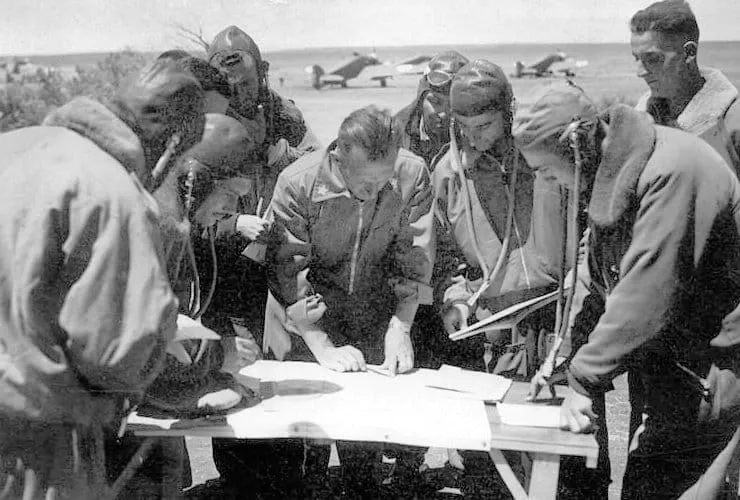
The Italian invasion of Egypt, called Operazione E in Italian plans, was the first major land offensive in North Africa in the Second World War. In September 1940 the Tenth Army of General Mario Berti, under the overall command of Marshal Rodolfo Graziani, crossed the Libyan–Egyptian frontier, took Sollum and the Halfaya Pass, and on 16 September entered the coastal settlement of Sidi Barrani. The British covering force of the 7th Armoured Division fell back before it step by step, shelling its columns and destroying the road. After advancing about a hundred kilometres the Italians halted and began to build a chain of fortified camps and a road that was to bring up supplies for a further advance on Mersa Matruh.
For Fascist propaganda it was a great success: Italian troops stood on Egyptian soil, and the radio hinted that the march would continue deep into the country. In reality the offensive, which Benito Mussolini had been pressing for since June, turned out to be a cautious advance in mass formation that inflicted no serious losses on the British and brought the Italians no closer to their goal. The halt at Sidi Barrani lasted almost three months, and in December the British struck at the scattered camps and destroyed the Tenth Army.
Name and dates
English-language literature uses the name “Italian invasion of Egypt”; Italian writers speak of the offensive on Sidi Barrani or of Operazione E. It is taken to have begun on 9 September 1940, the date Mussolini had set for the attack, on which Italian troops began moving towards the frontier in the area of Fort Capuzzo and Sidi Omar and the Italian and British air forces stepped up their operations. The main force crossed the Egyptian frontier only on 13 September, after yet another change of plan. The end is put at 16 September, when the Blackshirt division “23 Marzo” occupied Sidi Barrani and the offensive was halted.
Sources give the depth of the advance differently, depending on the point from which they measure it: Sidi Barrani lies about 95 kilometres from the frontier, while from the starting positions of the Italian divisions the distance was about 100–105 kilometres. The invasion opened the Western Desert campaign proper, which continued, with pauses, until 1943.
Background
Two armies facing each other across the desert
The eastern province of Libya, Cyrenaica, had been Italian since the war with Turkey of 1911–1912, although the resistance of the local tribes went on until 1932. Across the border lay Egypt, formally an independent kingdom, where under a treaty of 1936 British troops were stationed to guard the Suez Canal, the empire’s most important link with India and the Far East. Egypt did not enter the war, although it broke off relations with Rome.
There were some 215,000 Italian and Libyan troops in Libya. In the west, facing French Tunisia, stood the Fifth Army of General Italo Gariboldi; in the east, the Tenth Army. After the Franco-Italian armistice the threat from Tunisia disappeared and four divisions were transferred to Cyrenaica. The British had about 36,000 men in Egypt, and a further 27,000 were training in Palestine. All forces in the Middle East had been commanded since 1939 by General Archibald Wavell, who was also responsible for East Africa, where in August he suffered the loss of British Somaliland.
On the frontier the commander was General Richard O’Connor. His 6th Infantry Division headquarters was renamed the Western Desert Force on 17 June. He had about 10,000 men at his disposal, above all the under-strength 7th Armoured Division of General Michael O’Moore Creagh, concentrated near Mersa Matruh, together with units of the 4th Indian Infantry Division and part of the New Zealand division. The main base and defensive line were at Mersa Matruh, about 200 kilometres from the frontier, which was served by the railway from Alexandria.
The first months of war on the frontier
After Italy entered the war on 10 June, British patrols at once moved up to the barbed-wire fence with which the Italians had sealed off the frontier from the sea to the oasis of Jarabub. Some Italian posts did not yet know that war had broken out, and seventy soldiers were taken prisoner on the road to Sidi Omar. Within a week the armoured cars of the 11th Hussars had seized Fort Capuzzo, and in an ambush east of Bardia they captured the Tenth Army’s chief engineer, General Romolo Lastrucci. O’Connor’s light, mobile columns harried Italian convoys on the coastal Via Balbia and dominated the frontier strip. The Italians, however, reinforced the frontier and retook Fort Capuzzo. On 13 August the British suspended the raids to spare their worn-out vehicles, and the 7th Support Group took over the watch on about a hundred kilometres of the frontier, from Sollum to Fort Maddalena.
British air strength in the Middle East was small and obsolete: at the turn of May and June it had about two hundred aircraft, including Bombay and Blenheim bombers and Gladiator biplane fighters. Admiral Andrew Cunningham’s Mediterranean Fleet, however, dominated the eastern part of the sea, as the Battle of Calabria and the Battle of Cape Spada had shown, so it could bombard the Italian coast and carry supplies to Mersa Matruh.
Italian plans
From Balbo to Graziani
The first plan for an attack on Egypt was drawn up by the Governor of Libya, Marshal Italo Balbo. He warned Mussolini that his troops lacked not numbers but weapons: the artillery was old, there were almost no anti-tank or anti-aircraft guns, and to wage war in the desert he needed a thousand lorries, a hundred water tankers and medium tanks. The Chief of the General Staff, Pietro Badoglio, fobbed him off with promises. Balbo intended to strike around 15 July, the expected date of a German landing in England, and to take Sollum. On 28 June he was killed when Italian anti-aircraft guns shot down his aircraft over Tobruk by mistake.
He was succeeded by Marshal Rodolfo Graziani, Chief of Staff of the Army, conqueror of Ethiopia and a veteran of the colonial wars in Libya. On arriving in Tripoli he took over command with Mussolini’s order to attack by 8 August at the latest. Graziani soon concluded that his largely unmotorised divisions were not ready to march across the desert in summer, and he began to play for time. A second plan, for 22 August, provided for a limited advance in three columns to Sollum and further east, but it too was postponed because of the August heat.
On 18 August Mussolini wrote to Graziani that the German invasion of the British Isles was imminent and that the moment had to be seized to move towards Suez. The Duce reckoned that the war would soon be over and wanted Italian troops to be standing on Egyptian soil before the peace negotiations, even if the objective of the advance was modest. As late as 7 September Graziani asked for the attack to be postponed until the first ten days of October. Mussolini replied with a categorical order to attack on 9 September.
The Tenth Army and its weaknesses
Since the summer the Tenth Army had been commanded by General Mario Berti, an experienced officer who had led the Italian volunteer corps in the Spanish Civil War. The invasion was entrusted to the XXIII Corps of General Annibale Bergonzoli, known for his bristling beard as “Electric Beard” (Barba Elettrica). It comprised two infantry divisions, the 62nd “Marmarica” and the 63rd “Cirene”, partly motorised for the operation, and the 1st Blackshirt Division “23 Marzo”, which was given lorries although it had never trained as a motorised formation. Alongside them operated the two Libyan divisions of General Sebastiano Gallina, formed only on 1 March 1940 and still in training, and the motorised group of General Pietro Maletti (Raggruppamento Maletti), made up of Libyan battalions, artillery and almost all the M11/39 medium tanks that had reached Libya. The XXI and XXII Corps remained in reserve, as there was no transport for them.
Air support was provided by the 5th Squadra of the Regia Aeronautica, which before the invasion numbered about three hundred aircraft: SM.79 bombers, Breda Ba.65 ground-attack aircraft and Fiat CR.42 biplane fighters. On 9 September about 150 more aircraft flew in from Italy. The navy could do little to help: since June it had lost ten submarines, it was short of fuel, and its command was unwilling to risk the fleet.
The gravest shortages were in transport, water and communications. The L3 light tanks were little more than tankettes, and the M11/39 medium tanks had a hull-mounted gun with a limited field of fire. Italian doctrine called for rapid action by motorised formations, but the army had neither the equipment nor the training to carry it out.
The British defence
Wavell and O’Connor did not intend to defend the frontier strip. In accordance with a plan prepared before the war, the main force waited at Mersa Matruh, where the infantry was to absorb the blow while the 7th Armoured Division, positioned on the escarpment on the desert side, would counter-attack the flank of the advancing enemy. In front of them operated the 7th Support Group of Brigadier William Gott, consisting of three motorised infantry battalions, artillery, sappers and machine guns. Its task was to appear stronger than it was, watch for the approaching enemy, harass him with fire and fall back in stages without getting drawn into a pitched fight.
Along the coast the screen was formed by the 3rd Battalion, Coldstream Guards with field artillery support, a company of the 1st Battalion, King’s Royal Rifle Corps, a machine-gun platoon of the Northumberland Fusiliers and a company of Free French marines. These detachments were to withdraw along the coast road, destroying it behind them. On the plateau above the escarpment, on the desert side, operated the armoured cars of the 11th Hussars, the 2nd Battalion, Rifle Brigade and the cruiser tanks of the 1st Royal Tank Regiment. The British knew the ground and could navigate in the desert, as the summer raids had already shown.
Wavell was in a difficult position. In August he had lost British Somaliland, and Winston Churchill, dissatisfied with his caution, summoned him to London for talks. Despite the Battle of Britain, however, the British government decided to send reinforcements to the Middle East, including three tank regiments, which at the turn of August and September were sailing round Africa. At the time of the Italian attack they had not yet arrived.
Course of the invasion
9–12 September: assembly and a change of plan
On 9 September the Italian air force greatly increased its activity over the frontier. Bombers of Nos. 55, 113 and 211 Squadrons RAF responded with raids on Italian airfields, columns and depots, and 21 aircraft attacked Tobruk. Air reconnaissance spotted heavy troop movements in the area of Bardia, Sidi Azeiz, Gabr Saleh and Sidi Omar, which the British rightly took to be the start of the invasion.
Graziani’s third plan provided for an advance along two routes. The non-motorised metropolitan divisions were to advance along the coast, through Sollum and the Halfaya Pass, while a southern column of the Libyan divisions and the Maletti Group was to outflank the British through the desert by way of Bir ar Rabiyah and Bir Enba. The assembly alone, however, exposed the army’s weakness. The Maletti Group, which had been given neither proper maps nor navigational equipment, got lost on its way to Sidi Omar, and aircraft had to be sent to find it and guide it to its destination. The Libyan divisions arrived late at the assembly point near Fort Capuzzo.
On 10 September armoured cars of the 11th Hussars detected the Maletti Group and, under cover of thick fog, watched its slow concentration. When the fog lifted, the Hussars came under fire from Italian aircraft, tanks and artillery and had to withdraw.
The Maletti fiasco, the lack of lorries and transport aircraft, and the conviction that the British were far stronger than they actually were led Graziani to change his plan once more. He abandoned the desert outflanking move. For 13 September he ordered an advance in mass along the coast road: five divisions, the tanks and the Maletti Group were to take Sollum and advance via Buq Buq to Sidi Barrani, dig in there, bring up supplies, repel a British counter-attack, and only then march on Mersa Matruh. This was how the Italian columns had advanced on the northern front in Ethiopia in 1936. Bergonzoli wanted to place the 1st Tank Group (1° Raggruppamento Carri) in the vanguard, but in the end most of the tanks were held back in reserve and individual tankette battalions were attached to the infantry divisions.
13 September: crossing the frontier
On the morning of 13 September the “23 Marzo” division reoccupied Fort Capuzzo, and the Italian artillery opened fire on Musaid, just on the Egyptian side of the frontier, after which the settlement was occupied. The artillery and aircraft then bombarded the airfield and barracks at Sollum. The British had already left them, and the bombardment merely raised an enormous cloud of dust. When the dust settled, Coldstream Guards observers saw the whole Italian army drawn up as if on parade: a screen of motorcyclists rode ahead of two divisions, followed by tanks, lorried infantry and artillery. Such a dense mass was an easy target for the British artillery and aircraft, but it kept moving forward.
The 1st Libyan Division occupied the barracks at Sollum and began descending the escarpment to the harbour. On the plateau the Italians attacked the Halfaya Pass, which was held by a company of the Coldstream Guards, a platoon of the Northumberland Fusiliers and a few guns. In the afternoon, as more Italian infantry and tanks came up, the defenders withdrew. In the evening two columns reached the pass: the 2nd Libyan Division, the “Cirene” division and the Maletti Group from the direction of Musaid, and the “Marmarica” division from Sidi Omar.
14–16 September: the advance on Sidi Barrani
On 14 September Italian units began descending from the plateau through the Halfaya Pass to meet the column coming along the road from Sollum. A squadron of the 11th Hussars, the 2nd Battalion, Rifle Brigade and the cruiser tanks of the 1st Royal Tank Regiment harassed them on the escarpment. Shortly after noon the British coastal screen withdrew to Buq Buq, where it was joined by reinforcements from the 11th Hussars and a motorised company of French marines. On 15 September the British fell back to Alam Hamid, and on 16 September to Alam el Dab. Each time they tried to inflict the greatest possible losses without getting drawn into a fight, and they blew up the coast road. The damage was made worse by the heavy traffic of the Italian columns, which churned up what was left of the surface.
The Italians advanced at about 20 kilometres a day, so that the Libyan infantry divisions on foot could keep up with the motorised ones. Their infantry suffered from the heat and lack of water, and the lorries broke down on the stony ground. British aircraft attacked the columns and flew reconnaissance throughout, while the Italian 5th Squadra replied with raids on forward airfields and positions, sometimes sending up as many as a hundred fighters and bombers at once.
On 16 September at Alam el Dab, near Sidi Barrani, about fifty Italian tanks with motorised infantry and artillery tried to outflank the Coldstream Guards’ positions, forcing them to withdraw. When the British field artillery took them under fire, the group advanced no further. It was the only attempt at an outflanking manoeuvre in the entire offensive. On the evening of 16 September the “23 Marzo” division entered Sidi Barrani, a small coastal settlement inhabited mainly by Bedouin. On the plateau the British covering units fell back in step with those on the coast, and no flank attack took place.
The halt at Sidi Barrani
The British expected the Italians to stop at Sidi Barrani and Sofafi, and they began watching their positions with patrols of the 11th Hussars, while the 7th Support Group was withdrawn to rest. The 7th Armoured Division prepared to repel an attack on Mersa Matruh. Italian radio implied that the advance would continue; British accounts also repeat the anecdote that Rome radio announced that the trams were running again in Sidi Barrani. It soon became clear, however, that the Italians were digging in.
Graziani had no intention of going further until he had secured his supplies. From Sidi Barrani to Mersa Matruh there were still some 130 kilometres of desert. Sappers began rebuilding the wrecked coast road, named the Via della Vittoria (Victory Road), as an extension of the Libyan Via Balbia, and laying a water pipeline from the frontier. The work was expected to last until mid-December. The divisions were deployed in a series of fortified camps stretching in an arc from the sea to the escarpment: at Maktila on the coast, at Tummar East and West, at Nibeiwa and on the escarpment at Sofafi. Other units occupied Buq Buq, Sidi Omar and the Halfaya Pass. The camps were surrounded by embankments, ditches and minefields, but they were separated by wide gaps and could not support one another with fire.
Losses
The exact losses of the two sides were never compiled, and studies give differing figures. The most frequently cited figures, given among others by Kenneth Macksey (1971) and Howard Christie (1999), put the Tenth Army’s losses from 9 to 16 September at 530: 120 killed and 410 wounded. Harold Raugh (1993) writes of about two thousand Italians killed and wounded. According to Macksey, British losses amounted to “a mere forty men” and little equipment; Giorgio Bocca (1997) gives 40 killed, 10 tanks, 11 armoured cars and 4 lorries. The Italians also lost six aircraft, two of them in accidents, and many tanks and lorries broke down. Of the 72 M11/39 tanks sent to Libya, 68 remained on 21 September, but in the two medium tank battalions only 37 were serviceable.
Assessment
The offensive gave the Italians territory at low cost, but it failed to achieve what mattered most in desert warfare: it did not destroy the enemy’s forces. The British screen withdrew in good order, and the main force at Mersa Matruh remained untouched. In his report Wavell gave credit to Brigadier Gott and Lieutenant Colonel John “Jock” Campbell, the Support Group’s artillery commander, for a “calm and efficient” withdrawal.
The armoured and motorised units, instead of delivering bold strokes, merely covered the infantry’s advance. Lack of preparation, training and organisation led to the Maletti Group’s fiasco and to excessive caution in the use of tanks, while the hasty motorisation of the “23 Marzo” division disrupted co-operation between drivers and infantry. Graziani overestimated British strength and believed he could defeat it only by sheer weight of numbers. He also rejected manoeuvre, although Italian doctrine provided for it, because his army was incapable of carrying it out.
Significance
The halt at Sidi Barrani dragged on for almost three months. The British fleet began bombarding Italian positions on the coast and mined the harbour at Benghazi, and aircraft attacked Italian airfields. On 26 October Mussolini asked Graziani whom this long halt had benefited more, and answered himself that it was rather the enemy. Two days later Italy attacked Greece, which drew attention and resources away from Africa.
Wavell and O’Connor made good use of the time. Reinforcements reached Egypt, including Matilda infantry tanks. On 8 December, while Berti was on sick leave and Gariboldi was standing in for him, the Western Desert Force launched Operation Compass, conceived as a five-day raid on the fortified camps. The British went in through the gap between Nibeiwa and Sofafi, took the camps one after another, and on 10–11 December recaptured Sidi Barrani. The raid grew into a counter-offensive that within two months carried the British forces through Bardia, Tobruk and Beda Fomm as far as El Agheila. At a cost of about 1,900 killed and wounded they took more than 130,000 Italian and Libyan soldiers prisoner, among them General Bergonzoli.
The defeat forced Hitler to send German troops to Libya under the command of Erwin Rommel, and it cost Graziani his command. The September advance on Sidi Barrani proved to be the furthest the Italians ever got in Egypt on their own. Mussolini’s hopes of taking the Suez Canal with his own forces ended in the December camps around Sidi Barrani.