Equipment
The Junkers Ju 88
Germany's "fast bomber" that became the Luftwaffe's most versatile aircraft: bomber, torpedo bomber, reconnaissance aircraft and night fighter.
- Role:
- medium bomber and multi-role aircraft
- State:
- Germany
- Maker:
- Junkers
- First flight:
- 21 December 1936
- Built:
- between about 15,000 and over 16,000
- Author:
- Łukasz
- Updated:
- 1 November 2026
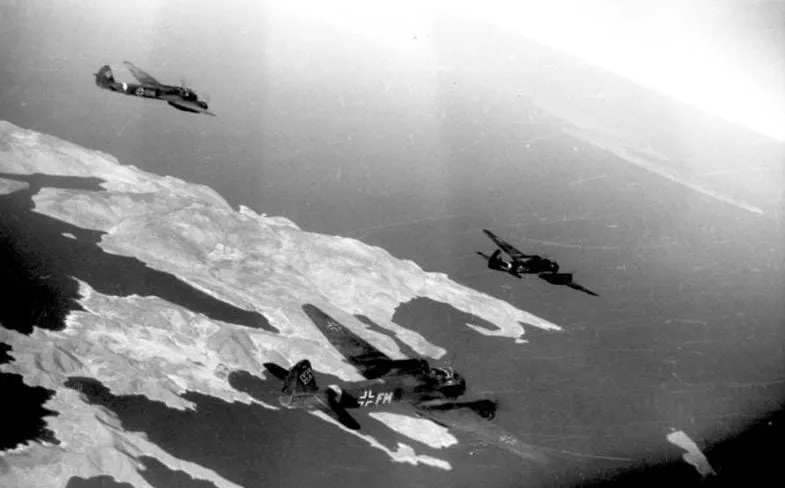
The Junkers Ju 88 was meant to be a bomber that no fighter could catch. Little of that promise survived, but the design itself proved so good that the Luftwaffe used it for almost everything: it bombed cities and airfields, sank ships, flew long-range reconnaissance and, from 1942, hunted British bombers by night. The Ju 88 fought from the first month of the war to the last, over England, the Mediterranean, the Arctic and the whole length of the Eastern Front, and no other German twin-engined aircraft was built in such numbers.
The fast bomber that slowed down
In 1935 the Reich Air Ministry called for a Schnellbomber: a three-seat bomber without heavy gun positions that would escape pursuit through speed alone. The Junkers team at Dessau, led by Ernst Zindel (PL), produced a slim, all-metal twin-engined aircraft, and the first prototype flew on 21 December 1936. The rival designs from Henschel and Messerschmitt soon fell away, and Hermann Göring saw the new machine as everything he had hoped for. In March 1939 the fifth prototype set a speed record over a 1,000-kilometre course carrying two tonnes.
By then, however, the production aircraft had become something else. In the autumn of 1937 Ernst Udet, convinced of the value of the Stukas, demanded that the Ju 88 should also bomb in a dive. The wings were strengthened, dive brakes added, the fuselage lengthened, and the crew grew to four. The prototype reportedly reached about 580 km/h, the production version about 450 km/h, and its arrival in the units slipped by roughly a year. When the war broke out only a dozen or so were ready for combat, and the factories were turning out one a week. That soon changed: in 1940 output reached several hundred a month. British intelligence had heard of the Ju 88 as early as November 1939 from the Oslo Report, which credited the Germans with plans several times larger than their factories could fulfil.
The first years of the war
The new Junkers flew their first missions over the sea. At the end of September 1939 they searched the Firth of Forth for British warships, and on 16 October twelve aircraft of Kampfgeschwader 30 (KG 30) carried out the first Luftwaffe raid on Britain there. In April 1940 the same wing fought off the coast of Norway in Hans Geisler’s X Air Corps. In France the Ju 88s showed how accurately they could dive-bomb, but they were also lost in accidents, since many crews were only just learning an aircraft that was difficult to fly. According to most accounts it was Junkers of KG 30 that sank the liner Lancastria off Saint-Nazaire on 17 June 1940, with thousands of evacuated soldiers on board.
In the Battle of Britain the Ju 88 was the fastest of the three German medium bombers and the only one able to attack in a dive. On 12 August, the day before Eagle Day, bombers of KG 51 badly damaged the radar station at Ventnor on the Isle of Wight. Speed gave no protection from Spitfires and Hurricanes, however, and a few single machine guns were not enough for defence. According to figures cited in the literature, between July and October 1940 the Germans lost about three hundred Ju 88s over Britain, more than Heinkels or Dorniers, although there were fewer of them. The crews were given extra armour and twin machine guns in the field, and in the autumn the Junkers moved, together with the He 111, to the night raids of the Blitz.
The Mediterranean, the East and the Arctic
At the turn of 1940 and 1941 Ju 88s appeared in Sicily and from then on were the Luftwaffe’s main bomber over Malta. In the spring of 1941 and again in the first months of 1942 it was they, escorted by Messerschmitt Bf 109s, that all but paralysed the island’s harbours and airfields, and in August 1942, together with Stukas and Italian torpedo bombers, they attacked the Pedestal convoy. In May 1941 they bombed British warships around Crete, and in the autumn of 1943, in the Dodecanese campaign, daily Ju 88 raids decided the loss of the islands by the British.
In the East the Junkers struck the undispersed Soviet airfields on 22 June 1941 and destroyed aircraft on the ground by the hundred, paying with losses to ground fire once they were thrown into direct support of the army. A few weeks later they took part in the first raid on Moscow. In the north, from airfields in Norway and Finland, the Ju 88s of KG 30 and torpedo-carrying Heinkels attacked the Arctic convoys; scattered in July 1942, convoy PQ 17 lost most of its ships to bombs, aerial torpedoes and U-boats. The Ju 88’s greatest success against shipping, though, came on 2 December 1943: 105 bombers assembled by Wolfram von Richthofen surprised the brightly lit harbour of Bari and sank, depending on the count, between 17 and 28 ships, losing one or two aircraft at most.
Night fighter and the end
The Ju 88’s last and most important career was made in the dark. Versions with a solid metal nose and cannon flew from 1940 as heavy fighters and as intruders over British airfields, and from 1942 aircraft fitted with Lichtenstein airborne radar joined the German night defences. Eventually a separate G version appeared, with a new tail and ever better radar. In 1944 twin-engined Ju 88s and Bf 110s, guided by ground controllers into the bomber stream, inflicted the heaviest losses in Bomber Command’s history, among them in the Nuremberg raid. Thanks to a defection the British knew this equipment at close quarters: on 9 May 1943 the crew of a Ju 88 R-1 night fighter, sent to intercept a courier aircraft bound for Stockholm, faked a crash at sea and landed in Scotland. The aircraft, with its radar intact, is now in the RAF Museum at Cosford.
The bomber Ju 88s flew to the end, more and more often by night and in ever smaller numbers. In June 1944, together with He 111s, they destroyed 47 American bombers on the ground at Poltava during Operation Frantic. Worn-out airframes were turned into unmanned Mistel flying bombs, steered by a fighter mounted on top of them. Ju 88s were also flown by the air forces of Italy, Romania, Hungary and Finland, which bought two dozen in 1943. The basic structure hardly changed throughout the war, which made it quick to build new versions. The number built, of all versions from bombers to night fighters, varies by source: from about 15,000 to over 16,000.
Sources
Battles
(04)- 10 July – 31 October 1940Battle of BritainFrom 10 July to 31 October 1940 the Luftwaffe tried to destroy the RAF ahead of an invasion of Britain. It failed, and Hitler postponed the landing.
- 7 September 1940 – 11 May 1941The BlitzFrom 7 September 1940 to May 1941 the Luftwaffe bombed London and other British cities by night. Over 40,000 civilians died, but the country did not break.
- 10–15 August 1942Operation PedestalOn 10–15 August 1942 the Pedestal convoy fought its way to Malta. Five of 14 ships arrived, including the tanker Ohio, and their cargo saved the island.
- 8 September – 22 November 1943Dodecanese campaignBetween 8 September and 22 November 1943 the Germans took Rhodes, Kos, Leros and Samos from the British and Italians. Luftwaffe air supremacy decided it.
In the chronicle
(43)1939
1940
- 16 March 1940The Scapa Flow raid and the first civilian death
- 17 June 1940The sinking of the Lancastria
- 10 July 1940The Battle of Britain begins
- 12 July 1940Air raids on Wales and Scotland
- 13 August 1940Adlertag
- 15 August 1940Black Thursday
- 18 August 1940The Hardest Day
- 31 August 1940Attacks on RAF airfields
- 14 October 1940The Balham station disaster
- 22 December 1940The Manchester Blitz
1941
- 10 January 1941The attack on HMS Illustrious
- 10 February 1941Malta under the bombs
- 26 March 1941The raid on Suda Bay
- 28 March 1941The Battle of Cape Matapan
- 16 April 1941The Belfast Blitz
- 27 April 1941New Hurricanes for Malta
- 10 May 1941The last night of the Blitz
- 21 July 1941The first air raid on Moscow
- 17 November 1941The suicide of Ernst Udet
- 1 December 1941The thousandth air raid on Malta
1942
- 7 January 1942Malta under air attack in January 1942
- 7 March 1942The first Spitfires over Malta
- 20 April 1942Operation Calendar
- 23 April 1942The Baedeker raids
- 4 May 1942The second raid on Exeter
- 9 May 1942Operation Bowery
- 11 June 1942Operation Harpoon
- 27 June 1942Convoy PQ 17 sails from Iceland
- 11 August 1942The sinking of HMS Eagle
- 15 August 1942The Ohio reaches Malta
- 23 August 1942The bombing of Stalingrad
- 14 September 1942Convoys PQ 18 and ON 127
- 11 November 1942Convoy Stoneage