- Category:
- Military
- Date:
- 2 December 1942
- Author:
- Łukasz
- Tags:
- nuclear weapons, United States, Enrico Fermi
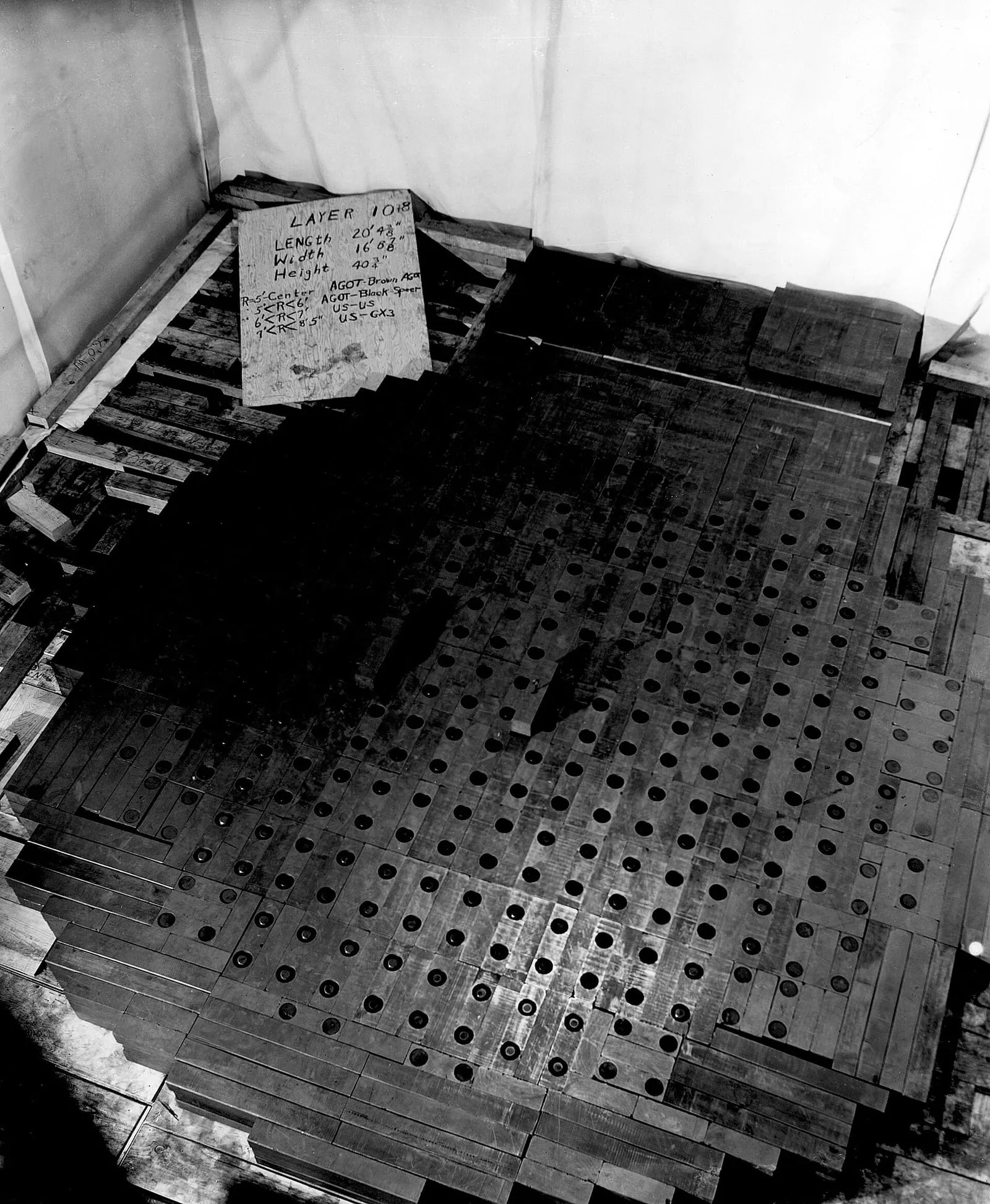
On Wednesday 2 December 1942, at 3.25 p.m. Chicago time, in a former squash court beneath the west stands of Stagg Field, a disused football stadium at the University of Chicago, Enrico Fermi announced that a pile of graphite and uranium had gone critical. A chain reaction – the fission of uranium nuclei, each of which releases neutrons that cause further fissions – had for the first time become self-sustaining, and for the first time it was under human control. The pile, later named Chicago Pile-1 (CP-1), ran for less than five minutes at a power of about half a watt, less than the bulb of a torch. That was enough, however, to prove that a nuclear reactor was possible, and therefore that plutonium – the second material for an atomic bomb, alongside uranium-235 – could be produced in one.
The news of the success was passed on by telephone in a code improvised on the spot: “The Italian navigator has landed in the New World.” War chronologies often state that these words were sent to President Franklin Delano Roosevelt. That is inaccurate. The call was made by the physicist Arthur Compton, head of the Metallurgical Laboratory, and taken by James Conant, chairman of the National Defense Research Committee (NDRC) and one of the leaders of the atomic programme in Washington. The President learned of the result through official channels, not from this conversation.
The road to Chicago
The idea of a nuclear chain reaction came to Leó Szilárd in London in September 1933, but only the discovery of uranium fission at the turn of 1938 and 1939 showed in what material it could be induced. On 25 January 1939, at Columbia University in New York, the fission experiment was repeated, and Fermi, newly arrived from Fascist Italy, and Leó Szilárd soon showed that fission releases additional neutrons. In the summer of 1939 Szilárd persuaded Albert Einstein to sign a letter to President Roosevelt, which started the American government’s work on uranium.
Fermi and Szilárd believed at the time that a bomb would require enormous quantities of uranium, so they first wanted to build a pile in which the reaction would proceed slowly and under control. The neutrons from fission are too fast to split further nuclei efficiently in natural uranium, in which the rare uranium-235 is mixed with uranium-238; they have to be slowed down in a moderator. Szilárd proposed graphite. It turned out that ordinary industrial graphite contained traces of boron, which greedily absorbs neutrons; only when manufacturers, above all National Carbon, learned to produce graphite almost free of this impurity did the moderator begin to work. German physicists studying the same problem failed to detect the impurities, concluded that graphite was unsuitable and opted for scarce heavy water – one of the reasons why their programme never built a working reactor.
In 1940–1941 Fermi’s team at Columbia assembled ever larger “exponential piles”, in which they measured how the number of neutrons in the system grew. After the United States entered the war, Compton, who was responsible for the programme’s physics within the Office of Scientific Research and Development, decided in January 1942 to concentrate all work on the reactor and plutonium in one place – at his own university in Chicago, in a centre given the deliberately misleading name of the Metallurgical Laboratory. Fermi, who as an Italian citizen had been formally an “enemy alien” since December 1941, moved there in 1942 with most of his team. From June the army was taking over the programme, and in September Colonel Leslie Groves was put in charge of the Manhattan Project.
A reactor under the stands
The experimental pile was to be built away from the city, in the Argonne Forest south-west of Chicago, where in June 1942 the army and the OSRD had chosen a site designated “Site A”. Construction of the building there was delayed by labour disputes, however, and by the beginning of November it was clear that the graphite and uranium would be ready before the building. Fermi therefore suggested to Compton that the pile be built in the court beneath the stands of Stagg Field, where since September the teams of Herbert L. Anderson and Walter Zinn had already assembled a dozen or so smaller, subcritical experimental piles. The university had given up football in 1939, and the stadium stood largely empty.
Starting up a reactor in a densely populated city was a risk. Fermi argued that the pile could be safely controlled thanks to so-called delayed neutrons: some neutrons are emitted by fission products only after seconds or minutes, which slows the build-up of the reaction and gives people time to react. Compton trusted these calculations and took the decision alone, without consulting the university’s president, Robert Hutchins. He later explained that Hutchins would not have been able to assess the danger for himself, and that, as the man responsible for the university, he could only have answered “no” – and that would have been the wrong answer. Groves, informed on 14 November at a meeting of the S-1 Executive Committee, had serious doubts but did not object. Conant reportedly turned pale.
Assembly of the actual pile began on 16 November 1942. The work went on in two twelve-hour shifts – Zinn led the day shift, Anderson the night shift. Layers of solid graphite blocks alternated with layers of blocks in which holes had been bored for lumps of uranium oxide and cylinders of uranium metal, the so-called “Spedding’s eggs”, delivered at the last minute by Iowa State College, Westinghouse and other plants. The physicist Leona Woods, the only woman on the team, built boron trifluoride neutron counters. After each shift Fermi converted the measurements into a factor that approached one as the pile approached criticality. The pile was originally to have been a sphere enclosed in a cube-shaped balloon of rubberised fabric, from which the air would be pumped out, but purer graphite and uranium metal made it possible to dispense with about twenty layers and with the evacuation. Fermi calculated that the factor would reach one between the 56th and 57th layers. Anderson stopped the stacking after the 57th layer, during the night of 1–2 December.
The finished pile had the shape of a flattened ellipsoid about 6 metres high and about 7.6 metres wide at the middle, resting on a wooden frame. It had neither radiation shielding nor cooling. Figures for its contents vary by source: according to one tally it contained about 45,000 graphite blocks weighing 330 tonnes, 4.9 tonnes of uranium metal and 41 tonnes of uranium oxide; according to another, 360 tonnes of graphite, 5.4 tonnes of uranium metal and 45 tonnes of oxide. Its cost was estimated at 2.7 million dollars. The reaction was held in check by control rods: sheets of cadmium, a strong neutron absorber, nailed to wooden strips.
2 December 1942
In the morning 49 people gathered in the court. From the programme’s leadership there was only one outside guest, Compton’s invitee Crawford Greenewalt of DuPont, the company that was to build the future plutonium plants; also present were Szilárd, Eugene Wigner and the chemist Frank Spedding. Fermi, Compton, Anderson and Zinn stood by the instruments on the balcony, originally intended for spectators. On the floor beside the pile there was only one man – the physicist George Weil, who withdrew the last control rod by hand.
The safety measures were simple and showed plainly that everyone was working at the limits of knowledge. Zinn had withdrawn and tied off the “zip”, an emergency cadmium rod suspended on a rope; Norman Hilberry stood with an axe, ready to cut the rope so that the rod would drop into the pile of its own accord. Samuel Allison held a bucket of concentrated cadmium nitrate solution, with which he was to flood the pile in the event of an accident. According to participants’ recollections, a three-man team of young physicists with buckets of the same solution also kept watch on top of the pile, nicknamed with gallows humour the “suicide squad”. Leona Woods read out the neutron counter readings.
The test began at 9.54 a.m. Fermi had Weil withdraw the last rod gradually, about 15 centimetres at a time, and after each step checked whether the neutron intensity was rising exactly as his calculations, worked out on a slide rule, predicted. At about 11.30 a.m. an automatic safety rod, set to too low a threshold, dropped into the pile of its own accord. Fermi calmly announced a break for lunch. When the tests resumed at 2 p.m., Weil withdrew the rod further still, and at 3.25 p.m. Fermi declared that the neutron intensity was rising exponentially and not levelling off – the pile had gone critical. Fermi still wanted to check the control circuits, but after 28 minutes the alarm bells rang because the neutron flux had exceeded the set safety threshold, and Fermi told Zinn to release the “zip”. The reaction died away at once. The self-sustaining chain reaction had lasted about four and a half minutes, at a power of about half a watt.
Wigner then produced a bottle of Italian Chianti, bought for the occasion, and everyone drank a sip from paper cups. The participants later signed the bottle’s straw wrapping; it was kept by the physicist Albert Wattenberg. When it was all over, Szilárd remained alone in the court with Fermi. He shook his hand and – as he recalled – said that this day would go down as a black day in the history of mankind.
Compton telephoned Conant at Harvard University. They had no agreed code, so – as Compton described it in his memoirs – they spoke in allusions. “Jim, you’ll be interested to know that the Italian navigator has just landed in the new world,” said Compton, alluding both to Columbus and to Fermi, and he added that the earth had turned out to be smaller than estimated, so the navigator had arrived sooner than expected – the pile had worked with fewer layers than predicted. “Were the natives friendly?” asked Conant. “Very friendly,” Compton replied.
What Chicago Pile-1 proved
Half a watt of power was of no practical significance. What mattered was that the pile had worked at all and that it could be shut down. The experiment confirmed Fermi’s calculations, the purity of the graphite and uranium, and the role of the delayed neutrons, thanks to which a reactor could be controlled with ordinary control rods instead of having to respond within fractions of a second. It thus became clear that industrial reactors could be built in which uranium-238, by absorbing neutrons, would be transformed into plutonium. This was important, because separating uranium isotopes – the other road to the bomb – promised to be extremely expensive and uncertain.
The success came just as the programme’s biggest decisions were being taken. Groves had already persuaded DuPont to design and build the plutonium plants; Greenewalt, an eyewitness of the test, carried back to Wilmington the conviction that the reactor was a reality. In the following weeks DuPont finally accepted the contract, and in January 1943 a remote site on the Columbia River in Washington State – the future Hanford Site – was chosen for the production plants. Wigner set about designing large water-cooled reactors.
The pile’s later history
On 12 December 1942 CP-1’s power was briefly raised to 200 watts, but the unshielded pile was dangerous to everyone nearby, so further measurements were made at half a watt. Work ended on 28 February 1943. The pile was dismantled and moved to the Argonne Forest, where Chicago Pile-2 was built from the same materials, this time with shielding. Alongside it the heavy-water reactor CP-3 was built. In them the neutron absorption of dozens of elements and materials needed for building industrial reactors was studied. The Argonne Forest site grew in 1946 into the Argonne National Laboratory, whose first director was Zinn. Both reactors were shut down in 1954 and their remains buried on site.
The reactor design remained a secret for a decade. Fermi and Szilárd jointly applied for a patent on it in December 1944 as a “neutronic reactor”. The Stagg Field stands were demolished in 1957. On the site of the former court there now stands Henry Moore’s sculpture Nuclear Energy, with commemorative plaques beside it; the site has been designated a National Historic Landmark of the United States.
Place in the war
2 December 1942 was one of those days on which the course of the war changed away from the battlefield. In those same weeks the ring around the encircled Sixth Army was tightening at Stalingrad, and in North Africa the Allies were fighting for Tunisia; beneath a Chicago stadium, meanwhile, an outcome was settled that would shape the end of the war in the Pacific and the whole post-war world. Without a working reactor there would have been no plutonium, and without plutonium no bomb detonated in the New Mexico desert in July 1945 in the Trinity test, and no bomb dropped on Nagasaki on 9 August 1945.
The Americans were in a hurry because they feared the Germans would get there first. In reality the German atomic programme, scattered among several institutes, lacking the backing of the Reich’s leaders and dependent on heavy water from the Norwegian plant at Vemork, never achieved a self-sustaining chain reaction before the end of the war. The British, who had been the first to show, in 1941, that a bomb was possible, joined the American programme only in 1943. The Soviet Union started up its first reactor in December 1946.
Szilárd’s words about a black day for mankind foreshadowed a dispute that accompanied nuclear science for the rest of the century. The same men who drank Chianti from paper cups in December 1942 argued in 1945 over whether the bomb should be used against Japan, and after the war over whether to build the hydrogen bomb. Fermi’s reactor was also the beginning of nuclear power. For the history of the Second World War, however, it remains above all the moment at which mankind acquired the means to destroy itself, and at which a programme that had begun with Einstein’s letter as the quiet anxiety of scientists gained the basis for building the weapon that was to end the war.
Sources
Meanwhile
(04)Elsewhere, within a week.
- 30 November 1942 · AfricaThe Free French on RéunionOn 28 November 1942 the destroyer Léopard landed Free French at Saint-Denis. On 30 November the Vichy governor surrendered Réunion without further fighting.
- 30 November 1942 · PacificThe Battle of TassafarongaDuring the night of 30 November–1 December 1942 Tanaka's Japanese destroyers torpedoed and sank the cruiser Northampton and badly damaged three others.
- 4 December 1942 · PolandThe Council to Aid Jews “Żegota” is foundedOn 4 December 1942 the Council to Aid Jews “Żegota” was founded in Warsaw under the Government Delegation. It gave hiding Jews money, papers and shelter.
- 6 December 1942 · Western FrontThe raid on the Philips works at EindhovenOn 6 December 1942 nearly a hundred RAF bombers struck the Philips works at Eindhoven at low level. Production stopped, but some 140–150 residents died.
Related events
(04)The same battle, people or subject.
- 18 June 1942 · MilitaryThe Manhattan Project beginsOn 18 June 1942 Colonel James C. Marshall was ordered to organise the military side of the American atomic programme. So the Manhattan Project was born.
- 4 September 1942 · MilitaryGroves takes over the Manhattan ProjectIn September 1942 Colonel Leslie Groves took charge of the US atomic programme. Within days he secured uranium, a site in Tennessee and top priority.
- 19 August 1943 · DiplomacyThe Quebec Conference and the Quebec AgreementOn 19 August 1943 in Quebec Churchill and Roosevelt signed a secret agreement on jointly building the atomic bomb. The conference also confirmed Overlord.
- 21 June 1941 · PoliticsThe creation of the Office of Scientific Research and DevelopmentIn late June 1941 Roosevelt created Vannevar Bush’s OSRD, which took over US military research, from radar to uranium. The Manhattan Project began in 1942.