1940–1943: The North African campaign
Tunisian campaign
- Dates:
- 17 November 1942 – 13 May 1943
- Front:
- Mediterranean
- Location:
- Tunisia (a French protectorate): the north of the country between the Algerian border and Tunis and Bizerte, the ridges of the Western and Eastern Dorsal with the Faïd and Kasserine passes, the gap between Medenine and Gabès with the Mareth Line, and the Cap Bon peninsulaOn the battle map →
- Sides:
- United Kingdom, United States and Free FranceDwight Eisenhower, Harold Alexander, Kenneth Anderson, Bernard Law Montgomery, George PattonNazi Germany and ItalyAlbert Kesselring, Walther Nehring, Hans-Jürgen von Arnim, Erwin Rommel, Giovanni Messe
- Result:
- Allied victory. After six months of fighting the Axis forces in Tunisia capitulated on 13 May 1943; by various calculations between some 240,000 and 275,000 German and Italian troops were taken prisoner. The war in North Africa was over, and the way across the Mediterranean lay open to the Allies.
- Author:
- Natalia
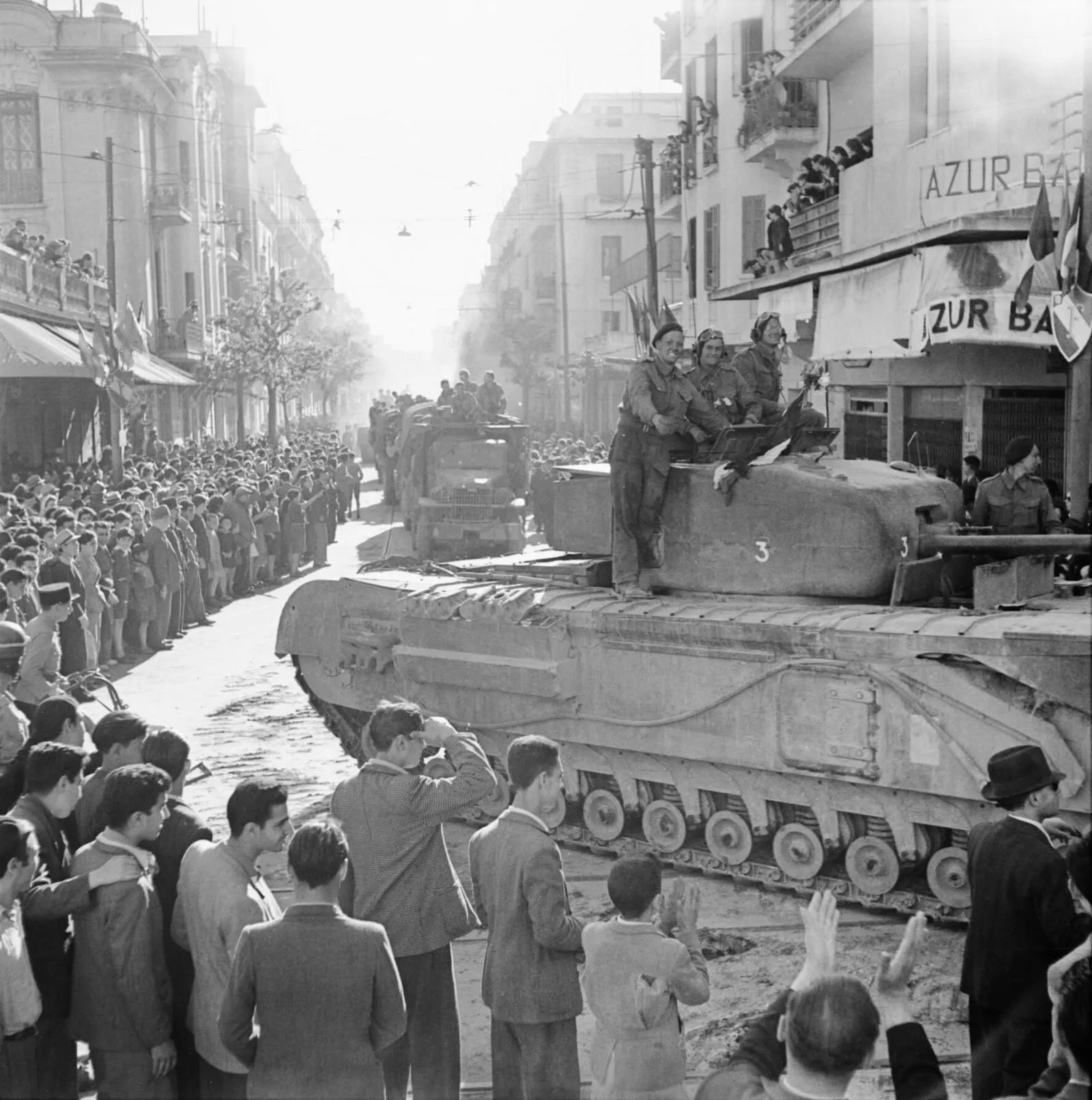
The Tunisian campaign was the last chapter of the war in North Africa and the first campaign in which the British, Americans and French fought side by side against the Germans and Italians. It began as an attempt to seize Tunis and Bizerte quickly, immediately after the landings in Morocco and Algeria. The attempt failed: the Axis powers moved first a corps and then a whole army into Tunisia by air and sea, and the autumn rains and mud halted the Allies a few dozen kilometres short of their goal. Through the winter both sides fought in the mountains, and in February 1943 the troops of Erwin Rommel, withdrawn from Libya, inflicted a painful defeat on the Americans at the Kasserine Pass. From March, however, the initiative passed to the Allies. The British Eighth Army broke through the Mareth Line in the south, and in April and May the combined Allied armies pushed the enemy into the north-eastern corner of the country. On 7 May 1943 Tunis and Bizerte fell, and on 13 May the last Axis units in Africa capitulated. By various calculations about a quarter of a million soldiers were taken prisoner – more than at Stalingrad.
Name and dates
Polish literature speaks of the Tunisian campaign or the battle for Tunisia; British literature of the “Tunisian Campaign”; the American official history of the “Northwest Africa” campaign, which also includes Operation Torch. The Germans wrote of the “Brückenkopf Tunesien”, the Tunisian bridgehead, and the Italians of the “Campagna di Tunisia”.
Most studies take 17 November 1942 as the start of the campaign. On that day General Walther Nehring took command of the new German corps in Tunis, and the British 36th Infantry Brigade, advancing along the coast towards Bizerte, ran into a German battle group for the first time at Djebel Abiod. The preceding days, 9 to 16 November, were taken up by the race for Tunis: both sides occupied ports and airfields without a fight, and the first Allied columns were only just approaching the border. The end is taken to be 13 May 1943, when the Italian First Army of Marshal Giovanni Messe, the last Axis formation still holding out on the African shore, capitulated.
The campaign falls into several distinct stages: the “race for Tunis” in November and December, ending in a winter stalemate (17 November – end of December 1942); the Axis offensives of January and February in the mountains of central Tunisia, including the battle of the Kasserine Pass (January – February 1943); the Allied victories in the south – at Medenine, on the Mareth Line, at Wadi Akarit and at El Guettar (March – April 1943); and the final offensive against Tunis and Bizerte (22 April – 13 May 1943).
Background
French Tunisia, a French protectorate since 1881, occupied a strategic point in the Mediterranean. Less than 150 kilometres separated it from Sicily, and the ports of Tunis and Bizerte lay roughly 200 kilometres from the airfields and ports of western Sicily. A convoy could make the crossing in a single night, covered by aircraft from both shores, whereas the voyage to Tripoli or Benghazi took many days and exposed the ships to attack from Malta. Whoever held Tunisia controlled the narrow passage between the eastern and western Mediterranean.
The country’s geography favoured the defender. In the west, along the border with Algeria, ran two parallel ranges of the Atlas Mountains, which the Allies called the Western Dorsal and the Eastern Dorsal, cut by only a few passes. Only in the north, between the mountains and the coast, did a road open towards Tunis – along the valley of the Medjerda river through Medjez el Bab and Tebourba. In the south the gap between the Matmata hills and the sea was closed by the Mareth Line, a system of French fortifications built in the 1930s against the Italians in Libya.
Operation Torch assumed that Tunisia would be taken by a rapid advance from Algeria, without a separate landing. When on 10 November 1942 Admiral François Darlan ordered the Vichy forces to cease fire, the French Resident-General in Tunisia, Admiral Jean-Pierre Esteva, remained loyal to Marshal Pétain and did not close the airfields to the Germans. Field Marshal Albert Kesselring had sent the first aircraft and paratroopers to Tunis as early as 9 November. Adolf Hitler and Benito Mussolini, who were losing Libya after the defeat at El Alamein, regarded the Tunisian bridgehead as the key to the defence of Italy and the whole of southern Europe. Hitler, as historians point out, believed it could be held for a very long time, thereby blocking Allied plans in the Mediterranean. At the same time, in response to the landings, the Germans and Italians occupied the unoccupied part of France.
General Georges Barré’s French troops in Tunisia joined neither side. Barré withdrew them from the towns westwards to a line from Teboursouk to Medjez el Bab and waited to see how events would unfold. Meanwhile Lieutenant General Kenneth Anderson’s British First Army – in the first days in practice two brigade groups of the 78th Infantry Division, Blade Force (an armoured group from the 6th Armoured Division), paratroopers and commandos – set off eastwards from Algeria. On 15 November its leading elements crossed the Tunisian border. At the other end of North Africa General Bernard Montgomery’s British Eighth Army was pursuing Rommel’s forces as they retreated from El Alamein, and on 13 November it recaptured Tobruk. Tunisia was to be the place where the two Allied arms – western and eastern – would at last meet.
Course of the campaign
The race for Tunis (17 November – 1 December 1942)
The Allied advance soon slowed. On 17 November at Djebel Abiod the 36th Brigade ran into a German battle group with tanks and paratroopers and was held up there for more than a week. The Luftwaffe dominated the roads, its aircraft flying from all-weather airfields near Tunis and Bizerte, while the Allies had to fly from distant bases in Algeria. On 19 November Nehring demanded that Barré let the Germans cross the bridge at Medjez el Bab. The French refused and beat off two attacks, but without tanks or heavy artillery they had to withdraw; this was the first battle between Vichy’s Armistice Army and the Germans. From 22 November, after the agreement between General Mark Clark and Darlan, French North Africa formally stood on the Allied side.
Anderson’s general offensive began on 25 and 26 November. In the north the 36th Brigade was ambushed at Jefna, where German paratroopers held the hills until the last days of the campaign. In the centre the 11th Brigade entered Medjez el Bab, which the Germans had abandoned, and Tebourba, while American light tanks of Blade Force burst onto the airfield at Djedeida and destroyed more than twenty aircraft. On 28 November the attack on Djedeida itself, some 20–30 kilometres from Tunis, collapsed under the fire of anti-tank guns. On 29 November Lieutenant Colonel John Frost’s British 2nd Parachute Battalion dropped at Depienne to threaten Tunis from the south; left without support, it spent several days fighting its way back and lost about half its strength. At no time in 1942 were the Allies closer to Tunis.
The Axis counter-attack at Tebourba (1–10 December 1942)
Meanwhile the fresh German 10th Panzer Division under General Wolfgang Fischer was arriving in Tunisia. On 1 December its battle groups struck from the north and east at the Allied salient at Tebourba. The fighting saw the first Tiger heavy tanks in Africa, from the 501st Heavy Tank Battalion. For four days the British 11th Brigade, the 2nd Battalion of the Hampshire Regiment and the American Combat Command B of the 1st Armored Division held out in the Medjerda valley, and then on the night of 3–4 December they withdrew from Tebourba. According to British figures the Hampshire battalion lost about three-quarters of its strength and the 1st Battalion of the East Surrey Regiment nearly 60 per cent; Combat Command B lost a large part of its tanks. The Allies fell back first to the hills above the river – Djebel el Ahmera, which the British called Longstop Hill, and Bou Aoukaz – and by 10 December to a line just east of Medjez el Bab. During the withdrawal on the night of 10–11 December Combat Command B abandoned dozens of tanks and vehicles on a waterlogged road.
On 8 December General Hans-Jürgen von Arnim flew into Tunis and took command of the new Fifth Panzer Army. Nehring, highly regarded as a commander but at odds with his superiors, left. Hitler promised Arnim several new divisions; the airlift and the convoys from Sicily were working at full stretch, and German and Italian aircraft covered them effectively.
Longstop Hill and the winter stalemate (December 1942 – January 1943)
General Dwight Eisenhower and Anderson wanted to renew the attack on Tunis before the end of the year. Its first step was to be the capture of Longstop Hill – a hill some 270 metres high that dominated the Medjerda valley between Medjez el Bab and Tebourba. On the afternoon of 22 December, in the rain and without adequate air cover, the 2nd Battalion of the Coldstream Guards attacked the slopes of the hill. By the morning of 23 December the Guardsmen had driven units of the 10th Panzer Division off the summit and handed the positions over to the US 18th Infantry Regiment. The Germans counter-attacked at once, and it turned out that the hill had a second, higher summit still in their hands. The Guards returned, but on 24 and 25 December, with their ammunition running out, the Allies had to fall back to Medjez el Bab. The Germans called the hill “Weihnachtshügel” – Christmas Hill. It remained in their hands until April 1943.
On 24 December, after conferring with Anderson at the front, Eisenhower called off the winter offensive. Downpours had turned roads and fields into a quagmire in which tanks and lorries bogged down, the forward airfields were unusable, and supplies reached the front along a single-track railway and winding roads from Algeria. That same day Darlan was shot dead in Algiers; General Henri Giraud took over French North Africa. The outcome of the “race for Tunis” was bitter for the Allies: the Axis had succeeded in building a strong bridgehead in Tunisia, and the Allies, who had counted on ending the fighting in Africa in 1942, had to prepare for a long campaign.
Throughout the winter both sides built up their forces. In the north the British First Army received further divisions (the 1st, 4th and 46th Infantry Divisions), and its command was divided between General Charles Allfrey’s V Corps and – from the spring – General John Crocker’s IX Corps. In the centre of the front, in the mountains of the Eastern Dorsal, stood the poorly armed French forces: General Louis-Marie Koeltz’s XIX Corps, part of the French army detachment of General Alphonse Juin. In the south, around Gafsa and Tébessa, Major General Lloyd Fredendall’s US II Corps deployed with the 1st Armored Division and the 1st and 34th Infantry Divisions. Giraud did not want to place the French under a British commander, so for a long time they came directly under Eisenhower’s headquarters; only at the end of January was Anderson given the task of coordinating the whole front, and Juin accepted his authority.
Arnim was not idle either. On 18 January he launched Operation Eilbote I (Courier I) against the French at the junction of the two Dorsals. The Germans advanced several dozen kilometres towards Ousseltia and Robaa and cut off several French battalions in the mountains; it took British and American reinforcements until 23 January to stabilise the front. On 30 January the 21st Panzer Division routed the French at the Faïd Pass, and belated American tank counter-attacks collapsed. The main pass of the Eastern Dorsal was in Axis hands.
Meanwhile Rommel was leading his army across Libya. On 23 January 1943 Eighth Army entered Tripoli, and the Axis troops were already taking up positions on the Mareth Line. Part of them was renamed the Italian First Army under General Giovanni Messe, who had come from the Eastern Front.
Sidi Bou Zid and Kasserine (14–25 February 1943)
The positions of the US II Corps in central Tunisia threatened a thrust to the coast at Sfax, which would have cut communications between Rommel’s army on the Mareth Line and Arnim’s forces in the north. Rommel decided to forestall this blow. On 14 February 1943, in Operation Frühlingswind (Spring Wind), the 10th and 21st Panzer Divisions from Arnim’s army struck through the Faïd Pass at Sidi Bou Zid. The Americans had deployed their units far apart, on hills that could not support one another. Combat Command A of the 1st Armored Division was smashed, infantry of the 168th Regiment were cut off on the hills, and the next day a counter-attack by Combat Command C broke down with heavy losses. On 17 February the Americans abandoned Sbeitla. In the south an Afrika Korps battle group, in Operation Morgenluft, occupied Gafsa, which the Allies had evacuated, and then Fériana and the airfield at Thélepte.
On 19 February Rommel, now given command of both panzer divisions, attacked the Kasserine Pass and Sbiba. The Comando Supremo imposed on him a northward axis, towards Thala and Le Kef, into the rear of the British First Army, instead of the thrust he had proposed against the American depots at Tébessa. At Sbiba the Germans were stopped by the British 1st Guards Brigade and American infantry. At the Kasserine Pass an improvised force under Colonel Alexander Stark, made up of American and French units, held out for a day, but on the afternoon of 20 February the defence collapsed, and German and Italian columns – including tanks of the Italian Centauro Armoured Division – broke out onto the plain. On 21 February, on the road to Thala, Rommel personally led an attack against the British 26th Armoured Brigade, which in heavy fighting, at the cost of severe tank losses, bought time for the defenders. During the night 48 guns of the US 9th Infantry Division reached Thala after a march of more than a thousand kilometres from Morocco, and their fire halted the German attack on the morning of 22 February. At Djebel el Hamra, on the road to Tébessa, Combat Command B beat off the Afrika Korps.
On 22 February Rommel concluded that a further advance had no chance of success and that Eighth Army was approaching in the south. Kesselring reluctantly agreed, and by 25 February the Axis forces were back in their positions. According to figures cited in the literature, II Corps lost some 300 killed, 3,000 wounded and 3,000 prisoners in this fighting, together with 183 tanks; German losses amounted to fewer than a thousand men and 20 tanks. The battle of the Kasserine Pass was the heaviest defeat suffered by the American army in the war against Germany. Years later Omar Bradley called it the worst performance of that army in its entire history.
The defeat, however, proved a lesson. The Americans stopped dispersing their units and improved cooperation between artillery and aircraft, and on 6 March General George Patton replaced Fredendall at the head of II Corps, with General Omar Bradley as his deputy. The command of the whole theatre also changed. In accordance with the decisions of the Casablanca Conference, on 20 February General Harold Alexander took command of the new 18th Army Group, comprising the First and Eighth Armies, and the Allied air forces in the Mediterranean were placed under Air Chief Marshal Arthur Tedder. Alexander was shocked by the disorder he found. On the Axis side, on 23 February Rommel took command of the new Army Group Africa.
Medenine, Mareth and El Guettar (March 1943)
In the north Arnim, convinced that the Allies had weakened this sector to save the south, launched Operation Ochsenkopf (Ox Head) against the British V Corps on 26 February. The attack, made in pouring rain, stalled before Béja and Medjez el Bab, among other places in the “trap” at Hunts Gap, and by 5 March had cost the Germans much of their infantry and most of the Tigers committed to the fighting. On the coast the Germans took Sedjenane, but this was the last major offensive of the Fifth Panzer Army.
In the south, on 6 March, Rommel struck with three panzer divisions at Eighth Army’s positions at Medenine. Montgomery, forewarned by reconnaissance and signals intelligence among other sources, had time to prepare an anti-tank defence. The attack collapsed within a single day; the Germans lost some 50 tanks, the British, by their own account, not a single one. This was Rommel’s last battle in Africa. On 9 March, ill and dispirited, he flew to Europe to persuade Mussolini and Hitler of the need to evacuate Tunisia. Hitler refused and kept him in Germany on sick leave, and Arnim took over command of Army Group Africa. On 10 March at Ksar Ghilane, on the desert flank of the Mareth Line, the French of General Philippe Leclerc’s force, which had come from Chad across the Sahara, beat off an attack by German armoured cars and aircraft.
On the night of 20–21 March Eighth Army attacked the Mareth Line frontally (Operation Pugilist). The 50th Infantry Division seized a bridgehead beyond the anti-tank ditch, but rain and mud prevented tanks and guns from being brought across, and on 22 March a counter-attack by the 15th Panzer Division and the Italian Giovani Fascisti Division retook most of the ground the British had won. Montgomery then shifted the weight of the attack to the flank. Lieutenant General Bernard Freyberg’s 2nd New Zealand Division, reinforced by Lieutenant General Brian Horrocks’s X Corps, outflanked the Matmata hills and on 26 March, with massive air support, broke through the defences in the Tebaga Gap (Operation Supercharge II). Messe had to abandon the Mareth Line and by the end of March had withdrawn his troops to a new position on the Wadi Akarit, north of Gabès.
At the same time Patton’s II Corps went over to the attack inland. On 17 March the Americans took Gafsa and then El Guettar. On 23 March the 10th Panzer Division attacked the US 1st Infantry Division at El Guettar, drove into a minefield and, under the fire of artillery and anti-tank guns, lost some 30 tanks. For the first time in the campaign the Americans had repulsed a German armoured attack in open battle. They failed, however, to break through the mountains to the coast and cut off Messe’s retreating army.
From 13 March the Polish Fighting Team was also in action over southern Tunisia – fifteen volunteers from the Polish Air Force under Captain Stanisław Skalski, flying Spitfires as a flight attached to No. 145 Squadron RAF. Known as “Skalski’s Circus”, by May it had, according to Polish figures, 25 confirmed kills, losing one pilot, who was taken prisoner. Also fighting on the British side was the Greek Sacred Band, and in Eighth Army there were divisions from India and New Zealand, as well as Leclerc’s French.
Wadi Akarit and the pursuit north (April 1943)
The position on the Wadi Akarit closed a narrow gap between the sea and salt marshes. On the night of 5–6 April Eighth Army attacked it in Operation Scipio. Soldiers of the 4th Indian Infantry Division, among them Gurkhas, silently seized the steep hills of Djebel Fatnassa in the darkness, while the 51st (Highland) and 50th Infantry Divisions forced the anti-tank ditch. After a day of Axis counter-attacks, on the morning of 7 April it turned out that Messe had withdrawn northwards. That same day, on the road from Gafsa to Gabès, patrols of the British Eighth Army met Americans of II Corps: the two arms of the Allied pincers had joined into a single front.
On 8 and 9 April IX Corps of the First Army tried to break through the Fondouk Pass to the coast and cut off Messe’s retreating army, but the US 34th Infantry Division was pinned down by fire from the hills, and the British tanks broke through too late. On 10 April Eighth Army entered Sfax, and on 12 April Sousse. The Axis forces halted only in the mountains north of Enfidaville, where on the night of 19–20 April the New Zealanders took the rocky peak of Takrouna after heavy fighting.
The fate of the bridgehead, however, was largely sealed by the severing of its supplies. Allied aircraft, submarines and surface ships from Malta and Bône destroyed the ships sailing from Sicily; in some months of the spring of 1943 most of the tonnage sent to Tunisia went to the bottom. From 5 April the air offensive Operation Flax struck at the airlift. On 18 April over Cap Bon American and British fighters shot down several dozen Ju 52 transports, and on 22 April they destroyed most of a formation of giant Me 323 Gigant aircraft. The Axis forces had less and less fuel and ammunition, and their air forces had to withdraw from the Tunisian airfields.
Operations Vulcan and Strike – the fall of Tunis and Bizerte (22 April – 13 May 1943)
Alexander planned the final offensive so that the main weight would rest on Anderson’s First Army, advancing from the west on Tunis, and on II Corps, which – now under General Bradley, since Patton had turned to planning the landings in Sicily – was moved from the south to the northern end of the front, opposite Bizerte. Eighth Army was to pin the enemy down at Enfidaville, and the French XIX Corps to attack in the centre.
Operation Vulcan began on 22 April. IX Corps broke through south of Medjez el Bab, but its tanks were stopped by a screen of anti-tank guns. In the Medjerda valley V Corps fought bitterly for the hills for eight days; in the course of this fighting, on 23–26 April, the British at last retook Longstop Hill. In the north the US 34th Infantry Division – the same division that had failed at Fondouk – took Hill 609 at the turn of April and May, opening the way to Mateur and Bizerte. Eighth Army’s attacks at Enfidaville stalled in the mountains, so Alexander transferred the British 7th Armoured Division, the 4th Indian Infantry Division and the 201st Guards Brigade to the First Army.
On the morning of 6 May, in Operation Strike, General Horrocks’s IX Corps attacked on a narrow front in the Medjerda valley, supported by massed artillery fire and air attacks. The infantry of the British 4th Infantry Division and the 4th Indian Infantry Division broke through the defences, and the 6th and 7th Armoured Divisions poured into the gap. On the afternoon of 7 May British armoured cars drove into Tunis, and American infantry of II Corps into Bizerte. The Axis front broke up into several isolated groups. British tanks swung towards Cap Bon to prevent an evacuation, and the ships of Admiral Andrew Cunningham patrolled the strait under the order “Sink, burn and destroy. Let nothing pass.” Only a few hundred people managed to escape to Italy.
On 9 May the remnants of General Gustav von Vaerst’s Fifth Panzer Army surrendered to Bradley. On 11 May some 22,000 Germans laid down their arms before the French in the mountains near Zaghouan. On 12 May Arnim was taken prisoner by the British 4th Indian Infantry Division. The Italian First Army at Enfidaville held out longest. On the evening of 12 May Mussolini, who had that day made Messe a Marshal of Italy, authorised him to capitulate, and on 13 May Messe surrendered to Freyberg’s New Zealanders. That day Alexander reported to Winston Churchill that the Tunisian campaign was over, that all enemy resistance had ceased and that the Allies were masters of the North African shores.
Losses
According to tallies cited in the literature, Allied losses in Tunisia – counted for the First Army from 8 November 1942 and for Eighth Army from 9 February 1943 – amounted to some 76,000 killed, wounded and missing. The British and Commonwealth troops lost more than 38,000 men (including over 6,000 killed), the French more than 19,000 (about 2,200 killed) and the Americans more than 18,000 (about 2,700 killed). The French losses, high in proportion to their numbers, were the price paid by poorly armed African regiments fighting in the front line.
Axis losses in killed and wounded are less well known; they are estimated at some 12,000 killed (8,500 Germans and 3,700 Italians) and 40,000–50,000 wounded. The number of prisoners, on the other hand, was enormous, though sources give differing figures. The British official history gives 238,243 unwounded prisoners (including some 102,000 Germans and 89,000 Italians), the American official history about 275,000, and the calculations of the 18th Army Group staff 244,500. Historians most often accept that about a quarter of a million Axis soldiers were taken prisoner, most of them in the last weeks of the fighting. Between November 1942 and May 1943 the Luftwaffe lost more than 2,400 aircraft in the Mediterranean, including a large part of its transport fleet.
Significance
The Tunisian campaign ended the war in North Africa that had been going on since 1940. The Allies controlled the entire southern coast of the Mediterranean, and the sea route from Gibraltar to Suez was opened – convoys no longer had to sail round Africa, which saved an enormous amount of shipping. North Africa became the base for the landings in Sicily in July 1943 and for further operations in Italy.
For the Axis powers the defeat was a catastrophe comparable to Stalingrad; in Germany people spoke of “Tunisgrad”. Hitler’s and Mussolini’s decision to defend Tunisia at all costs did delay the opening of the Mediterranean by six months, but it cost them several elite divisions, including the remnants of the Afrika Korps, and a large part of their transport aircraft. Italy lost her last colonies and her best troops, which hastened the fall of Mussolini’s regime in July 1943. The British official historian I. S. O. Playfair observed that had the Allies managed to cut the Axis lines of communication more quickly after the landings in Africa, they might have won the campaign in 1942 – and that had the Axis received the supplies it needed, it might have put off defeat for a long time.
The campaign was also a school of coalition warfare. The American army, which in Tunisia fought the Wehrmacht on a large scale for the first time, paid for its inexperience at Kasserine but quickly learned its lessons: it changed commanders, the way it used artillery and its cooperation with the air forces. Eisenhower, Alexander, Bradley and Patton, who held commands in Tunisia, went on to lead Allied armies in Europe. The French troops from North Africa, who returned to the fight against the Germans in Tunisia, became the nucleus of the army that later fought in Italy and France. On 20 May 1943 British, American and French troops marched past Eisenhower, Alexander and Giraud in a victory parade in Tunis.