United States
Albert Einstein
Theoretical physicist, creator of the theory of relativity, Nobel laureate (1921), professor at the Institute for Advanced Study in Princeton (1933–1955), signatory of the letter to Roosevelt (1939)
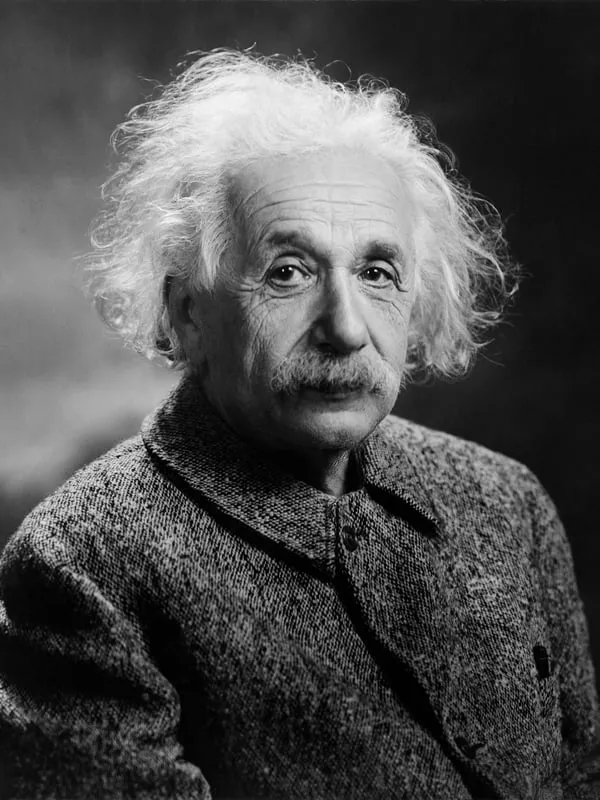
- Born:
- 14 March 1879, Ulm (German Empire)
- Died:
- 18 April 1955, Princeton (New Jersey, United States)
- Author:
- Natalia
- Photo:
- Oren Jack Turner, domena publiczna, Wikimedia Commons

Albert Einstein was the most famous scientist of the 20th century: the creator of the special and general theories of relativity, one of the fathers of quantum physics and the author of the equation E = mc², which became a symbol of the whole of modern science. Yet he earned his place in the history of the Second World War for a different reason. A German Jew, a pacifist and a democrat, he was a favourite target of nationalist hate campaigns in the Weimar Republic, and after Hitler came to power he became the best-known exile from the Third Reich. In August 1939, fearing a German atomic bomb, he signed a letter to President Franklin Delano Roosevelt that set off American work on nuclear weapons. For the rest of his life he regarded that signature as his greatest mistake.
Childhood and youth
He was born on 14 March 1879 in Ulm in the Kingdom of Württemberg, into an assimilated, non-religious Jewish family. His father Hermann was a merchant, and his mother Pauline, née Koch, came from a prosperous family of traders. In 1880 the family moved to Munich, where his father and his uncle Jakob ran a small electrical engineering firm. Albert developed an early interest in mathematics and physics. At the age of twelve he taught himself geometry and algebra, and in his spare time he played the violin, which remained his companion for the rest of his life.
In 1894 the firm failed and his parents left for Italy. Albert, who could not bear the barrack-room discipline of the German Gymnasium, soon abandoned school and joined his family. He passed his school-leaving examinations in 1896 in Aarau in Switzerland. At the beginning of that year, with his father’s consent, he renounced his Württemberg citizenship, partly to avoid service in the German army, and for several years he was stateless. From 1896 to 1900 he studied physics and mathematics at the Federal Polytechnic in Zurich. There he met a Serbian student, Mileva Marić, whom he married in 1903. They had two sons, Hans Albert and Eduard. In 1901 he obtained Swiss citizenship, which he kept until his death.
The miracle year
After graduating he could not find a university post. Only in 1902 did he obtain a position as an examiner at the federal patent office in Bern. As a third-class technical expert he assessed patent applications, doing physics in his own time. In 1905, known as his “miracle year”, he published four papers in Annalen der Physik, each of which transformed a field of physics. In the first he explained the photoelectric effect by assuming that light consists of packets of energy, later called photons. In the second he described Brownian motion, which became one of the decisive proofs that atoms exist. In the third he set out the special theory of relativity, according to which time and space are not absolute but depend on the motion of the observer. In the fourth he showed that mass and energy are equivalent. The equation E = mc² states that even a small mass contains an enormous amount of energy. Three decades later it turned out that part of it could be released by splitting the atomic nucleus.
Recognition came quickly. In 1909 Einstein became a professor at the University of Zurich, in 1911 at the German University in Prague, and in 1912 he returned to the Zurich Polytechnic. In 1913 Max Planck and Walther Nernst offered him membership of the Prussian Academy of Sciences, a professorship in Berlin with no teaching duties and the directorship of a planned institute of physics. In April 1914 Einstein moved to Berlin.
Berlin and the Great War
A few months later war broke out. In October 1914, 93 German scholars and artists, among them Planck and Nernst, signed a manifesto defending the conduct of the German army in Belgium. Einstein was one of only four signatories of a counter-manifesto, “To the Europeans”, written by the physician Georg Nicolai, which called for understanding across national divisions. He remained a pacifist throughout the war and was active in the Bund Neues Vaterland (New Fatherland League), which demanded a swift peace. None of this kept him from his work. In November 1915 he completed the general theory of relativity, according to which gravity is the curvature of spacetime by mass. In 1917 he became head of the Kaiser Wilhelm Institute for Physics. His marriage to Mileva broke down. His wife returned to Zurich with their sons in 1914, the divorce was granted in February 1919, and a few months later Einstein married his cousin Elsa.
General relativity predicted that starlight passing close to the Sun is deflected by a precisely defined angle. On 29 May 1919, during a total solar eclipse, this was tested by British expeditions organised by the astronomer Arthur Eddington. When it was announced in London in November 1919 that the measurements confirmed Einstein’s predictions, the world’s press hailed him as the man who had overthrown Newton. A German physicist whose theory had been confirmed by the British a year after the end of the war became, overnight, the most famous scientist in the world.
A target of hatred
Fame brought him enemies. In Germany after the defeat, Einstein – a Jew, a pacifist, a supporter of the republic and of reconciliation with the former enemies – embodied everything the nationalist right hated. In August 1920 a rally was held in the Berlin Philharmonic against the theory of relativity, which was presented as a “Jewish” hoax. The campaign was backed by the Nobel laureate Philipp Lenard and later by Johannes Stark, who in the Third Reich became the patrons of so-called German physics, which rejected “Jewish” relativity. After the murder in June 1922 of the foreign minister Walther Rathenau, a friend of Einstein’s, he was warned that he too was on the list of targets of right-wing assassins. For a time he gave up public appearances, and in the autumn he set off on a long journey to Japan, Palestine and Spain. During the voyage he learned that he had been awarded the Nobel Prize for 1921 – not for the theory of relativity, which was still contested, but for his explanation of the photoelectric effect.
From 1922 to 1932, with a short break, he was a member of the International Committee on Intellectual Co-operation of the League of Nations, on which Marie Skłodowska-Curie also sat and whose secretary in its early years was the Polish historian Oskar Halecki. He supported the Zionist movement, although he was not in favour of a Jewish state, and in 1921 he raised funds in America with Chaim Weizmann for the Hebrew University of Jerusalem. In those years he was a convinced pacifist. He urged young men to refuse military service, and in 1932, at the request of the League of Nations, he exchanged letters with Sigmund Freud on whether humanity could be delivered from war. That summer he signed an appeal to the Social Democrats and Communists to form a common front against the Nazis. In his scientific work in Berlin he dealt with the quantum theory of radiation and quantum statistics, and increasingly with the search for a unified field theory that would unite gravity and electromagnetism. Although he had helped to create modern quantum mechanics, he never reconciled himself to it (“God does not play dice”).
Exile
In December 1932 Einstein and Elsa left for another research stay at Caltech in Pasadena. He never returned to Germany. When Adolf Hitler became chancellor on 30 January 1933, Einstein declared that he would not live in a country without freedom and equality before the law. Police and Nazi stormtroopers searched his Berlin flat and his summer house in Caputh, and his property, including his beloved sailing boat, was soon confiscated. On 28 March 1933, immediately after landing in Antwerp, Einstein handed in his passport at the German consulate and renounced his citizenship, and then resigned from the Prussian Academy of Sciences. The Academy publicly accused him of spreading “atrocity propaganda” against Germany abroad. In May 1933 his books were burned in bonfires organised by Nazi students, while Joseph Goebbels proclaimed the end of “Jewish intellectualism”. The Reich authorities formally stripped him of his citizenship in March 1934.
Einstein spent the spring and summer of 1933 in the Belgian seaside resort of De Haan under police protection, as threats against him were appearing in the Nazi press in Germany. It was there that he changed his mind about pacifism. When Belgian pacifists asked him to support men refusing military service, he replied that, faced with a rearming Reich, in their place he would himself join the army to defend European civilisation. This about-turn disappointed many of his former allies, but Einstein did not retract it. He also worked to rescue scholars driven out of Germany. In September 1933 he wrote, among others, to the Turkish prime minister İsmet İnönü, asking him to take in German professors of Jewish origin. On 3 October he spoke at the Royal Albert Hall in London in defence of academic freedom, and a few days later he sailed for America.
Princeton
From October 1933 until the end of his life Einstein was a professor at the newly founded Institute for Advanced Study in Princeton. Elsa died at the end of 1936. Increasingly isolated from the mainstream of physics, Einstein worked on a unified field theory and argued with Niels Bohr over the interpretation of quantum mechanics. At the same time he signed dozens of guarantees, so-called affidavits, which enabled refugees from Germany and Austria to obtain American visas, and supported organisations helping Jews.
In the summer of 1939, while he was on holiday on Long Island, he was visited by a former Berlin colleague, the Hungarian physicist Leó Szilárd. Ever since the fission of uranium had been confirmed in America at the beginning of the year, Szilárd had feared that Germany would build an atomic bomb. Einstein, who by Szilárd’s account had “never thought of that”, agreed to lend his name. The letter dated 2 August 1939, written by Szilárd and signed by Einstein, warned President Franklin Delano Roosevelt that a chain reaction in uranium could be used to build “extremely powerful bombs of a new type” and that Germany might be working on it. Delivered to the President in October 1939, after the war had already begun, it led to the creation of a government committee on uranium. In 1940 Einstein signed two further letters urging action.
The Second World War
On 1 October 1940 Einstein became a citizen of the United States, while keeping his Swiss citizenship. He was not admitted to the Manhattan Project. In 1940 the army judged that a world-famous left-wing pacifist was a security risk, and the FBI had been collecting denunciations of him for years. From 1943 to 1946 he was a consultant to the Navy’s Bureau of Ordnance, where he worked on problems of explosives. In 1944 he wrote out by hand his 1905 paper on special relativity, the original of which had been lost. The manuscript was sold at auction for several million dollars in aid of war bonds.
Like many others, Einstein learned of the Holocaust of European Jewry from ever more horrifying reports. After the war he wrote that the Germans as a nation bore responsibility for the mass murders, and to the end of his life he refused all contact with German scientific institutions. He learned of the atomic bombing of Hiroshima and Nagasaki in August 1945 from the radio. According to his secretary, all he said, in German, was: “Oh, woe.”
Last years
After the war Einstein became one of the most outspoken opponents of the nuclear arms race. In 1946 he became chairman of the Emergency Committee of Atomic Scientists, which informed the public about the dangers of nuclear weapons. He advocated a world government that would control these weapons, criticised the building of the hydrogen bomb and McCarthyism, and urged intellectuals summoned before congressional committees to refuse to testify. In 1947 he told Newsweek that had he known the Germans would not succeed in building the bomb, he would have done nothing. In 1954 he confided to Linus Pauling that the letter to Roosevelt had been the one great mistake of his life, though there had been some justification for it at the time in the danger that the Germans would build the bomb first.
After the founding of Israel he supported the new state. When Israel’s first president, Chaim Weizmann, died in November 1952, Prime Minister David Ben-Gurion offered Einstein the office. Einstein declined, explaining that he had neither the experience nor the aptitude to hold it. On 11 April 1955 he signed an appeal drafted by the British philosopher Bertrand Russell, known as the Russell–Einstein Manifesto, which called on governments to renounce war as a means of settling disputes in the nuclear age. It was his last public act. A week later, on 18 April 1955, he died in hospital in Princeton after the rupture of an aortic aneurysm. He had refused surgery, saying that prolonging life artificially was in bad taste. His body was cremated and his ashes scattered at an undisclosed place.
Significance
Einstein’s scientific achievement reaches far beyond the history of the war: relativity and his quantum work are the foundations of modern physics, from cosmology to satellite navigation. On the road to the Second World War and in the war itself, however, his fate has a particular significance. The campaign against Einstein in the Weimar Republic shows how early the antisemitism of the German right reached into science. His exile in 1933 became a symbol of the exodus of scientists from the Third Reich, which deprived Germany of many of its finest physicists and strengthened the science of its future enemies. His signature on the 1939 letter, although it did not by itself decide that the bomb would be built, meant that the United States government took up nuclear weapons for the first time. Einstein, a pacifist who out of fear of Hitler helped to bring about the most terrible weapon in history, spent the rest of his life trying to limit its consequences. His story remains one of the most telling accounts of how war draws into its machinery even those who hate it most.
Sources
Often appears with
People who appear in the same events.