United States
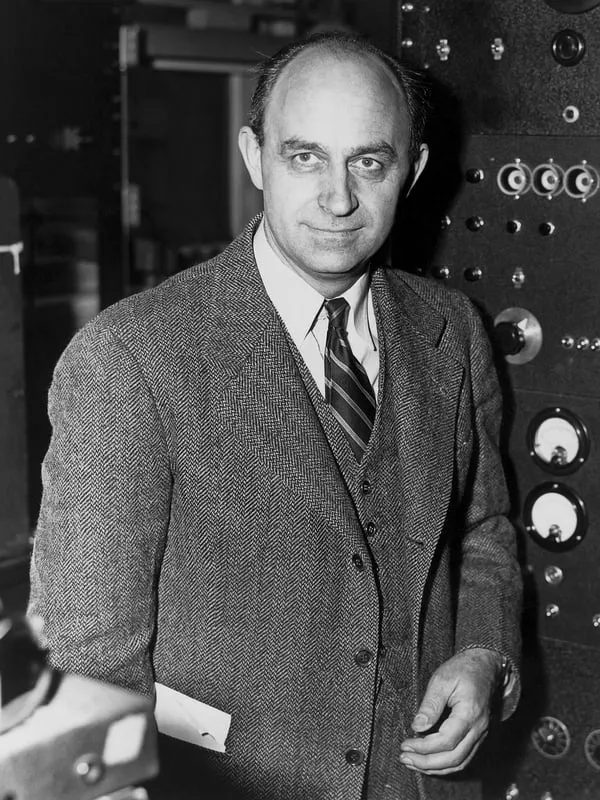
Enrico Fermi
Physicist, Nobel laureate in physics (1938), creator of the first nuclear reactor, Chicago Pile-1 (1942), associate director of the Los Alamos Laboratory (1944–1945)
- Born:
- 29 September 1901, Rome (Kingdom of Italy)
- Died:
- 28 November 1954, Chicago (Illinois, United States)
- Author:
- Łukasz
- Photo:
- Department of Energy-Office of Public Affairs, restored by Yann, domena publiczna, Wikimedia Commons

Enrico Fermi was the last great physicist who was equally at home developing theory and building his own experimental apparatus. His colleagues called him “the Pope” because in matters of physics he was considered infallible. At 37 he received the Nobel Prize for his work on neutrons, and a few days later, instead of returning to Fascist Italy, where racial laws threatened his Jewish wife, he sailed with his family to New York. Four years later, on 2 December 1942, beneath the stands of a stadium in Chicago, he started up the first nuclear reactor. In the history of the war he is – alongside Leo Szilard and Albert Einstein – one of the scientists driven out of Europe by the dictatorships without whom the United States would not have built the atomic bomb before the war ended.
Rome and Pisa
He was born on 29 September 1901 in Rome, the third child of Alberto Fermi, an official of the Ministry of Railways, and Ida de Gattis, a schoolteacher. As a boy he lost his beloved elder brother Giulio, who died in 1915 during an operation on a throat abscess; in his grief he threw himself into learning. With the help of a friend of his father’s, the engineer Adolfo Amidei, he worked his way through textbooks of mathematics and physics on his own, including some written in Latin. He finished secondary school in 1918, having skipped a year.
In the autumn of 1918 he sat the entrance competition for the elite Scuola Normale di Pisa. He came first, and his essay on the characteristics of sound, in which he used Fourier analysis and partial differential equations, was so mature that the examiner judged it worthy of a doctorate. In Pisa he quickly proved better than his teachers – it was he who taught them the new quantum physics and the theory of relativity. He obtained his doctorate in July 1922, aged 20. He then continued his training abroad: in 1923–1924 with Max Born in Göttingen, and in the autumn of 1924 with Paul Ehrenfest in Leiden. From 1925 he lectured at the University of Florence.
There, in 1926, he published the paper that secured his place in the history of theoretical physics: he applied the newly formulated Pauli exclusion principle to a gas of particles and described their statistical behaviour. The British physicist Paul Dirac arrived at the same result independently, which is why we now speak of Fermi–Dirac statistics, and the particles that obey it – electrons, protons, neutrons – are called fermions.
The Via Panisperna boys
In 1926, at the age of 25, he took up in Rome one of the first three chairs of theoretical physics in Italy, created on the initiative of Professor Orso Mario Corbino, an influential senator and former minister who wanted to raise the standard of Italian physics. Corbino helped him to assemble a team of gifted students and assistants: Franco Rasetti, Emilio Segrè, Edoardo Amaldi, Ettore Majorana and Bruno Pontecorvo. After the street on which the physics institute stood, they became known as the “Via Panisperna boys”. In July 1928 Fermi married a student, Laura Capon, the daughter of a naval officer from an assimilated Jewish family; they had two children, Nella (1931) and Giulio (1936).
Fermi’s career became intertwined with the regime of Benito Mussolini. In March 1929 the dictator appointed him a member of the newly created Royal Academy of Italy, which brought a high salary and the title of “Excellency”, and in April that year Fermi joined the Fascist Party. Membership was then almost a condition of a career in state science; Fermi himself took no part in politics and was no Fascist by conviction. He turned away from the regime when in 1938 it adopted racial laws on the German model.
In 1933–1934 Fermi published his theory of beta decay, in which he postulated a light, neutral particle that he named the neutrino, and introduced the interaction now called the weak interaction. The British journal Nature rejected the paper as too remote from physical reality; today it belongs to the canon of twentieth-century physics.
Neutrons
In January 1934 Irène and Frédéric Joliot-Curie induced artificial radioactivity by bombarding elements with alpha particles. Fermi had the idea of using neutrons instead, which, being neutral, are not repelled by the nucleus and do not require an accelerator – something the Rome group did not have. In March 1934 he announced the discovery of radioactivity induced by neutrons, and within a few months his team had worked its way in this manner through the elements up to uranium. In October 1934 he noticed that neutrons passed through paraffin induced radioactivity in silver up to a hundred times stronger. He guessed that the neutrons slowed down in collisions with hydrogen nuclei and were therefore more easily absorbed. The discovery of the effect of slow neutrons became the basis of every later reactor.
By bombarding uranium the Rome group obtained products that they took to be new elements heavier than uranium. As early as 1934 the chemist Ida Noddack suggested that the nucleus might have broken up into lighter fragments, but nobody, Fermi included, took the idea seriously. In fact the Rome team had been splitting uranium without knowing it. This was explained only at the end of 1938 by Otto Hahn and Fritz Strassmann in Berlin and by Lise Meitner and Otto Frisch.
Escape to America
In the summer and autumn of 1938 Fascist Italy adopted racial laws that excluded Jews from public life, schools and many professions. They affected Fermi’s wife and their children, as well as some of his colleagues; Segrè, who happened to be in California, never returned to Italy. Fermi decided to leave. When it was announced in November 1938 that he would receive the Nobel Prize in Physics – “for his demonstrations of the existence of new radioactive elements produced by neutron irradiation, and for his related discovery of nuclear reactions brought about by slow neutrons” – he used the journey to Stockholm as a pretext. After the ceremony on 10 December 1938 the family did not return to Rome but sailed via Copenhagen and Southampton to New York, where they landed on 2 January 1939. Fermi took up a chair at Columbia University. Laura’s father, Admiral Augusto Capon, remained in Italy; after the German round-up of Jews in Rome in October 1943 he was deported to Auschwitz, where he was killed.
A few weeks after Fermi’s arrival in America, Niels Bohr brought news of the discovery of fission. On 25 January 1939 the experiment was repeated at Columbia, and Fermi and Herbert L. Anderson, and in parallel Szilard and Walter Zinn, soon showed that fission releases additional neutrons, which made a chain reaction possible. On 18 March 1939 Fermi, one of the first scientists to warn the military of this possibility, gave a talk at the Navy Department in Washington. He was received coolly – the navy granted only $1,500 for further research. The government programme began only after Einstein’s letter to Roosevelt of August 1939, drafted by Szilard.
Fermi and Szilard, though very different in character – the methodical, cautious Italian and the restless Hungarian brimming with ideas – together designed the graphite and uranium pile. In 1940–1941 Fermi’s team assembled ever larger experimental piles at Columbia. After Pearl Harbor and Italy’s declaration of war on the United States in December 1941, Fermi formally became an “enemy alien”: he had to ask permission to travel, and his correspondence and conversations were monitored.
Chicago Pile-1
In 1942 Arthur Compton concentrated reactor work at the Metallurgical Laboratory of the University of Chicago, and Fermi moved there with his team. Beneath the stands of the Stagg Field stadium he built a pile of around 400 short tons (about 360 tonnes) of graphite and several dozen tons of uranium and uranium oxide. On 2 December 1942, directing every step of the experiment from the balcony of the hall and calculating on his slide rule, he brought it to criticality: at 3.25 p.m. the first self-sustaining, controlled chain reaction took place in Chicago Pile-1. Compton passed the news to James Conant in a coded message: “The Italian navigator has landed in the New World.”
Hanford and Los Alamos
After the success of the pile Fermi directed research at the site in the Argonne Forest outside Chicago, to which the reactor had been moved, and from May 1944 he was director of the facility. He was present at the start-up of the X-10 reactor at Oak Ridge in 1943, and in September 1944 he personally inserted the first fuel slug into the great B Reactor at Hanford in Washington State, which was to produce plutonium. When after a few hours of operation the reactor unexpectedly began to shut down, Fermi helped to identify the cause: the neutron-absorbing xenon-135, a fission product. The problem could be overcome because DuPont’s engineers had designed the reactor with spare fuel channels. On 11 July 1944 Fermi and his wife became citizens of the United States.
In the summer of 1944 Robert Oppenheimer brought him to the Los Alamos laboratory in New Mexico, where the bomb was being designed. Fermi became associate director and took charge of F Division, named after him, which dealt with problems that fitted nowhere else – among them Edward Teller’s idea of a thermonuclear bomb. Young physicists came to him as to an oracle. On 16 July 1945 he watched the Trinity test, the first nuclear explosion in history. When the blast wave arrived, he let scraps of paper fall from his hand, paced out how far they had been carried, and estimated the yield at about 10 kilotons of TNT; the actual figure was about 18–21 kilotons.
With Oppenheimer, Compton and Ernest Lawrence, Fermi sat on the scientific panel advising the Interim Committee of the Secretary of War, Henry Stimson. In June 1945 the panel concluded that it could propose no technical demonstration likely to end the war and saw no acceptable alternative to direct military use of the bomb. On 6 and 9 August 1945 the bombs were dropped on Hiroshima and Nagasaki; the second, a plutonium bomb, was the fruit of the road that had begun in Chicago in December 1942.
After the war
In 1945 Fermi returned to the University of Chicago, where he helped to found the Institute for Nuclear Studies, named after him following his death. There he trained a generation of physicists, among them future Nobel laureates. From 1946 to 1950 he sat on the General Advisory Committee of the Atomic Energy Commission. When, after the first Soviet nuclear test in August 1949, the building of a hydrogen bomb was under consideration, Fermi and Isidor Isaac Rabi wrote a sharply worded minority annex to the committee’s report: they called a weapon of unlimited destructive power “an evil thing considered in any light”. President Truman nevertheless decided in January 1950 to build it, and Fermi, reasoning that if the bomb was to be built it had better be built well, helped with the calculations at Los Alamos. In 1954 he testified in Oppenheimer’s favour before the board that stripped him of his security clearance.
Also part of the history of science are the question he asked over lunch at Los Alamos – “Where is everybody?” – which gave its name to the Fermi paradox, and his habit of estimating on a scrap of paper quantities that nobody knew how to measure. In the autumn of 1954 he was found to have inoperable stomach cancer. He died in Chicago on 28 November 1954, aged 53. His name is borne by the element fermium, discovered in the debris of the first thermonuclear test, by the Fermilab accelerator laboratory and by an award conferred by the United States government.
Significance
Fermi was neither a politician nor a soldier, yet his life says a great deal about the Second World War. Fascist Italy, which made him an academician in 1929, drove him out of the country with its racial laws nine years later. The scientist who in Rome had unwittingly split uranium built in Chicago, for a state at war with his homeland, the reactor that began the production of plutonium for the atomic bomb. He himself regarded this work as a duty to the country that had taken him in and rarely spoke in public about the moral side of the bomb, but after the war he was among those who wanted to set limits to the arms race. In the history of the war, 2 December 1942 remains his day.
Sources
Often appears with
People who appear in the same events.