United States
Leo Szilard
Physicist, originator of the idea of the nuclear chain reaction (1933), initiator of Einstein’s letter to Roosevelt (1939), chief physicist of the Metallurgical Laboratory in Chicago (1942–1946)
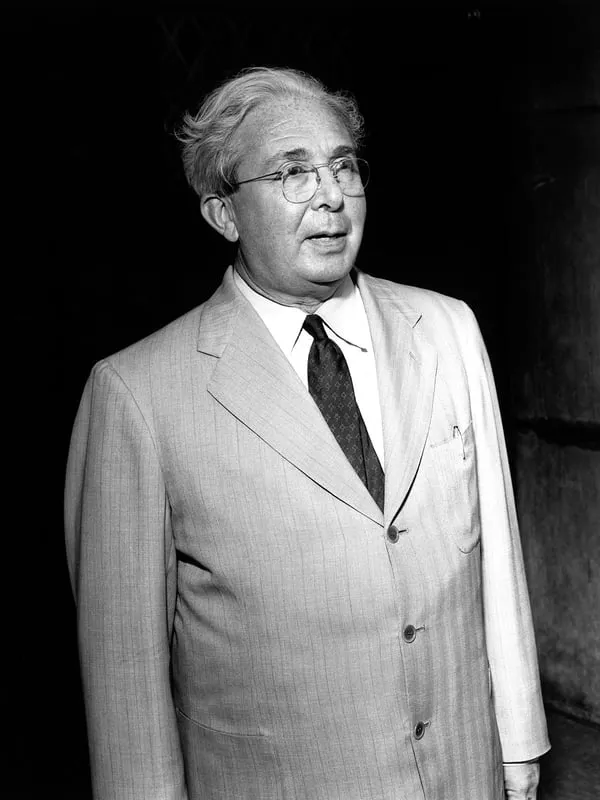
- Born:
- 11 February 1898, Budapest (Austria-Hungary)
- Died:
- 30 May 1964, La Jolla (California, USA)
- Author:
- Łukasz
- Photo:
- U.S. Department of Energy, domena publiczna, Wikimedia Commons

Leo Szilard was a physicist, an inventor and a perpetual wanderer who throughout his adult life lived in hotels and kept his suitcases packed. The habit saved him in 1933 when, as he told the story, he left Hitler’s Germany the day before the authorities began stopping trains at the border and questioning passengers. A few months later, in a London street, he hit upon the idea of the nuclear chain reaction, on which both nuclear power and the atomic bomb rest. In 1939, when the discovery of uranium fission had made that idea a real possibility, it was he who persuaded Albert Einstein to sign the letter that led President Roosevelt to start research on nuclear weapons. Six years later he tried to stop the weapon being used against Japan. His life is the clearest example of how the policies of Nazi Germany drove out of Europe the scientists who then helped to defeat it.
Budapest
He was born on 11 February 1898 in Budapest as Leó Spitz, the eldest of three children of Lajos Spitz, a civil engineer, and Tekla, née Vidor. The family was Jewish, prosperous and assimilated. In 1900, like many Jewish families in Hungary, they exchanged their German surname for the Hungarian Szilárd, meaning “firm” or “solid”. Leó attended a modern secondary school (Realschule) in Budapest, took an interest in physics and politics, and in 1916 began studying engineering at the technical university. In 1917 he was called up into the Austro-Hungarian army as an artillery officer cadet. In the autumn of 1918, before leaving for the front, he caught Spanish flu and was sent to hospital. He later learned that his regiment had been almost completely wiped out.
After the war Hungary sank into chaos. Szilard was then convinced of the case for socialism, though not for the communism of Béla Kun, and with his brother Béla he founded an association of socialist students. After the fall of the Hungarian Soviet Republic and the seizure of power by the camp of Miklós Horthy, antisemitism grew. Nationalist students barred the Szilard brothers from continuing their studies, even though they had formally converted to Calvinism. On 25 December 1919 Leó left for Germany by way of Austria.
Berlin
From 1920 he studied in Berlin, first engineering at the technical university in Charlottenburg and then physics at the Friedrich Wilhelm University, where Albert Einstein, Max Planck and Max von Laue taught. There he met other young Hungarians: Eugene Wigner, John von Neumann and Dennis Gabor. In 1922 he was awarded his doctorate in thermodynamics with the highest distinction, for a thesis that Einstein praised. In 1927 he became a Privatdozent (university lecturer). His paper on Maxwell’s demon, published in 1929, was the first to link entropy with information and after the war came to be regarded as one of the foundations of information theory.
Szilard was above all an inventor. In Germany he filed patent applications for a linear accelerator in 1928, a cyclotron in 1929 and an electron microscope in 1931. He built none of these devices, and the fame and the Nobel Prizes later went to others. For several years he worked with Einstein on a refrigerator without moving parts, for which the two obtained patents. In 1930 he became a German citizen. Politics already troubled him. He owed much to his reading of H. G. Wells, whom he met in 1929, and he tried to organise an international association of progressive intellectuals. In 1932, during a visit to the United States, he tried to organise a boycott of Japan by scientists in protest against the Japanese invasion of Manchuria.
After Adolf Hitler became Chancellor on 30 January 1933, Szilard urged his family and friends to leave Europe. He himself left Berlin on 31 March 1933, the eve of the boycott of Jewish shops, and travelled via Vienna to London, arriving at the beginning of May. Under the law of April 1933 the university withdrew his right to teach.
England and the chain reaction
In London he first helped others. He played a part in founding the Academic Assistance Council, an organisation that found work for scholars driven out of Germany and by 1939 had helped more than 2,500 of them. In September 1933 he read in The Times a report of a speech by Ernest Rutherford, who had dismissed hopes of obtaining energy from the transformation of atoms as moonshine. Irritated, while walking through Bloomsbury he realised that a neutron, a particle with no charge, might trigger a nuclear transformation that released two new neutrons, which in turn would trigger further transformations. This was the origin of the idea of the nuclear chain reaction and of critical mass.
From March 1934 Szilard filed patent applications in Britain describing the chain reaction. Having read Wells’s The World Set Free, he knew what it could be used for, and in 1936 he assigned the patent to the British Admiralty so that it would remain secret. He did not know, however, which element could sustain the reaction. He tried beryllium, then indium, without success. At St Bartholomew’s Hospital in London he and Thomas Chalmers discovered a method of separating radioactive isotopes, and from 1935 he worked at the Clarendon Laboratory in Oxford. Most physicists, including Rutherford, Niels Bohr and Enrico Fermi, did not take his fears seriously.
Convinced that war in Europe was inevitable, he left for the United States at the beginning of 1938. After the Munich Agreement of September 1938 he decided not to return to England.
The letter to Roosevelt
In January 1939 news reached America that in Berlin Otto Hahn and Fritz Strassmann had split the uranium nucleus. Szilard at once understood that uranium might sustain a chain reaction. At Columbia University he borrowed money for a neutron source and at the beginning of March 1939, with Walter Zinn, showed that fission releases new neutrons. He knew what this meant. He tried to persuade physicists in the West to stop publishing the results of research on uranium, but Frédéric Joliot-Curie published his measurements. With Fermi he carried out the first experiments with uranium and water, and then proposed the uranium–graphite arrangement on which the first reactor was later based.
He feared that Germany, which had access to uranium from Czechoslovakia, occupied since March 1939, would build a bomb first. In July 1939, together with Wigner and then with Edward Teller, he visited Einstein on Long Island and prepared a letter to President Franklin Delano Roosevelt. Einstein signed it on 2 August 1939. The economist Alexander Sachs delivered the letter to the President on 11 October, after war had already broken out in Europe. Roosevelt set up an Advisory Committee on Uranium, which at its first meeting granted Szilard and Fermi a modest $6,000 to buy graphite.
The Manhattan Project
From 1942 Szilard worked at the Metallurgical Laboratory of the University of Chicago, where the first reactor was being built. He arranged supplies of pure uranium and graphite and discovered that ordinary graphite contained boron, which absorbs neutrons. Had he not noticed this, the Americans might have concluded that graphite was unsuitable, as the German physicists did. On 2 December 1942 he was present when the Chicago Pile-1 reactor was started up and Fermi’s team achieved the first controlled chain reaction. With Fermi he was co-author of the patent for the nuclear reactor.
His relations with the leadership of the Manhattan Project were poor. General Leslie Groves regarded the independent-minded Hungarian, with his awkward questions, as a security risk and wanted to dismiss him, and even to have him interned for the rest of the war. The Secretary of War, Henry Stimson, refused. In March 1943 Szilard became an American citizen, and under pressure from Groves he sold his patent rights to the government.
Against the bomb
When Germany capitulated in 1945 and the bomb was close to completion, Szilard concluded that using it against Japan would be a moral and political mistake that would start an arms race with the Soviet Union. He tried to reach Roosevelt, who died before reading his memorandum, and then President Harry Truman. He managed to see only the future Secretary of State, James Byrnes, who did not share his fears and believed that the bomb would make the Soviet Union more amenable. He was a co-author of the Franck Report, which proposed demonstrating the bomb’s power on an uninhabited area. On 17 July 1945 he addressed to Truman a petition, signed by several dozen scientists in Chicago, asking that the bomb not be used until Japan had been told the terms of surrender and had rejected them. The petition, passed up through official channels by the project’s leadership, did not reach the President before the atomic bombings of Hiroshima and Nagasaki on 6 and 9 August 1945.
After the war
After the war Szilard campaigned successfully against a bill that would have given the military control over nuclear energy, and with Einstein he helped to found the Emergency Committee of Atomic Scientists. Disillusioned with physics, from 1946 he turned to biology. At the University of Chicago he and Aaron Novick invented the chemostat, a device for the continuous culture of bacteria, and he studied regulatory mechanisms in cells. He warned against the hydrogen bomb and against a bomb whose radioactive fallout could threaten all humanity. In 1951 he married Gertrud Weiss, a physician whom he had known since his Berlin days.
He worked for an understanding between East and West. He took part in the Pugwash conferences, and in 1960, when Nikita Khrushchev visited New York, he talked with him and proposed, among other things, a direct line of communication between Moscow and Washington – a link that was set up after the Cuban Missile Crisis. In 1959 he was diagnosed with bladder cancer; he designed his own radiation treatment and recovered. In 1962 he founded the organisation that, as the Council for a Livable World, supported politicians who favoured arms control. He spent his last months at the Salk Institute in La Jolla, California, where he died of a heart attack in his sleep on 30 May 1964.
Significance
Szilard never received a Nobel Prize and long remained in the shadow of Fermi, Oppenheimer and Einstein, even though the most important steps on the road to nuclear weapons began with him: the idea of the chain reaction in 1933, the first evidence that uranium could sustain it, and the letter that convinced Roosevelt. His life illustrates the consequences of the Third Reich’s policies. A Hungarian Jew, driven out first from Horthy’s Hungary and then from Hitler’s Germany, he helped to build the weapon he had most feared Germany would build. He was also one of the first to understand that this weapon would change the post-war world, and for the rest of his life he tried to limit the danger he himself had helped to create.
Sources
Often appears with
People who appear in the same events.