United States
Leslie Groves
US Army Corps of Engineers officer, supervisor of the construction of the Pentagon (1941–1942), director of the Manhattan Project (1942–1947)
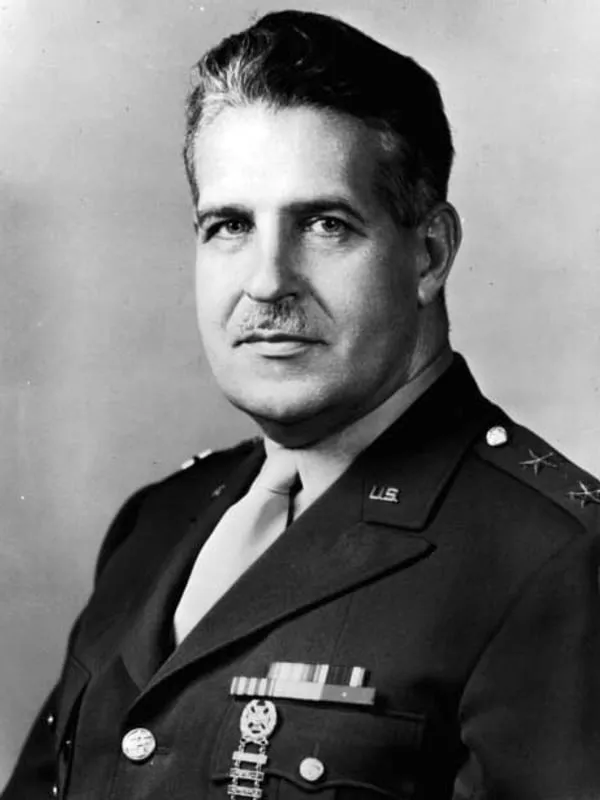
- Born:
- 17 August 1896, Albany (New York, USA)
- Died:
- 13 July 1970, Washington, D.C.
- Author:
- Łukasz
- Photo:
- autor nieznany, domena publiczna, Wikimedia Commons

Leslie Richard Groves was a career officer of the US Army Corps of Engineers who spent most of his service building barracks, canals and waterworks. In 1941–1942 he supervised the construction of the Pentagon, and from September 1942 he directed the Manhattan Project – the programme that in less than three years produced the first atomic bombs, used against Japan in August 1945. He was neither a scientist nor a combat commander but an organiser: he harnessed Nobel laureates, great industrial corporations and the army to an undertaking without precedent. Those who worked with him found him insufferable and, at the same time, indispensable.
Childhood and West Point
He was born on 17 August 1896 in Albany, the capital of New York State, the third of four children of Leslie Richard Groves Sr, a Presbyterian minister, and Gwen, née Griffith. A few months later his father joined the army as a chaplain, so the boy grew up in garrisons in the western United States: at Vancouver Barracks in Washington State, at Fort Apache in Arizona, in California and in Montana. His father served in the Spanish–American War in Cuba and the Philippines. At Fort Harrison in Montana the young Groves met Grace Wilson, an officer’s daughter, whom he married in 1922; they had a son and a daughter.
After finishing high school in Seattle he studied at the University of Washington and at the Massachusetts Institute of Technology while preparing for the military academy entrance examinations. At his second attempt, in 1916, he won a place at West Point. Because the United States had entered the First World War, his class graduated early, on 1 November 1918, ten days before the Armistice. Groves finished fourth in his class, which allowed him to choose the most prestigious branch, the Corps of Engineers. He never reached the front; in 1919 he made only an instructional tour of the battlefields of France.
A peacetime engineer
For Groves the interwar years were a time of slow promotion and varied assignments. He commanded engineer companies in Georgia, Washington State and Hawaii and worked on dredging canals and harbours in Texas; during the New England floods of 1927 his career nearly came to an end when a superior blamed him for a pontoon bridge swept away by the water, and the Chief of Engineers came to his defence. In 1929 he went to Nicaragua with an expedition surveying the route of a proposed interoceanic canal. After the earthquake that devastated Managua in 1931 he took charge of rebuilding the city’s water supply, for which he received a Nicaraguan decoration.
He was not made captain until 1934, after sixteen years of service. He completed the Command and General Staff School at Fort Leavenworth (1935–1936) and the Army War College (1938–1939), and in July 1939 he joined the General Staff in Washington. His efficiency reports described him as an energetic, demanding and meticulous officer, but a difficult one to work with.
Builder of the army and the Pentagon
When the United States introduced conscription in 1940 and began to expand its army, Groves, promoted to major on 1 July, became special assistant for construction to the Quartermaster General. The Quartermaster Corps’ construction division, which was to prepare camps for some two million soldiers within a few months, was mired in delays and cost overruns, and the press accused it of incompetence. In November 1940 Groves, made a temporary colonel, took over its contracts branch and imposed strict discipline: weekly reports, construction priorities, payment of contractors within a week, and special troubleshooters sent to sites short of materials. By mid-December 1940 the worst of the crisis was over. Groves later recalled that in those weeks decisions worth millions of dollars were taken every few dozen paces along a corridor.
In August 1941 the head of the construction division, General Brehon Somervell, put him in charge of building a vast headquarters for the War Department in Arlington, just outside Washington, which was to house 40,000 employees then scattered across more than a dozen buildings. The five-sided Pentagon, twice the size of the Empire State Building, was the largest office building in the world. At the peak 13,000 people worked on the site; the first staff moved in as early as the end of April 1942, and the whole building was completed in January 1943. During this time Groves also oversaw hundreds of other military projects – camps, airfields, munitions plants – worth billions of dollars in total. He worked six days a week and spent his Sundays touring construction sites. He hoped finally to be given an overseas posting.
Head of the Manhattan Project
Instead, on 17 September 1942, Somervell, by then head of the Army Service Forces, told him that the Secretary of War, Henry Stimson, had chosen him for a very important task and that President Franklin Delano Roosevelt had approved the choice. The task was the atomic bomb programme, set in motion by Einstein’s letter of 1939 and being taken over by the army since June 1942. Groves knew of it from his post and was disappointed. Under his direction the programme, hitherto run cautiously by Colonel James C. Marshall, gathered pace within days: Groves bought from the Belgian company Union Minière some 1,200 tons of rich Congolese uranium ore stored on Staten Island, decided to build plants in Tennessee, where the town of Oak Ridge grew up, and forced the War Production Board to grant the project the highest priority for supplies. On 23 September 1942 he was promoted to brigadier general and formally took charge; the same day the Military Policy Committee, to which he answered, was set up.
Groves took decisions that the scientists had been afraid to take. He resolved to build large plants for several methods at once – electromagnetic separation and gaseous diffusion for uranium, and reactors for plutonium – before laboratory experiments had shown which would work. He entrusted plutonium production to DuPont, which built the reactors at Hanford in Washington State. His most famous personnel decision was the choice of Robert Oppenheimer as director of the weapons laboratory at Los Alamos in New Mexico, a site the two men chose together in November 1942. Oppenheimer had neither administrative experience nor a Nobel Prize, and counter-intelligence distrusted him because of his communist acquaintances. In July 1943 Groves personally ordered that he be given security clearance. The physicist Isidor Rabi called the choice a stroke of genius on the part of a general “who was not generally considered to be a genius”.
Secrecy, uranium and intelligence
Groves surrounded the programme with a secrecy unknown to any earlier civilian or military undertaking. He introduced compartmentalisation, under which each worker knew only his own part of the task; of the more than a hundred thousand people employed at the peak, almost none knew what they were working on. The scientists chafed at the rule, and with some of them, above all Leo Szilard, the general was in open conflict. Yet the secret could not be kept: Soviet intelligence recruited several informants within the project, among them Klaus Fuchs of the British mission, which hastened the building of the Soviet bomb.
Groves’s distrust extended to the British as well. His restrictive policy on the exchange of information contributed to a crisis in the two countries’ atomic relations that was resolved only by the Quebec Agreement of August 1943. Groves also looked after raw materials: in 1944 he became head of the British–American–Canadian Combined Development Trust, which bought up uranium and thorium ores around the world, above all from the Shinkolobwe mine in the Belgian Congo. From 1943 the Manhattan District was also responsible for intelligence on the German atomic programme. The teams of the Alsos Mission, created by Groves, followed the Allied armies through Italy, France and Germany, detaining German physicists and seizing documents and stocks of uranium. They established that the Germans had been far from a bomb. On 9 March 1944 Groves was promoted to major general.
Hiroshima and Nagasaki
In 1944 Groves agreed with the commander of the Army Air Forces, General Henry H. Arnold, that the bombs would be carried by B-29 bombers, and secured the creation of a special unit under Colonel Paul Tibbets. In 1945 a joint committee of the District and the air forces selected the Japanese cities that were to be targets. Groves pressed hard for Kyoto, but Stimson, aware of the former capital’s importance to Japanese culture, refused several times and struck it off the list. On 16 July 1945 Groves witnessed the first nuclear explosion in the New Mexico desert. It was he who drafted the order of 25 July 1945 directing that the bomb be used after 3 August against one of the designated cities. On 6 August the Little Boy bomb destroyed Hiroshima, and on 9 August Fat Man destroyed Nagasaki. By the end of 1945, according to various estimates, between some 110,000 and more than 200,000 people had died in the two cities.
For his direction of the project Groves received the Distinguished Service Medal; the British made him an honorary member of the Order of the Bath, and the Belgians awarded him the Order of the Crown.
After the war
Groves headed the Manhattan District until 1 January 1947, when responsibility for nuclear weapons and nuclear energy passed to the civilian Atomic Energy Commission. He then became head of a new military agency, the Armed Forces Special Weapons Project, responsible for the military aspects of nuclear weapons. His standing, however, soon declined. On 30 January 1948 the Army Chief of Staff, General Dwight Eisenhower, set out a long list of complaints about his arrogance, disregard for regulations and lobbying for promotion, and made it clear that Groves would never become Chief of Engineers. Groves left the army on 29 February 1948. By a special act of Congress he was given, on his departure, the rank of lieutenant general, backdated to 16 July 1945, the day of the Trinity test.
He became a vice-president of Sperry Rand, where he worked until 1961. In 1954 he testified at the hearing on Oppenheimer’s security clearance: he defended his wartime decision but admitted that under the new criteria he would not have granted him clearance. In 1962 he published his memoir of the Manhattan Project, Now It Can Be Told. He died of heart disease on 13 July 1970 at Walter Reed Army Hospital in Washington and was buried at Arlington National Cemetery.
Significance
Groves was one of the key figures of the Second World War, although he never commanded in battle. His closest associate, Kenneth Nichols, called him “the biggest S.O.B.” he had ever worked for, yet admitted that if he had to build the bomb again he would choose Groves to lead it. The ruthlessness, stubbornness and organisational talent that made him a difficult superior made it possible to build from scratch, in less than three years, a whole industry and a weapon that helped to end the war with Japan and opened the nuclear age. Historians agree that without his energy the bomb would not have been ready during the war; they disagree, however, about how far his drive to use the finished weapon as quickly as possible influenced the decisions of the summer of 1945.
Sources
Often appears with
People who appear in the same events.