United States
Frank Jack Fletcher
Commander of Task Force 17 (1942), tactical commander at the Coral Sea and Midway (1942), Commander, North Pacific Force (1944–1945), admiral
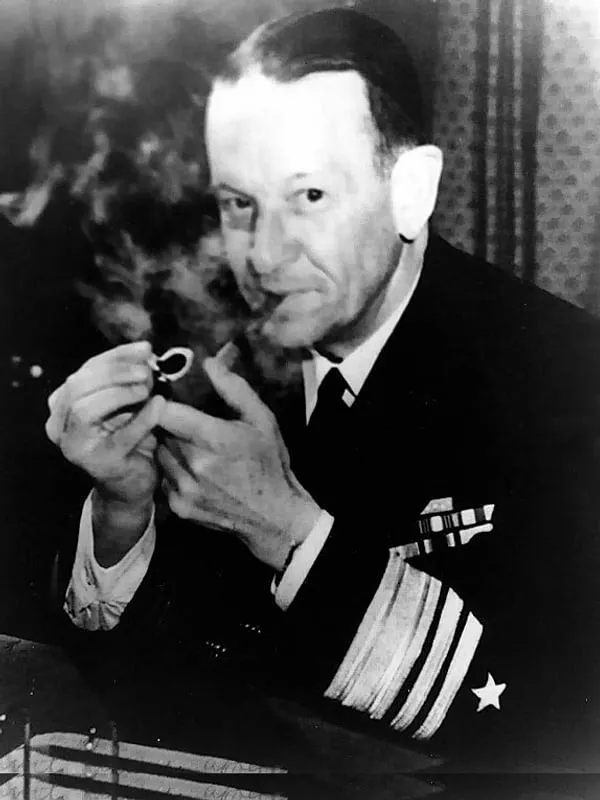
- Born:
- 29 April 1885, Marshalltown, Iowa (United States)
- Died:
- 25 April 1973, Bethesda, Maryland (United States)
- Author:
- Łukasz
- Photo:
- autor nieznany, domena publiczna, Wikimedia Commons

Frank Jack Fletcher commanded the American carriers in the first and hardest year of the Pacific war. It was he who led the forces that in May 1942, in the Coral Sea, stopped the Japanese landing at Port Moresby, and in June at Midway sank four of Chūichi Nagumo’s carriers. In 1942 the forces under his command sank six Japanese carriers in all – more than under any other admiral of the war. Yet in popular memory Fletcher has remained in the shadow of Raymond Spruance and William Halsey, and for decades he was regarded as an admiral cautious to a fault, who had abandoned the relief of Wake and left the Marines on Guadalcanal in the lurch. He was, moreover, a surface officer – a “black shoe”, as naval aviators called such men – who learned the art of commanding carriers in the course of the war. His life is therefore also the story of how the US Navy learned a new kind of war in the space of a few months.
The admiral’s nephew
He was born on 29 April 1885 in Marshalltown, Iowa, far from the sea, to Thomas Fletcher and Alice, née Glick, the daughter of a German settler. The way into the navy was shown him by his uncle, Frank Friday Fletcher, a naval officer who later rose to the rank of admiral. In 1902 Frank Jack entered the Naval Academy at Annapolis, graduating on 12 February 1906. After the two years at sea then required, he was commissioned as an ensign in February 1908.
He spent his first years in battleships of the Atlantic Fleet and, from 1909, in the Far East with the Asiatic Torpedo Flotilla. As early as 1910, as a very young officer, he took command of the destroyer Dale, and in 1912 of the destroyer Chauncey. At the end of 1912 he moved to the battleship Florida, which in 1914 was the flagship of his uncle, then commanding a division in the Gulf of Mexico.
Veracruz and the First World War
In April 1914, during the Mexican Revolution and the dispute between President Woodrow Wilson and General Victoriano Huerta, the US Navy occupied the port of Veracruz. The landing force was commanded by Frank Friday Fletcher. His nephew was given the task of taking foreigners out of the strife-torn country. He took more than 350 refugees aboard the transport Esperanza, many of them after the fighting had begun, although the ship was hit many times. Then, under a flag of truce, he brought a train carrying refugees from the interior through the Mexican lines, along a track believed to be mined. For these actions Lieutenant Fletcher received the Medal of Honor, the highest American military decoration – the same one as his uncle.
After the United States entered the First World War in 1917 he was gunnery officer of the battleship Kearsarge, and then commanded in turn an armed patrol yacht and destroyers. In the destroyer Benham in 1918 he escorted convoys through waters menaced by German submarines, for which he received the Navy Cross. In February 1917 he married Martha Richards; the marriage lasted until his death.
A career between the wars
In the 1920s and 1930s he followed the typical path of an officer marked out for high command, serving mostly in surface ships and on staffs. He worked in the Bureau of Navigation, which handled the navy’s personnel; in the 1920s he commanded in the Far East a destroyer, a gunboat, a submarine tender and the submarine base at Cavite in the Philippines. He was executive officer of the battleship Colorado, and in 1929–1931 passed through first the Naval War College at Newport and then the Army War College in Washington. In August 1931 he became chief of staff of the Asiatic Fleet, just as Japan was occupying Manchuria and, early in 1932, fighting in Shanghai. From 1933 to 1936 he was aide to the Secretary of the Navy, Claude Swanson; he then commanded the battleship New Mexico, and from 1938 he was assistant chief of the Bureau of Navigation.
In November 1939 he was promoted to rear admiral and took over a division of light cruisers, and in June 1940 Cruiser Division 6, made up of heavy cruisers, in the Pacific Fleet. All this was the career of a “black shoe” officer: Fletcher had never undergone flight training and had never commanded a carrier. In the pre-war navy, in which by law only officers with aviation qualifications could command carriers, nothing suggested that he would become one of its most important carrier admirals.
The relief of Wake
On 7 December 1941 Fletcher was at sea with his cruisers. Admiral Husband Kimmel, commander of the Pacific Fleet, thought highly of him and after the attack on Pearl Harbor gave him command of Task Force 14, built around the carrier Saratoga, which was to go to the aid of the embattled Wake Island. The carrier left Pearl Harbor on 16 December but made slow progress, at the pace of the old oiler Neches. Meanwhile Kimmel was relieved, and until the arrival of the new commander, Admiral Chester Nimitz, the fleet was temporarily directed by Vice Admiral William Pye. On 22 December Fletcher spent the whole day refuelling his destroyers in heavy seas, believing that they could not go into battle without it. When the Japanese landed on Wake again, Pye called off the relief. Wake surrendered on 23 December.
The decision to turn back was Pye’s, not Fletcher’s, but the episode clung to him for a long time. Some officers, especially aviators, concluded that the admiral paid too much attention to fuel and too little to seeking battle. That charge, justified or not, was to follow him throughout 1942.
The first months with carriers
On 1 January 1942 Fletcher took over Task Force 17, built around the carrier Yorktown, which had just arrived from the Atlantic. He was chosen despite his lack of aviation experience and although there were more senior candidates. He learned on the job, alongside more experienced men: first he covered the convoy taking Marines to Samoa, and on 1 February, together with Vice Admiral William Halsey’s task force, he carried out the raid on the Marshall and Gilbert Islands, in which his part of the operation went less well. On 10 March, together with Vice Admiral Wilson Brown’s task force with the carrier Lexington, he attacked the Japanese ships that had landed troops at Lae and Salamaua in New Guinea.
In April Nimitz, aware through radio intelligence of a Japanese operation being prepared against Port Moresby, sent Fletcher’s force and that of Rear Admiral Aubrey Fitch with the Lexington into the Coral Sea, giving Fletcher overall command. On 4 May aircraft from the Yorktown attacked the Japanese ships that had occupied Tulagi the day before. On 7 May, after days of fruitless searching, Fletcher detached Rear Admiral John Crace’s Australian-American cruiser force to bar the way to the invasion convoy, and his aviators sank the light carrier Shōhō. On 8 May the two carrier forces struck at each other: the Japanese sank the Lexington and damaged the Yorktown, while the Americans put the Shōkaku out of action. Fletcher withdrew, but the Japanese landing at Port Moresby was called off. It was the first battle in history fought by ships that never saw each other, and the first strategic setback for the Japanese offensive. Fletcher failed to exploit the moment when the Japanese forces were dispersed, and the American losses in ships were the heavier, so in Washington, especially with Admiral Ernest King, the outcome was received with mixed feelings. Nimitz stood by his admiral.
Midway
Fletcher brought the damaged Yorktown back to Pearl Harbor on 27 May. The dockyard patched the ship up in three days, and Nimitz gave Fletcher, as the senior officer, tactical command of the whole operation: his own Task Force 17 and Task Force 16 with the Enterprise and Hornet, led in place of the sick Halsey by Rear Admiral Raymond Spruance. On 4 June 1942 the American carriers, forewarned by the cryptanalysts and lying in ambush north-east of Midway, attacked Nagumo’s force. Dive bombers from the Enterprise and Yorktown destroyed the Akagi, Kaga and Sōryū within a few minutes. In the afternoon aircraft from the last Japanese carrier, the Hiryū, twice hit the Yorktown. Fletcher shifted his flag to the cruiser Astoria and, knowing that he could not direct air operations effectively from there, handed over the further conduct of the battle to Spruance. Scout planes from the Yorktown still located the Hiryū, which was destroyed the same day by bombers from the Enterprise, supported by Yorktown aviators. The Yorktown herself, already under tow, was torpedoed on 6 June by the submarine I-168 and sank the following morning.
The Battle of Midway was the turning point of the Pacific war: Japan lost the core of its carrier fleet and the strategic initiative. The credit went mainly to Spruance, but Nimitz also recognised Fletcher’s contribution. After the battle Fletcher was promoted to vice admiral, a promotion Nimitz had to press for with a reluctant King.
Guadalcanal and the end of command at sea
In August 1942 Fletcher commanded Task Force 61, which covered the first American offensive in the Pacific: the landing of the 1st Marine Division on Tulagi and Guadalcanal on 7 August. He was subordinate to Vice Admiral Robert Ghormley, commander of the South Pacific Area. On the evening of 8 August, citing his losses in fighters, his fuel situation and the threat from Japanese torpedo bombers based at Rabaul, he withdrew the carriers with Ghormley’s consent. He believed that the few American carriers had to be preserved for the fight against the enemy’s carriers. That same night Japanese cruisers routed the covering force in the Battle of Savo Island, and on 9 August Rear Admiral Richmond Turner, deprived of air cover, took the transports away before they had unloaded all their equipment and supplies. General Alexander Vandegrift’s Marines were left alone on the island, and in their memory the withdrawal of the carriers went down as a betrayal. To this day that decision is the argument most often cited by Fletcher’s critics.
On 24 August, in the Battle of the Eastern Solomons, his aviators sank the light carrier Ryūjō, and the Enterprise was damaged by three bombs. The Japanese gave up a large convoy of reinforcements for Guadalcanal, but King reproached Fletcher for not pursuing the retreating enemy fleet. On 31 August his flagship, the carrier Saratoga, was torpedoed by a Japanese submarine; Fletcher suffered a slight head wound. He was sent on his first leave in eight months of fighting, and never returned to the South Pacific.
The North Pacific
From November 1942 he commanded the 13th Naval District and the Northwestern Sea Frontier, based in Seattle, and from April 1944 the North Pacific Force and the Alaskan Sea Frontier. It was a secondary front, but not an idle one: after the Americans retook the Aleutians in 1943, ships and aircraft under his command attacked Japanese bases in the Kuril Islands, including Paramushir, forcing the Japanese to keep considerable forces there. In September 1945, after Japan’s surrender, he led the North Pacific Force to Ōminato in northern Honshu and directed the naval part of the occupation of northern Japan.
After the war
On 17 December 1945 he became a member of the General Board of the Navy, an advisory body to the Secretary of the Navy, and from 1 May 1946 he was its chairman. On 1 May 1947 he retired with the rank of admiral and settled on his estate, Araby, in Maryland. He died on 25 April 1973 at the naval hospital in Bethesda, four days before his eighty-eighth birthday. He was buried in Arlington National Cemetery. The destroyer USS Fletcher (DD-992), commissioned in 1980, was named after him; the earlier ship of that name, the prototype of the famous wartime class of destroyers, had commemorated his uncle.
The dispute over the admiral
For decades the verdict on Fletcher depended on who was writing the history. The admiral lost a large part of his papers during the fighting, and after the war he declined to reconstruct them from the archives and refused to be interviewed by Samuel Eliot Morison, author of the multi-volume semi-official history of US Navy operations in the Second World War. Morison portrayed him as an overcautious commander, preoccupied with refuelling and averse to risk, and later writers adopted this picture. It was also kept alive by naval aviators, who disliked seeing carriers commanded by an officer without aviation qualifications, and by the Marines, who never forgave him for Guadalcanal.
The revision of this picture came only with John B. Lundstrom’s biography Black Shoe Carrier Admiral (2006), based on a meticulous analysis of the documents. Lundstrom argues that Fletcher acted sensibly on scanty and belated information, that his concern for fuel was justified by the ships’ real consumption, and that the decisions held against him as cowardly were, in the light of what he knew at the time, generally rational. Above all, he reminds readers that it was Fletcher who won the first two carrier battles in history, and did so at a time when the US Navy could not afford to lose a single ship more. Critics still point to Wake, to the withdrawal from Guadalcanal and to the lack of initiative after his victories, but today Fletcher is regarded as an underrated rather than an incompetent commander: an admiral of the transitional period, who led the American fleet from the disaster at Pearl Harbor to its first victories before the new carriers and a new generation of commanders entered the fight.
Sources
Commanded in battles
(03)Mentioned in battles
(01)Often appears with
People who appear in the same events.