1942–1943: Guadalcanal and New Guinea
Guadalcanal campaign
- Dates:
- 7 August 1942 – 9 February 1943
- Front:
- Pacific
- Location:
- British Solomon Islands Protectorate: Guadalcanal (above all the plain by the Lunga with Henderson Field), the islets of Tulagi, Gavutu and Tanambogo, and the surrounding waters – the strait between Guadalcanal and the Florida Islands (Ironbottom Sound) and the sea east of the archipelagoOn the battle map →
- Sides:
- United States (with Australia, New Zealand and Solomon Islanders)Alexander Vandegrift, Robert Ghormley, William Halsey, Frank Jack Fletcher, Richmond Turner, Alexander PatchJapanIsoroku Yamamoto, Harukichi Hyakutake, Gun'ichi Mikawa, Raizō Tanaka
- Result:
- Allied victory. The Americans held Henderson Field despite three major Japanese land offensives and seven naval battles. At the turn of 1942 and 1943 Tokyo decided to withdraw; in Operation Ke some 10,600 soldiers were evacuated from the island, and on 9 February 1943 Guadalcanal was declared secured.
- Author:
- Natalia
Name and dates
The Guadalcanal campaign – also known as the battle for Guadalcanal – is the name given to the series of land, sea and air operations that the Americans and their allies conducted against Japan on Guadalcanal and the neighbouring islands in the southern part of the Solomon Islands archipelago. The American code name for the whole operation was Watchtower; in signals the island itself was called Cactus. The troops called it “Operation Shoestring”, because from the outset it was short of everything.
The literature agrees on the limits of the campaign: it began on 7 August 1942 with the landing of the 1st Marine Division on Guadalcanal and Tulagi, and ended on 9 February 1943, when Major General Alexander Patch reported that there were no longer any organised Japanese forces on the island. The campaign was made up of several separate, named land and naval battles, described below in turn. The dates of the night actions at sea vary, depending on whether they are reckoned in local or American time.
The Guadalcanal campaign was part of the wider Solomon Islands campaign, which lasted until 1945, and it ran in parallel with the fighting on the Kokoda Track and at Buna in New Guinea. The two theatres were linked by the common focus of the Japanese defence – the base at Rabaul on New Britain.
Background
In early 1942 Japan took Rabaul and began moving into the Solomon Islands. On 3 May its troops occupied Tulagi without a fight – the seat of the protectorate’s British administration – and set up a seaplane base there. This was part of a wider plan to cut Australia off from the United States: from airfields in the Solomons, the New Hebrides, New Caledonia and Fiji, Japanese aircraft would be able to sever the shipping route across the South Pacific. These plans were undermined by two battles: the Coral Sea, after which the Japanese postponed the seaborne landing at Port Moresby, and above all Midway, where in June the Imperial Japanese Navy lost four fleet carriers.
The Japanese navy did not, however, give up building forward bases. At the turn of June and July 1942 it began building an airfield on a grassy plain by the Lunga River on the north coast of Guadalcanal. Some 2,500 men from two construction units worked on it, many of them labourers forcibly brought from Korea, covered by a few hundred naval infantry under Captain Kanae Monzen. The construction was reported by the coastwatchers – British and Australian officials, planters and missionaries who had stayed on the islands with radio sets; on Guadalcanal this was above all the district officer Martin Clemens with his scouts from the local police – and by air reconnaissance.
On the American side, the Chief of Naval Operations, Admiral Ernest King, had been pressing since the spring for a limited offensive in the South Pacific, even though the “Germany first” strategy called for forces to be husbanded for Europe. On 2 July 1942 the US Joint Chiefs of Staff issued a directive to seize Tulagi and the Santa Cruz Islands and then advance on Rabaul. The first task was entrusted to Admiral Chester Nimitz and his subordinate, Vice Admiral Robert Ghormley, commander of the South Pacific Area, with his headquarters in Auckland and later in Nouméa. When reports of the Japanese airfield were confirmed in early July, Guadalcanal became the main objective of the operation: the Americans had to take the runway before Japanese aircraft began operating from it.
Plan and forces
The striking force was the 1st Marine Division of Major General Alexander Vandegrift, which was only just arriving in New Zealand and expected months of training. Reinforced by, among others, the 2nd Marine Regiment from the 2nd Division, Lieutenant Colonel Merritt Edson’s 1st Raider Battalion and a parachute battalion, it numbered some 19,000 men, of whom about 16,000 were assigned to the first wave. It had barely a few weeks for loading at Wellington, done in the rain and largely by the troops themselves; supplies were cut from ninety days to sixty, and ammunition was taken for about ten days of fighting. The only rehearsal, a landing on Koro in Fiji at the end of July, went badly.
The whole expeditionary force was commanded by Vice Admiral Frank Jack Fletcher, who had three carriers – Saratoga, Enterprise and Wasp – with some 250 aircraft. The amphibious force was directed by Rear Admiral Richmond Turner, and the screen of American and Australian cruisers protecting the transports was led by the British Rear Admiral Victor Crutchley. In all the fleet numbered about 75 warships and transports. As early as the conference of 27 July Fletcher announced that he would not keep his carriers within range of Japanese aircraft for more than two or three days, which Turner and Vandegrift received with alarm.
On the Japanese side the area came under the 8th Fleet of Vice Admiral Gun’ichi Mikawa, formed in July at Rabaul, and the 25th Air Flotilla, with Admiral Isoroku Yamamoto’s Combined Fleet in reserve at its base on Truk Atoll. Land operations were the responsibility of Lieutenant General Harukichi Hyakutake’s 17th Army, also at Rabaul, which was, however, busy with the advance on Port Moresby across New Guinea. Japanese intelligence knew of the movements of Allied convoys but concluded that they were reinforcements for Australia or Port Moresby.
Course of the campaign: the landings and the Battle of Savo Island (7–9 August)
Screened by cloud and rain, the fleet approached Guadalcanal undetected. On the morning of 7 August 1942 ships and carrier aircraft bombarded the shore and destroyed a dozen or so Japanese seaplanes on the water off Tulagi. At about 9.10 some 11,000 Marines began landing on the beach between Koli Point and Lunga Point. Resistance was negligible: after the bombardment Monzen’s labourers and soldiers fled west across the Matanikau River, leaving behind food, construction equipment, lorries and an almost finished runway, which the Americans took on the afternoon of 8 August. In mid-August the airfield was named Henderson Field in honour of Major Lofton Henderson, a Marine aviator killed at Midway.
The fighting on the other side of the strait was quite different. On Tulagi and the causeway-linked islets of Gavutu and Tanambogo, some 3,000 troops under Brigadier General William Rupertus, including Edson’s raiders and the paratroopers, came up against the garrison of the Japanese seaplane base, about 880 strong according to American studies. The Japanese defended themselves in caves and dugouts to the last man; only a handful were taken prisoner, and a few dozen swam to nearby Florida Island. Tulagi was taken on 8 August and Gavutu and Tanambogo a day later, at a cost of about 250 Americans killed and wounded.
The Japanese reacted at once. On 7 and 8 August bombers and fighters from Rabaul attacked the invasion fleet several times, setting the transport George F. Elliott on fire and damaging the destroyer Jarvis, but suffering heavy losses themselves. On the evening of 8 August Fletcher, worried by his fighter losses and his fuel stocks, asked for permission to withdraw his carriers and sailed off without waiting for a reply. Turner thereupon announced that his transports would also leave in the morning.
Meanwhile Mikawa was already heading for Guadalcanal from Rabaul and Kavieng with five heavy and two light cruisers and a destroyer. Although he was sighted several times, the reports arrived late and misidentified the composition of his force. On the night of 8/9 August, in the Battle of Savo Island, the Japanese caught by surprise the divided screen of Crutchley, who had just left in the cruiser Australia for a conference with Turner. In less than an hour, with torpedoes and gunfire, they sank or mortally damaged the Australian cruiser Canberra and the American Quincy, Vincennes and Astoria, and damaged Chicago and the destroyer Ralph Talbot. About 1,000 Allied sailors were killed (the figure usually given is 1,077), while the Japanese lost no ship in the action. Mikawa did not, however, attack the defenceless transports; fearing air attack from the carriers, whose departure he did not know of, he turned back to Rabaul. On the way back the American submarine S-44 sank one of his cruisers, Kako.
It was the US Navy’s most painful defeat in a surface action. On the afternoon of 9 August Turner sailed away with the transports, although less than half of the supplies had been unloaded. Some 11,000 Marines were left on Guadalcanal and about 6,000 on Tulagi, with no cover from sea or air and with food for a couple of weeks, counting captured Japanese stocks of rice. The sailors named the strait between Guadalcanal, Savo and Florida Ironbottom Sound, after the wrecks that came to rest on its bottom by February 1943.
Course of the campaign: Henderson Field, the Tenaru and the Eastern Solomons (August)
Vandegrift abandoned further advances and organised a defence around the airfield – a strip of beach and hills between the Ilu River in the east and the Lunga and Kukum in the west. The men finished the runway with captured Japanese machinery and ate two meals a day; by mid-August one in five was suffering from dysentery. On 12 August almost the entire 25-man patrol of the divisional intelligence officer, Lieutenant Colonel Frank Goettge, who had sailed to check a rumour of Japanese ready to surrender, was killed in an ambush west of the perimeter. Japanese destroyers and submarines shelled the coast every night, and bombers from Rabaul came over almost daily around noon.
The Japanese command in Tokyo regarded the landing as a raid or a reconnaissance in force and estimated the American strength at about 2,000 men. Hyakutake was ordered to retake the island with whatever forces were to hand: Colonel Kiyonao Ichiki’s regiment, originally earmarked for the occupation of Midway, and Major General Kiyotake Kawaguchi’s 35th Brigade from Palau. Ichiki’s first echelon, some 900 men, was landed by destroyers on the night of 18/19 August at Taivu Point, east of the perimeter. Among those who brought warning was the retired police sergeant major Jacob Vouza, one of Clemens’s scouts, who had been beaten and bayoneted as a prisoner of the Japanese but managed to free himself and reach the American lines. Before dawn on 21 August Ichiki attacked frontally across the sandbar at the mouth of the Ilu, which the Marines’ maps wrongly called the Tenaru. In the Battle of Alligator Creek, known in America as the Battle of the Tenaru, his detachment was almost entirely destroyed – some 790 Japanese were killed, Ichiki among them – for American losses of around 40–45 dead.
The day before, on 20 August, the escort carrier Long Island had delivered the first aircraft to Henderson Field: 19 Grumman F4F Wildcat fighters and 12 Douglas SBD Dauntless dive bombers of the Marine Corps, and on 22 August five Army Airacobras flew in. So was born the Cactus Air Force – a scratch force of Marine, Navy and Army airmen which for the following months ruled the waters around the island by day, although the night belonged to the Japanese ships.
The next attempt to bring in reinforcements – the remaining 1,400 or so of Ichiki’s men and the Yokosuka 5th Special Naval Landing Force, in Rear Admiral Raizō Tanaka’s transports – was covered by the carriers of Vice Admiral Chūichi Nagumo. In the Battle of the Eastern Solomons on 24 August Fletcher’s aircraft sank the light carrier Ryūjō, pushed forward as bait, while bombers from Shōkaku and Zuikaku hit Enterprise with three bombs, forcing her to leave for nearly two months of repairs at Pearl Harbor. The next day aircraft from Henderson Field damaged Tanaka’s flagship, the cruiser Jintsū, and sank the transport Kinryū Maru, and American B-17s sank the destroyer Mutsuki. The convoy turned back. The Japanese lost some 75 aircraft, most of them with experienced crews; the Americans about 25.
The Tokyo Express and the battle for supplies
After the defeat of Tanaka’s convoy the Japanese stopped sending slow transports within range of the aircraft at Henderson Field. From then on troops, weapons and food were carried by fast destroyers, which left their bases in the Shortland Islands, entered the strait in the evening, unloaded men and cargo during the night and were gone beyond the reach of American aircraft before dawn. Japanese sailors called these runs “rat transport”; the Americans called them the Tokyo Express. They were supplemented by landing barges moving at night along the islands. The night runs allowed infantry to be moved quickly, but the destroyers could not carry heavy artillery, large stocks of ammunition or enough food. This imbalance – the Americans controlling the island by day, the Japanese by night – shaped the whole subsequent course of the campaign.
The Americans supplied Guadalcanal from Espiritu Santo in the New Hebrides and from Nouméa in New Caledonia, and they too struggled. Japanese submarines operated in the waters south-east of the Solomon Islands, which the sailors called “Torpedo Junction”. On 31 August one of them torpedoed Saratoga, putting her out of action for three months, and on 15 September the submarine I-19 with a single salvo sank the carrier Wasp and damaged the battleship North Carolina and the destroyer O’Brien. For several weeks the Americans had only one serviceable carrier in the South Pacific, Hornet.
Course of the campaign: Bloody Ridge (September)
Between 29 August and 11 September the Tokyo Express landed some 5,000–6,000 men of Kawaguchi’s brigade on the island, most of them at Taivu Point east of the perimeter and some in the west, beyond the Matanikau. On 8 September Edson’s raiders landed behind the Japanese near the village of Tasimboko, destroyed their supply base and captured documents showing that a major attack was being prepared. Vandegrift’s staff predicted that the blow would come from the jungle, from the south, along a narrow grassy ridge running parallel to the Lunga about 1.5 km from the airfield.
Some 840 of Edson’s raiders and paratroopers dug in on the ridge. On the night of 12/13 September Kawaguchi’s first battalion, exhausted by its march through the jungle, attacked in disorder and was halted. The following night some 3,000 Japanese advanced on the ridge in waves, pushed the defenders back to the last knoll just above the airfield and very nearly broke through. Edson, personally keeping up his men’s spirits, held the position thanks to the fire of the 11th Marines’ artillery, which fired thousands of shells before dawn. In the morning the Japanese gave way. In the Battle of Bloody Ridge, known to the Americans as Edson’s Ridge or Bloody Ridge, some 850 Japanese were killed, and their wounded and survivors spent a week struggling west without food through the jungle to beyond the Matanikau. The Americans lost about 100 dead. Edson and one of his company commanders, Major Kenneth Bailey, were awarded the Medal of Honor.
Kawaguchi’s defeat convinced the Japanese command that a much larger army was fighting on Guadalcanal than had been thought. Hyakutake, with Tokyo’s approval, ordered his troops in New Guinea, who had by then come within a few dozen kilometres of Port Moresby, to halt their advance until “the Guadalcanal question” had been settled. From then on Guadalcanal took priority over New Guinea. On 18 September Turner brought the 7th Marine Regiment to the island, with some 4,200 men, equipment and aviation fuel, which allowed Vandegrift to close the perimeter with a continuous line. In late September and early October the Marines twice attacked the Japanese on the Matanikau. The first attempt ended on 27 September with the retreat of the battalion of Lieutenant Colonel Lewis “Chesty” Puller, whose encircled companies were evacuated by boat under fire; the second, on 7–9 October, inflicted heavy losses on the Japanese and delayed their preparations.
Course of the campaign: Cape Esperance and the Battle for Henderson Field (October)
For October the Japanese prepared a third, and their largest, offensive. The island was to receive Lieutenant General Masao Maruyama’s 2nd (Sendai) Division together with part of the 38th Division and heavy artillery, and on 9 October Hyakutake himself arrived on Guadalcanal. On the night of 11 October, in the Battle of Cape Esperance, a cruiser force under Rear Admiral Norman Scott, covering a reinforcement convoy, used its radar to surprise the force of Rear Admiral Aritomo Gotō, which was to have shelled the airfield. The Japanese lost the cruiser Furutaka and the destroyer Fubuki, and Gotō was mortally wounded; the Americans lost the destroyer Duncan. It was the US Navy’s first night victory over the Japanese, though at the same time a Japanese convoy carrying artillery unloaded undisturbed. On 13 October the first US Army regiment reached Guadalcanal: the 164th Infantry Regiment of the Americal Division, some 2,800 strong.
On the night of 13/14 October the Japanese battleships Kongō and Haruna shelled Henderson Field for an hour and a half, firing nearly a thousand 356 mm shells. They destroyed about half of the 90 aircraft, burned almost all the aviation fuel and killed several dozen people. The Marines remembered it as “the Night”. The following night cruisers shelled the airfield, and on 15 October, in broad daylight, a convoy with some 4,500 troops unloaded off Tassafaronga. The airmen of Henderson Field, refuelling with petrol drained from wrecked aircraft, sank three of the six transports. In those days the American command in the Pacific seriously reckoned with losing the island. On 18 October Nimitz judged Ghormley too tired and pessimistic and replaced him with Vice Admiral William Halsey, whose appointment the men on the island greeted with relief.
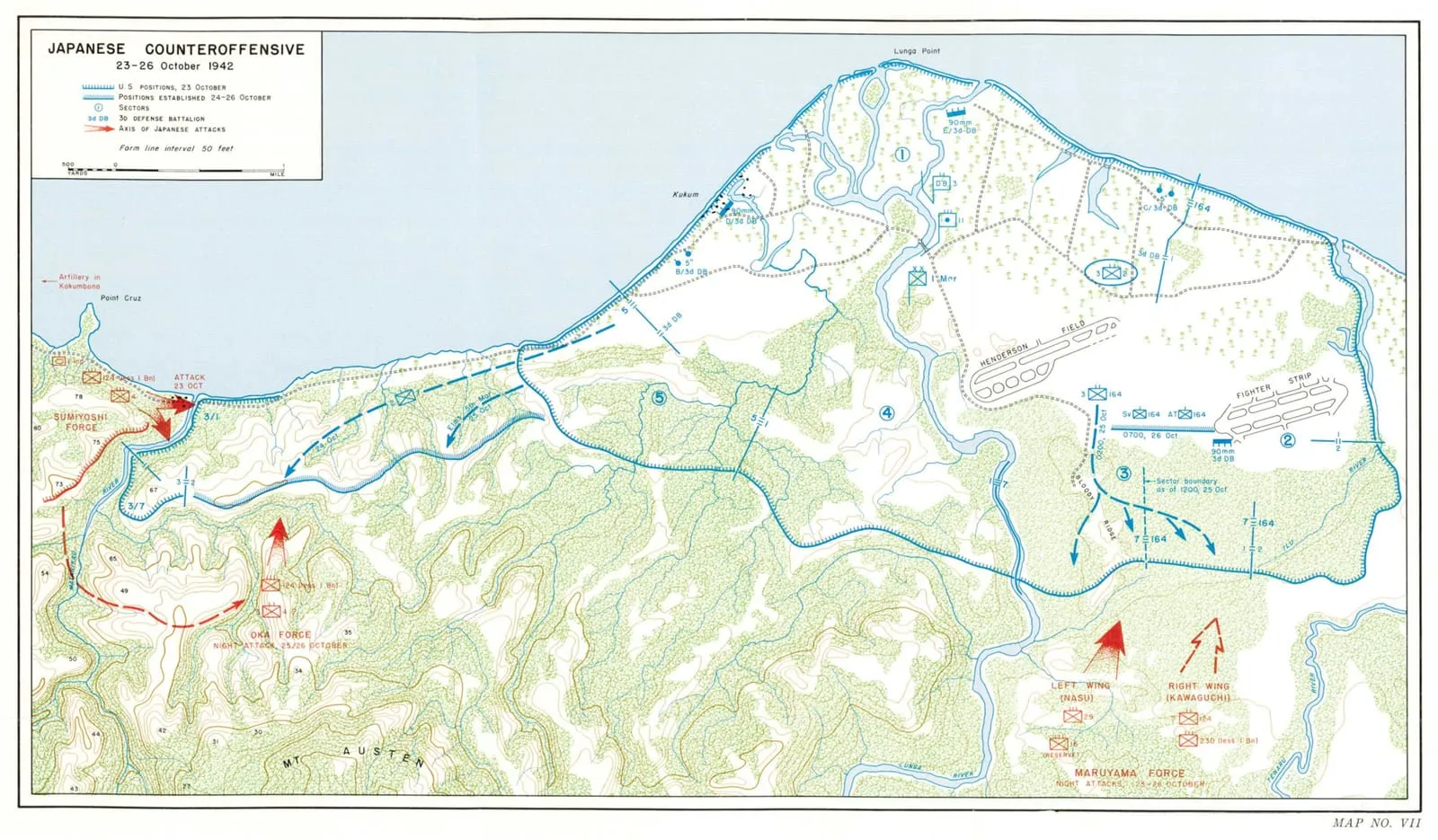
Hyakutake, who by mid-October had some 20,000 troops on the island, believed he faced about 10,000 Americans; in fact there were about 23,000. Maruyama led his main force, some 7,000 men, along the “Maruyama Road” hacked through the jungle south of the perimeter, to strike where Kawaguchi had attacked before. The march across mountains, ravines and rivers took longer than planned, and the men abandoned most of their heavy weapons along the way. Because of the delays and broken communications the offensive began without coordination: on 23 October tanks and infantry under Major General Tadashi Sumiyoshi attacked at the mouth of the Matanikau and were smashed by artillery. On the nights of 24/25 and 25/26 October Maruyama’s main force struck the positions of Puller’s battalion and the 164th Regiment and, in pouring rain, was cut down by machine guns, mortars and anti-tank guns firing canister. In the Battle for Henderson Field at least 1,500 Japanese were killed – more than 2,000 by some estimates; the Americans lost some 60–80 dead.
At the same time Yamamoto sent the strongest fleet since Midway, with four carriers, east of the Solomon Islands. On 26 October, in the Battle of the Santa Cruz Islands, the Japanese sank Hornet and damaged Enterprise, while their own carriers Shōkaku and Zuihō were damaged. It was a tactical victory for Japan, but it was bought with the loss of nearly 150 experienced carrier airmen who could not be replaced. The Japanese carriers played no further part in the campaign. For several weeks the Americans did not have a single fully serviceable carrier in the Pacific.
Course of the campaign: the Naval Battle of Guadalcanal (November)
At the beginning of November the Americans went over to the offensive: west of the Matanikau towards Point Cruz, and east towards Koli Point, where Japanese reinforcements had landed on 3 November. Colonel Toshinari Shōji’s men, encircled there, slipped away south and for almost a month were hunted through the jungle by the 2nd Raider Battalion of Lieutenant Colonel Evans Carlson, which in the course of its nearly month-long “Long Patrol” killed some 500 Japanese, according to American figures, for the loss of 16 men. When Shōji reached his own lines beyond the Matanikau, only 700–800 soldiers were with him.
Meanwhile the Japanese were preparing a fourth offensive with the rest of the 38th Division. Tanaka’s eleven transports with some 7,000 troops were to sail from the Shortlands, and before that two battleships under Vice Admiral Hiroaki Abe were to knock out the airfield. On the night of 12/13 November Abe was met by the cruisers and destroyers of Rear Admiral Daniel Callaghan. In a chaotic close-range action, fought almost blindly in the dark, Callaghan and Scott were killed, and the Americans lost the light cruiser Atlanta and four destroyers. Before noon on 13 November the submarine I-26 sank the damaged cruiser Juneau; of nearly 700 crew ten survived, and among the dead were the five Sullivan brothers. Abe, however, abandoned the bombardment of the airfield, and his flagship, the battleship Hiei, damaged in the night, was finished off by aircraft from Henderson Field and Enterprise and sank – the first Japanese battleship lost in the war.
On 14 November aircraft from Henderson Field and Enterprise attacked Tanaka’s convoy and sank seven transports. On the night of 14/15 November Vice Admiral Nobutake Kondō, with the battleship Kirishima, renewed the attempt to shell the airfield. Halsey sent two new battleships against him, Washington and South Dakota, under Rear Admiral Willis Lee. The Japanese sank three American destroyers and badly damaged South Dakota, but the unseen Washington, firing under radar control, reduced Kirishima within minutes to a wreck, which her crew scuttled. Tanaka beached his four surviving transports at Tassafaronga, where aircraft and artillery destroyed them in the morning. Only some 2,000–3,000 troops and a small part of the cargo got ashore.
The First and Second (PL) Naval Battles of Guadalcanal, known together in America as the Naval Battle of Guadalcanal, decided the outcome of the campaign. Japan was never again able to send a large convoy to the island or to put Henderson Field out of action.
Course of the campaign: Tassafaronga, Mount Austen and Operation Ke (December 1942 – February 1943)
Cut off, the 17th Army began to starve. Tanaka tried to deliver food in drums dropped from destroyers and towed ashore. On the first such run, on 30 November, in the Battle of Tassafaronga, his eight destroyers answered an attack by a stronger American force with a torpedo salvo: the cruiser Northampton sank and three others were badly damaged, for the loss of one Japanese destroyer. It was the Japanese navy’s last great victory of the campaign, but the supplies were not delivered. In December Hyakutake’s men were dying of hunger, malaria, dysentery and beriberi; they themselves called Guadalcanal “Starvation Island”.
On 9 December Patch relieved the exhausted 1st Marine Division and took command on the island. By January his XIV Corps – the Americal Division, the 25th Infantry Division and the 2nd Marine Division – numbered more than 50,000 men. From 18 December the Americans attacked Mount Austen, where the Japanese were holding a fortified position called the Gifu, and from 10 January also the neighbouring hills known as the Galloping Horse and the Sea Horse; by 23 January they had taken them, losing some 250 dead against some 3,000 Japanese killed.
On 12 December the Japanese navy proposed abandoning the island. After a visit by staff officers to Rabaul, where Lieutenant General Hitoshi Imamura had been in command since 26 November, Emperor Hirohito approved the decision to withdraw on 31 December. Operation Ke was prepared in secret. The Americans, seeing the destroyer traffic, expected a new offensive rather than a withdrawal and advanced cautiously. On the nights of 1/2, 4/5 and 7/8 February 1943 some 20 destroyers took off a total of about 10,600 soldiers from Cape Esperance and the Russell Islands, most of them emaciated and sick. On 9 February Patch reported to Halsey that the “Tokyo Express no longer has terminus on Guadalcanal”.
Losses
Casualty figures vary according to the source and to whether sailors and airmen are included. According to tallies based on the work of Richard B. Frank, the Allies lost some 7,100 dead – about 1,600 of them ground troops and most of the rest at sea – more than 7,700 wounded, 29 ships (including two carriers, six heavy cruisers, two light cruisers and 17 destroyers) and some 615 aircraft. Losses to disease were heavy: malaria put more men out of action than Japanese fire. Japan lost 38 ships (including a light carrier, two battleships, four cruisers and 11 destroyers) and some 680 aircraft, and with them many experienced airmen. Of the roughly 36,000 army and navy personnel sent to the island, some 25,000 were killed or died, according to American estimates; of the army alone some 19,000, of whom only about 8,500 in combat and the rest from hunger and disease. About a thousand men were taken prisoner, many of them Korean labourers.
Significance
Guadalcanal was the first major Allied land offensive against Japan, and the first that Japan lost. Together with Midway and the fighting in New Guinea it marked the end of Japanese expansion in the South Pacific and the passing of the initiative to the Allies, who never relinquished it. For Japan it was above all a war of attrition that it could not sustain: for half a year it fed troops onto the island piecemeal, underestimating its enemy, and in the struggle for supplies it lost ships, transports and airmen that its industry and training system could not replace. The concentration of forces on Guadalcanal also weakened the Japanese troops in New Guinea and contributed to their defeat at Buna and Gona.
The campaign was also a school for the Americans. The Navy learned night fighting and the use of radar, the Marines and the Army learned jungle warfare, and the airmen of the Cactus Air Force showed how much a land airfield on a contested island was worth. Henderson Field and the harbour at Tulagi became bases for further operations in the Solomon Islands, which, as part of Operation Cartwheel, led in 1943–1944 to the isolation of Rabaul. A direct consequence of the campaign was also the death of Yamamoto, shot down over Bougainville in April 1943 while inspecting bases in the Solomons.