- Category:
- Military operations
- Front:
- Balkans
- Date:
- 1 August 1943
- Author:
- Natalia
- Tags:
- United States, Romania, Luftwaffe, Ion Antonescu
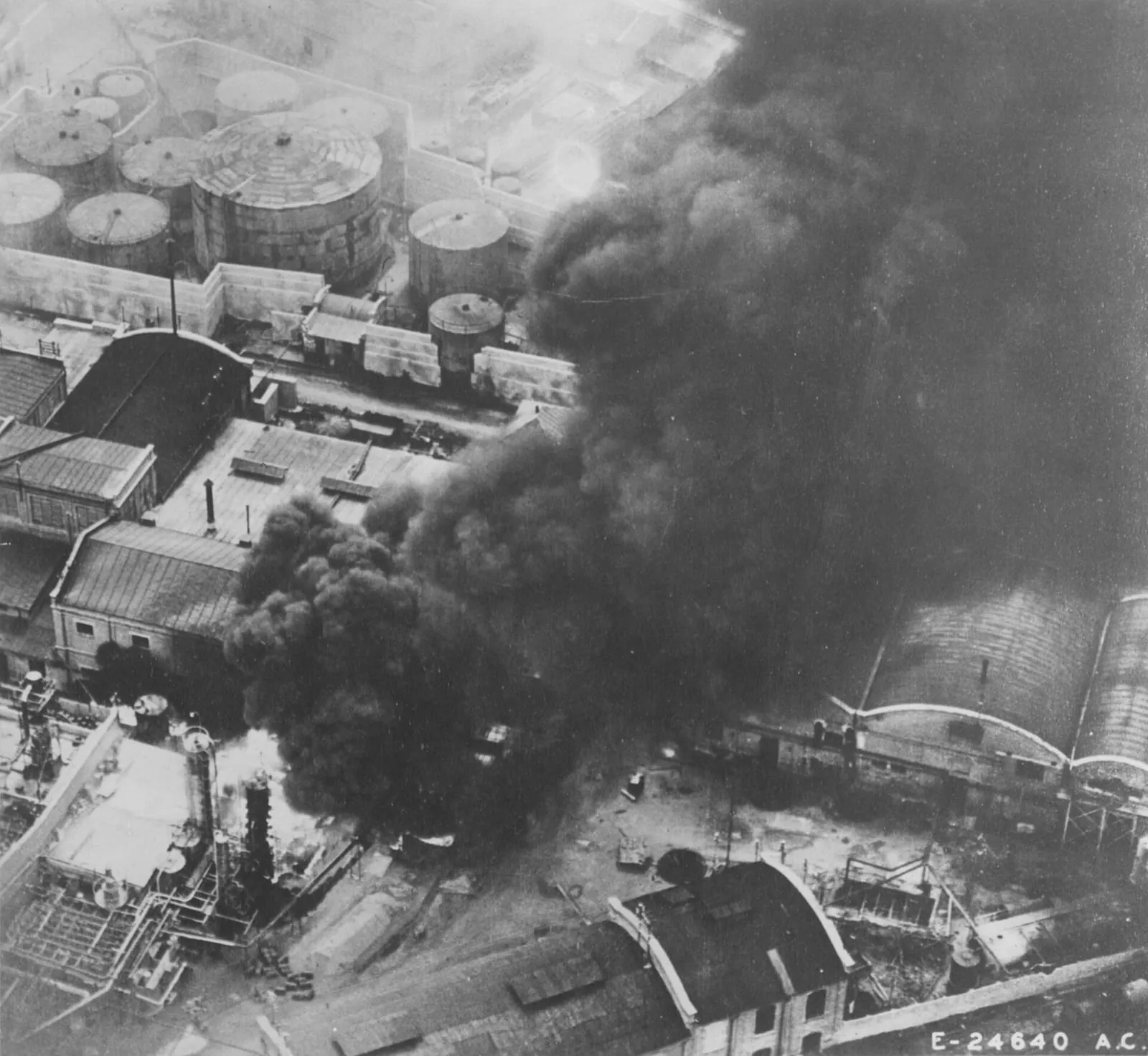
Operation Tidal Wave was an American raid on the oil refineries around the Romanian town of Ploiești, carried out on Sunday 1 August 1943. A total of 178 Consolidated B-24 Liberator heavy bombers set off from airfields around Benghazi in Libya, of which 177 got into the air. They were led by the Ninth Air Force’s bomber command (IX Bomber Command), but only two of the five bomb groups belonged to it permanently; the other three had been sent from England by the Eighth Air Force for this single operation. The bombers were to fly almost 2,000 kilometres over the sea and the Balkans to strike their targets from a height of a few dozen metres, almost brushing the chimneys. A raid meant to cut Germany off from a large part of its fuel turned into one of the bloodiest missions flown by the American air force in the entire war. Nearly a third of the aircraft were destroyed or failed to return to base, and the American airmen called the day “Black Sunday”. The refineries, though badly damaged, were back in full production within a few weeks.
Oil from Ploiești
Since the 19th century Romania had been one of the largest oil producers in Europe, and its oil industry was concentrated in the foothills of the Carpathians around Ploiești, some 60 kilometres north of Bucharest. From the economic agreement of March 1939 onwards Romanian oil flowed to the Reich in an ever wider stream, and after Romania joined the Axis camp in 1940 it became Germany’s most important source of natural oil, apart from synthetic petrol made from coal. Hitler entrusted the protection of the oilfields to the German military mission, and according to estimates cited in the literature the Ploiești refineries supplied about 30 per cent of the fuel used by the Axis states.
The first American attack on Ploiești had been made as early as June 1942, a few days after the United States declared war on Romania. Thirteen Liberators of Colonel Harry Halverson’s detachment dropped their bombs from high altitude and at night, with no visible result. The raid nevertheless had a serious consequence: the Germans and Romanians realised that the refineries were within range of Allied bombers. The district’s air defences were built up by the German air attaché in Bucharest, General Alfred Gerstenberg. According to figures cited in the literature, 52 anti-aircraft batteries were deployed around Ploiești, including 36 batteries of heavy 88 mm guns directed by Würzburg radar stations. They were divided between the German 5th Flak Division, half of whose soldiers were Romanians, and the Romanian 7th Anti-Aircraft Artillery Regiment. Lighter guns were hidden in haystacks, in dummy buildings and on railway wagons, and smokescreens and barrage balloons were added. More than 50 fighters were stationed within reach of Ploiești: German Messerschmitt Bf 109s and Bf 110 night fighters, as well as aircraft of the Romanian air force, including Romanian IAR-80 fighters. Ploiești had become the most heavily defended target in Europe outside the Reich itself.
The plan for a low-level attack
A strike against Romanian oil had been urged in January 1943 at the Casablanca Conference by Winston Churchill, who saw it as a blow that could paralyse the German war machine. In the spring the head of the US Army Air Forces, Henry H. Arnold, told his staff to work out a plan, and in May, at the Trident Conference in Washington, the Combined Chiefs of Staff agreed that the raid should be carried out by bombers from North Africa. The concept was devised by Colonel Jacob E. Smart of Arnold’s staff. He believed that a smaller number of bombers coming in low and unexpectedly would achieve as much as a far larger force bombing from high altitude. It was assumed that the anti-aircraft defences would be weak and geared mainly to repelling night raids, and that the guns would be manned mostly by Romanian soldiers. These assumptions proved illusory: there were in fact several times as many guns, and they were largely manned by Germans.
The operation’s code name was changed twice, from Statesman to Soapsuds and finally to Tidal Wave. It was commanded by General Lewis Brereton, commander of the Ninth Air Force, and the details were worked out by the head of its bomber command, Brigadier General Uzal Ent. The airmen and some of the group commanders doubted the wisdom of flying at low level in heavy aircraft not designed for it. The commander-in-chief of Allied air forces in the Mediterranean, the British Air Chief Marshal Arthur Tedder, proposed postponing the operation or striking aircraft factories instead. Brereton would not give way: he considered the refineries more important, and training was almost complete.
Five bomb groups were assigned to the mission. The Ninth Air Force, formed in November 1942 from the American air units in the Middle East, provided the 98th and 376th Bomb Groups. From England came the 44th and 93rd Groups, veterans of the first American raids on Germany, and the newly arrived and inexperienced 389th Group. For several weeks the crews practised over a mock-up of the targets built in the Libyan desert and studied a three-dimensional model of the Ploiești area prepared by the RAF. The aircraft were given additional fuel tanks in their bomb bays, and the lead aircraft also had nose-mounted machine guns with which the pilot was to suppress the fire of the guns. The bombs were fitted with delayed-action fuses set from 45 seconds to several hours, so that they would not destroy aircraft flying close behind. Each group was to attack its assigned refinery from the north at the same moment: five plants around the town, the Creditul Minier refinery at Brazi south of Ploiești and the Steaua Română refinery at Câmpina. For political reasons the town itself was to be spared.
The flight over the Balkans
The bombers began taking off at around four in the morning. In the clouds of dust one of them crashed on take-off, and the remaining 177 aircraft, with 1,751 airmen on board, headed across the Mediterranean towards Greece. Over Corfu the aircraft leading the whole mission went into a spin for reasons never explained and plunged into the sea. None of the crew survived. One of the pilots descended to look for survivors and, weighed down by the extra fuel, was unable to catch up with the formation again. Ten other crews turned back to base after this incident or because of mechanical failures. Over the Pindus mountains, in dense cloud, the two leading groups, the 376th and the 93rd, drew away from the other three. For fear of detection radio silence was in force, and nobody tried to re-form, although the orders allowed it. Instead of a single synchronised strike, two separate formations, several dozen kilometres apart, arrived over Romania.
Meanwhile the raid came as no surprise to the Germans. German radio monitoring had picked up a signal in the morning about the take-off of a large formation from Libya, and radar tracked the bombers over the Balkans. Over Bulgaria they were also spotted by Bulgarian fighter pilots. The Ploiești defences had time to go on alert, although German and Romanian fighters were initially sent up to high altitude, since a conventional raid was expected.
The wrong turn near Târgoviște
Beyond the Danube the bombers descended, and after passing Pitești they came down to a few dozen metres. As planned, the 389th Group broke away towards Câmpina. The leading 376th Group, in whose aircraft General Ent was flying, then made the mistake that sealed the mission’s fate. Near Târgoviște the group commander, Colonel Keith Compton, decided that they had reached the last checkpoint at Florești and ordered a turn. Ignoring the warnings of his navigators, he led both leading groups along the wrong railway line – not towards Ploiești but straight towards Bucharest, into the zone of its strong anti-aircraft defences. Many crews broke radio silence to warn of the mistake, but before it was corrected the Liberators had come under fire from the capital’s guns.
Over the refineries
Lieutenant Colonel Addison Baker’s 93rd Group turned towards Ploiești and attacked the refineries from the wrong direction, flying into the very centre of the anti-aircraft defences. Baker’s aircraft was hit; he jettisoned his bombs short of the target in order to stay at the head of the formation, led the group over the Columbia Aquila refinery and then crashed with his entire crew. Baker and his co-pilot, Major John Jerstad, were posthumously awarded the Medal of Honor. Other pilots of the 93rd Group bombed the Astra Română, Unirea Orion and Columbia Aquila refineries. The group lost eleven aircraft over the targets. One of the Liberators, shot down by a Romanian fighter pilot, crashed onto the women’s prison in Ploiești. According to Romanian figures cited in the literature, the raid killed 101 civilians and injured 238, and roughly half of the dead perished in the burning prison.
The 376th Group, which General Ent had ordered to attack “targets of opportunity”, abandoned its attack on its assigned target, the Româno-Americana refinery, in the face of heavy fire. Most of its aircraft bombed the Steaua Română refinery at Câmpina, and a few struck the already burning Concordia Vega plant. Behind them, from the right direction, came Colonel John Kane’s 98th Group and Colonel Leon Johnson’s 44th Group. They ran into refineries shrouded in smoke and flame, the explosions of delayed-action bombs dropped earlier by the 93rd Group, and fully alert defences. Along the Florești–Ploiești railway a camouflaged flak train ran alongside them, trading fire with the Liberators at a height of a dozen or so metres. Kane and Johnson led their groups over the Astra Română and Columbia Aquila refineries at heavy cost, and both received the Medal of Honor. A detachment of the 44th Group under Lieutenant Colonel James Posey hit the Creditul Minier refinery at Brazi without loss.
The 389th Group, after briefly losing its way in the clouds, attacked the Steaua Română refinery at Câmpina as planned between 12.10 and 12.20 p.m., from a height of 60–200 metres, and badly damaged it. One of the aircraft it lost was flown by Second Lieutenant Lloyd Hughes. Despite fuel streaming from his holed tanks, he held his course over the burning target until his bombardier had released the bombs, and then tried to make an emergency landing in a riverbed. Hughes was killed and became the fifth participant in the raid to receive the Medal of Honor, the third to be awarded posthumously.
The return and the losses
The bombers spent a dozen or so minutes over the targets. The way home proved almost as dangerous. Over Bulgaria the broken formations were intercepted by German and Bulgarian fighters, and over the Ionian Sea Messerschmitts from Greece shot down more aircraft. The groups did not re-form as the plan had envisaged and flew back separately. Damaged aircraft landed on Cyprus, Malta and Sicily, where the Allied invasion had been under way for three weeks. Eight aircraft landed in neutral Turkey, where their crews were interned. The Liberators that made it back to Benghazi had been in the air for 13 to 14 hours.
Only 88 bombers returned to Libya, 55 of them damaged. Depending on how they are counted, the Americans lost 53 or 54 aircraft, 44 of which fell to anti-aircraft fire and fighters. The human toll also varies according to the source. According to the National Museum of the US Air Force, of 1,726 airmen (other figures give 1,751) nearly 500 did not return: 310 were killed or missing and 186 were taken prisoner or interned. Other tallies speak of 532 airmen lost, and some accounts give around 660. A total of 108 airmen were taken prisoner by the Axis, 78 were interned in Turkey, and four were hidden by Yugoslav partisans. After the raid the Ninth Air Force’s bomber command had for a time only about thirty serviceable Liberators. Five Medals of Honor were awarded for the operation, the most ever for a single air action, as well as 56 Distinguished Service Crosses.
The defenders’ losses were much smaller. The Romanian air force flew 59 sorties and the Luftwaffe 89. According to Romanian and German sources, the Romanians lost two aircraft and the Germans five. Among the troops there were 19 killed and 97 wounded. Near Corlătești one of the Liberators crashed straight onto a heavy battery position, killing its own crew and six gunners. Bombers forced to get rid of their bombs over random targets also killed people in several Bulgarian villages.
Consequences
After the raid the Allies estimated that they had destroyed about 40 per cent of the Ploiești refineries’ processing capacity, and the mission was presented as a success. Aerial photographs taken in the following weeks and later analyses showed that the raid had not reduced fuel output. Before the raid the Ploiești refineries had been working below full capacity, so the Germans and Romanians shifted processing to the undamaged plants. Most of the damage was repaired within a few weeks, and according to American analyses fuel production was higher in September than before the attack. The hardest-hit refineries, Creditul Minier and Columbia Aquila, did not resume work until the autumn of 1944. What was lost, above all, was the reserve of processing capacity that was supposed to shield the industry from further attacks.
After the raid Marshal Ion Antonescu visited Ploiești and Câmpina. On his orders a special corps was set up to deal with the aftermath of bombing, and camouflage and the anti-aircraft defences were expanded. Successive Allied commands drew a clear lesson from Black Sunday: a low-level raid by heavy bombers on a heavily defended target was too costly. The American air force never again repeated an operation of this kind on a similar scale.
Its place in the war
In proportion to the forces involved, Operation Tidal Wave was the costliest major Allied air raid of the entire war. At the same time it showed how important Romanian oil was to the Reich and how difficult it was to destroy with a single blow. Within two years the US Army Air Forces had grown from a few squadrons into mighty fleets of heavy bombers. In July 1943 they had even ordered the B-36 – a successor to the Liberator from the same Consolidated works, a bomber designed to fly across the ocean. Ploiești, though still too far away for fighter escort, remained on the list of top-priority targets.
The raid had no immediate sequel, because after the losses of 1 August the air force in Africa could not repeat it. American bombers returned over Ploiești only after bases in Italy had been taken. From April 1944 the refineries were regularly attacked from Foggia by the American Fifteenth Air Force as part of General Carl Spaatz’s programme, and by RAF bombers at night. This time the raids were accompanied by fighter escorts and the bombing was done from high altitude. The oil campaign had its effect: in the summer of 1944 Romanian fuel production fell sharply. The bombing ended in August 1944, after the coup in Bucharest that overthrew Antonescu and took Romania over to the Allied side. According to figures cited in the literature, the whole campaign against Ploiești cost the Allied air forces 324 aircraft, and the Allies lost some 1,700 airmen killed and 1,500 taken prisoner. For Germany the loss of Romanian oil was one of the heaviest blows of the last year of the war.
Sources
Meanwhile
(04)Elsewhere, within a week.
- 2 August 1943 · PolandThe Gypsy family camp at AuschwitzFrom February 1943 the Germans held whole Roma and Sinti families in section BIIe of Birkenau. About 23,000 people were sent there; most did not survive.
- 2 August 1943 · PacificThe sinking of PT-109On 2 August 1943 the Japanese destroyer Amagiri cut PT-109 in two. Its commander, John F. Kennedy, and ten survivors were rescued after six days.
- 3 August 1943 · MediterraneanThe Patton slapping incidentsOn 3 and 10 August 1943 General George Patton struck two soldiers suffering from combat exhaustion in field hospitals in Sicily. The affair became a scandal.
- 5 August 1943 · ScandinaviaSweden ends the German transit trafficOn 5 August 1943 Sweden announced it had terminated the agreement allowing German troops and war material to travel by rail between Norway and the Reich.
Related events
(04)The same battle, people or subject.
- 19 August 1943 · DiplomacyThe Quebec Conference and the Quebec AgreementOn 19 August 1943 in Quebec Churchill and Roosevelt signed a secret agreement on jointly building the atomic bomb. The conference also confirmed Overlord.
- 17 August 1943 · Western FrontThe Schweinfurt–Regensburg raidOn 17 August 1943 376 US B-17s attacked the Schweinfurt ball-bearing plants and the Messerschmitt works at Regensburg by day. Sixty bombers did not return.
- 27 January 1943 · Western FrontThe first American raid on GermanyOn 27 January 1943 American bombers attacked Germany for the first time. Of 91 B-17s and B-24s dispatched, 53 bombed Wilhelmshaven and three were lost.
- 12 May 1943 · DiplomacyThe Trident ConferenceOn 12 May 1943 Churchill and Roosevelt opened the Trident Conference in Washington. It set 1 May 1944 as the date for the cross-Channel invasion.