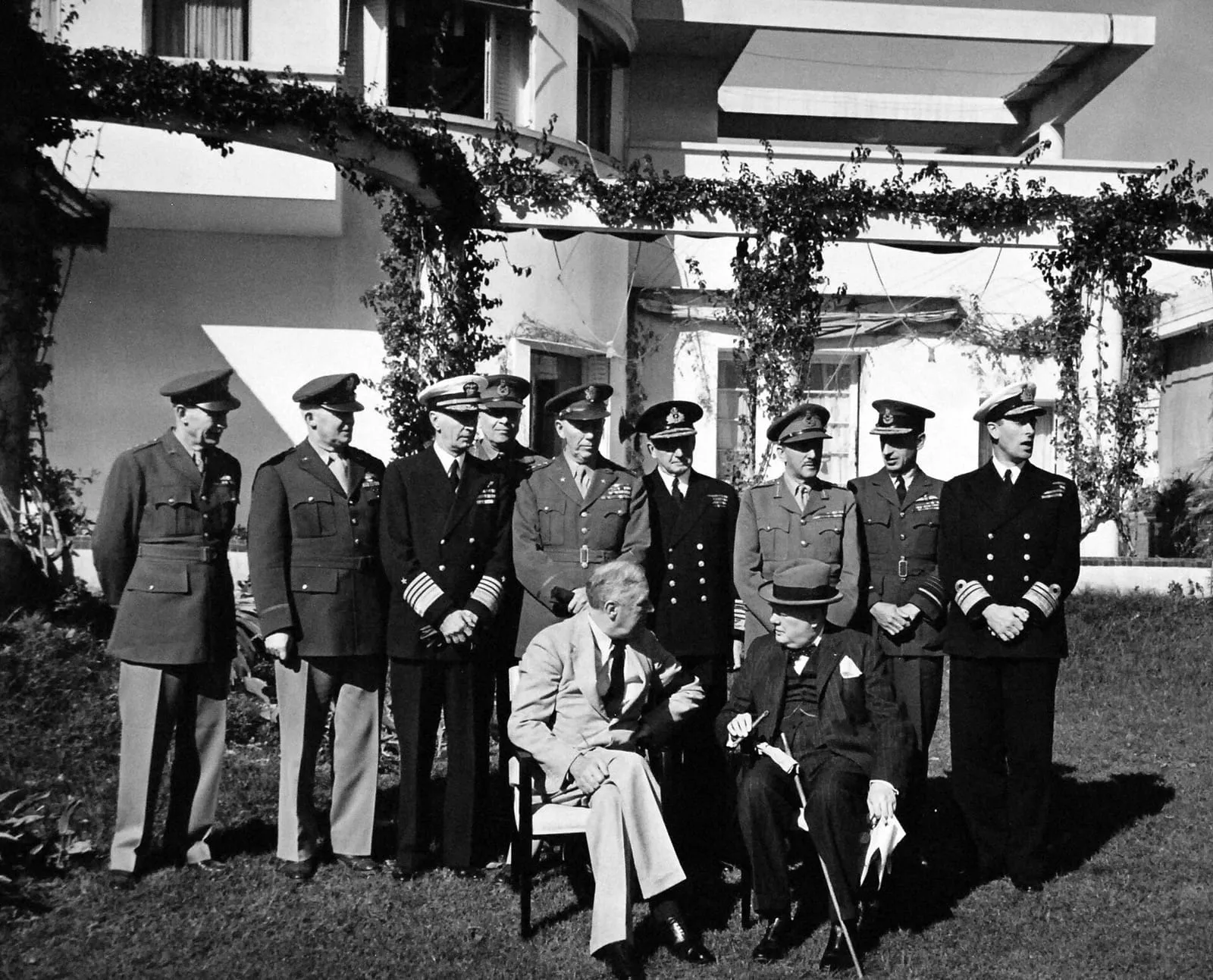
On 14 January 1943 a conference opened at Anfa, an elegant suburb of villas on a hill above Casablanca, which was to set the strategy of the Western Allies for the coming year. Prime Minister Winston Churchill and President Franklin Delano Roosevelt met in French Morocco, captured two months earlier, while the British and American chiefs of staff conferred alongside them for ten days. The meeting was code-named Symbol. It produced decisions on a landing in Sicily, the postponement of the cross-Channel invasion, a combined bomber offensive against Germany and priority for the war against the U-boats. At its close, on 24 January, Roosevelt announced that the Allies would demand the unconditional surrender of the Axis powers.
Why Casablanca
Since the Arcadia Conference in Washington at the turn of 1941 and 1942, the two leaders had met again in June 1942, when the fall of Tobruk found Churchill in Washington. Much had changed since then. In November 1942 the Allies had landed in French North Africa, the Eighth Army was driving Rommel across Libya, and at Stalingrad the Red Army had trapped the Sixth Army in a pocket. Operation Torch, however, had been the last strategic decision the Allies had taken together, and it did not settle what was to follow the capture of Tunisia. The Americans still wanted to strike at France as soon as possible; the British wanted to make use of the forces assembled in the Mediterranean. A new meeting at the highest level was needed.
From December 1942 Roosevelt had been pressing for a three-way meeting with Joseph Stalin. Stalin refused: he explained that he could not leave Moscow during the decisive fighting at Stalingrad, and at the same time reminded them of the promise of a second front in Europe, which for months he had regarded as unfulfilled. Churchill had been in Moscow only five months earlier and had explained to Stalin in person why there would be no invasion of France in 1942. In the end the Western leaders decided to meet on their own, and Morocco was chosen as the venue – reasonably close for both, well protected, and a visible sign of their first joint victory.
Anfa and Patton
The host was Major General George Patton. His troops had landed near Casablanca in November as the Western Task Force of Operation Torch. This was in reality the headquarters of I Armored Corps, renamed for the invasion in September 1942. On 9 January 1943, five days before the leaders arrived, Patton’s headquarters formally reverted to its old name of I Armored Corps. The change was a formality: the Western Task Force had existed to mislead the enemy about the nature of the forces landing in Morocco, and once the fighting with the French was over there was no reason to keep up the cover. Six months later, on 10 July 1943, its headquarters was used to form the US Seventh Army, which landed in Sicily under Patton’s command. In January 1943 Patton’s soldiers were responsible for guarding the conference, and the general himself acted as host; on 21 January he accompanied Roosevelt on a review of American troops near Rabat.
The talks took place in the Anfa Hotel and the surrounding villas, ringed with barbed wire and guarded by American soldiers. Churchill flew in on 12 January. Roosevelt made a journey of several days via the Caribbean, Brazil and West Africa; he was the first President of the United States to travel by air while in office. He reached Anfa on the evening of 14 January, the same day the chiefs of staff began their meetings.
The participants
The core of the conference was the Combined Chiefs of Staff, a body created at its first meeting in February 1942. The British were represented by the Chief of the Imperial General Staff, General Alan Brooke; the First Sea Lord, Admiral of the Fleet Dudley Pound; and the Chief of the Air Staff, Air Chief Marshal Charles Portal. They were accompanied by the Chief of Combined Operations, Vice Admiral Louis Mountbatten; Lieutenant General Hastings Ismay, Churchill’s chief of staff as Minister of Defence; and Field Marshal John Dill, head of the British military mission in Washington, who knew the American partners better than anyone. The American side consisted of the Army Chief of Staff, General George Marshall; the Commander-in-Chief of the US Fleet and Chief of Naval Operations, Admiral Ernest King; and the commanding general of the Army Air Forces, General Henry Arnold. Roosevelt also brought his closest adviser, Harry Hopkins, and his special envoy Averell Harriman.
The commanders from North Africa came from Algiers. On 15 January General Dwight Eisenhower reported on the situation in Tunisia, where, after the failed race for Tunis, the front had bogged down in the winter mud. Later came General Harold Alexander, Commander-in-Chief Middle East, and Air Chief Marshal Arthur Tedder. Also present were the diplomats responsible for French affairs: the American representative in North Africa, Robert Murphy, and the newly appointed British Minister Resident at Eisenhower’s headquarters, Harold Macmillan.
The dispute over strategy for 1943
The British arrived at Anfa much better prepared. The communications ship HMS Bulolo lay in the harbour with a team of planners and an archive of documents, so that they had calculations ready for every question: on tonnage, numbers of landing craft, timetables. The Americans, later convinced that they had been out-talked, brought far larger staffs to subsequent conferences.
Marshall defended the principle he had held since early 1942: Germany had to be defeated by a cross-Channel attack, and every operation in the Mediterranean drew forces away from that goal, acting like a “suction pump” that sucked in more and more divisions and ships. King looked above all to the Pacific. According to participants’ accounts, he argued that the war against Japan was receiving a mere fifteen per cent or so of the Allied effort and demanded at least twice that share, so as not to hand the initiative back to the Japanese after the victories at Midway and Guadalcanal.
Brooke replied that an invasion of France was impracticable in 1943. There were not enough ships, landing craft or trained divisions, and the Battle of the Atlantic was still swallowing enormous tonnage. The armies in North Africa would stand idle for many months if they were to be moved to England. It was better to use them where they already were: to knock Italy out of the war, open the route through the Mediterranean, save millions of tons of shipping on voyages round the Cape of Good Hope, force the Germans to disperse their forces and perhaps persuade Turkey to enter the war. The British remained realistic: the invasion of France was to come, but only once Germany had been worn down by the fighting in the East and from the air.
After several days of hard argument, in which John Dill played a key role as intermediary, a compromise was reached on 18–19 January. The next objective in the Mediterranean after the capture of Tunisia was to be Sicily (Operation Husky), rather than Sardinia – an easier but less valuable prize favoured by some British planners. The landing was scheduled for July, during a favourable phase of the moon, with Eisenhower as commander-in-chief. The full-scale cross-Channel invasion was postponed, although American troops were to continue to build up in Britain and a limited operation was to be prepared for 1943 in case German resistance unexpectedly collapsed. In the spring of 1943, as agreed at Anfa, an Anglo-American planning staff was set up in London to prepare the future invasion.
It is often said that at Casablanca the Allies decided on the invasion of Sicily and Italy. In fact only Sicily was decided. What would come next – a landing on the Italian mainland or operations in the eastern Mediterranean – was left to be settled at later meetings. Marshall had no intention of committing himself to an Italian campaign and agreed to Sicily mainly because no other operation could simply be mounted in 1943.
U-boats, bombers, Russia and the Pacific
The chiefs of staff’s final report, “Conduct of the War in 1943”, began with the Atlantic. The defeat of the U-boat was to be a “first charge” on the resources of the United Nations: in 1942 German submarines had sunk more than six million tons of Allied shipping, and without ships it was impossible either to supply Britain or to carry an American army to Europe. Next came aid to the Soviet Union – supplies were to continue, but not at the cost of losses that could not be borne.
On 21 January the chiefs of staff approved a directive for the bomber forces, known as the Casablanca Directive. Air Marshal Arthur Harris’s Bomber Command and General Ira Eaker’s US Eighth Air Force were jointly to pursue “the progressive destruction and dislocation of the German military, industrial and economic system, and the undermining of the morale of the German people to a point where their capacity for armed resistance is fatally weakened”. The list of targets was headed by U-boat construction yards, followed by the aircraft industry, transport and oil refineries. Along the way the dispute over day and night bombing was settled: Churchill, who had wanted to persuade the Americans to join the RAF’s night raids, after talking to Eaker and reading his short memorandum accepted the formula of bombing “round the clock” – the British by night, the Americans by day.
In the Pacific the Allies were to keep up the pressure on Japan and prepare further operations: clearing the Solomon Islands and New Guinea, capturing Rabaul and – in line with King’s plan – an advance across the central Pacific towards the Marshall and Caroline Islands. For Burma, Operation Anakim was provisionally planned for the end of 1943, to recover the country and open a land route to China in support of Chiang Kai-shek. Churchill gave an assurance that once Germany was defeated Britain would throw all its forces against Japan.
The command structure in the Mediterranean was also agreed. Eisenhower remained Commander-in-Chief of the Allied forces in North Africa. When Bernard Montgomery’s Eighth Army entered Tunisia, it was to come under his command, and Alexander became his deputy responsible for the land forces in Tunisia. Tedder took command of the air forces throughout the Mediterranean, and Admiral Andrew Cunningham of the naval forces. The British thus gained control over the day-to-day conduct of operations, and the Americans the supreme command.
The French question
Alongside the military talks a political game was being played over the leadership of the French fighting on the Allied side. After the assassination of Admiral Darlan on Christmas Eve 1942, power in North Africa had passed to General Henri Giraud, who had American backing. In London there was General Charles de Gaulle, leader of the Free French and of the French National Committee, supported – though with growing difficulty – by the British. Roosevelt did not trust de Gaulle, regarding him both as a would-be dictator and as Churchill’s instrument. Both leaders nevertheless wanted the French to act together.
Giraud flew in to Anfa on 17 January. De Gaulle, invited by Churchill through the Foreign Secretary, Anthony Eden, at first refused: he did not wish to negotiate with another Frenchman on French soil under the supervision of foreign troops. He gave way only when Churchill let him understand that a further refusal might cost him British support. He arrived on 22 January, cold and offended, and held a series of difficult talks with Giraud, Roosevelt and Churchill. The Anglo-Saxons proposed that the two generals should jointly head the French authority. Giraud agreed; de Gaulle rejected a formula imposed from outside. It all ended with a brief joint communiqué on their common goal, the liberation of France, and a handshake for the press photographers on 24 January. In private Roosevelt spoke of a “shotgun wedding”.
At the same time the President concluded separate agreements with Giraud, the so-called Anfa memoranda. These recognised Giraud’s right to represent French military, economic and financial interests in North Africa and promised American arms for the French army – according to the arrangements at Anfa, some eleven divisions, including three armoured ones. Churchill was not informed of these documents in good time, and their content later had to be toned down. Even so, the army that fought in Tunisia, Italy and France from 1943 onwards did receive new equipment.
On 22 January Roosevelt gave a dinner at his villa in honour of the Sultan of Morocco, Muhammad ibn Yusuf, who was accompanied by his son, the heir to the throne Hassan, and by the French Resident-General, General Charles Noguès. According to the account of the President’s son, Elliott Roosevelt, the President spoke to the Sultan about post-war economic cooperation between Morocco and the United States and about the end of the colonial era – to Churchill’s evident displeasure. How much truth there is in this account is hard to judge, but in Morocco the meeting was remembered as the first sign that the Americans would not unconditionally defend French rule.
The close of the talks
On 23 January Roosevelt and Churchill approved the chiefs of staff’s final report. The next day, 24 January, a press conference was held on the lawn in front of the President’s villa. The journalists, who had been kept in the dark for ten days, learned where the leaders had been, saw de Gaulle and Giraud shake hands and heard Roosevelt say that the Allies would demand the unconditional surrender of Germany, Italy and Japan. This formula became the most famous outcome of the conference. The news of the meeting was announced to the world only a few days later, once both leaders were safe. Churchill then took Roosevelt to Marrakesh to show him the sunset over the Atlas Mountains, and after the President’s departure painted there the only picture he produced during the war. From there he flew to Turkey, where on 30 January at Adana he tried to persuade President İsmet İnönü to move closer to the Allies.
Stalin received a joint message announcing operations in the Mediterranean and a bomber offensive, but with no firm date for a second front. He replied coolly, demanding explanations, and when in the spring the Allies suspended the Arctic convoys, his letters contained open accusations of broken promises.
Significance
Historians often regard Casablanca as the last conference at which the British imposed their strategy on their ally. Thanks to their superior preparation and the lack of any real alternative for 1943, the war in the West took a shape that lasted until the summer: first Tunisia, then Sicily. Out of the decision on Sicily, although nobody at Anfa had settled this, grew the Italian campaign – at the Trident Conference in Washington in May 1943 it was decided to knock Italy out of the war, and at the same time the cross-Channel invasion was set for May 1944. The invasion of Sicily began on 10 July 1943, and on 25 July Mussolini was overthrown. The postponement of the invasion of France prolonged the tension in relations with Stalin until the Tehran Conference at the end of 1943.
The Casablanca Directive became the basis of the Combined Bomber Offensive of Bomber Command and the Eighth Air Force, supplemented in June 1943 by the Pointblank directive, which made the German fighter force target number one. In the war against the U-boats the turning point came in the spring of 1943, when within a few weeks the Allies inflicted a defeat on the German submarine fleet after which Karl Dönitz withdrew it from the North Atlantic. On the French question, the handshake at Anfa opened the way to an agreement: on 3 June 1943 the French Committee of National Liberation was established in Algiers under the joint chairmanship of de Gaulle and Giraud, from which Giraud was squeezed out within a few months. The longest-lived legacy, however, was the slogan of unconditional surrender proclaimed at the close of the talks – a principle from which the Allies did not depart until 1945.
Sources
Meanwhile
(04)Elsewhere, within a week.
- 16 January 1943 · Western FrontRAF raids on Berlin in January 1943On the nights of 16/17 and 17/18 January 1943 RAF Lancasters and Halifaxes bombed Berlin after a 14-month gap. Damage was slight, second-night losses heavy.
- 18 January 1943 · PolandThe first armed resistance in the Warsaw GhettoOn 18 January 1943 the Germans resumed deportations from the Warsaw Ghetto. ŻOB fighters first resisted with arms; after four days the action was halted.
- 18 January 1943 · Eastern FrontThe siege of Leningrad brokenOn 18 January 1943 the Leningrad and Volkhov Fronts met by Lake Ladoga. Operation Iskra cut a land corridor 8–11 km wide through to Leningrad.
- 19 January 1943 · Eastern FrontZhukov made Marshal of the Soviet UnionIn January 1943 Georgy Zhukov became the first commander of the war to be made Marshal of the USSR, and on 28 January received Order of Suvorov 1st Class No. 1.
Related events
(04)The same battle, people or subject.
- 12 May 1943 · DiplomacyThe Trident ConferenceOn 12 May 1943 Churchill and Roosevelt opened the Trident Conference in Washington. It set 1 May 1944 as the date for the cross-Channel invasion.
- 19 August 1943 · DiplomacyThe Quebec Conference and the Quebec AgreementOn 19 August 1943 in Quebec Churchill and Roosevelt signed a secret agreement on jointly building the atomic bomb. The conference also confirmed Overlord.
- 24 January 1943 · DiplomacyThe demand for unconditional surrenderOn 24 January 1943, closing the Casablanca Conference, Roosevelt announced that the Allies would demand the unconditional surrender of Germany, Italy and Japan.
- 2 February 1943 · MediterraneanRommel on the Mareth LineIn early February 1943 Rommel's army fell back from Libya behind the old French Mareth Line in Tunisia. The Eighth Army entered Tunisia on 4 February.