Spain
Agustín Muñoz Grandes
Commander of the Blue Division (1941–1942), Minister of the Army (1951–1957), Deputy Prime Minister of Spain (1962–1967)
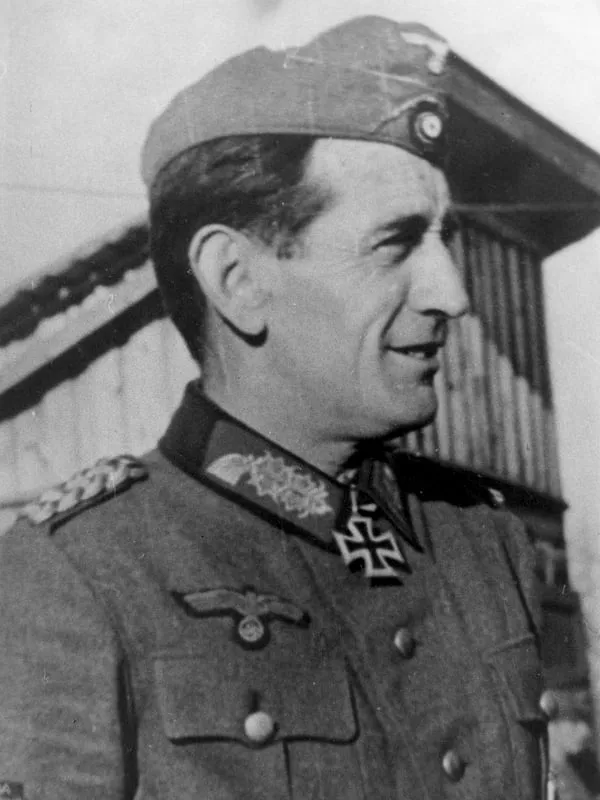
- Born:
- 27 January 1896, Carabanchel Bajo, near Madrid (Spain)
- Died:
- 11 July 1970, Madrid
- Author:
- Łukasz
- Photo:
- autor nieznany, CC0, Wikimedia Commons

Agustín Muñoz Grandes was a professional infantry officer who made his career in the colonial war in Morocco, commanded the public order police in Madrid under the Republic, and fought on the side of Francisco Franco in the Civil War. In the history of the Second World War he is remembered as the first commander of the Blue Division, the Spanish volunteer unit that fought as part of the Wehrmacht on the Eastern Front in 1941–1943. To Hitler he was the most pro-German of the Spanish generals and, as many historians believe, a possible successor to Franco should the latter refuse to bring Spain into the war. Franco brought him back from the front, promoted him and kept him close. After the war Muñoz Grandes was Minister of the Army, Chief of the General Staff and Deputy Prime Minister, and for some years he was regarded as the second man of the regime.
A shopkeeper’s son from Carabanchel
He was born on 27 January 1896 in Carabanchel Bajo, then a village outside Madrid and today part of the Madrid district of Carabanchel, the fifth child of a small trader who kept a grocery shop. In 1909, according to his service record (some biographies give a later year), he entered the Infantry Academy in Toledo, and on 26 June 1913 he was commissioned as a second lieutenant. Like Franco, three years his senior, he owed his career to the war in Africa.
The Moroccan school
From 1913 Muñoz Grandes served in the Spanish protectorate in Morocco, where Spain was waging a long Rif War against the Berber tribes. For most of that time he was an officer of the Regulares, units of Moroccan soldiers under Spanish officers which always fought in the front line. He was wounded several times and promoted for gallantry, and in 1923 he received the Individual Military Medal (Medalla Militar Individual), one of Spain’s highest decorations. He distinguished himself in 1924 during the bloody retreat from Chefchaouen (Xauen). He then commanded a harka – a unit of irregular Moroccan volunteers – at whose head he took part on 8 September 1925 in the Alhucemas landing, the operation that sealed the defeat of Abd el-Krim and the Republic of the Rif. In the fighting that followed he was seriously wounded in the chest.
The Moroccan years shaped him just as they shaped the other “Africanists” – Franco, Juan Yagüe and José Enrique Varela. He differed from many of them in his way of life: he was taciturn, modest, almost ascetic, and reportedly declined an appointment as aide-de-camp to King Alfonso XIII. This, together with his origins in a working-class district, later earned him a reputation as an officer with republican sympathies.
The Republic and the Assault Guard
In February 1926, at the age of thirty, Muñoz Grandes was promoted to lieutenant colonel for war services. After the proclamation of the Second Republic in 1931 he remained in Morocco, away from the plots of monarchist officers; he took no part in General José Sanjurjo’s failed coup attempt of August 1932. In 1932 he returned to Spain, and in September 1933 the republican government gave him command of the Assault Guard (Guardia de Asalto), a new armed public order police force created in 1931 as a counterweight to the conservative Civil Guard. Muñoz Grandes gave it organisation and discipline. He commanded it during the turbulent years 1933–1935, which saw, among other things, the Asturian uprising.
In 1935 he left the Assault Guard; in November he returned to Morocco as an official of the protectorate in charge of native affairs, and on 31 December 1935 he was promoted to colonel. In July 1936, when the Civil War broke out, he was in Madrid, which remained in republican hands. He tried to go into hiding but was soon arrested and held in Madrid’s Modelo prison. There he survived the mass executions of prisoners in August and November 1936. Sentenced to imprisonment by a republican court, he was pardoned through the intercession of Generals José Miaja and Vicente Rojo and offered service in the republican army. In March 1937, having been sent to Valencia, he seized his chance and escaped; by 1 April 1937 he was in the Nationalist zone.
The Civil War
Franco, who knew him well from Morocco, gave him command of the 2nd Navarrese Brigade, one of the best units of the Nationalist army. At its head Muñoz Grandes fought in the summer of 1937 in the Battle of Santander, and then in Asturias and at Teruel. On 9 March 1938 he took command of the 150th Division, with which, in the Aragon offensive, he fought the International Brigades at Caspe and reached the River Segre in Catalonia. At the end of 1938 he commanded the newly formed Urgel Army Corps, which in the Catalonia offensive broke through the republican defences on the Segre and at the beginning of January 1939 took Artesa de Segre. The war ended on 1 April 1939, and Muñoz Grandes was soon promoted to brigadier general.
The Nationalists conducted a systematic terror in the territories they captured. In 2008 Judge Baltasar Garzón included Muñoz Grandes among 35 senior officials of the regime whom he accused of crimes against humanity committed during the Civil War and the first years of the dictatorship; proceedings against the dead, however, could not go ahead.
Secretary of the Falange and Gibraltar
On 9 August 1939, a few weeks before the outbreak of the world war, Franco formed his second government and unexpectedly appointed Muñoz Grandes minister-secretary general of the single state party, the Falange (FET y de las JONS). The general was neither an old Falangist, nor a monarchist, nor a politician, and perhaps that was precisely why Franco entrusted the party to him. He soon fell out with the party’s real leader, Ramón Serrano Suñer. His biographers credit him with a scheme of partial reconciliation with the defeated – restoring to public life those republicans who had no blood on their hands – which found no support in the government. In March 1940 he resigned.
He returned to the army and took command of the 22nd Division and of the military command of the Campo de Gibraltar, the area bordering on the British fortress. In the summer and autumn of 1940, when Franco was angling to enter the war in exchange for Gibraltar and French colonies, and the Germans were preparing Operation Felix, an attack on Gibraltar, Muñoz Grandes was regarded as a general on whose cooperation the Wehrmacht could count without reservation. He made no secret of his admiration for the German army and favoured Spain’s entry into the war on the Axis side. The operation never took place, because in December 1940 Franco refused to set a date for it. On 21 January 1941 Muñoz Grandes was promoted to major general.
Commander of the Blue Division
After Germany attacked the USSR on 22 June 1941, Spain decided to send a division of volunteers to the Eastern Front. The Falange and the army argued over its character, and Muñoz Grandes, a professional general who was also a former party secretary, was a candidate acceptable to both sides. He was appointed its commander at the end of June. The volunteers were trained at the Grafenwöhr training ground in Bavaria as the Wehrmacht’s 250th Infantry Division; Muñoz Grandes, eager to reach the front, insisted that the training be cut to about five weeks. On 31 July he and his division swore an oath of obedience to Hitler “in the struggle against communism”, and on 20 August the division set off eastwards by rail.
It marched to the front on foot from Suwałki and Grodno, through Wilno (Vilnius), Minsk and Orsha, towards Smolensk and Moscow. At the end of September, to the general’s disappointment, it was assigned to Field Marshal Wilhelm von Leeb’s Army Group North, on the River Volkhov near Novgorod. In the autumn and winter of 1941 the Spaniards fought there in a bridgehead across the Volkhov; in December they had to withdraw from it, and in January 1942 they beat off Soviet attacks during the offensive intended to break the blockade of Leningrad. Muñoz Grandes was often in the front line and won great authority among his soldiers, and the Germans, initially sceptical, changed their opinion of the Spaniards. In March 1942 Hitler awarded him the Knight’s Cross of the Iron Cross, and a communiqué from his headquarters called the general the division’s “soul of the resistance”.
“Hitler’s general”
Hitler, disappointed with Franco after Hendaye and convinced that Serrano Suñer would not manage to draw Spain into the war, saw in the commander of the Blue Division a man who could do so – and, if necessary, even replace the Caudillo. On 12 July 1942 he received him at the Wolf’s Lair for a conversation of more than two hours, mostly about politics. Franco, who was kept informed of these contacts, decided to recall the general and as early as June 1942 sent his successor, General Emilio Esteban Infantes, to Germany. For several months the Germans kept him away from the division, because Hitler wanted to give Muñoz Grandes time to win military glory. Esteban Infantes reached the front only in August, when the division was moving from the Volkhov to Leningrad.
Only at the beginning of December 1942, after the Allied landings in North Africa, did Hitler agree to the general’s return home. On 12 December Franco promoted him to lieutenant general – then the highest rank in the Spanish army apart from his own – and on the same day Muñoz Grandes handed over command to Esteban Infantes. According to figures cited by his biographer, during his time in command the division lost about 1,000 killed and more than 2,000 wounded. On 13 December Hitler received him for the last time and personally presented him with the Oak Leaves to the Knight’s Cross. On 18 December Muñoz Grandes arrived in Madrid, where he was greeted by crowds, ministers and the Reich ambassador, and the Falange awarded him its highest decoration, the Silver Palm.
Franco did with the popular general what he did with every potential rival. On 3 January 1943 he left him without a post, and on 3 March appointed him head of his Military Household (Casa Militar), that is, the highest-ranking officer in his entourage – with no troops under his command. In Madrid he was then nicknamed “the tamed shrew”. The Spanish historian Xavier Moreno Juliá judges that the general lacked determination, and that the course of the war made his pro-German plans irrelevant. The general himself remained loyal to Franco. When in October 1943 Spain returned to strict neutrality and withdrew the Blue Division from the front, his political standing was already slight.
The regime’s second soldier
After 1945, when the victorious powers isolated Francoist Spain, Muñoz Grandes proved useful to Franco precisely because he had no links with the monarchists gathered around the pretender Juan de Borbón, and his loyalty had been tested. For years he headed the Military Household, and in March 1950 (some studies give 1945) he took command of the 1st Military Region in Madrid, the army’s most important district. On 18 July 1951 he became Minister of the Army. The Cold War was then changing the West’s attitude to Spain, and Muñoz Grandes played an important part in the military negotiations with the United States which ended in 1953 with the Pact of Madrid, allowing the Americans to build bases in Spain. In 1954 he received the American Legion of Merit.
In February 1957 he lost his ministerial portfolio, but in the same year he was given the rank of captain general, and in June 1958 he became Chief of the Supreme General Staff (Alto Estado Mayor), which coordinated all branches of the armed forces. In July 1962, a few months after a hunting accident that had damaged Franco’s health, the dictator appointed him Deputy Prime Minister – the first in the regime’s history. For several years Muñoz Grandes was considered a possible regent or successor in the event of the Caudillo’s death, especially in Falangist circles that did not want a restoration of the monarchy. In July 1967 Franco removed him as Deputy Prime Minister, and in September he was succeeded by Admiral Luis Carrero Blanco. In 1969 Franco designated Prince Juan Carlos as his successor. Gravely ill from 1969, Muñoz Grandes died on 11 July 1970 in a military hospital in Madrid and was buried with great honours in the cemetery of his native Carabanchel.
Significance
Muñoz Grandes was a figure typical of wartime Francoist Spain: a professional soldier shaped by colonial war and civil war, a sincere anti-communist and an admirer of the German army. For many Spaniards he became a symbol of their country’s part in the “crusade against Bolshevism”, and for Hitler the most promising ally in Madrid. That he did not play the role Berlin had in mind for him is above all a testament to the skill of Franco, who sidelined rivals by heaping honours upon them. Paradoxically, his recall from the front at the end of 1942 saved his career: he came home a hero rather than the commander of a beaten unit, and in the Cold War years he could become Deputy Prime Minister of a state allied with the United States.