Spain
Ramón Serrano Suñer
Spanish Minister of the Interior (1938–1940) and Foreign Minister (1940–1942), President of the Falange's Political Junta (1939–1942)
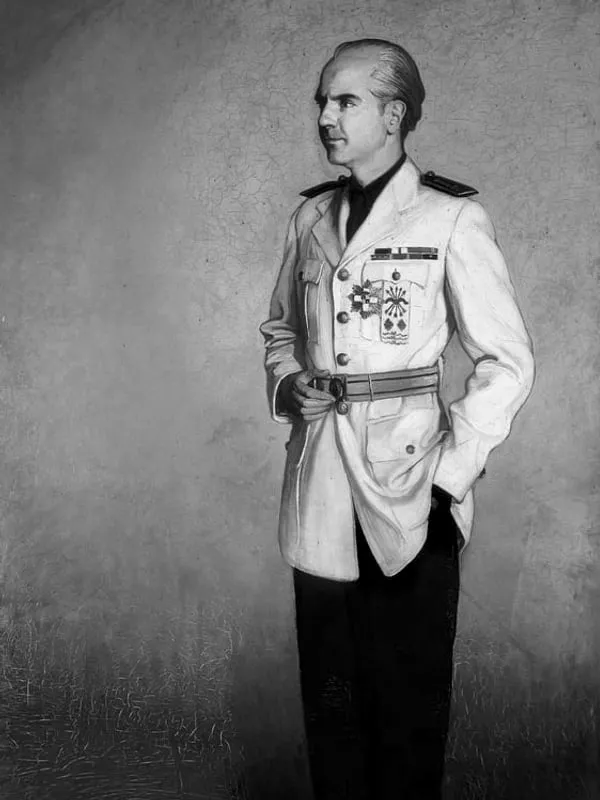
- Born:
- 12 September 1901, Cartagena (Spain)
- Died:
- 1 September 2003, Madrid
- Author:
- Natalia
- Photo:
- Ignacio Zuloaga, domena publiczna, Wikimedia Commons

Ramón Serrano Suñer was a lawyer and right-wing politician who, through his marriage to the sister of Francisco Franco’s wife, became the Caudillo’s closest adviser during the Civil War. From 1937 to 1942 he was the second man in the state after Franco. He laid the legal and political foundations of the dictatorship: a single party, censorship and laws modelled on Fascist Italy. Spaniards nicknamed him Cuñadísimo, “the Supreme Brother-in-Law”, in imitation of the title Generalísimo. In the autumn of 1940, as Minister of the Interior and then Foreign Minister, he negotiated in Berlin and at Hendaye the terms of Spain’s entry into the war on the side of the Axis, and in June 1941 he was the chief advocate of sending the Blue Division to the Eastern Front. Removed in 1942, he outlived Franco by almost thirty years and died at the age of nearly 102, the last of the men who had governed Francoist Spain in its early years.
Youth and marriage
He was born on 12 September 1901 in Cartagena, where his father, the civil engineer José Serrano Lloveres, was working; the family came from Catalonia, from the province of Tarragona. His father, transferred from town to town, eventually settled in Madrid. Ramón studied law at the Central University of Madrid, graduating with distinction in 1923. At university he presided over the students’ association and became friends with José Antonio Primo de Rivera, son of the dictator Miguel Primo de Rivera and later founder of the Falange. He also studied for a time in Bologna, where he encountered Mussolini’s Fascism and came to admire it.
While still very young he passed the competitive examination for the corps of state lawyers (abogados del Estado), who represent the state treasury, and after a short spell in Castellón he was posted to Zaragoza. There he met Ramona “Zita” Polo, the sister of Carmen Polo, wife of General Franco, then commandant of the Military Academy in Zaragoza. The wedding took place on 6 February 1932 in Oviedo; the witnesses were Franco and José Antonio Primo de Rivera, who met each other on that occasion. Serrano Suñer and Franco became brothers-in-law, which was to shape his entire subsequent career.
Right-wing deputy
In 1933 Serrano Suñer was elected to the Cortes for Zaragoza on the list of a right-wing coalition linked to José María Gil-Robles’s Spanish Confederation of Autonomous Right-wing Groups (CEDA), although he never formally joined it. He was a conservative Catholic, distrustful of parliamentary democracy; at a CEDA rally at El Escorial in April 1934 he spoke of the “degeneration” of democracy. He maintained close contacts with José Antonio and drew steadily closer to the Falange. In February 1936 he won his seat again. Before the elections he had tried to bring Franco and José Antonio together, but their meeting was a failure, and when Franco wanted to stand in the re-run election in Cuenca on the same list as the Falange leader, Serrano Suñer travelled to the Canary Islands and persuaded his brother-in-law to withdraw. In the spring of 1936 he encouraged young people of the Catholic right to go over to the Falange, and he knew of the preparations for a military conspiracy against the Popular Front government.
Prison and escape
The outbreak of the Civil War in July 1936 found him in Madrid, where the rising failed. Despite his parliamentary immunity he was soon arrested and held in Madrid’s Modelo prison. He survived the massacre of 22 August 1936, when an armed crowd broke into the prison and murdered many of the inmates, among them Falangists he knew. Later, thanks to the intercession of friends, he was transferred under guard to a private clinic because of a stomach ulcer. From there he escaped disguised as a woman; according to most Spanish sources this happened in January 1937, though some biographies give the autumn of 1936. He took refuge in the Dutch legation, reached Alicante with a forged pass, and an Argentine destroyer took him to Marseille. On 20 February 1937, by way of Hendaye, he made his way to Salamanca, Franco’s headquarters.
His two elder brothers, José and Fernando, were taken from prison in Madrid and murdered by Republican militiamen. According to the historian Hugh Thomas, the French embassy had earlier refused them asylum. His brothers’ deaths left Serrano Suñer with a lasting hatred of the Republic and, his biographers believe, an aversion to France as well.
Architect of Franco’s state
In Salamanca Franco lived in the bishop’s palace, and his brother-in-law and family found themselves under the same roof. The trained lawyer and experienced politician quickly supplanted the Caudillo’s brother Nicolás as his principal adviser. It was he who drafted the Decree of Unification, issued on 19 April 1937, which merged the Falange and the Carlists into a single state party, FET y de las JONS, headed by Franco. The resistance of the old Falange leader Manuel Hedilla was broken by his arrest; sentenced to death, he was pardoned, partly on Serrano Suñer’s advice. Serrano Suñer himself, although he had never been an “old shirt”, began to present himself as the heir of José Antonio, who had been shot by the Republicans in Alicante in November 1936.
In January 1938 he wrote the law on the central administration of the state, which replaced the military Technical Junta with a proper government. In Franco’s first cabinet, formed in Burgos on 30 January 1938, he took the Ministry of the Interior and served as secretary of the Council of Ministers. Under his direction came the Labour Charter (Fuero del Trabajo) of 9 March 1938, modelled on the Italian Carta del Lavoro, and the press law of 22 April 1938, which subjected every newspaper to prior censorship and remained in force until 1966. His ministry set up an office to collect the documents of Republican parties and organisations, which were later used to prosecute opponents. Serrano Suñer opposed any talk of a compromise peace with the Republic. He was also behind the founding of the EFE news agency and of ONCE, the organisation for the blind.
After the victory, in August 1939, he became Minister of the Interior in a new, merged ministry (Gobernación) and President of the Political Junta of FET y de las JONS, which made him the party’s de facto leader. He was responsible for the police, the press and propaganda in the years when military courts sentenced tens of thousands of the defeated to death. In June 1939 he accompanied the returning Italian corps to Italy and met Mussolini and Pope Pius XII. Together with General Juan Yagüe, he was among the most ardent advocates of Spain’s entering the war on the side of the Axis.
Berlin and Hendaye
In September 1940 Franco sent him to Berlin to settle the terms of Spain’s entry into the war. In talks with Joachim von Ribbentrop on 16 and 17 September and with Adolf Hitler he demanded Gibraltar, the whole of French Morocco and the Oran district, and said of Portugal that “geographically speaking, it has no right to exist”. In return Ribbentrop demanded one of the Canary Islands, bases in Morocco and economic concessions, and treated the Spaniard with condescension, as the representative of a satellite state. The two ministers came to loathe each other, and Serrano Suñer, as he later claimed, began to doubt whether Spain should enter the war on such terms. Franco’s letters from those days show that it was the Caudillo who was then keener on war than he was. In Berlin he lived through a major RAF raid and was present at the signing of the Tripartite Pact.
On 16 October 1940 Franco appointed him Foreign Minister in place of the pro-British Juan Beigbeder. He kept his influence over the Ministry of the Interior through a trusted under-secretary. The day before he left that ministry, on 15 October, the former President of the Government of Catalonia, Lluís Companys, whom the Germans had arrested in occupied France and handed over to the Spanish police, was shot in Barcelona. In those same days Serrano Suñer played host to Heinrich Himmler and agreed with him on close cooperation between the Spanish police and the Gestapo.
On 23 October he accompanied Franco to Hendaye. After the dictators’ conversation he negotiated a secret protocol with Ribbentrop, and that night in San Sebastián he reworked its text with Franco. Ribbentrop rejected the Spanish amendments, which Serrano Suñer did not tell his brother-in-law; he himself signed the protocol in Madrid in November. Hitler believed that it was Serrano Suñer who “had Franco in his pocket” and blamed him for the failure of the talks, while Ribbentrop abused him as a “Jesuit”. On 18 November Serrano Suñer met Hitler at the Berghof, but there too he committed himself to no fixed date. Years later he claimed that had Hitler promised Franco French Morocco, Spain would have entered the war.
The Blue Division and downfall
In the spring of 1941 Serrano Suñer was at the height of his power, but the number of his enemies was growing: generals, monarchists and Catholics, outraged by his power and his Falangist radicalism. After his speech at Mota del Cuervo on 2 May 1941, in which he demanded all power for the Falange, Franco handed the Ministry of the Interior to an anti-Falangist, Colonel Valentín Galarza, who removed Serrano Suñer’s people from the administration. The minister resigned but withdrew his resignation under pressure from his brother-in-law.
On 22 June 1941, the day of the German attack on the USSR, he proposed to the Reich’s ambassador that volunteers be sent to the front, and on 24 June, from the balcony of the party headquarters in Madrid, he cried: “Russia is guilty!” – guilty of the Civil War and of the death of José Antonio. After the speech the crowd stoned the British embassy. The Blue Division under General Agustín Muñoz Grandes set off for the Eastern Front; by 1943 some 45,000 Spaniards had served in it. Serrano Suñer refused, however, to declare war on the USSR formally, fearing the British reaction. On 25 November 1941 in Berlin he signed the extension of the Anti-Comintern Pact on Spain’s behalf.
The German defeats before Moscow and the entry of the United States into the war weakened his position. On 16 August 1942 Falangists threw grenades into the crowd leaving a Mass for fallen Carlists at the Basilica of Begoña in Bilbao, which the Army Minister, General José Enrique Varela, had attended. The military regarded the attack as an assault by the Falange on the army. Franco dismissed Varela and Galarza, but, on the advice of Luis Carrero Blanco, to keep the balance he also dismissed his brother-in-law on 3 September 1942. The Foreign Ministry went to the Anglophile General Francisco Gómez-Jordana, which London and Washington read as Spain’s first step away from the Axis. Hitler, who according to the records of his table talk called Serrano Suñer “the gravedigger of the new Spain”, welcomed his fall.
A long life after power
Serrano Suñer never held office again and returned to the law, although he sat in the Cortes and the National Council of the Falange until 1967. Relations between the two families cooled. In 1945 he wrote Franco a letter advising him to form a transitional government that would include liberal intellectuals from exile; Franco scribbled a mocking “ha, ha, ha” in the margin. In 1947 he published his memoirs, Entre Hendaya y Gibraltar, in which he portrayed himself and Franco as men who had skilfully kept Hitler at arm’s length, and in 1977 a further volume, Entre el silencio y la propaganda, la Historia como fue, more critical of the dictatorship; in it he called the post-war repression “justice in reverse”. In 1949 he played host to Oswald Mosley in Spain, and in 1961 he helped General Raoul Salan, who was preparing in Spain the putsch against de Gaulle in Algiers. He gave many interviews to historians, among them Paul Preston, in which he defended his role. He died in Madrid on 1 September 2003, eleven days before his 102nd birthday. In 2008 Judge Baltasar Garzón posthumously included him among 35 dignitaries of the Franco regime named in an investigation into crimes against humanity.
Significance
Serrano Suñer was the most important civilian architect of Franco’s dictatorship and the most Fascist of its politicians. It was he who gave the military regime of the Civil War years the shape of a one-party state, with censorship and an apparatus of repression, modelled on Mussolini’s Italy. In 1940–1941 he was Hitler’s and Ribbentrop’s chief interlocutor on the question of Spain’s entry into the war. After the war he and Franco together built up the legend that they had cunningly kept the country out of it. The documents tell a different story. Both wanted war at Germany’s side, provided only that Hitler paid for it with French colonies and supplies; what kept Spain out of the war was above all its weakness, British resistance and Hitler’s choice to bet on Vichy France. Paradoxically, it was Ribbentrop’s arrogance in Berlin that made Serrano Suñer one of the first in Madrid to take a more sober view of the Reich.
Sources
Often appears with
People who appear in the same events.