- Category:
- Military operations
- Front:
- Spain
- Date:
- 18 July 1936
- Author:
- Natalia
- Battle:
- The Spanish Civil War
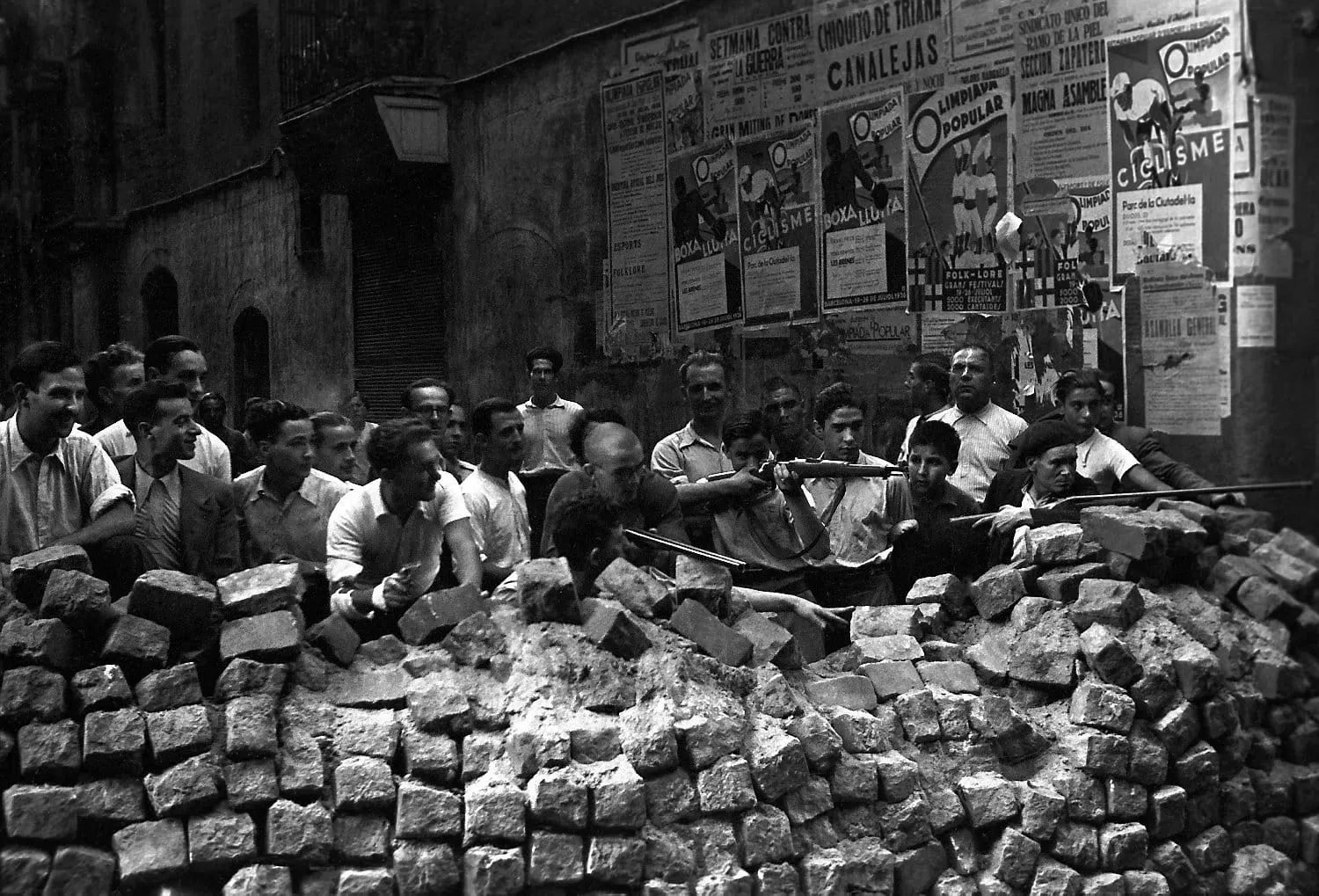
On 18 July 1936 garrisons all over Spain began to rise against the Popular Front government. The revolt had already broken out the previous afternoon, 17 July, in the Spanish protectorate in Morocco, and on the morning of 18 July General Francisco Franco declared martial law in the Canary Islands and called on the army to rise. The conspirators, led by General Emilio Mola, were counting on a swift coup that would hand them Madrid within a few days. Things turned out differently. In Seville, Zaragoza, Pamplona, Burgos and Valladolid the revolt succeeded, but in Madrid, Barcelona, Valencia and Bilbao it was crushed by police officers and soldiers loyal to the government and by armed workers. After three days Spain was divided into two zones, and the failed coup turned into a civil war that lasted almost three years, cost several hundred thousand lives and drew in Hitler, Mussolini and Stalin.
War chronologies often give 18 July as the start of the war, because on that day the revolt spread to the Iberian Peninsula, and for almost forty years Francoist Spain celebrated it as the feast of the “National Uprising”. The first shots, however, were fired on 17 July in Melilla. Either day can therefore be regarded as the start of the war.
The Republic after the 1936 election
The October Revolution of 1934 and its bloody suppression had split Spain into two camps. The election of 16 February 1936 was won, by a narrow margin of votes but a large majority of seats, by the Popular Front, a coalition of left-wing republicans, socialists and communists, supported this time by many anarchists as well. A government was formed by Manuel Azaña, who became president in May, with his associate Santiago Casares Quiroga as prime minister. The Asturian prisoners were amnestied, Catalonia regained its autonomy, and in the south peasants began seizing land on the great estates on their own initiative.
The spring of 1936 was a time of chaos. Strikes, church burnings, assassinations and street shoot-outs between gunmen of the Falange, the fascist party of José Antonio Primo de Rivera, and socialists, communists and anarchists claimed several hundred lives between February and July. The radical wing of the socialists talked of revolution, the right of impending Bolshevism. The government of left-wing republicans was weak and could neither calm the streets nor disarm the conspirators in the army.
The generals’ conspiracy
The conspiracy took shape immediately after the election. On 8 March 1936, on the eve of Franco’s departure for the Canary Islands, a group of generals met in Madrid and agreed to overthrow the government if necessary. The new cabinet, aware of the danger, dispersed suspect commanders to the provinces: Franco to the Canaries, Manuel Goded to the Balearics, and Mola, the commander of the troops in Morocco, to the post of military governor of Pamplona. This proved a mistake. From Navarre Mola, who signed his coded correspondence as “the Director”, spent three months building a conspiracy that embraced most of the garrisons. Its formal leader was to be General José Sanjurjo, the author of a failed coup in 1932, who was living in exile in Estoril in Portugal.
Mola’s plan envisaged a simultaneous rising of the garrisons, a march by columns from the north on Madrid, and the transfer from Morocco of the best part of the army, more than 30,000 professional soldiers of the Spanish Foreign Legion and the Regulares. The first of his secret instructions, dated 25 May, stated that the action must be “extremely violent” and that opponents must be punished in exemplary fashion. Mola bargained at length with the Carlists, traditionalist monarchists who had thousands of armed volunteers, the requetés, in Navarre. Funding came from the tycoon Juan March, and as early as 1934 the monarchists had obtained a promise of help from Mussolini.
Franco hesitated until the last days, so much so that the other conspirators mockingly nicknamed him “Miss Canary Islands 1936”. On 23 June he wrote an ambiguous letter to Casares Quiroga warning of discontent in the army. His participation was nonetheless crucial, because he enjoyed immense authority among the officers of the Army of Africa. With March’s money, Luis Bolín, the London correspondent of the daily ABC, chartered a de Havilland Dragon Rapide aircraft in England to fly the general from the Canaries to Morocco. On 11 July the aircraft took off from England.
The murder of Calvo Sotelo
On 12 July Falangists shot dead a lieutenant of the Assault Guard, José del Castillo, a socialist, in Madrid. In reprisal, on the night of 12–13 July, a group of his comrades and socialist gunmen dragged the monarchist leader in the Cortes, José Calvo Sotelo, from his home, and one of them, Luis Cuenca, shot him in a police lorry. The murder of a deputy by agents of the state shook the right. The conspiracy was by then almost ready, but the killing won over the waverers, probably including Franco, and gave the rebels a justification: the army was to save Spain from anarchy. On 14 July the Carlists finally joined the rising.
17 July: Morocco
The rising was set for 18 July (according to some historians, for the evening of 17 July in Morocco). In Melilla the conspirators feared arrest and began to act ahead of time on the afternoon of 17 July. A Legion detachment surrounded police officers sent to the building of the boundary commission, where officers had gathered, and the rebels arrested the district commander, General Manuel Romerales, who was loyal to the Republic; they later shot him. That evening and night the rising spread to Tetuán, the capital of the protectorate, and to Ceuta, where Lieutenant Colonel Juan Yagüe took the town without firing a shot. Legionaries entered the working-class districts and shot trade union activists. By the evening of 18 July the whole of Spanish Morocco was in rebel hands.
Franco was then in Las Palmas on Gran Canaria. His pretext for crossing from Tenerife was the funeral of the island’s military commander, General Amado Balmes, who had died on 16 July from a bullet from his own pistol; it is still not known for certain whether this was an accident. He received news of the outbreak of the rising in Melilla on the evening of 17 July. At dawn on 18 July he declared martial law in the islands, and radio stations broadcast his manifesto. In the afternoon the Dragon Rapide took off from Gando airfield, reached Casablanca via Agadir that evening and landed at Tetuán on the morning of 19 July. Franco took command of the troops in Morocco.
18–20 July: Spain breaks apart
On 18 July the garrisons on the Peninsula rose. In Seville General Gonzalo Queipo de Llano, with a small detachment and a great deal of nerve, arrested the district commander, seized the city centre and then brutally subdued the working-class districts. The rising also triumphed in Cádiz and Córdoba, but failed in Málaga. Casares Quiroga’s government played down the news from Morocco and refused to hand out arms to the trade unions, which had declared a general strike. On the night of 18–19 July the prime minister resigned. The new prime minister, Diego Martínez Barrio, tried to reach an agreement with Mola by telephone, but Mola replied that it was too late. After a few hours Martínez Barrio was replaced by José Giral, who disbanded the mutinous units and ordered arms to be issued to the workers’ militias.
On 19 July Mola declared martial law in Navarre, where thousands of red-bereted Carlists greeted the rising like a festival. Without much resistance the rebels took Zaragoza, where General Miguel Cabanellas was in command, as well as Burgos and Valladolid, and on 20 July Galicia. The district commander in Burgos, General Domènec Batet, who two years earlier had put down the rising in Barcelona, refused to join the revolt; his subordinates arrested him, and in 1937 the rebels shot him.
In Barcelona the soldiers left their barracks on the morning of 19 July, but ran into the Assault Guard, the Civil Guard, which remained loyal to the government, and thousands of anarchists of the CNT. General Goded, who had flown in from Majorca to take command, was forced to surrender that same day and, at the authorities’ demand, called on the rebels over the radio to lay down their arms. He was shot in August. In Madrid General Joaquín Fanjul shut himself up in the Montaña barracks with several thousand soldiers, Falangists and monarchists. On 20 July a crowd of militiamen and loyal troops, supported by artillery and aircraft, stormed in. Many of the defenders were murdered on the spot; Fanjul was later tried and executed. The revolt also failed in Valencia, Bilbao, Santander, Gijón, Málaga and Cartagena.
On that same 20 July, in Estoril, the small aircraft that was to fly Sanjurjo to Burgos crashed on take-off. The general was killed; the pilot survived. The rebels had lost the leader around whom the junta was meant to form. On 24 July they set up a National Defence Junta in Burgos under the most senior general, Cabanellas.
Two Spains
After a few days the map was clear. The rebels, who began to call themselves “Nationalists”, held Galicia, Old Castile, León, Navarre, western Aragon, the Canaries, the Balearics (except Minorca), a fragment of Andalusia around Seville, Cádiz and Córdoba, and Morocco. Some eleven of Spain’s twenty-five million people lived in their zone. The Republic kept the capital, Catalonia, Valencia, most of Andalusia, Asturias, Cantabria, part of the Basque Country, the big cities, industry and the gold reserves of the Bank of Spain. The army split roughly in half, but most of the officers sided with the rebellion, and the Republic had to build an army from scratch out of party and trade-union militias. Most of the fleet remained Republican, because the sailors mutinied against their officers, killing many of them, and blockaded the Strait of Gibraltar. The Army of Africa was stuck in Morocco.
From the very first hours both sides killed. In the rebel zone Mola told the mayors of Navarre that it was necessary to “spread terror” and to eliminate without scruple all who did not think as they did. Left-wing activists, trade unionists, freemasons, teachers, mayors and officers loyal to the government were shot; this White Terror was planned and directed by the military authorities. In the Republican zone the state lost control of the streets for several months. Committees and militias murdered priests, members of religious orders, landowners, industrialists and right-wing politicians, and in Catalonia and Aragon the anarchists carried out a social revolution. By the end of the war nearly 7,000 clergy had been killed in the Republican zone. The Red Terror, however, was curbed within a few months, while the Francoist repression went on for many years after the war.
Junkers over the Strait
A coup that had not triumphed within a few days needed outside help. Franco began ferrying soldiers across the Strait in the handful of aircraft at his disposal, but in this way he could move at most a few dozen men a day. He therefore sent emissaries to Rome and Berlin. Two members of the NSDAP’s foreign organisation in Morocco, the merchant Johannes Bernhardt and Adolf Langenheim, flew to Germany. Against the advice of the Auswärtiges Amt (the Foreign Office), on the evening of 25 July 1936 they were received in Bayreuth by Hitler, who was there for the Wagner festival. After talking to Hermann Göring and the War Minister, Werner von Blomberg, he decided to help. The operation was codenamed Feuerzauber (“Magic Fire”), after the music from Die Walküre that Hitler had heard that evening.
At the end of July the first Junkers Ju 52 transport aircraft with Lufthansa and Luftwaffe crews reached Tetuán, and by August there were some twenty in all. Mussolini, initially reluctant, sent twelve Savoia-Marchetti SM.81 bombers from Sardinia on 30 July; three of them crashed or made forced landings in French Morocco and Algeria, which immediately revealed Italian involvement to the world. Within a few weeks German aircraft had carried well over ten thousand soldiers and their weapons across the Strait – the first airlift of such scale in history. On 5 August, under the cover of Italian and German aircraft, the first convoy of ships also broke through the blockade.
As a result the Army of Africa, moved to Seville, set off northwards. Columns of the Legion and the Regulares under Yagüe’s command swept through Extremadura in a month, took Badajoz on 14 August – where hundreds, and according to some authors even several thousand, people were shot – and joined up the southern and northern zones. At the end of September the relief of the besieged Alcázar in Toledo made Franco the hero of the Nationalists. On 1 October 1936, in Burgos, the generals proclaimed him “Generalissimo” and head of state.
Significance
The July coup was meant to be a swift seizure of power, but it opened the bloodiest civil war in twentieth-century Western Europe. According to various estimates, between 300,000 and more than 500,000 people died in it, including some 200,000 victims of repression on both sides of the front, and hundreds of thousands fled the country. Spain also became an arena for the great powers. Germany and Italy, barely out of the Ethiopian crisis and the remilitarisation of the Rhineland, acted together for the first time. Mussolini sent tens of thousands of soldiers to Spain, and Hitler sent an air force that, as the Condor Legion, tested new aircraft and tactics there. The common Spanish cause led in the autumn of 1936 to the proclamation of the Rome–Berlin Axis. From October the Soviet Union supported the Republic with tanks, aircraft and advisers, and through the Comintern with the International Brigades, in which several thousand volunteers from Poland fought.
Britain and France, fearing that Spain would ignite a European war, proclaimed a policy of non-intervention, which Germany, Italy and the USSR openly flouted. For Hitler it was a lesson that the Western democracies would not stand up to accomplished facts. For millions of Europeans the war in Spain became the prelude to the clash between fascism and its opponents that three years later engulfed the whole continent. Franco, the victor of April 1939, ruled Spain until his death in 1975.
Sources
Related events
(04)The same battle, people or subject.
- 15 November 1936 · SpainThe Condor Legion goes into actionIn November 1936 Hitler sent Hugo Sperrle's Condor Legion to Spain. By the middle of the month its aircraft were already fighting over besieged Madrid.
- 23 December 1936 · SpainItalian troops land at CádizOn 23 December 1936 about 3,000 Italian Blackshirts came ashore at Cádiz, the first wave of a corps soon named the Corpo Truppe Volontarie.
- 26 April 1937 · SpainThe bombing of GuernicaOn 26 April 1937 aircraft of the Condor Legion and the Italian air force bombed the Basque town of Guernica. Most researchers put the dead at 150–300.
- 7 May 1937 · SpainCondor Legion fighters in SpainIn the spring of 1937 the Condor Legion’s fighter group brought the Messerschmitt Bf 109 into combat in Spain, and its pilots developed new air-combat tactics.