Spain
Francisco Franco
Commander of the Spanish Legion (1923–1926), Chief of the General Staff (1935–1936), Generalissimo and Head of the Spanish State (1936–1975)
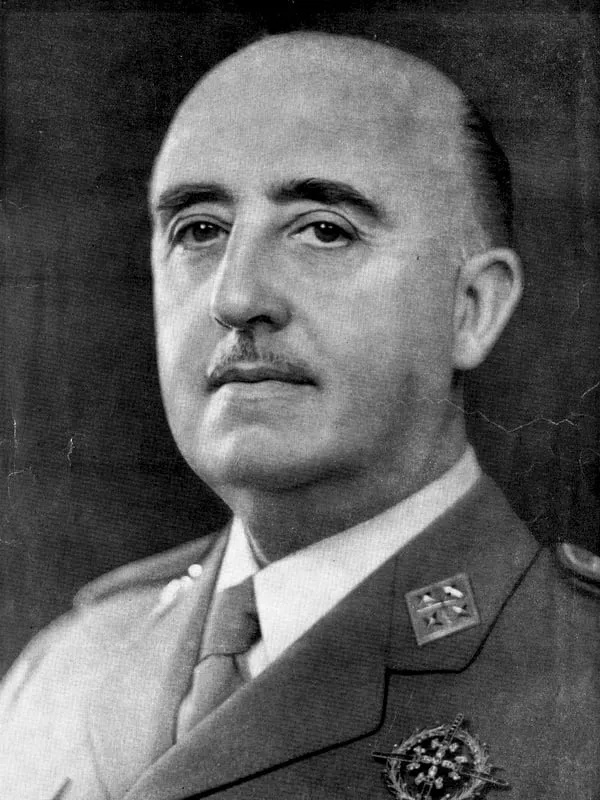
- Born:
- 4 December 1892, Ferrol (Spain)
- Died:
- 20 November 1975, Madrid
- Author:
- Łukasz
- Photo:
- autor nieznany, CC0, Wikimedia Commons

Francisco Franco Bahamonde was a professional officer who made his career in the colonial wars in Morocco, joined the generals’ conspiracy against the Second Spanish Republic in 1936 and within a few months became its leader. He won the civil war, which lasted almost three years, thanks to the professional Army of Africa, the help of Hitler and Mussolini, and ruthless terror against the defeated. His victory in April 1939 was the last triumph of the fascist dictators before the outbreak of the Second World War, and Spain became a testing ground for new German and Italian weapons. During the world war Franco, although he sympathised with the Axis and sent the Blue Division to the Eastern Front, did not join it. He outlived the fall of his patrons, became an ally of the United States during the Cold War and ruled Spain until his death in 1975.
Youth and Morocco
He was born on 4 December 1892 in Ferrol in Galicia, into a family that had been connected with the navy for generations. His father, a paymaster officer, was a dissolute and liberal man; his mother, María del Pilar Bahamonde, a pious Catholic. Franco was deeply attached to her and avoided his father in adult life. He wanted to become a naval officer, but after the defeat in the war with the United States in 1898 the navy reduced its intake. In 1907, aged fourteen, he entered the infantry academy in Toledo, from which he graduated in 1910 without distinction. His younger brother Ramón later became famous as an aviator and, unlike him, as a republican.
In 1912, at his own request, Franco went to Morocco, where Spain was fighting the tribes of the Rif for its protectorate. He quickly gained a reputation as a brave, cold officer with an extraordinary concern for discipline. He served in the Regulares, units made up of Moroccans. In June 1916 at El Biutz near Ceuta he was seriously wounded in the stomach; he survived by a miracle, and for this action he was promoted to major. In 1917, as an officer of the Oviedo garrison, he took part in suppressing the general strike in Asturias.
In 1920 Lieutenant Colonel José Millán-Astray founded the Spanish Foreign Legion, known as the Tercio, and Franco became his deputy and commander of its first battalion. The Legion, with its cult of death and its cruelty towards the enemy, waged a war without prisoners in the Rif War; its soldiers cut off the heads of the defeated. In 1923 Franco took command of the Legion, and on 22 October that year he married Carmen Polo, the daughter of a wealthy Oviedo family. In September 1925 the Legion spearheaded the landing in the bay of Alhucemas, which sealed the defeat of Abd el-Krim. In February 1926, at the age of thirty-three, Franco became a brigadier general – according to the press of the day, the youngest in Europe. In the same year his only daughter, Carmen, was born. The Moroccan experience shaped him for life: the conviction that the army was the bulwark of the nation, contempt for politicians and a habit of violence towards a population treated as the enemy.
A general of the Republic
In 1928 the dictator Miguel Primo de Rivera entrusted him with the newly created General Military Academy in Zaragoza. When King Alfonso XIII left the country in April 1931 and the Republic was proclaimed, Franco, a monarchist and a Catholic, accepted it with reluctance but did not join the conspiracies. The War Minister, Manuel Azaña, closed the Zaragoza academy, and its director bade farewell to the cadets with a speech that was barely veiled criticism of the government. Sidelined to minor posts in Galicia and the Balearic Islands, he did not support General José Sanjurjo’s failed coup in August 1932. Sanjurjo would remember this.
After the right won the 1933 elections, Franco’s career gathered pace. In the spring of 1934 he was promoted to major general, and in October, during the revolution in Asturias, the War Minister put him in charge, from Madrid, of coordinating the suppression of the miners’ uprising. Franco brought in the Legion and the Regulares from Morocco, which retook the coalfield, committing many atrocities. The right saw him as the saviour of the fatherland, the left as the “butcher of Asturias”. In February 1935 he became commander of the troops in Morocco, and in May, when the leader of the Catholic CEDA, José María Gil-Robles, was War Minister, Chief of the General Staff.
From conspirator to Caudillo
After the Popular Front’s victory in February 1936 the government sent him to the Canary Islands. Franco knew about the conspiracy led by General Emilio Mola, but until the end of June he would not commit himself definitively; his colleagues mocked him as “Miss Canary Islands”. What finally persuaded him was the murder of the monarchist José Calvo Sotelo on 13 July. On 18 July 1936 he declared martial law in Las Palmas, and the next day, in an aeroplane chartered in England, he reached Tetouan and took command of the Army of Africa, Spain’s best fighting force.
The coup failed in Madrid and Barcelona, and the Republican fleet blockaded the Strait, but Franco had an advantage the other generals lacked: troops and foreign contacts. In July his emissaries obtained aircraft from Hitler and Mussolini, which ferried the Army of Africa to Seville. On 20 July Sanjurjo, who had been designated leader of the rebellion, was killed. Franco’s columns marched on Madrid, leaving mass executions in their wake, as at Badajoz in August. At the end of September Franco deliberately turned aside from the road to the capital to relieve the Alcázar of Toledo, which had been under siege for two months. This propaganda success, filmed for the newsreels, made him a hero. On 1 October 1936 in Burgos the other generals proclaimed him Generalissimo and head of the government of the state, and from the outset he styled himself head of state. He adopted the title of Caudillo, the equivalent of the Italian Duce and the German Führer.
The Civil War
Franco conducted the Civil War slowly and methodically. The attack on Madrid in November 1936 was repulsed by defenders supported by the International Brigades and Soviet equipment, and further attempts to encircle the capital on the Jarama and at Guadalajara in the winter of 1937 failed. Franco then turned his forces north, where Mola, with the help of the German Condor Legion and Italian aviation, bombed Guernica, and by the autumn of 1937 had taken the Basque Country, Cantabria and Asturias. Throughout, Franco enjoyed enormous outside help: Hitler sent aircraft, Mussolini tens of thousands of troops, and Salazar’s Portugal volunteers and logistical support. Britain and France held to a policy of non-intervention which in practice cut off arms mainly to the Republic.
The war allowed Franco to build a dictatorship. On 19 April 1937 he decreed the merger of the fascist Falange and the monarchist Carlists into a single state party, which he himself led. His chief political adviser became his brother-in-law, Ramón Serrano Suñer. Mola’s death in an air crash in June 1937 removed the last general who could have rivalled him. The Catholic Church, thousands of whose priests had been murdered in the Republican zone, supported his “crusade”. Franco put the purging of conquered territory before a quick victory; he said he had to conquer Spain province by province and could not leave enemies behind him. The Nationalists won the battles of Teruel and the Ebro in 1938, in January 1939 they took Barcelona, and half a million refugees crossed into France. On 28 March Franco’s troops entered Madrid, and on 1 April 1939 he declared the war over.
Victory and terror
Franco did not want reconciliation. The Law of Political Responsibilities of February 1939 made it possible to punish activity going back to 1934. In the post-war years military courts sentenced tens of thousands of people to death; historians estimate the number shot after the war at no fewer than 20,000–50,000, and the total number of victims of Francoist repression during and after the war at more than 150,000. Hundreds of thousands passed through concentration camps, prisons and forced-labour battalions. Many Spanish republicans who had fled to France ended up in German camps after France’s defeat in 1940; more than four thousand of them died in Mauthausen, and the Franco regime did not intercede for them. In 1940 the Gestapo handed over to Spain the President of Catalonia, Lluís Companys, who was shot in Barcelona.
Between the Axis and the Allies
Already during the Civil War Franco had tied himself to the fascist states. On 27 March 1939 Spain joined the Anti-Comintern Pact, and in May it left the League of Nations. When the Second World War broke out it declared neutrality, but after the fall of France in June 1940 Franco changed this to “non-belligerence”, occupied the international zone of Tangier and was ready to enter the war in exchange for Gibraltar, French Morocco and Oran, and large deliveries of food and weapons. On 23 October 1940 he met Hitler at Hendaye. The talks produced no result, because Hitler did not want to promise French colonies and Spain, exhausted by its war, could not fight without massive help. The later legend of Franco outwitting Hitler is largely a product of his own propaganda; what kept Spain out of the war was above all its weakness and Hitler’s own hesitation.
After Germany attacked the USSR in June 1941 Franco sent the volunteer Blue Division to the Eastern Front; by 1943 some 45,000 Spaniards in all had served in it, fighting among other places near Leningrad. Spain supplied Germany with tungsten (wolfram) and other raw materials, and German U-boats used its ports. When the tide turned in the Allies’ favour, Franco returned to neutrality in October 1943 and withdrew the division. The regime allowed Spanish diplomats who were rescuing Sephardic Jews to act only to a limited extent; the claims of later propaganda about a great rescue operation by Franco are exaggerated.
A Cold War dictator
After 1945 Spain was isolated as the last ally of the defeated dictators; in 1946 the UN recommended the withdrawal of ambassadors from Madrid. Franco survived thanks to the Cold War, in which his anti-communism became an asset. In 1947 he declared Spain a kingdom, with himself as head of state for life. In 1953 he signed a concordat with the Vatican and an agreement with the United States on military bases, and in 1955 Spain joined the UN. In the 1960s technocrats in his government carried out economic reforms that brought rapid growth, but censorship, the ban on parties and trade unions, and repression of the opposition, the Basques and the Catalans continued to the end. In 1969 Franco named Prince Juan Carlos de Borbón as his successor. He died in Madrid on 20 November 1975 after a long illness. He was buried in the monumental mausoleum of the Valle de los Caídos, built partly by political prisoners. In 2019 his remains were moved to the cemetery at Mingorrubio.
Significance
Franco was not a creator of fascism and did not share Hitler’s racial obsessions. He was above all a general and a Catholic nationalist, and his regime rested on the army, the Church and a single party. For the history of the road to the Second World War, however, he is of key importance. The war that he and his fellow generals unleashed became the first open trial of strength between the dictatorships and their opponents. Germany and Italy, fighting side by side in Spain, drew closer together and created the Axis; the Luftwaffe gained experience that it used in Poland in September 1939; and the Western democracies, looking on passively as the Republic was destroyed, confirmed Hitler in his belief that they would also give way over Austria and Czechoslovakia. Spain paid for this war with hundreds of thousands of dead and almost forty years of dictatorship.
Sources
Commanded in battles
(01)Often appears with
People who appear in the same events.