Germany
Wilhelm von Leeb
Commander of Army Group C (1939–1941) and Army Group North (1941–1942), field marshal (from 1940)
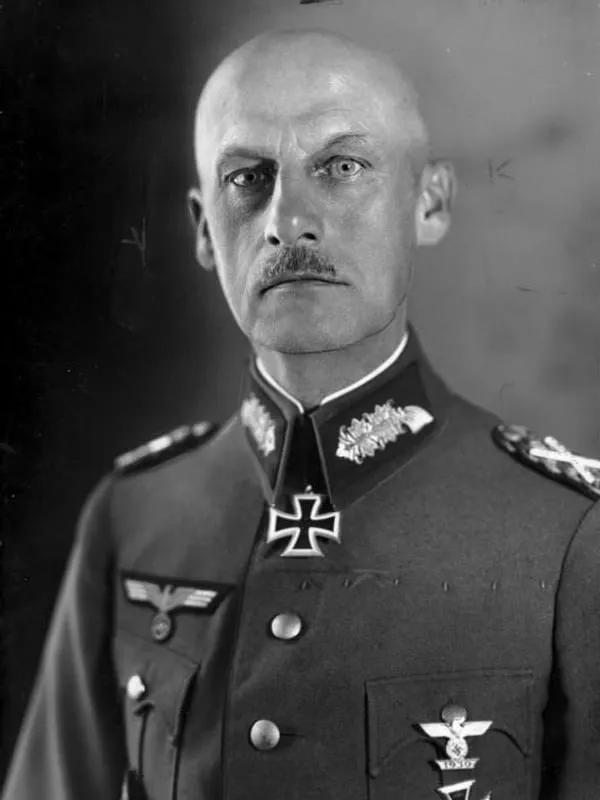
- Born:
- 5 September 1876, Landsberg am Lech (Bavaria, German Empire)
- Died:
- 29 April 1956, Füssen (Bavaria)
- Author:
- Łukasz
- Photo:
- Schwz, CC BY-SA 3.0 DE, Wikimedia Commons

Wilhelm Ritter von Leeb was a Bavarian artillery officer and staff officer who commanded two of Germany’s army groups during the Second World War. In 1939–1940 his Army Group C guarded the border with France, and in June 1940 it broke through the Maginot Line. In 1941 Army Group North under his command advanced through the Baltic states, broke the defences on the approaches to Leningrad and began the blockade of the city, which cost hundreds of thousands of its inhabitants their lives. A conservative Catholic who kept his distance from the Nazis, and who in 1939 opposed an attack in the west through neutral countries, he nevertheless accepted lavish gifts from Hitler, while troops under his orders took part in the murder of Jews in Lithuania and the starvation of Leningrad. After the war an American tribunal at Nuremberg sentenced him to three years’ imprisonment.
A Bavarian gunner
He was born on 5 September 1876 in Landsberg am Lech in Bavaria, into the Catholic family of a Bavarian officer, Major Adolf Leeb. His younger brother Emil also became a general of artillery and during the war headed the Army Ordnance Office. After finishing a classical gymnasium, Wilhelm joined the Bavarian Army’s 4th Field Artillery Regiment “König” in Augsburg as a volunteer in July 1895. After attending the war school in Munich he was commissioned as a second lieutenant.
In 1900 he volunteered for the expeditionary corps sent to China and, as a platoon commander in a mountain battery, took part in the suppression of the Boxer Rebellion. On his return he attended the Bavarian War Academy in Munich from 1903 to 1906, which qualified him as a General Staff officer. He served on the general staff in Munich and on the Great General Staff in Berlin, and in 1912 he took command of a battery in Erlangen. In 1912 or 1913 he married Maria Schrott, the daughter of a Bavarian general of cavalry. They had three sons, one of whom was killed in the Second World War.
The First World War
He began the war on the staff of the I Bavarian Corps, with which he fought in Lorraine and France. In the spring of 1915 he became first staff officer of the 11th Bavarian Infantry Division and went with it through several fronts. He distinguished himself in the breakthrough at Gorlice, in the capture of the fortress of Przemyśl and in the crossing of the Danube during the campaign against Serbia. On the recommendation of his divisional commander he was awarded the Bavarian Military Order of Max Joseph for these actions, which carried with it personal nobility and the title “Ritter von”. From then on he was Wilhelm Ritter von Leeb, though he is usually referred to simply as Wilhelm von Leeb.
In 1916 he was promoted to major. From May 1917 until the end of the war he served on the Western Front on the staff of the Army Group of Crown Prince Rupprecht of Bavaria, first as second staff officer and later as quartermaster. According to his biographer, he experienced the failure of the spring offensive of 1918, the destruction of his old division and the revolution as a profound shock.
In the Reichswehr
After the war he worked in the Bavarian Ministry of Military Affairs and, according to German biographical sketches, took part in crushing the Bavarian Soviet Republic in the spring of 1919. He then moved to the Reichswehr Ministry in Berlin. After the Kapp Putsch he became chief of staff of Military District II in Stettin, and after Hitler’s Munich Putsch in 1923, chief of staff of Military District VII in Munich. From 1924 to 1928 he commanded an artillery battalion and then the 7th (Bavarian) Artillery Regiment. In 1929, as a Generalmajor, he became artillery commander of District VII, and in 1930, by then a Generalleutnant, commander of the 7th Division and of the Munich military district – in effect the senior military commander in Bavaria.
In the 100,000-strong army of the Weimar Republic Leeb was regarded as an educated, reserved and reticent officer. He was convinced that the Reichswehr was incapable of defending the country, let alone of throwing off what he called in 1924 “the shackles of the peace treaty”.
Under Hitler: commander, pensioner, commander again
After Adolf Hitler came to power, Leeb, as a conservative Catholic, kept his distance from the new regime but continued to be promoted. On 1 October 1933 he took command of Group Command 2 in Kassel, one of the two highest commands of the army, and on 1 January 1934 he became a general of artillery. In these years he wrote a book, Die Abwehr (Defence), published in 1938, in which, against the prevailing fashion for fast mobile warfare, he argued that defence was a “mirror of the political and military situation” of Germany.
At the beginning of 1938, during the Blomberg–Fritsch affair, when Hitler removed the War Minister Werner von Blomberg and the Commander-in-Chief of the Army Werner von Fritsch, Leeb was one of the generals sent into retirement. He received the honorary rank of Colonel General at the same time. As early as the summer of 1938, during the Sudeten crisis, he was recalled to command the 12th Army, which after the Munich Agreement occupied part of the Sudetenland. Afterwards he retired once more.
Army Group C
In the summer of 1939 he was recalled for a second time and placed at the head of Army Group C, which was to defend the western border of the Reich while the main forces fought in Poland. He was 62 and, after Gerd von Rundstedt, the oldest general in the German army. According to his diary, after Britain and France declared war he wrote of Hitler that he was a “blinded fool, a criminal”. In September his troops fell back before the French offensive in the Saar, which soon came to a halt.
In the autumn of 1939 Leeb was one of the most determined opponents of the plan to attack in the west. In mid-October he sent the Commander-in-Chief of the Army, Walther von Brauchitsch, a memorandum warning that an attack through neutral countries would turn the whole world against Germany. “A Germany that for the second time in 25 years invades neutral Belgium”, he wrote, would forfeit all credibility. The Chief of the General Staff, Franz Halder, and some officers were at that time even considering removing Hitler. According to accounts from those weeks, Leeb proposed to the commanders of the other two army groups that they act together, up to and including resignation, if Hitler insisted on the attack. No such joint step was taken, however.
During the French campaign Army Group C long remained on the defensive opposite the Maginot Line. When the French armies in the north had already been routed, his 1st Army broke through the fortifications in the Saar on 14 June 1940, and on 15 June the 7th Army crossed the Rhine near Colmar. Army Group C helped to encircle several hundred thousand French soldiers in Alsace and Lorraine. According to his biographer, Leeb quickly broke off the fighting to avoid unnecessary losses. On 24 June he received the Knight’s Cross, and on 19 July 1940, at a ceremony in Berlin’s Kroll Opera House, Hitler made him one of twelve new field marshals.
Army Group North
In the autumn of 1940 Leeb’s headquarters was moved to Dresden, and in the spring of 1941 it was renamed the headquarters of Army Group North. On 30 March 1941 Leeb was one of more than two hundred senior officers who heard Hitler’s speech describing the coming war against the USSR as an ideological war of annihilation. His army group, with the 16th and 18th Armies and Panzer Group 4, was, under the Barbarossa plan, to advance through the Baltic states and take Leningrad.
On 22 June 1941 his troops set out from East Prussia. On 26 June Erich von Manstein’s corps seized the bridges over the Dvina at Daugavpils (Dyneburg), and on 1 July the Germans took Riga. In those same days in Kaunas, Lithuanian squads acting at German instigation were murdering Jews, and Einsatzgruppe A under Franz Stahlecker was beginning mass executions. The commander of the army group’s rear area reported the massacres to Leeb. Leeb noted in his diary that the army had no choice but to “keep out of it”. According to historians who have studied his notes, he regarded the killing of Jewish men as to some extent justified by alleged crimes committed during the Soviet occupation, and considered at most the murder of women and children excessive. In September Stahlecker praised, in a report to Berlin, the exemplary cooperation of Army Group North with his men.
The advance on Leningrad grew steadily slower. In July the counter-attack at Soltsy held up the tanks for several weeks on the Luga. In August Leeb resumed the offensive, broke through the Luga line, took Novgorod and Chudovo, and at the end of the month reached Leningrad. On 28 August his 18th Army captured Tallinn. On 8 September the Germans took Shlisselburg on Lake Ladoga and cut the city off from the rest of the country. For Leeb’s birthday, on 5 September, Hitler secretly gave him 250,000 Reichsmarks, paid out of an extra-budgetary fund set aside for senior commanders.
The September assault stalled on the Pulkovo Heights, and Hitler took most of Leeb’s armour away for the drive on Moscow. In accordance with the dictator’s wishes, the city was not to be taken but starved and razed to the ground, and no capitulation was to be accepted. Leeb put this policy into effect. According to the research of historians, among them Johannes Hürter, he ordered the artillery to fire on civilians trying to get out of the encircled city, so that the infantry would not have to shoot them at close range. Troops under his command also murdered Roma and the mentally ill.
On 8 November 1941 the Germans took Tikhvin, cutting the last railway by which supplies reached Lake Ladoga, but on 9 December the Red Army recaptured the town. On 15 December, during the crisis before Moscow, Leeb began withdrawing his troops to the Volkhov line without the consent of the high command. The next day he obtained Hitler’s approval at the Wolf’s Lair. In January 1942, when the Red Army threatened to encircle his corps at Demyansk, he asked for freedom of action or to be relieved. Hitler chose the latter: on 16 January 1942 Leeb was transferred to the command reserve, and Army Group North was taken over by Georg von Küchler. Unlike Rundstedt and Fedor von Bock, he never received another command.
Hitler’s gifts and the end of the war
Despite his dismissal Leeb remained a beneficiary of the system of gifts by which Hitler bound the generals to himself. He wanted to add a landed estate to his house in Solln near Munich, and in 1944 Hitler gave him more than 200 hectares of forest at Seestetten near Passau, valued at the time at around 638,000 Reichsmarks. According to German researchers, at about this time, after the 20 July plot of 1944, Leeb sent Hitler a declaration of loyalty.
On 2 May 1945 the Americans arrested him at Hohenschwangau. He was held as a prisoner of war, then interned, and finally became the most senior defendant in the High Command Trial, the last of the twelve trials before American military tribunals at Nuremberg. His counsel, Hans Laternser, presented him as a humane soldier who had not known of the criminal orders and was unaware of the activities of the Einsatzgruppen. Leeb delivered the closing statement on behalf of the defendants, in which he portrayed them as victims of history. On 27–28 October 1948 the tribunal found him guilty on one of four counts: passing on to his subordinates the Barbarossa jurisdiction decree, which exempted from court-martial soldiers who committed offences against the civilian population. He was sentenced to three years’ imprisonment, which was deemed to have been served in custody, and on 29 October he was released. In the reasoning of the judgment the judges stated that no criminal order bearing his signature had been produced. His West German biographer Georg Meyer later argued that the verdict rested on a mix-up in the documents.
Final years
After his release he settled in Hohenschwangau. From 1954 he was Grand Chancellor of the Military Order of Max Joseph. He died of a heart attack on 29 April 1956 in Füssen and was buried in Munich-Solln.
Assessment
Leeb was a typical representative of the old, pre-Hitler generals: an educated staff officer, a Catholic and a conservative, sceptical of the Nazis and, unlike many of his colleagues, openly opposed in 1939 to extending the war to the west. As a commander he was considered cautious and methodical, more a master of defence than of pursuit, as both his book and the slow, drawn-out advance on Leningrad bear out. For a long time he was portrayed as a “decent” officer whom Hitler had pushed aside for his independence. More recent research, based on his diary and the records of Army Group North, presents him differently: as a commander who accepted the murder of Jews behind his lines, put the plan to starve Leningrad into effect, and accepted money and land from Hitler. The blockade that his troops began lasted until January 1944 and, according to various estimates, claimed the lives of between some 650,000 and more than a million inhabitants of Leningrad.
Sources
Commanded in battles
(03)Mentioned in battles
(02)Often appears with
People who appear in the same events.