Italy
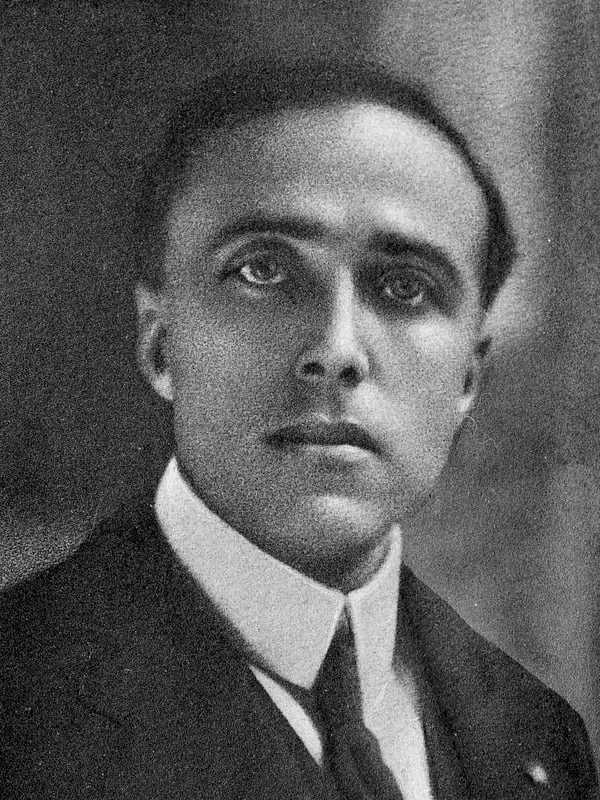
Giacomo Matteotti
Member of the Italian Chamber of Deputies (1919–1924), secretary of the Unitary Socialist Party (1922–1924)
- Born:
- 22 May 1885, Fratta Polesine (Kingdom of Italy)
- Died:
- 10 June 1924, Near Rome
- Author:
- Łukasz
- Photo:
- autor nieznany, domena publiczna, Wikimedia Commons

Giacomo Matteotti was an Italian socialist, lawyer and deputy, the most unyielding opponent of Benito Mussolini in parliament in the first years of Fascist rule. For years he collected and published evidence of the violence of the Fascist squads, and on 30 May 1924 he demanded in the Chamber of Deputies that the election won by Mussolini’s list be annulled. Eleven days later he was abducted in Rome and murdered by a Fascist squad. Mussolini ended the crisis that this crime provoked by establishing a dictatorship. Matteotti became the symbol of Italian anti-fascism, and his death marks the moment when Italy ceased to be a state governed by the rule of law and set out on the road that led it to the alliance with Hitler and to war.
The son of a wealthy Polesine family
He was born on 22 May 1885 at Fratta Polesine in the province of Rovigo, in the poor lowlands between the lower Po and the Adige. His father Girolamo traded in iron and copper, bought up land and lent money at interest. The family was among the richest in the district, something his opponents threw in his face all his life, mocking the “socialist in a fur coat”. Of the seven children, three sons reached adulthood. His elder brother Matteo and his younger brother Silvio, both socialists, died of tuberculosis in 1909–1910, leaving Giacomo the sole heir.
He joined the youth wing of the Italian Socialist Party at the age of thirteen, in 1898, following his elder brother’s example. He completed secondary school in Rovigo and in 1907 graduated in law with distinction from the University of Bologna. His thesis on recidivism, developed after travels in several European countries and a stay in Oxford, was published as a book in 1910. He knew French, English and German. He could have become a professor of criminal law, but chose politics.
A socialist in local government
He belonged to the reformist current led by Filippo Turati. He believed that socialism had to be built from the bottom up, through schools, local government and peasant leagues, not by a sudden upheaval. In 1908 he became a councillor in his home municipality, in 1910 a councillor of the province of Rovigo, and in 1912 mayor of the small town of Villamarzana. Since the law allowed candidates to stand wherever they paid taxes, he sat on more than a dozen municipal councils in the Polesine at once. He was renowned for his precision in budgetary matters, and in the municipalities he ran he built schools and fought illiteracy among farm labourers. At rallies he was a fiery speaker; in the council chamber he was a meticulous administrator.
In 1914 he firmly opposed Italy’s entry into the war. He saw it as a clash between the bourgeoisies of different nations paid for with the blood of workers and peasants. He sharply criticised his former party comrade Benito Mussolini, editor of Avanti!, who in the autumn of 1914 went over to the interventionists and was expelled from the party. In 1916 the military authorities judged Matteotti to be a “stubborn, violent agitator” and, although he was the only surviving son of a widowed mother, called him up and sent him to Sicily, to the mountains near Messina, where he remained until March 1919. In 1916 he married the poet Velia Titta, sister of the famous baritone Titta Ruffo. They had three children: Giancarlo, Gianmatteo and Isabella. Both sons became deputies after the Second World War.
A deputy in the time of squadrismo
In the election of November 1919, in which the socialists became the largest party in the Chamber, Matteotti was elected deputy for the Ferrara constituency. He was re-elected in 1921 and 1924. His colleagues called him “Tempesta” (the Storm) for his combative, uncompromising character. He spoke in the Chamber more than a hundred times, most often on public finance, taxation and administration, which he knew better than most ministers.
The years 1919–1920, the so-called “Red Biennium” of strikes and land occupations, ended in a counter-offensive by the landowners and the Fascist squads. The Po valley, and above all Ferrara and the Polesine, was its main battleground. In January 1921 Matteotti, who had taken over the leadership of the Ferrara chamber of labour after its leaders were arrested, was besieged there for several hours by Italo Balbo’s squads and then beaten up in the street. On 12 March 1921 at Castelguglielmo Fascists bundled him into a lorry, threatened him with death and dumped him in the countryside. He had to leave the Polesine, and his family was harassed and persecuted. In 1921 he published the Socialist Inquiry into the Deeds of the Fascists in Italy, the first systematic record of the squads’ attacks. Time and again he demanded that the governments of Giovanni Giolitti and his successors stop tolerating the violence, but to no avail. In March 1921, urging workers not to respond to provocation, he said that at such a moment even silence and “cowardice” could be heroic. For years the communists held these words against him as proof of passivity.
In October 1922, a few weeks before the March on Rome, the maximalists expelled Turati’s reformists from the party. The reformists founded the Unitary Socialist Party (PSU), and Matteotti became its secretary. From the outset he rejected any cooperation with the government Mussolini formed after taking power. He rejected Bolshevism too. He believed that a revolution imposed from above led to a new tyranny, and in January 1924 he refused the communists a united front on their terms. Instead he tried to build a broad anti-fascist bloc with the maximalists and the Catholic Popular Party. He travelled abroad to seek the support of European socialists until, in May 1923, the government refused to renew his passport. In July 1923 he was recognised by Fascists in Siena, attacked, and forced to leave the city.
The 1924 election and the last speech
At the beginning of 1924 he published A Year of Fascist Domination, in which he used figures to challenge the government’s economic successes and listed the acts of violence of Mussolini’s first year in power. In April an English translation appeared in London, where Matteotti had travelled secretly. The election of 6 April 1924, held under the Acerbo Law, gave the government list two-thirds of the seats. Matteotti was re-elected, and his party was the second-largest opposition force after the Popular Party, even though during the campaign Fascists had driven him from a rally in Cefalù.
On 30 May 1924 he made his most famous speech in the Chamber. Interrupted by Fascist deputies, he listed the violence and fraud constituency by constituency and demanded that the election of the government list’s deputies not be validated. According to his colleagues, he said as he finished: “I have made my speech. Now you can prepare the funeral oration for me.” On 10 June, on his way to parliament, he was dragged into a car on the Tiber embankment by Amerigo Dumini’s men and stabbed to death in the struggle. His body was found on 16 August in a copse in the municipality of Riano. The course of the crime, the political crisis that followed, and the historians’ debate over whether Mussolini himself gave the order are part of the story of the murder of Matteotti. He was buried on 21 August 1924 in his native Fratta Polesine.
Memory and significance
On 3 January 1925 Mussolini assumed in parliament the “political, moral and historical responsibility” for what had happened, and within two years he had abolished the opposition, the free press and free elections. Matteotti’s memory, however, became a banner for anti-fascists at home and in exile. In 1926 the Labour and Socialist International set up a fund in his name to aid the labour movement in countries under dictatorship, which operated until the outbreak of the Second World War. In socialist Vienna the Matteottihof workers’ housing estate was opened in 1927, and a monument to him was erected in Brussels. The young socialist Sandro Pertini, later President of Italy, joined the PSU under the impact of the news of the crime. According to Italian sources a unit bearing his name fought on the Republican side in the Spanish Civil War, and in 1943–1945 the socialist brigades of the Italian Resistance, fighting the Germans and the Fascists of the Italian Social Republic, bore Matteotti’s name.
Not everyone on the left saw him as a hero. The communist leader Antonio Gramsci called him in August 1924 a “pilgrim of nothingness”, a tragic champion of an idea that could never lead to revolution, and for a long time the communists accused the reformists of having disarmed the workers in the face of fascism. Historians judge him differently today: as a politician who understood earlier than others that fascism was not a passing reaction to the “Red Biennium” but an assault on the rule of law, and who defended parliament as the only arena in which to fight for workers’ rights. In 1955 the Italian Republic recognised him by law as a martyr. Some three thousand streets, squares and schools in Italy bear his name, more than for any other twentieth-century politician, and his family home in Fratta Polesine is now a museum.
For the history of the road to the Second World War, Matteotti’s death matters in two ways. It proved that fascism in power would not mellow, and that violence would remain its method of government. It was also a trial of strength that the liberal institutions lost: the king, the Senate and the old elites decided that Mussolini was a lesser evil than chaos. Nine years later the German elites made the same calculation about Adolf Hitler. The dictatorship built on the crisis of 1924 took Italy into the war on 10 June 1940, the sixteenth anniversary of his death.
Sources
Often appears with
People who appear in the same events.