- Category:
- Politics
- Date:
- 29 October 1922
- Author:
- Łukasz
- Tags:
- Italy, fascism, Benito Mussolini, Victor Emmanuel III
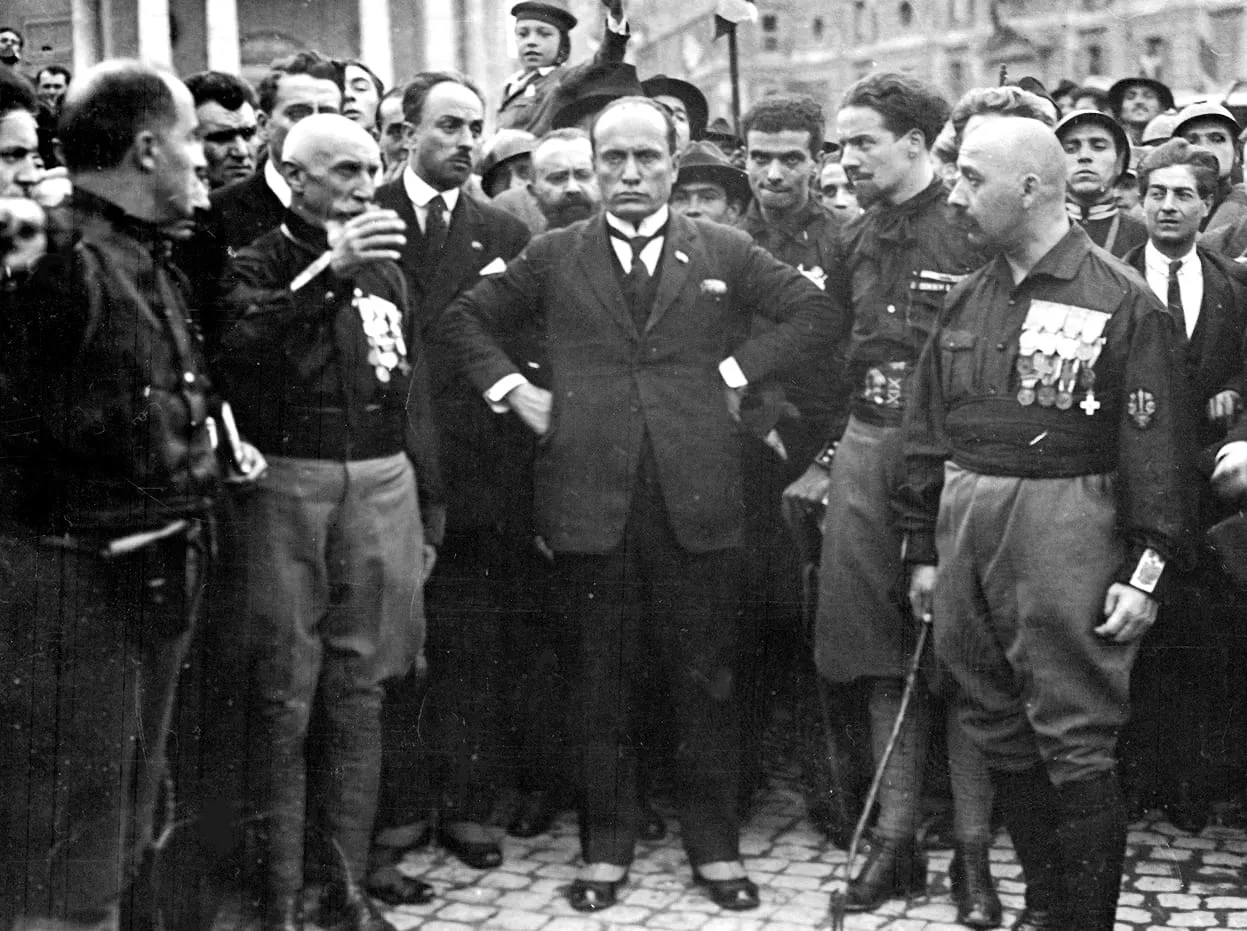
On Sunday 29 October 1922, in the Milan offices of the daily Il Popolo d’Italia, Benito Mussolini received a telegram from the king’s first aide-de-camp, General Arturo Cittadini. King Victor Emmanuel III was summoning him to Rome to entrust him with forming a government. The 39-year-old leader of the National Fascist Party, who had never been a minister and had only about thirty deputies behind him in the Chamber, boarded a sleeping car that evening and the next morning stood before the monarch. He had been brought to power not by elections or a parliamentary majority but by a threat. For two days tens of thousands of armed Fascists had been occupying prefectures, post offices and railway stations across the north and centre of the country, and their columns were gathering in the rain a few dozen kilometres from Rome. The government had wanted to disperse them by force, but on the morning of 28 October the king refused to sign the decree declaring a state of siege. So ended the March on Rome. For the first time in the history of parliamentary Europe, government passed to the leader of a party that had its own army and was conquering the country by violence against every other party.
Four dates for one seizure of power
Chronologies give different days for Mussolini’s assumption of power, because the takeover stretched over several days. On the evening of 27 October the Fascists began occupying public buildings, and the prime minister, Luigi Facta, resigned. On the morning of 28 October the king refused to sign the state of siege, and Fascism made this day its holiday, counting the years of the “Fascist era” from it. On 29 October Mussolini received the telegram summoning him to Rome and announcing that he would be asked to form a government; the Italian Dizionario Biografico degli Italiani (Treccani) treats this as the day on which he received the mandate. On 30 October the king formally entrusted him with office, and in the evening Mussolini presented his list of ministers. On 31 October the new government was sworn in and the Fascists paraded past the Quirinal. The most important date was 29 October, the day of the royal summons, but it was the whole turn of October 1922 that decided the seizure of power.
A state in decay
When the Fascists founded their party in November 1921, their squads already dominated much of the Po valley. In 1922 they went further. In May Italo Balbo brought tens of thousands of unemployed farm labourers into Ferrara and held the city for several days until the prefect gave way. Bologna and Cremona suffered similar “occupations”. Governments came and went in quick succession. In February 1922 the cabinet of Ivanoe Bonomi fell and Luigi Facta, an honest but colourless politician from the camp of Giovanni Giolitti, became prime minister. The Socialists and the Catholic Italian People’s Party could not reach agreement, and the Liberals believed that the Fascists could be tamed by giving them a few portfolios in a coalition.
The turning point came in August. The anti-Fascist trade unions, united in the Labour Alliance, called a “legalitarian strike” from 1 August to force the state to restore the rule of law. Mussolini announced that if the government did not break the strike within 48 hours, the Fascists would. The strike soon collapsed, and the squads used it as a pretext for reprisals. In Ancona, Genoa, Livorno and Parma they attacked the premises of the left, and in Milan they burned down the printing works of Avanti! and drove the Socialist city administration out of the town hall. Fascism now presented itself as the defender of order against the “Reds”, although it was itself the main source of violence. At the beginning of October several thousand squadristi occupied Bolzano and Trento, removing authorities they disliked. Once again the government did nothing. On 3 October Il Popolo d’Italia published the regulations of the “Fascist militia”, openly announcing the existence of a party army.
The plan of the march and the Naples congress
In these weeks Mussolini played a double game. In public he threatened revolution, while in secret talks with Giolitti, Antonio Salandra, Francesco Saverio Nitti, Vittorio Emanuele Orlando and Facta himself he gave each of them to understand that he would gladly join his coalition. Each of them saw himself as the saviour of the nation who would tame the Fascists by handing them a few ministries. Mussolini also reassured the monarchy. On 20 September at Udine he declared that Fascism would not act against the Crown, as officers who sympathised with him had urged.
On 16 October in Milan the decision to march was taken. It was to be led by four men, known as the quadrumvirs: the party secretary, Michele Bianchi; the commander of the militia, Italo Balbo; the retired general Emilio De Bono; and the monarchist Cesare Maria De Vecchi. The plan provided for the seizure of public buildings in the cities of the north and centre, the concentration of columns at Santa Marinella, Monterotondo and Tivoli, with a reserve at Foligno, and a march on the capital. Headquarters were to be in Perugia. There is much to suggest that Mussolini brought the operation forward when he learned that Facta intended to mark the anniversary of victory on 4 November with a great demonstration involving Gabriele D’Annunzio. The poet, who had once seized Fiume and ruled it until “Bloody Christmas”, was still a natural leader in the eyes of many veterans.
On 24 October the party gathered in Naples. Some ten to twenty thousand Fascists came to the congress – around 15,000 according to reliable estimates, although the party press claimed as many as 40,000–60,000. Mussolini demanded five ministries for the Fascists, and in the afternoon, taking the salute of the squads, he threatened: “either they give us the government, or we will take it by descending on Rome”. In the evening he himself returned to Milan. There, close to the Swiss border, he waited for the outcome and carried on negotiating.
The night of 27–28 October
On 27 October the Fascists went into action. In Pisa, Siena, Florence, Cremona, Bologna, Venice, Trieste and dozens of other towns they occupied prefectures, telephone exchanges, post offices and railway stations. Where the local authorities were well disposed to them, this happened without resistance. In Cremona the army opened fire and there were deaths. In the evening Facta, whose cabinet was in any case falling apart, tendered his resignation to the king, who had just returned to Rome from his estate of San Rossore near Pisa. He remained in office, however, until a new government could be formed.
During the night, after alarming news from the provinces, Facta, his ministers and General Emanuele Pugliese, commander of the Rome garrison, met at the War Ministry. Pugliese had at his disposal some 28,000 soldiers, machine guns, artillery and armoured cars. He prepared a blockade of the railway lines and roads leading to Rome. The Fascists gathered around the city numbered somewhere between sixteen and thirty thousand men according to various estimates, most of them poorly armed and soaked by pouring rain. All historians agree that the army could have dispersed them. At six in the morning on 28 October the Council of Ministers resolved to declare a state of siege throughout the country from noon, and at 7.30 a.m. the telegraphs sent the news to the prefects.
At about nine Facta brought the decree to the king for signature. Victor Emmanuel III refused. According to the accounts that have survived, he told the prime minister that such decisions were his alone, and that after a state of siege there was only civil war. At noon the government withdrew the telegram: without the royal signature the decree had no force. Prefects and commanders who for several hours had been preparing to defend themselves received the signal that the state was giving in. The Fascist columns moved on unhindered.
Why the king did not sign
Victor Emmanuel III never fully explained his decision. Years later he claimed that he had wanted to avoid bloodshed and civil war. The historian of Fascism Renzo De Felice lists several reasons: the weakness of Facta’s government, the uncertainty of the senior military commanders, the fear of civil war, and anxiety about the ambitions of the king’s cousin, the Duke of Aosta, who sympathised with the Fascists and, it was feared, might reach for the throne. Marshal Armando Diaz is credited with saying that the army would do its duty, but that it would be better not to put it to the test. Other historians, such as Denis Mack Smith, believe that the king simply wanted to be rid of a weak government and was counting on a cabinet of right-wing Liberals with Fascist participation. Mauro Canali adds to the list the monarch’s personal timidity, since the balance of forces was clearly in the state’s favour.
One thing is certain: the king had the right to refuse his signature, and his refusal decided everything. The Fascists won no battle. They won because the state gave up defending itself.
From Salandra to Mussolini
On the afternoon of 28 October the king entrusted the task of forming a government to Antonio Salandra, the former prime minister who had taken Italy into the war. Salandra, and with him the industrialists who had visited Mussolini in Milan that morning, were counting on a coalition in which the Fascists would receive a few ministries. Mussolini, knowing by now that the army would not be used, refused. He did not want to be a minister under Salandra. He wanted to be prime minister. Without the Fascists no one could form a government, and without a government the columns outside Rome had no reason to disperse. Salandra gave up the mandate, and the king, after consulting political and military leaders, decided to summon Mussolini.
According to those around him, Mussolini was not satisfied with telephone calls from friendly politicians and demanded a written summons. On 29 October he received General Cittadini’s telegram. In the evening he left Milan, and on 30 October he was in Rome before midday. He went to the Quirinal in a black shirt. He is credited with telling the king that he brought him “the Italy of Vittorio Veneto”. In the evening he presented his list of ministers. The same day the government lifted the roadblocks around the city and the Fascist columns, still armed, entered Rome. In the working-class district of San Lorenzo, which a year earlier had driven off Fascists arriving for the party congress, Tuscan squadristi opened fire while the soldiers stood by: eight people were killed. In the days that followed the squads ransacked the homes of opposition politicians and newspaper offices.
On 31 October the government was sworn in, and in the afternoon tens of thousands of Fascists – armed civilians without any legal status – paraded past the Altar of the Fatherland and in front of the Quirinal, saluting the king. The same day Il Popolo d’Italia published the order to demobilise, and the columns began to head home.
A coalition government and the “grey, deaf hall”
Mussolini’s first cabinet was not a one-party government. Besides four Fascists, including the prime minister himself, who kept the interior and foreign affairs for himself, it included the Nationalist Luigi Federzoni, two ministers from the People’s Party, Liberals and Democrats, and the two most famous commanders of the war: Marshal Diaz as minister of war and Admiral Paolo Thaon di Revel as minister of the navy. The philosopher Giovanni Gentile became minister of education. The line-up was meant to reassure the elites and show that Fascism was fitting into the framework of the state.
On 16 November Mussolini presented his government to the Chamber of Deputies. His speech went down in history for its contempt for parliament: “I could have made this grey, deaf hall a bivouac for my squads. I could have shut parliament and formed a government made up solely of Fascists. I could have, but I did not wish to, at least not for now.” Even so, on 17 November the Chamber gave him a vote of confidence by 306 votes to 116, with 7 abstentions. Those voting in favour included Giolitti, Benedetto Croce and the future prime minister of the Republic, Alcide De Gasperi. The Senate backed the government on 29 November. Parliament also granted the prime minister full powers for a year to reform taxation and the administration. The Liberals hoped that power would civilise the Fascists. The opposite happened.
In December 1922 the Grand Council of Fascism was created, the party’s supreme body, chaired by the prime minister, and in January 1923 the party squads were turned into the state-funded Voluntary Militia for National Security, answerable not to the king but to the head of government. For the time being everything appeared to be done in accordance with the constitution, but already anti-Fascists such as Giovanni Amendola had begun to use a new word: “totalitarian”.
The long shadow of the March on Rome
The March on Rome was not the revolution that propaganda later claimed, but a constitutional transfer of power under pressure from an armed party. That is precisely why it was such a dangerous precedent. It showed that in a country worn down by crisis and fear of communism there was no need to win elections or capture the capital. It was enough to intimidate the elites and convince the head of state that concession was the lesser evil. The conservatives, industrialists and Liberals who helped Mussolini believed they would control him. In 1924 his men murdered the Socialist deputy Giacomo Matteotti, and the king did nothing. On 3 January 1925 Mussolini took responsibility for Fascist violence upon himself, and within two years he had abolished every party but his own, the free press and the independent trade unions.
Munich took up the Roman example at once. Adolf Hitler, leader of the NSDAP for a year, began to talk of a “march on Berlin”, and his followers called him the German Mussolini. A year after the March on Rome, in November 1923, he tried to repeat the manoeuvre in Bavaria, but there the police opened fire and the putsch failed. Hitler drew the conclusion that power had to be won as Mussolini had won it, with an appearance of legality and with the complicity of the old elites. In January 1933, when Paul von Hindenburg appointed him chancellor, the lesson proved its worth.
Victor Emmanuel III’s decision bound the monarchy to Fascism for twenty years. The king signed one law of the dictatorship after another; in 1936 he accepted the crown of Emperor of Ethiopia after the invasion of that country, in 1938 he signed the anti-Jewish laws, in 1939 he accepted the crown of Albania, and on 10 June 1940 he agreed to war at Hitler’s side. He removed Mussolini himself only in July 1943, when the Allies had already landed in Sicily. By then it was too late to save Italy from war on its own soil, or the monarchy from collapse. It had all begun on the morning of 28 October 1922, when the king put aside the unsigned decree, and a day later, when the telegram from the Quirinal went out to Milan.
Sources
Related events
(04)The same battle, people or subject.
- 9 November 1921 · PoliticsThe founding of the National Fascist PartyOn 9 November 1921 a congress at Rome's Teatro Augusteo turned the Fasci di combattimento into the National Fascist Party, with Mussolini as its leader.
- 6 April 1924 · PoliticsThe Italian general election of 1924On 6 April 1924 Mussolini's list won about 65% of the vote and 374 of 535 seats. The election under the Acerbo Law was marred by violence and fraud.
- 10 June 1924 · Crimes and repressionThe murder of Giacomo MatteottiOn 10 June 1924 a Fascist squad abducted and killed the Socialist Giacomo Matteotti in Rome. Mussolini ended the ensuing crisis by setting up a dictatorship.
- 24 December 1920 · Military operationsBloody Christmas in FiumeOn Christmas Eve 1920 the Italian army attacked D'Annunzio's legionaries, who rejected the Treaty of Rapallo. After five days of fighting he gave up power.