Italy
Gabriele D'Annunzio
Poet, novelist and playwright, officer and airman in the First World War, Comandante of Fiume (1919–1920), Prince of Montenevoso from 1924
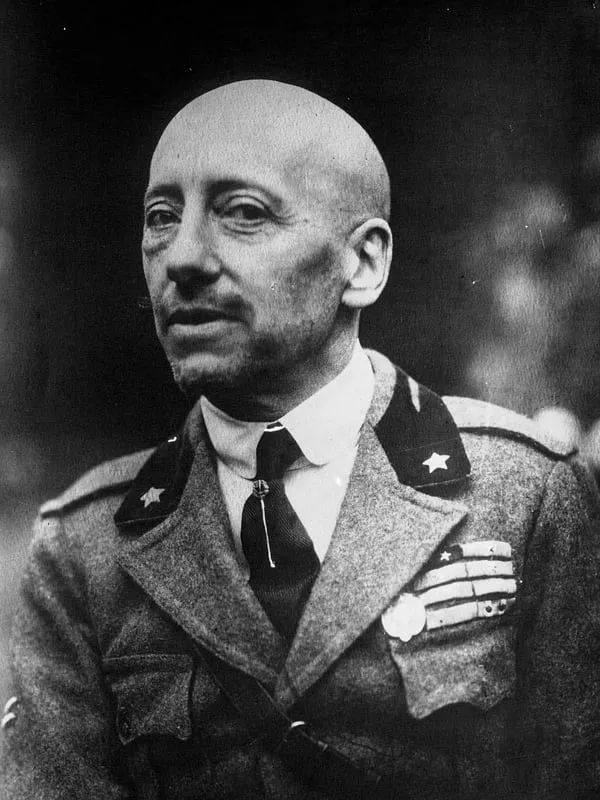
- Born:
- 12 March 1863, Pescara (Kingdom of Italy)
- Died:
- 1 March 1938, Gardone Riviera (Italy)
- Author:
- Łukasz
- Photo:
- Agence de presse Meurisse, domena publiczna, Wikimedia Commons

Gabriele D’Annunzio was the most celebrated Italian writer of the turn of the twentieth century and later one of the strangest politicians in Europe. He began as a child prodigy of poetry, became famous for his novels about aesthetes and supermen, for his love affairs and for his debts, and in 1915 he roused the crowds for war. During the war, although he was over fifty, he flew over enemy lines and became a national hero. In September 1919, at the head of mutinous soldiers, he seized the disputed city of Fiume and ruled it for sixteen months in defiance of the government in Rome and of the whole of Europe. The balcony speeches, the dialogue with the crowd, the black shirts and the rituals he invented there were taken over by Benito Mussolini. That is why historians call D’Annunzio “the John the Baptist of fascism” or “the first Duce”, although he never joined the Fascist Party himself and spent his last years as a prisoner of his own legend, laden with honours.
The prodigy from Pescara
He was born on 12 March 1863 in Pescara on the Adriatic, into a well-to-do family from the Abruzzi. His father, Francesco Paolo, was born a Rapagnetta and took the name D’Annunzio from a relative who adopted him and left him his fortune; he was mayor of the small town. Gabriele was educated at the renowned Cicognini college in Prato in Tuscany. In 1879, aged sixteen, he published at his father’s expense his first collection of verse, Primo vere, which delighted the critics. To win publicity he then spread a rumour that he had died in a riding accident. He would go on using this device – blending life, literature and self-promotion – to the very end.
In 1881 he moved to Rome. He never finished his studies, but he quickly found his way into the salons and newspaper offices. He wrote society columns, poems and short stories whose sensuality caused outrage. In 1883 he eloped with Maria Hardouin, daughter of the Duke of Gallese, and married her when she was pregnant. They had three sons, but the marriage soon broke down, although it was never formally dissolved. Fame came with the novel Il piacere (“Pleasure”) of 1889, a portrait of a Roman aesthete living for art and love. His next novels, The Intruder (L’innocente), The Triumph of Death and The Virgins of the Rocks, won readers all over Europe, chiefly through French translations. D’Annunzio drew on French symbolism and decadentism, and from the 1890s on the thought of Friedrich Nietzsche, which he read in his own way: as a celebration of the exceptional individual, the superman, who stands above the morality of the herd and is called to rule.
Duse, parliament and debts
In the mid-1890s he began his famous affair with the greatest actress of the age, Eleonora Duse. He wrote plays for her – The Dead City, La Gioconda, Francesca da Rimini – and she financed their productions and took them on tour around the world. His novel The Flame (Il fuoco) of 1900 laid bare their affair before the whole of Europe. The relationship ended in the early years of the twentieth century. These years also produced D’Annunzio’s finest collections of poetry, above all Alcyone of 1903, and the play The Daughter of Jorio, regarded as his masterpiece for the stage.
In 1897 he was elected to the Chamber of Deputies for a constituency in the Abruzzi. He entered it as a conservative and an advocate of a great, imperial Italy. In March 1900, during the opposition’s struggle against the authoritarian government of General Luigi Pelloux, he crossed ostentatiously to the benches of the far left, declaring that he was going towards life. In the elections that same year he stood in Florence with socialist support and lost. It was not an ideological conversion but a gesture. Politics interested him as a stage, not as a programme.
He lived beyond his means. At the villa La Capponcina near Florence he kept horses, dogs, servants and collections of knick-knacks, and ran up debts without restraint. In 1910, pursued by his creditors, he fled to France and lived in Arcachon on the Atlantic coast and in Paris. He wrote in French. In 1911 his mystery play The Martyrdom of Saint Sebastian was staged with music by Claude Debussy, and the Church placed his works on the Index of Forbidden Books. In 1914 he wrote the intertitles for Cabiria, one of the first great cinematic spectacles.
Tribune of war
When war broke out in August 1914, D’Annunzio campaigned in the press from France for Italy to join the Entente. On 4 May 1915 he returned home, and the next day at Quarto near Genoa – the spot from which Garibaldi had set out on the Expedition of the Thousand in 1860 – he gave a fiery speech at the unveiling of a monument. Over the following days in Rome he harangued the crowds, denouncing the neutralists and the parliamentary majority that preferred peace. These “radiant days of May” put pressure on the King and the government, and on 24 May Italy went to war with Austria-Hungary. For the first time in Italy the street and a poet had forced a decision on parliament.
Although he was fifty-two, D’Annunzio went to the front. He served as a liaison officer, but above all he flew as an observer over Trieste, Trento and the Austrian lines. In January 1916, during a hard landing in a seaplane, he struck his head and lost the sight of his right eye. For several months he had to lie with his eyes bandaged, and during that time he wrote Notturno on thousands of strips of paper, one of his most interesting works. Then he went back to flying. During a raid on Pola in August 1917 he had his men shout “Eja, eja, alalà!” instead of the traditional “hurrah”. In February 1918 he sailed with three torpedo boats into the bay of Bakar, where Austrian ships lay at anchor. Militarily the raid achieved nothing, but it lifted Italian spirits after the defeat at Caporetto. On 9 August 1918 he led a squadron of aircraft over Vienna, on a round trip of about 1,100 kilometres, and dropped leaflets on the city calling for an end to the war. The flight over Vienna made him a legend. He ended the war as a lieutenant colonel, with the gold medal for military valour.
Every one of his exploits was also a performance. He took photographers along, coined slogans and described his own actions in the newspapers. He became the symbol of a war that many at home regarded with distaste, and for the soldiers of the assault units, the arditi, he was a model.
Fiume
In the autumn of 1918, when victory was already close, D’Annunzio warned that the Allies and the politicians would rob Italy of the fruits of the war, and he coined the slogan of the “mutilated victory”. When at the Paris Peace Conference President Woodrow Wilson refused Italy Dalmatia and Fiume, and Prime Minister Vittorio Emanuele Orlando came home empty-handed, the poet became the voice of embittered veterans and nationalists. He regarded the new Prime Minister, Francesco Saverio Nitti, who wanted an understanding with the Americans, as a coward and a traitor.
In August 1919 grenadiers who had been withdrawn from Fiume at the Allies’ demand asked him to put himself at their head. On the night of 11–12 September 1919 D’Annunzio set out from Ronchi with fewer than two hundred soldiers, and in the morning he entered Fiume without a shot being fired and proclaimed the city’s union with Italy from the balcony of the governor’s palace. The government refused to recognise him and declared a blockade, but did not dare to use force. The number of legionaries grew to several thousand. D’Annunzio took the title of Comandante and ruled the city for sixteen months. He rejected the compromise negotiated with the government by General Pietro Badoglio, and when in December 1919 the inhabitants began voting for it in a plebiscite, he had the vote annulled.
Under his rule Fiume was at once a barracks, a theatre and a laboratory. Every day there were parades and speeches from the balcony, in which the Comandante put questions to the crowd and the crowd answered him. The legionaries, in the black shirts of the arditi, greeted one another with a raised arm. Futurists, anarchists and adventurers flocked to the city, and Lenin is supposed to have said that D’Annunzio was the only revolutionary in Italy, although the story has never been confirmed. Opponents were intimidated, and the legionaries simply hijacked ships in the Adriatic. On 8 September 1920 the poet proclaimed the independent Italian Regency of Carnaro, with a constitution he had written with the syndicalist Alceste De Ambris. The Charter of Carnaro divided citizens into professional corporations, gave women the vote and declared music a fundamental institution of the state.
When in November 1920 Italy and the Kingdom of Serbs, Croats and Slovenes concluded the Treaty of Rapallo, which made Fiume a free state, D’Annunzio refused to submit. The government of Giovanni Giolitti sent in the army. In the fighting of 24–29 December, which the poet called “Bloody Christmas”, about fifty people were killed, and warships shelled his headquarters. On 28 December he gave up power, and on 18 January 1921 he left the city. Giolitti did not dare to put him on trial, and the legionaries were amnestied.
The Vittoriale and Mussolini
After Fiume D’Annunzio settled in a villa at Cargnacco on Lake Garda, in the municipality of Gardone Riviera. For the rest of his life he rebuilt it into a vast complex overloaded with symbols, called the Vittoriale degli Italiani (“the Shrine of Italian Victories”), with a mausoleum, a theatre, a torpedo boat from the Bakar raid and the bow of a cruiser built into the hillside.
In 1921–1922 he was still a political player. To many former legionaries and some of the fascists he seemed a more natural leader of a national revolution than Mussolini, and in 1921 some fascist activists, among them Italo Balbo, considered handing him the leadership. Opponents of fascism also sought contact with him: in April 1921 the communist Antonio Gramsci waited three days in Gardone for a meeting that never took place. In August 1922 D’Annunzio was due to meet Nitti and Mussolini to discuss the “national pacification” of the country, but on 13 August he fell from a window of his villa and was badly injured. The circumstances of the fall have never been explained. By the time he recovered, the fascists had carried out the March on Rome and Mussolini was Prime Minister.
The Duce, who owed him so much, resolved to neutralise him with honours. The state took over ownership of the Vittoriale and paid for its expansion, a national edition of the poet’s works was published, and in 1924, when Italy annexed Fiume, the King made him hereditary Prince of Montenevoso. Mussolini is credited with the remark that there are two things you can do with a rotten tooth – pull it out or fill it with gold – and that with D’Annunzio he chose the latter. The poet did not join the Fascist Party, but neither did he criticise it in public. Fascist Italy made him its national bard and turned Fiume into one of its founding myths. In private D’Annunzio despised many of the regime’s leaders, and the political police kept him under discreet surveillance.
In the mid-1930s he greeted the conquest of Ethiopia with enthusiasm. He looked with disfavour, however, on Mussolini’s rapprochement with Adolf Hitler. Contemptuous descriptions of the Nazi leader are attributed to him, among them “Attila the house-painter”. In September 1937, as Mussolini was returning from a visit to Germany, D’Annunzio went to meet him at the station in Verona. According to some accounts he tried to dissuade him from an alliance with Hitler, but what they said to each other is not known. That same year, at Mussolini’s wish, he became president of the Royal Academy of Italy, although he took no part in its sessions.
He died suddenly on the evening of 1 March 1938 at the Vittoriale, according to most sources of a cerebral haemorrhage. Mussolini gave him a state funeral. Less than two weeks later Hitler annexed Austria to the Reich, and Mussolini, who in 1934 had sent troops to the Brenner Pass in defence of Austria, this time did nothing.
Legacy
D’Annunzio remains an awkward classic for Italians. His poetry, especially “The Rain in the Pine Wood” from Alcyone, belongs to the school canon, and his novels influenced a whole generation of European writers. At the same time his name is inseparably linked with the birth of fascism. Historians disagree about how far he was a fascist. Some, like Renzo De Felice, stress that his Fiume also had libertarian and left-wing features and that the Charter of Carnaro was a project more utopian than totalitarian. Others, like Michael Ledeen, author of D’Annunzio: The First Duce, or George Mosse, point out that he was the first to show how a crowd could be ruled through spectacle, myth and ritual.
For the road to the Second World War three things matter. In 1915 D’Annunzio proved that street agitation could force a state into war. In 1919 he showed that an armed band of veterans could defy the government with impunity, and that a weak liberal state would not dare to disarm it. Finally, he gave the nationalists the slogan of the “mutilated victory”, which fascism turned into a programme: Italy was to take by force what had been denied it in Paris. From this myth grew Mussolini’s imperial ambitions in the Adriatic, in Africa and in the Balkans, which in the end led Italy into alliance with Hitler and into war.
Sources
Often appears with
People who appear in the same events.