Austria
Karl Seitz
President of the Constituent National Assembly and head of state of German Austria (1919–1920), chairman of the Social Democratic Workers' Party of Austria (1918–1934), Mayor of Vienna (1923–1934)
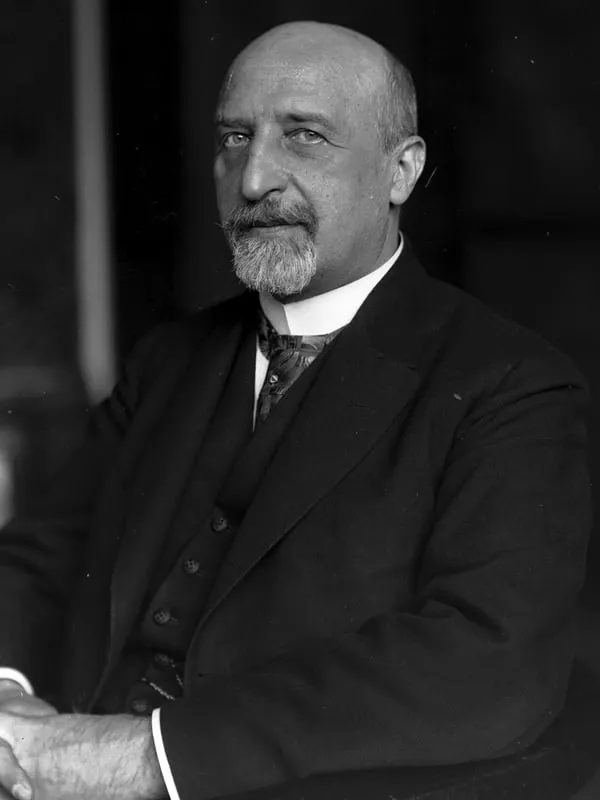
- Born:
- 4 September 1869, Vienna (Austria-Hungary)
- Died:
- 3 February 1950, Vienna
- Author:
- Łukasz
- Photo:
- Ferdinand Schmutzer, domena publiczna, Wikimedia Commons

Karl Seitz, an orphanage boy turned elementary school teacher, was one of the founding fathers of the Austrian republic. On 12 November 1918, together with the nationalist Franz Dinghofer, he proclaimed the Republic of German Austria from the ramp of the Vienna parliament building, and from March 1919 to December 1920, as President of the Constituent National Assembly, he acted as head of state. It was under his chairmanship that on 12 March 1919 parliament confirmed that German Austria was part of the German Reich – and the same parliament had to repeal that provision six months later, after the Treaty of Saint-Germain. He then served for more than ten years as mayor of Vienna, which under Social Democratic rule became a European symbol of modern social policy. Both the dictatorships that destroyed Austrian democracy, the Austrofascist and the Nazi, imprisoned him. He survived a concentration camp and lived to see Austria reborn.
The orphan from the Rossau
He was born on 4 September 1869 in the Rossau district of Vienna, one of the seven children of Karl Borromäus Seitz, a firewood dealer, and Barbara, née Kaiser, an innkeeper’s daughter. His father died when Karl was a few years old. His mother tried to support the family by sewing, but in the end had to place her two youngest sons in the municipal orphanage on the Galileigasse. A liberal city councillor obtained a free place for the boy at the teachers’ training college in St. Pölten, from which Seitz graduated in 1888.
As a young teacher in Vienna’s elementary schools he soon came into conflict with the conservative school authorities and was reprimanded several times for his political activity. He belonged to the radical democratic association of “Young” teachers, published the journal Freie Lehrerstimme and in 1896 founded the Social Democratic Central Association of Viennese Teachers, becoming its chairman. In 1897 he was dismissed from the school service for his political activity. He then devoted himself to educational work in the Social Democratic Workers’ Party, where he made a name for himself as an outstanding speaker. At courses for workers he lectured on the state, schools and workers’ rights. Schools and the struggle against the Church’s influence on education remained his main theme for many years.
A deputy in the imperial parliament
In 1901 he was elected to the Imperial Council (Reichsrat), the Austrian parliament, for the Floridsdorf constituency outside Vienna, and in 1902 also to the Diet of Lower Austria. In parliament he conducted celebrated debates on schools with the mayor of Vienna, Karl Lueger, leader of the Christian Socials. From 1907, when the Social Democrats won 87 seats after the introduction of universal male suffrage, he was one of the leaders of their parliamentary club and the closest parliamentary associate of the party leader, Victor Adler. In 1900 he married a teacher, Emilie Heindl.
During the First World War Seitz was among those Social Democrats who came out ever more clearly in favour of peace. After parliament reconvened in 1917 he spoke out against the absolutist wartime government and demanded peace and civil rights. Through acquaintances in Stockholm he sent money to a younger comrade, Otto Bauer, who was being held as a prisoner of war in Siberia. In 1918 he became Vice-President of the Chamber of Deputies.
The birth of the republic
When the monarchy disintegrated in the autumn of 1918, the German-speaking deputies of the Imperial Council met on 21 October as the Provisional National Assembly of German Austria. They elected three presidents of equal rank: Franz Dinghofer from the nationalist camp, Jodok Fink from the Christian Socials and Seitz from the Social Democrats. They took weekly turns in presiding over the assembly, its State Council and the meetings of the government, and together served as a collective head of state. On 30 October the State Council, under Seitz’s chairmanship, appointed the first government, with Karl Renner as State Chancellor.
On 11 November Emperor Charles I renounced any part in the affairs of state, and on the same day Victor Adler died. Seitz succeeded him as leader of the party and its parliamentary club. On 12 November the assembly passed a law declaring German Austria a democratic republic and a constituent part of the German Republic. That afternoon Seitz and Dinghofer proclaimed the Republic of German Austria in front of the parliament building to a crowd which German-language studies put at around 150,000 people. The ceremony ended in rioting provoked by the communist Red Guard, in which two people died.
On 16 February 1919, in the first elections in which women voted, the Social Democrats won the most seats. On 5 March the Constituent Assembly elected Seitz as its president, and when the State Council was abolished from 15 March the president of parliament became, without any separate title, the sole head of state. Seitz was not styled president, but Austrian history counts him as the republic’s first head of state. It was he who presided when, on 12 March 1919, the Constituent Assembly renewed its demand for union with Germany, and as head of state he appointed officials. During his term, on 3 April 1919, parliament passed the law banishing the Habsburgs and taking over their property, and the law abolishing the nobility.
Union with Germany proved impossible. On 10 September 1919 Renner signed the Treaty of Saint-Germain, which prohibited unification without the consent of the League of Nations, and on 21 October parliament changed the name of the state to the Republic of Austria and repealed the provision on belonging to the Reich. The last sitting of the Constituent Assembly, chaired by Seitz, took place on 1 October 1920. At it the assembly adopted the federal constitution which, in amended form, remains in force in Austria to this day. On 9 December 1920 the Federal Assembly elected the first president, Michael Hainisch, and Seitz’s term came to an end.
Mayor of Red Vienna
After the elections of October 1920, which the Christian Socials won, the Social Democrats under Seitz’s chairmanship left the coalition on Bauer’s initiative. Seitz became Second President of the National Council. He took part in separating Vienna from Lower Austria, which made the capital a federal state in its own right with its own taxes. In November 1923 he was elected mayor and at the same time governor (Landeshauptmann) of Vienna, succeeding Jakob Reumann. He held the office until February 1934.
These were the years of Red Vienna. The city councillor for finance, Hugo Breitner, introduced progressive taxes on luxury and on housing construction, and with the proceeds the city built tens of thousands of cheap flats in large municipal estates, complete with laundries, kindergartens, clinics and libraries. The most famous of them was the Karl-Marx-Hof, completed in 1930. Councillor Julius Tandler built up a system of health and social care, and Otto Glöckel reformed the schools. Vienna became a model for socialists all over Europe, and for the right and the Catholic provinces a symbol of the “Marxist” threat. In 1929 the city council made Seitz an honorary citizen of Vienna.
Austria, meanwhile, was splitting into hostile camps, each with its own armed units. In 1927 Seitz escaped unharmed from an attempt on his life. On 15 July that year, after the acquittal of right-wing militiamen who had shot dead two people in Schattendorf, rioting broke out in Vienna and the crowd set fire to the Palace of Justice. Seitz and Bauer tried to calm the demonstrators and get the fire brigade through. The police fired into the crowd and nearly ninety people were killed. From that day on the gulf between the camps only deepened. In 1931–1932 Seitz backed Bauer’s rejection of offers to share power with the Christian Socials, a decision many later considered a mistake.
In the prisons of two dictatorships
In March 1933 Chancellor Engelbert Dollfuss exploited a procedural crisis in parliament to govern without it. Social Democratic Vienna became his chief adversary. On 12 February 1934, when the uprising of the Republican Protection League (Schutzbund) broke out, Seitz was arrested in his office in the city hall and removed from office. The party was banned. According to the Wien Geschichte Wiki, Vienna’s municipal history encyclopedia, he spent nearly a year in prison and was released in December 1934 without being indicted, when the charge of high treason collapsed. Afterwards, watched by the police, he conducted a silent protest: he walked the streets of Vienna, where everyone knew him and greeted him. He kept loose contacts with the underground Revolutionary Socialists.
After the Anschluss in March 1938 the Nazis briefly imprisoned him. He was in contact with the Catholic resistance group of the priest Heinrich Maier, which passed information on the German armaments industry to the Allies. After the attempt on Hitler’s life on 20 July 1944 the Gestapo arrested Seitz on a charge of involvement in the plot. He was sent to Ravensbrück concentration camp, and in March 1945 he was banished to the small town of Plaue in Thuringia. Gravely ill, he returned to Vienna in June 1945.
Last years
He was then 75 years old. The revived party, which took the name Socialist Party of Austria, entrusted its chairmanship to Adolf Schärf, and Seitz became its honorary chairman. In August 1945, two years after the death of his first wife, he married Emma Seidel, the daughter of a socialist activist who had been one of the first women deputies in the Austrian parliament. He entered the new National Council and on 19 December 1945, as its oldest member, opened its first sitting. On 20 March 1946 he made a widely noted speech calling on the powers occupying Austria to stop controlling its parliament and to give the country back its freedom. He died in Vienna on 3 February 1950. His urn was laid in an honorary grave in the Central Cemetery, beside Victor Adler and Otto Bauer.
Significance
Seitz was not a theorist like Bauer, nor an author of laws and treaties like Renner. He was an organiser, an orator and an administrator who embodied the human face of Austrian Social Democracy: the boy from the orphanage who rose to the highest office in the state and built homes for workers. His life contains the whole history of the First Republic. In 1918 and 1919, like almost all the politicians of German Austria, he believed that the state left over from the monarchy had a future only as part of a democratic Germany. The victors did not allow it, and the Austria nobody wanted, worn down by economic crisis and civil war, fell prey to Hitler in 1938. Seitz refused to collaborate with either Austrofascism or the Nazis, and both dictatorships threw him into prison for it. A monument in front of the city hall and the large Karl-Seitz-Hof municipal estate in Floridsdorf, the district where he began his political career, keep his memory alive in Vienna.
Sources
Often appears with
People who appear in the same events.