Austria
Otto Bauer
State Secretary for Foreign Affairs of German Austria (1918–1919), deputy chairman of the Social Democratic Workers' Party of Austria (1918–1934), member of the National Council (1920–1934)
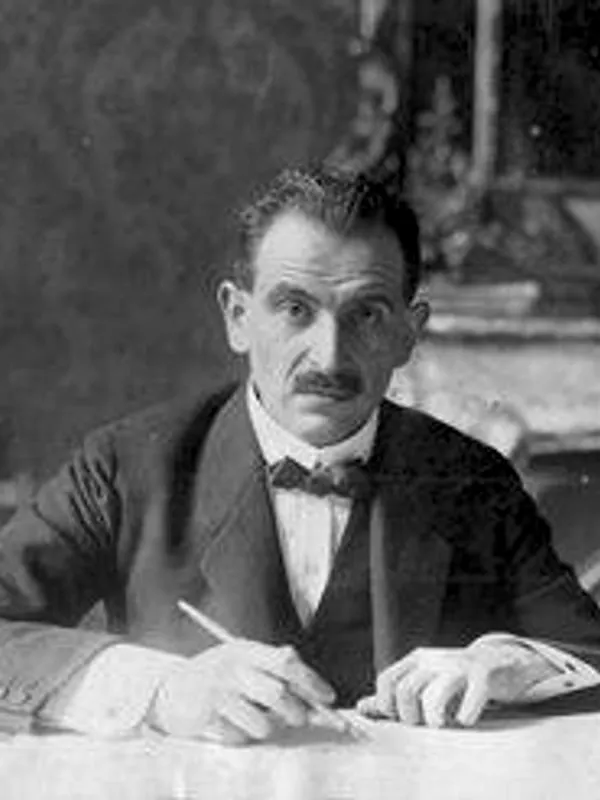
- Born:
- 5 September 1881, Vienna (Austria-Hungary)
- Died:
- 4 July 1938, Paris
- Author:
- Natalia
- Photo:
- Robert Sennecke, domena publiczna, Wikimedia Commons

Otto Bauer was the most eminent theorist of Austrian Social Democracy and for sixteen years the de facto leader of a party that governed Vienna and was the strongest force on the left in Central Europe. For the history of the road to the Second World War he matters for two reasons. As the first foreign secretary of republican Austria in 1918–1919, he campaigned more zealously than any other politician for union with Germany – the Anschluss – which the victorious powers refused to allow. And as leader of the opposition in the 1920s and 1930s, he pursued a policy of waiting which many, including members of his own party, regard as one of the causes of the collapse of Austrian democracy in 1934. He died in exile in Paris a few months after Austria had been absorbed into Hitler’s Reich.
Manufacturer’s son and theorist of nations
He was born on 5 September 1881 in Vienna into a wealthy, assimilated Jewish family. His father, Philipp, was a liberal textile manufacturer; his mother, Katharina, was née Gerber. His younger sister Ida entered the history of psychoanalysis as “Dora”, a patient of Sigmund Freud. Otto attended gymnasia in Vienna, Merano and Reichenberg (Liberec); in 1902 he did his one-year volunteer service in a regiment of the Tyrolean Kaiserjäger and passed the examination for reserve officers. At the University of Vienna he studied law, as well as economics, philosophy and sociology. In the seminars he met future luminaries of economics and philosophy, among them Ludwig von Mises, Joseph Schumpeter and Otto Neurath. In 1906 he took a doctorate in law.
From 1900 onwards he was active in the Social Democratic Workers’ Party of Austria. With slightly older comrades – Max Adler, Rudolf Hilferding and Karl Renner – he founded the workers’ school “Zukunft” (The Future), from which grew the current later known as Austro-Marxism. He made his name in 1907 with The Question of Nationalities and Social Democracy, a book of more than 600 pages. Bauer understood the nation not as a community of blood but as a community of culture and character shaped by a common destiny. For the multinational monarchy he proposed national-cultural autonomy: nations were to run their own schools and culture themselves, regardless of where their members lived. The book provoked wide debate throughout the socialist movement. In 1913 a young Georgian Bolshevik, Joseph Stalin, took issue with it in his pamphlet Marxism and the National Question, rejecting cultural autonomy. In 1907 Bauer also became secretary of the Social Democratic group of deputies in the Reichsrat, the Imperial Council, and the party leader Victor Adler made him one of his closest collaborators. He co-founded the theoretical monthly Der Kampf, and in 1912–1914 worked on the editorial staff of the party paper, the Arbeiter-Zeitung. Over his lifetime he wrote several thousand articles.
War and captivity
In August 1914 he went to the Galician front as a lieutenant of the infantry reserve. He fought at Gródek, received the Military Merit Cross for saving his company, and on 23 November 1914 was taken prisoner by the Russians. He spent almost three years in prisoner-of-war camps in Siberia. As an officer he was not required to do manual labour; he could read Russian, English and French newspapers, learned Russian and wrote a philosophical treatise. Thanks to the party’s efforts he returned to Vienna in September 1917 in an exchange of invalids, less than two months before the Bolshevik coup. From Russia he brought back a sympathy for the Mensheviks and convictions that placed him on the left, Marxist wing of the Austrian party.
In 1918 he became the leader of the party’s left. In the spring he published, partly under a pseudonym, a programme that broke with the party’s existing line: instead of rebuilding the monarchy as a federation of nations, he proposed the right of each of its nations to self-determination and to its own national assembly. For the German Austrians this meant, in his view, one thing: union with Germany.
Foreign secretary and the question of union
When the monarchy disintegrated in October 1918 and the German deputies created the state of German Austria in Vienna, Victor Adler became State Secretary for Foreign Affairs, with Bauer as his deputy. Adler died on 11 November, the day before the republic was proclaimed, and Bauer took over his office. At the party congress at the turn of October and November 1918 he argued that, as Germans and as socialists, they had to demand union with Germany, which after the November Revolution was governed by the Social Democrats. A law of 12 November 1918 declared German Austria a part of the German Republic, and on 25 December Bauer sent the Entente powers a note presenting union as the only right course. In parliament he called opponents of union traitors.
From 27 February to 2 March 1919 he held confidential talks in Berlin with the Reich Foreign Minister, Count Ulrich von Brockdorff-Rantzau. The Berlin protocol signed at the end set out how union was to be carried out “once it becomes feasible”, but fixed no date. Neither side wanted to confront the Peace Conference with a fait accompli. On 12 March 1919, when the Constituent Assembly elected in February reaffirmed its declaration that German Austria was a part of the German Reich, Bauer called union with the great German Republic “once again our programme”. On 15 March the new parliament re-elected him State Secretary in Renner’s second government.
The spring of 1919 put him to yet another test. On 21 March the Hungarian Soviet Republic was proclaimed in Budapest, and its leader, Béla Kun, was counting on Vienna to follow the same path. Bauer, Marxist though he was, opposed it. He explained that Austria, which lived on supplies of food and coal from the victors, would be starved after a week of soviet rule. The Social Democrats kept the workers on their side, and the attempts at a communist coup in Vienna in April and June 1919 won no support. Bauer also sat on the socialisation commission, whose most important achievement was the Works Councils Act of May 1919.
His policy of union, however, ended in defeat. France had no intention of allowing Germany to grow larger, and in mid-April a British officer in Vienna passed on to Bauer the advice that he should avoid the subject altogether in the peace negotiations. Bauer delayed informing his government colleagues of this, and wanted the delegation to Saint-Germain to be led by an ardent supporter of union, the lawyer Franz Klein. In the end the delegation was led by Renner. The draft Treaty of Versailles, handed to the Germans on 7 May 1919, prohibited union without the consent of the League of Nations. On 26 July Bauer resigned and Renner took over foreign affairs. He remained in the government until October as State Secretary for Socialisation. The ban on union was confirmed by the Treaty of Saint-Germain, which Renner signed in September.
Leader of the opposition
After the elections of October 1920, won by the Christian Socials, the Social Democrats left the coalition, chiefly at Bauer’s insistence. At national level they did not return to government until 1945. Renner, who had been against this, later wrote bitterly that Bauer, through his intransigence and the weight of his personality, had made participation in government impossible except at the price of a split, and had handed the republic founded by the workers over to the bourgeoisie. Until 1934 Bauer was the party’s deputy chairman, its chief speaker in the National Council and the author of its programmes, while the party chairman, Karl Seitz, governed “Red Vienna” as its mayor from 1923, a model city of Social Democratic social policy. In 1923 Bauer published The Austrian Revolution, a history of the birth of the republic.
The programme adopted at Linz in 1926 was largely his work. It promised to win power through elections, but contained the proviso that, should the bourgeoisie try to overthrow democracy, the working class would have to break its resistance by the means of dictatorship. The party’s opponents read this wording as a promise of revolution and raised the spectre of “Austro-Bolshevism”. The later chancellor Bruno Kreisky called it a “terrible verbal blunder” that clung to the party like a stigma. In practice, however, Bauer’s policy was cautious. He reckoned that economic development would of itself bring the Social Democrats an absolute majority, and that joining a coalition with the bourgeois parties would only postpone the fall of capitalism. Meanwhile the country was dividing into two armed camps, the Social Democratic Republican Protection League (Schutzbund) and the right-wing Heimwehr. On 15 July 1927, after the acquittal of right-wing paramilitaries who had shot dead two people, an enraged crowd set fire to the Palace of Justice in Vienna. Bauer and Seitz tried in vain to calm the workers, and the police fired on the demonstrators. Nearly ninety people were killed.
The fall of democracy
In 1931–1932 Bauer, with the agreement of Seitz and Renner, rejected offers of cooperation made by Chancellor Ignaz Seipel and then by Engelbert Dollfuss. Kreisky regarded this as the waste of the last chance to save Austrian democracy. On 4 March 1933, during a dispute over a single vote, all three presidents of the National Council resigned, Renner among them. Dollfuss declared that parliament had “eliminated itself” and began to rule by decree. The party, whose statutes required a general strike in such a case, did not call one, and Bauer kept putting off resistance in the hope of avoiding civil war. At the party congress of October 1933 the party’s left accused him of letting the enemy dictate all the timing and terms of the confrontation. In 1933, after Hitler came to power in Germany, the Social Democrats dropped the slogan of union. Bauer later explained that they had wanted union with the German Republic, “not with Hitler’s penitentiary”.
When, on 12 February 1934, members of the Schutzbund in Linz, and then in Vienna and other towns, took up arms to resist being disarmed, it was too late. The army turned artillery on the workers’ housing estates, and after four days the uprising collapsed. The party was banned. On the second day of the fighting Bauer, on the advice of his comrades, fled with Julius Deutsch to Czechoslovakia. His opponents never let him forget this flight.
Exile and death
In Brno Bauer set up the Foreign Bureau of the Austrian Social Democrats, which published the Arbeiter-Zeitung and Der Kampf, smuggled them into Austria, and supported the underground Revolutionary Socialists. He announced, however, that he would no longer take on any leadership role. In 1934 he published an analysis of the defeat, The Austrian Workers’ Uprising, and in 1936 his most important theoretical work, Between Two World Wars?. The title alone showed that Bauer saw the 1930s as an interval between two wars. In it he proposed an “integral socialism” that would in time unite Social Democrats and Communists.
After the Anschluss in March 1938 Bauer moved via Brussels to Paris, where together with the leadership of the Revolutionary Socialists he set up the foreign representation of the Austrian socialists and edited Der sozialistische Kampf. In his last political text, often called his testament, he called not for the restoration of an independent Austria but for a joint revolution of all Germany, Austria included, because he did not believe that Austria on its own could overthrow fascism. According to his biographers, he also believed that Renner had been right to come out publicly in favour of the Anschluss in April 1938. He died of a heart attack in Paris on 4 July 1938 (5 July according to some sources). He was buried in Père Lachaise cemetery, opposite the memorial to the fallen Communards. In 1948 his urn was taken to Vienna, and in 1950 it was placed in a grave of honour in the Central Cemetery, next to Victor Adler and Karl Seitz.
Significance
Bauer was one of the ablest minds of European socialism. His writings on the nation, on the interwar economy and on fascism are still read today. As a politician he lost almost all the decisive contests. Union with a democratic Germany, to which he sacrificed his office in 1919, proved impossible, and nineteen years later it came about in a form he could not have imagined: as Hitler’s conquest of Austria. A Social Democratic document of 1988 called the party’s pursuit of the Anschluss in 1918–1919 unrealistic and irrational. His critics, among them Renner and Kreisky, believed that Bauer’s radical language frightened bourgeois Austria and that his waiting game handed the initiative to the enemies of democracy. His defenders recall that he warned against fascism earlier and more sharply than anyone, and that thanks to him the Austrian left, unlike the German, did not split into hostile Social Democratic and Communist parties. His life shows how the slogan of union, proclaimed by the democratic left in 1919, was taken over by Nazism in the 1930s and turned against Austria.
Sources
Often appears with
People who appear in the same events.