Germany
Erich von dem Bach-Zelewski
Higher SS and Police Leader in Silesia (1938–1941) and Central Russia (1941–1943), Chief of Anti-Partisan Formations (1943–1945), commander of German forces in Warsaw (1944), SS-Obergruppenführer
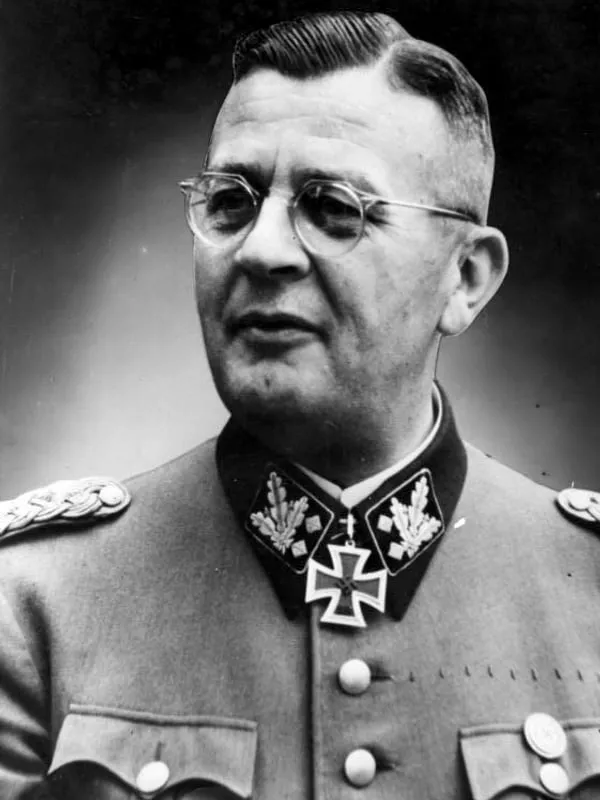
- Born:
- 1 March 1899, Lauenburg, now Lębork (Pomerania, Kingdom of Prussia)
- Died:
- 8 March 1972, Munich (West Germany)
- Author:
- Łukasz
- Photo:
- Unger, CC BY-SA 3.0 DE, Wikimedia Commons

Erich von dem Bach-Zelewski, born Erich Julius Eberhard von Zelewski, was a general of the SS and police and one of the chief executors of the German policy of terror in the occupied East. As Higher SS and Police Leader in the rear of Army Group Centre he was responsible in 1941 for the mass murder of Jews in Belarus, and from 1943 he directed, on behalf of Heinrich Himmler, the whole German “war against bandits” – the war against the partisans, whose victims were above all civilians. Poles know him chiefly as the commander of the forces that crushed the Warsaw Uprising in August and September 1944, and as the man who signed the agreement ending the fighting at Ożarów on 2 October. After the war he testified at Nuremberg as a prosecution witness; he was never handed over to Poland or the USSR and never stood trial for war crimes. He was convicted only in the 1960s, for killings committed in Germany before the war.
Zelewski from Lębork
He was born on 1 March 1899 in Lębork (then Lauenburg) in Pomerania, into an impoverished family descended – as his biographer Marek Dzięcielski has established – from the Kashubian minor nobility of the Żelewski family, Catholic and connected with the parish of Strzepcz. His father, Otto von Zelewski, was an insurance inspector and merchant; he died in 1911, and the children were sent to relatives and foster families. Erich grew up partly in Biała Piska in East Prussia. The later legend of his descent from Prussian Junkers came from him alone.
In November 1914, aged fifteen, he volunteered for the Prussian army. He fought at the front, was wounded twice, received the Iron Cross of both classes and in 1916 was promoted to second lieutenant. After the war he served in the Freikorps and the Reichswehr and took part in the fighting against the Poles during the Silesian Uprisings. He left the Reichswehr in 1924; until 1930 he worked in the German border guard on the frontier with Poland, in Opole Silesia and in Masuria. He was active in the Stahlhelm and in far-right nationalist associations. In 1922 he married Ruth Apfeld; they had six children.
Career in the SS
In 1930 he joined the NSDAP, and in February 1931 the SS, in which he rose very quickly. From 1932 he sat in the Reichstag. From 1934 he commanded the SS in East Prussia, and in the second half of the 1930s he was transferred to Silesia, where in 1938 he became Higher SS and Police Leader, based in Breslau (Wrocław).
From the first years of Nazi rule he was implicated in political violence. During the Night of the Long Knives in July 1934 his subordinates shot the SS officer Anton von Hohberg und Buchwald, with whom he had been at odds; this case and the killings of communists in the early 1930s became the basis of his only convictions after the war.
In the early 1930s he began to use the double surname von dem Bach-Zelewski, claiming descent from the Pomeranian Bach family, to whom – according to Dzięcielski – he was not related. In 1940 he went further. In a letter to Himmler of 29 October 1940 he explained that he wished to “stop bearing a second, Polish-sounding surname” so that his sons might one day join the SS. Permission came on 28 November 1940, and until the end of the war he signed himself Erich von dem Bach.
Silesia and Auschwitz
In September 1939 he held no command at the front, but police formations from Silesia under his authority took part in executions and reprisals in the occupied Polish territories. In the autumn Himmler appointed him his plenipotentiary for the strengthening of Germandom in Upper Silesia, which had been annexed to the Reich. Von dem Bach directed the expulsion of Poles and the settlement of Germans in their place. The best known of these operations was Aktion Saybusch in the Żywiec region in September–December 1940: according to German documents some 17,500 Poles were thrown out of their homes, allowed to take only hand luggage, and deported to the General Government.
The camp at Oświęcim was created on his initiative. According to historians it was von dem Bach, short of space in the overcrowded Silesian prisons, who at the turn of 1939 and 1940 proposed establishing a concentration camp in the former barracks in the Zasole district of Oświęcim, and his subordinate Arpad Wigand who inspected the site. The first transport, of Polish political prisoners from Tarnów, arrived at Auschwitz on 14 June 1940; two weeks later von dem Bach visited the camp in person. Rudolf Höss became its commandant, and the camp, expanded on Himmler’s orders, later became the largest site of the Holocaust.
Belarus 1941–1943
On 22 June 1941, the day of the attack on the USSR, von dem Bach became Higher SS and Police Leader in the rear of Army Group Centre, that is, mainly in Belarus; once Moscow was taken he was to assume the same post in the Soviet capital. Under his command were Order Police battalions, the SS Cavalry Brigade and other formations which, together with Arthur Nebe’s Einsatzgruppe B, murdered Jews in Białystok, Grodno, Minsk, Baranovichi, Mogilev and Pinsk. He regularly reported the numbers killed to Berlin. In July and August 1941 he was formally in command of the operation in the Pripet Marshes during which the SS Cavalry Brigade murdered, according to various estimates, from over ten thousand to around 30,000 people, most of them Jews. On 15 August 1941 he accompanied Himmler as he watched an execution near Minsk; after the war he claimed that he had pointed out to Himmler how such executions psychologically destroyed the men who carried them out.
In February 1942 he was admitted to hospital in Berlin. An SS doctor reported that von dem Bach was suffering from hallucinations connected with the shooting of Jews. He returned to duty in the summer and asked Himmler to be assigned to anti-partisan warfare. After the assassination of Heydrich in June 1942 Adolf Hitler wanted to send him to Prague, but Himmler considered him indispensable in the East, and Kurt Daluege became Deputy Protector instead. In November 1942 von dem Bach was promoted to SS-Obergruppenführer and General of Police.
The war against the “bandits”
In June 1943 Himmler appointed him Chief of Anti-Partisan Formations (Chef der Bandenkampfverbände). The Germans called all partisans “bandits”, and in practice anyone deemed to be helping them. The great anti-partisan operations in Belarus, such as Operation Cottbus in May–June 1943, consisted of encircling entire districts, burning villages together with their inhabitants and deporting the survivors for forced labour; the figures for “bandits killed” given in the reports included thousands of civilians, among them Jews hiding in the forests, while the number of rifles captured was many times smaller. Polish studies hold his formations responsible for the deaths of some 230,000 people in the Baltic states, Belarus and eastern Poland. At the beginning of 1944 von dem Bach also commanded at the front in the Kovel area, but in March he again had to leave for medical treatment.
Warsaw 1944
The outbreak of the Warsaw Uprising on 1 August 1944 found him in Sopot. Himmler assigned him to command the forces sent against the insurgents. According to his later testimony, Hitler gave Himmler a verbal order to raze Warsaw to the ground and kill its inhabitants, taking no prisoners; some historians accept his version, in which the order to murder the population was added by Himmler himself, while others regard it as an attempt to play down his own role. Von dem Bach probably arrived outside Warsaw on the evening of 5 August – at Nuremberg he maintained that he had not come until the middle of the month – and took over command from Heinz Reinefarth while the latter’s units, together with Oskar Dirlewanger’s assault brigade, had been carrying out the Wola massacre since the morning and Bronislav Kaminski’s brigade was murdering the inhabitants of Ochota.
On 5 August von dem Bach forbade the killing of women and children, and on 12 August of civilian men as well; from then on the population was to be sent to the Dulag 121 transit camp at Pruszków, and from there to camps and to forced labour in the Reich. He himself presented this as proof of his moderation; the war diary and witness testimony show that he was driven above all by practical considerations, and the murder of prisoners, the wounded and civilians continued. Over two months his corps, some 25,000 strong with heavy artillery and air support, took the city district by district – the Old Town, Powiśle, Czerniaków, Mokotów and Żoliborz. By various estimates between 150,000 and 200,000 civilians were killed. On 30 September Hitler awarded him the Knight’s Cross.
It was von dem Bach who conducted the talks with the envoys of the Home Army headquarters. He sought a capitulation that would quickly free up his troops, and later took credit for persuading Hitler to recognise Home Army soldiers as combatants. On 2 October 1944, at his headquarters in Ożarów, Colonel Kazimierz Iranek-Osmecki and Lieutenant Colonel Zygmunt Dobrowolski signed the agreement on the cessation of hostilities, which granted the insurgents the rights of prisoners of war. On 5 October von dem Bach received General Tadeusz Bór-Komorowski at Ożarów. In his report to Himmler he put his own forces’ losses at 1,570 killed and 7,474 wounded. Once the population had left, the city was systematically demolished and looted, in accordance with Hitler’s order.
A few days later Hitler sent him to Hungary. In mid-October von dem Bach was in Budapest when the Germans overthrew Miklós Horthy and handed power to Ferenc Szálasi’s Arrow Cross; his actual role in these events is described differently in the literature. At the end of 1944 he commanded the XIV SS Corps in Baden, from 26 January to 10 February 1945 the X SS Corps in Pomerania, which was shattered in less than two weeks, and from February a corps on the Oder in Army Group Vistula.
A witness instead of a defendant
After Germany’s surrender he went into hiding. American military police arrested him on 1 August 1945. On 7 January 1946 he testified before the International Military Tribunal at Nuremberg as a witness for the prosecution. He spoke about the murders committed by the Einsatzgruppen and stated that if for years it is preached that Slavs are subhuman and Jews are not human, such crimes are the inevitable result. The defendant Hermann Göring, according to those present in the courtroom, called him a traitor and a swine. In January and February 1946 he was interrogated at Nuremberg by the Polish prosecutor Jerzy Sawicki; von dem Bach then admitted that he had been responsible for the actions of the troops under his command in Warsaw. In 1947 he testified in Warsaw at the trial of Ludwig Fischer, but the Americans handed him over neither to Poland nor to the USSR.
In 1949 he was released from custody. In 1951 a denazification tribunal in Munich sentenced him to ten years in a labour camp, but the sentence was commuted to house arrest. He also claimed that in 1946 he had helped Göring commit suicide by supplying him with a cyanide capsule; most historians reject this version. In 1961 he testified for the defence at the trial of Adolf Eichmann, and a West German court sentenced him to four and a half years’ imprisonment for the killing of Hohberg in 1934. At the same time he declared that he had remained “Hitler’s man” to the end. In a further trial, for the killings of several German communists in the early 1930s, he was sentenced to life imprisonment. None of these verdicts concerned Poland, the USSR or the Holocaust, even though he publicly called himself a mass murderer. Polish documentation of his activities was assembled by, among others, Władysław Bartoszewski in the book Prawda o von dem Bachu (“The Truth about von dem Bach”, 1961). He died on 8 March 1972 in the prison hospital in Munich.
Significance
Erich von dem Bach-Zelewski took part in almost every form of German violence in the East: the expulsions from the territories annexed to the Reich, the founding of the camp at Oświęcim, the murder of Jews in 1941, the burned villages of Belarus and the destruction of Warsaw. His career shows how the SS combined police, settlement and military tasks, and how the “war against bandits” became a cover for the murder of civilians. The capitulation of the uprising, negotiated with him at Ożarów on 2 October 1944, brought to an end the largest armed rising in occupied Europe. His post-war fate – a witness at Nuremberg, convictions for pre-war killings and no trial for his crimes in the East – makes him, in Poland, the example of a criminal who escaped responsibility for his gravest deeds.
Sources
Commanded in battles
(01)Often appears with
People who appear in the same events.