Germany
Ludwig von Reuter
Commander of the High Seas Fleet's scouting forces (1918), commander of the ships interned at Scapa Flow (1918–1919), Konteradmiral, titular admiral (1939)
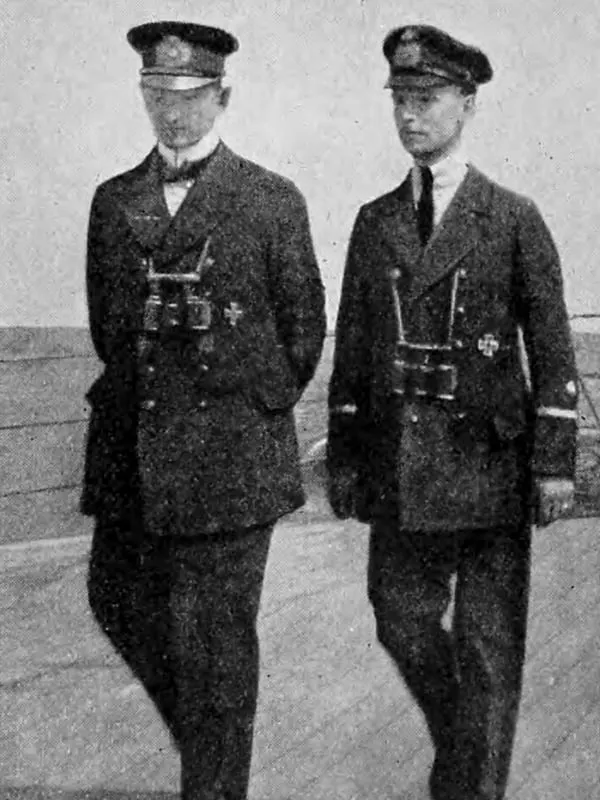
- Born:
- 9 February 1869, Guben (Brandenburg, Prussia)
- Died:
- 18 December 1943, Potsdam
- Author:
- Natalia
- Photo:
- autor nieznany, domena publiczna, Wikimedia Commons

Ludwig von Reuter was one of the many capable but little-known admirals of the Imperial German Navy until a single order made him a historical figure. After Germany’s defeat in 1918 he took on a task no other admiral wanted: he led the High Seas Fleet into internment with the British and for seven months commanded its ships at the Scapa Flow anchorage in Orkney. On 21 June 1919, convinced that the victors were about to seize the ships at any moment, he ordered them scuttled. Fifty-two of the 74 vessels went to the bottom. The British regarded him as a prisoner of war who had broken the armistice; in Germany he became the hero who had saved the navy’s honour. His act became one of the founding myths of the Third Reich’s navy, which, on the eve of the Second World War, gave Reuter himself the title of admiral.
Background and early career
Hans Hermann Ludwig von Reuter was born on 9 February 1869 in Guben on the Lusatian Neisse, in Prussian Brandenburg. The old town of Guben now lies on the Polish side of the river, in Gubin. He came from a family with military traditions. His grandfather was a Prussian general, ennobled in 1826. His father, Colonel Eduard von Reuter, commander of a grenadier regiment, was killed in August 1870 at the Battle of Spicheren, at the start of the Franco-Prussian War, when Ludwig was eighteen months old. According to genealogists, his mother, Helene von Sternheim, was an illegitimate daughter of Duke Ernest II of Saxe-Coburg and Gotha, brother of Prince Albert, Queen Victoria’s husband. If so, Reuter was a distant relative of the British royal family, whose navy he would one day face at sea.
In 1885, at his mother’s urging, he joined the Kaiserliche Marine as a cadet. At the time it was a small coastal navy, but from the late 1890s, when Admiral Alfred von Tirpitz, backed by Kaiser Wilhelm II, began building a great battle fleet, new opportunities opened up for young officers. Reuter’s promotions were slow and steady. In 1888 he became an Unterleutnant zur See, and by 1910 he was a Kapitän zur See. Before the war his commands included the armoured cruiser Yorck.
War in the North Sea
A few weeks after the outbreak of the First World War he took command of the battlecruiser Derfflinger, one of the newest and most powerful ships in the fleet, which belonged to Admiral Franz von Hipper’s I Scouting Group. He took part in the battlecruiser raid on the English coast on 16 December 1914, when Scarborough and Hartlepool were shelled, and in the Battle of Dogger Bank on 24 January 1915, in which the Germans lost the armoured cruiser Blücher.
In September 1915 Reuter became a Kommodore and commander of the IV Scouting Group, made up of five older light cruisers. At its head he fought in the Battle of Jutland on 31 May and 1 June 1916, in which Admiral Reinhard Scheer’s High Seas Fleet clashed with the entire British Grand Fleet. His cruisers took part in the night actions against British light forces, in which one of them, Frauenlob, was sunk. In September 1916 he took over the II Scouting Group, made up of newer light cruisers, and in November 1916 he was promoted to Konteradmiral (rear admiral). (Some sources give 1917, but German and English studies agree on the end of 1916.)
On 17 November 1917 his cruisers were covering minesweepers in the Heligoland Bight when superior British forces attacked them. In what became known as the Second Battle of Heligoland Bight, Reuter withdrew under fire towards the battleships Kaiser and Kaiserin, which drove the British off. It was judged a successful defensive action. In January 1918 he became deputy commander of the fleet’s scouting forces, and in August 1918, when Hipper took command of the whole High Seas Fleet, Reuter succeeded him in command of the scouting forces. This was the peak of his wartime career.
Into internment
In October 1918 Scheer and Hipper prepared a final sortie by the fleet against the British. The sailors, convinced that the admirals were sending them to their deaths for the sake of the navy’s honour, refused to obey orders, and their mutiny grew into the German Revolution. The monarchy fell, and the Armistice of Compiègne required Germany to disarm its newest ships and hand them over for internment. Hipper refused to lead the fleet into what amounted to surrender. On 18 November, at his request, Reuter accepted the task.
It was no easy matter. Sailors’ councils held sway on board the ships, and officers had to negotiate every order with them. On 19 November a force of about 70 ships left the roads off Wilhelmshaven, and on 21 November it met the Grand Fleet and its allies in the North Sea. The British cruiser Cardiff led the Germans between two columns of the victors’ ships and brought them into the Firth of Forth. Admiral David Beatty ordered the German ensigns to be hauled down at sunset and not raised again without permission. Reuter protested, to no avail. Between 25 and 27 November the ships moved to Scapa Flow.
In December 1918, when most of the sailors had been sent home, Reuter handed command for a few weeks to the senior ship’s captain and travelled to Germany to assess the situation. He returned on 25 January 1919. Conditions in the anchorage were depressing: ships without ammunition, crews forbidden to go ashore, monotonous food, censored mail and constant tension between officers and men. Reuter was in poor health. On 25 March, harassed by radical sailors of the so-called Red Guard, he shifted his flag from the battleship Friedrich der Grosse to the light cruiser Emden.
The order of 21 June 1919
In May 1919 Reuter learned from the press that the draft peace treaty provided for the surrender to the victors of all the ships interned at Scapa Flow. From then on he prepared to scuttle them. He used a further reduction in the crews to send home sailors he did not trust. On 17 June he sent his captains a secret order to prepare the ships for scuttling. He drew his news on the progress of the peace talks from British newspapers. From these it appeared that the Allied ultimatum to Germany would expire at noon on 21 June. He did not know that the deadline had been extended to the evening of 23 June.
On the morning of 21 June the British squadron of Vice-Admiral Sydney Fremantle, which was guarding the interned ships, put to sea for exercises. At about 11.20 a.m. the agreed signal was hoisted on Emden: “Paragraph eleven. Confirm.” The crews opened the seacocks. In less than six hours 10 battleships, 5 battlecruisers, 5 light cruisers and 32 destroyers sank, among them Derfflinger, which Reuter had commanded at the start of the war. The British managed to beach only the battleship Baden, three light cruisers including the flagship Emden, and some of the destroyers. British guards fired on Germans abandoning their ships and killed nine of them. It was the largest scuttling of a war fleet in history.
In the evening Reuter and his officers were paraded on the deck of the battleship Revenge. Through an interpreter Fremantle accused them of breaking the armistice and of violating the honour and traditions of seamen of all nations, and declared them prisoners of war. According to accounts, Reuter replied that any British officer in his place would have done the same. In his order of 17 June he had written that he would scuttle the ships only if the enemy tried to seize them without the German government’s consent. In reality he acted in the belief that the armistice was just expiring, but without orders from Berlin. Historians still argue over whether the naval command had unofficially given him to understand that the ships must not fall into enemy hands. Erich Raeder, later commander of the German navy, wrote that Reuter knew the fleet was to be scuttled at all costs.
Prisoner and hero
Reuter and 1,773 of his men were taken prisoner. The sailors were taken to a prisoner-of-war camp in Scotland, and the admiral was treated as the man chiefly responsible for breaking the armistice. He returned to Germany with the last prisoners at the end of January 1920, after more than seven months in captivity. He was welcomed as a hero. For the right, which could not forgive the navy for the mutiny of November 1918, the deed at Scapa Flow was proof that the fleet had, after all, been able to preserve its honour. For the government it was an embarrassment, because the Allies demanded further ships and 400,000 tons of harbour equipment in compensation.
There was no place for Reuter in the new Reichsmarine, which the Treaty of Versailles restricted and which could have only a handful of admirals. A few months after his return, in 1920, he left the service. According to some sources he was given the titular rank of vice-admiral on retirement. He settled in Potsdam and kept out of politics. In 1921 he published his memoirs, Scapa Flow. Das Grab der deutschen Flotte (Scapa Flow: The Grave of the German Fleet), in which he defended his decision. The book fixed the image of the scuttling as an act of honour in German minds, and in 1940, with the war already under way, it was published in London in English translation.
The Third Reich and death
The National Socialists, who took power in 1933 and in 1935 renamed the Reichsmarine the Kriegsmarine, readily drew on the Scapa Flow legend, which had already been alive in the Weimar Republic, when the feature film Scapa Flow was made in 1929. For the new navy it was a counterweight to the memory of the Kiel mutiny and a symbol of resistance to the Versailles diktat. At the end of August 1939, as part of the celebrations of the 25th anniversary of the Battle of Tannenberg, Reuter was given the title of admiral. A few days later Germany invaded Poland. He held no further post. He died of a heart attack in Potsdam on 18 December 1943 and was buried in the cemetery in the Bornstedt district.
Significance
Reuter was not a great commander. His war service, though solid, did not set him apart from the other admirals of the imperial navy. He passed into history through a single order issued in captivity. From the standpoint of international law, the scuttling of the interned ships breached the terms of the armistice, which forbade the destruction of military equipment. Paradoxically, the British benefited: the Admiralty was spared the awkward business of dividing up the German ships, which would have strengthened the navies of France and Italy.
On the road to the Second World War, Reuter’s act mattered above all psychologically. The German navy built on it its own version of the legend of armed forces undefeated in the field and betrayed by politicians and revolution. Raeder and his officers brought up successive classes of cadets in the conviction that a German warship must never surrender. The same principle was applied during the war: in December 1939 the Admiral Graf Spee was scuttled off Montevideo, and in May 1945 hundreds of U-boats were sunk to keep them out of Allied hands. Scapa Flow, where three of Reuter’s battleships and four of his cruisers still lie under water, remains the place where the story of Wilhelm II’s imperial navy came to an end.
Sources
Often appears with
People who appear in the same events.