Germany
Wilhelm II
German Emperor and King of Prussia (1888–1918)
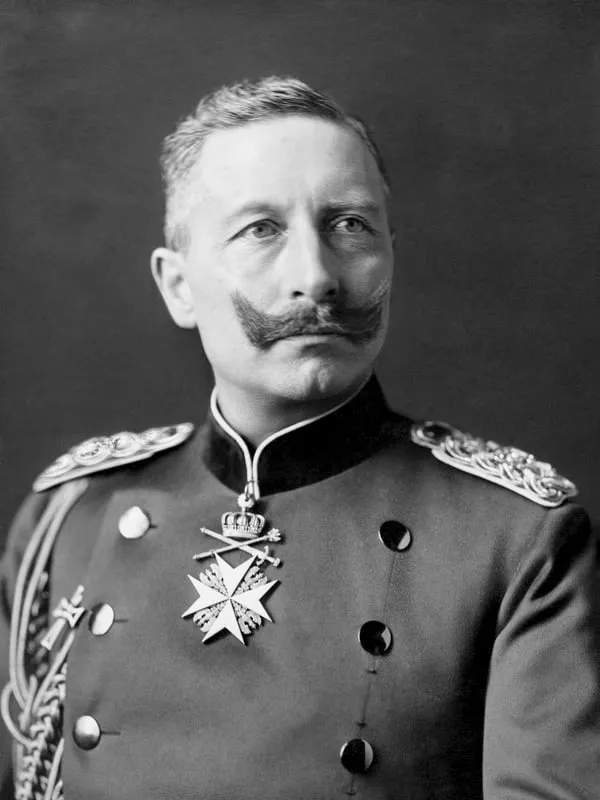
- Born:
- 27 January 1859, Berlin
- Died:
- 4 June 1941, Doorn (Netherlands)
- Author:
- Łukasz
- Photo:
- Studio of Thomas Heinrich Voigt, domena publiczna, Wikimedia Commons

For thirty years Wilhelm II was the face of the German Empire. Loud, impulsive and hungry for attention, he wanted to be seen as a ruler who personally directed policy and the army, and his speeches, interviews and whims repeatedly shook Europe. Under his rule Germany embarked on “world policy” (Weltpolitik), built a battle fleet that challenged Britain and found itself in the very encirclement it most feared. In July 1914 his assurance that Germany would back Austria-Hungary set off the chain of decisions that led to the Great War. During the war he surrendered real power to the generals, and once it was lost, the army abandoned him. His fall in November 1918, the revolution that brought it about and the “stab-in-the-back” myth that grew out of it are among the roots of the Weimar Republic and of its collapse. Wilhelm II himself lived on for another twenty-two years at Doorn in the Netherlands, saw Hitler’s victories over France and died in a Netherlands occupied by German troops.
Early life
He was born on 27 January 1859 in Berlin, the eldest son of the heir to the Prussian throne, later Emperor Frederick III, and of Victoria, the eldest daughter of Queen Victoria of Britain. A difficult breech birth left him with a withered, shorter left arm, which all his life he tried to hide in photographs and portraits. Brought up strictly by his Calvinist tutor Georg Hinzpeter, he had a difficult relationship with his liberal mother. Towards Britain, the homeland of his mother and grandmother, he felt all his life a mixture of admiration, envy and resentment. He spent his youth in the atmosphere of the Prussian barracks at Potsdam, where he served in an elite Guards regiment and absorbed the cult of the army and of monarchical power.
In 1888, known in Germany as the Year of the Three Emperors, his grandfather Wilhelm I died, followed after a reign of only 99 days by his father, who had cancer of the larynx. On 15 June 1888 the twenty-nine-year-old Wilhelm became German Emperor and King of Prussia.
Personal rule and world policy
In March 1890 he forced the resignation of the Chancellor, Otto von Bismarck, the architect of German unification, and announced that he would direct policy himself. His “personal rule” consisted largely of choosing ministers, making public pronouncements and meddling in matters he did not understand. The first decision of the new course was not to renew the secret Reinsurance Treaty with Russia. Russia turned to France and concluded an alliance with it in 1894. The Bismarckian system, which had kept France isolated, began to fall apart.
Wilhelm II wanted Germany to be a world power, not merely a European one. The Far East was one of the first arenas of this ambition. In April 1895 Germany, together with Russia and France, forced Japan, victorious in its war with China, to give up the Liaodong Peninsula. This Triple Intervention embittered the Japanese and prepared the ground for their later rivalry with Russia, which bore fruit in the assassination of Queen Min and the Russo-Japanese War. In the same year the Emperor sketched an allegory of the “Yellow Peril”, which the painter Hermann Knackfuß turned into a picture bearing the motto “Peoples of Europe, guard your most sacred goods”. The Emperor sent a copy to his cousin, Tsar Nicholas II, whom for years he encouraged to expand in Asia, which drew Russia’s attention away from Europe. In November 1897, after the murder of two German missionaries, a German squadron seized Kiautschou Bay in Shandong province, which China was forced to lease to Germany in 1898. In 1900, seeing off at Bremerhaven the corps sent against the Boxer Rebellion, Wilhelm II urged the soldiers to take no prisoners and to make the name of Germany known in China as the Huns of Attila had done a thousand years before. This “Hun speech” later gave Allied propaganda its nickname for the Germans.
Under the banner of world policy Germany demanded “a place in the sun”. With the Emperor’s backing, Admiral Alfred von Tirpitz built from 1898 onwards a battle fleet meant to force Britain to reckon with Germany. The effect was the opposite. The naval arms race alienated London and pushed it towards agreements with France in 1904 and with Russia in 1907. The Emperor’s public gestures deepened mistrust of Germany: the telegram of congratulations to President Paul Kruger of the Transvaal in 1896, the ostentatious visit to Tangier in 1905 that provoked the First Moroccan Crisis, and the interview with a British newspaper that gave rise in 1908 to the Daily Telegraph affair. In July 1905, during the Russo-Japanese War, Wilhelm II persuaded Nicholas II to sign a treaty of alliance at Björkö, but the Russian ministers quickly annulled it. At the same time he supported the mediation of President Theodore Roosevelt, which led to the Treaty of Portsmouth. Yet despite his menacing rhetoric in successive crises before 1914, the Emperor drew back from war, which German nationalists and some of the generals held against him.
July 1914
Wilhelm II was a friend of the Austrian heir to the throne, Archduke Franz Ferdinand, and was deeply shaken by the assassination at Sarajevo on 28 June 1914. When on 5 July Vienna’s envoys brought a letter from Emperor Franz Joseph to Potsdam, Wilhelm II assured them of Germany’s full support, even if a reckoning with Serbia led to conflict with Russia. This assurance went down in history as the “blank cheque”. The next day, on the advice of the Chancellor, Theobald von Bethmann Hollweg, the Emperor set off on his annual cruise in Norwegian waters so as not to arouse suspicion.
When on 28 July he read the Serbian reply to the Austrian ultimatum, he judged it a great success for Vienna that removed every reason for war, and proposed that the Austrians occupy only Belgrade as a pledge. His proposal reached Vienna late and in a weakened form, and on the same day Austria-Hungary declared war on Serbia. In night-time telegrams to Nicholas II he pleaded that Russian military preparations should not wreck his mediation. When Russia announced general mobilisation, he concluded that he had fallen victim to encirclement by Britain, France and Russia. On 1 August he signed the mobilisation order, and Germany declared war on Russia, and two days later on France. On 4 August, in his speech from the throne, the Emperor proclaimed a domestic truce: “I no longer recognise parties; I know only Germans.”
The shadow emperor
Under the constitution the Emperor was supreme commander of the army and navy. In war it soon became clear that he had neither the knowledge nor the perseverance to command in earnest. He spent the war at a succession of headquarters, receiving reports, visiting the troops and handing out decorations, while his moods swung violently from confidence in victory to deep depression. The German historian Wilhelm Deist called him a “shadow emperor”. He did, however, retain the power of appointment. He lavished particular care on the navy, his beloved creation, and for a long time would not allow the battleships to be risked in a great battle.
In August 1916, after Romania entered the war, he entrusted the Supreme Command to Field Marshal Paul von Hindenburg and General Erich Ludendorff. From then on his position steadily weakened. Hindenburg’s popularity surpassed the monarch’s, and the two generals extracted one decision after another by threatening to resign. In January 1917 the Emperor agreed to unrestricted submarine warfare, which in April brought the United States into the war. In July 1917, at the generals’ demand, he sacrificed Chancellor Bethmann Hollweg. In the spring of 1918 he greeted with enthusiasm the Peace of Brest-Litovsk with Bolshevik Russia and the great offensive in the west.
Downfall
On 29 September 1918, when Hindenburg and Ludendorff demanded an immediate request for an armistice, Wilhelm II agreed to an appeal to President Wilson and to a government based on a Reichstag majority under the Chancellor, Prince Max von Baden. On 28 October he signed the constitutional amendments that made Germany a parliamentary monarchy. Meanwhile Wilson’s notes made it clear that the Allies would not negotiate with the Emperor. Wilhelm II would not hear of abdication. On 29 October he left Potsdam for Supreme Headquarters at Spa, which at home was seen as a flight into the generals’ protection. In those same days Admirals Reinhard Scheer and Franz von Hipper tried to send his beloved fleet into a final battle. The sailors’ mutiny, with which the revolution in Germany began, engulfed the whole country within a week.
On 9 November at Spa General Wilhelm Groener told the Emperor that the army would return home in good order, but not under his command. Wilhelm II wanted to renounce the imperial crown while keeping the Prussian one, which the constitution ruled out. Meanwhile in Berlin the Chancellor, on his own initiative, announced the Emperor’s abdication and handed power to Friedrich Ebert, and Philipp Scheidemann proclaimed the republic. On Hindenburg’s advice Wilhelm II crossed the Dutch border on 10 November. Many Germans, monarchists among them, regarded this as desertion. A day later the Armistice of Compiègne was signed. On 28 November, at Amerongen castle, Wilhelm II signed a formal act of abdication, renouncing the crowns of Prussia and the Reich “for all time”.
Exile at Doorn
The Dutch government treated him as a private person and refused to hand him over to the Allies. The Treaty of Versailles provided for his arraignment before a tribunal for “a supreme offence against international morality and the sanctity of treaties”, but the victorious powers did not press the Dutch very hard. In 1920 Wilhelm II moved to Huis Doorn, an estate he had bought at Doorn, where he spent the rest of his life. In 1921 Empress Augusta Victoria died, and in 1922 he married the widowed Princess Hermine Reuss. He wrote memoirs in which he rejected responsibility for the war, chopped wood in the park and received German visitors. His letters and conversations of those years are full of violent antisemitic outbursts and accusations that Germany had fallen victim to a conspiracy of Jews, Freemasons and socialists.
To the end he hoped for the restoration of the monarchy. For a time he pinned his hopes on the growing Nazi movement. His son August Wilhelm joined the NSDAP and the SA, and in the early 1930s Hermann Göring visited Doorn several times. Adolf Hitler, however, had no intention of restoring the Hohenzollerns, and once in power he quickly disabused the monarchists of their illusions. According to accounts from his circle, Wilhelm II was shaken by the pogrom of November 1938. When German troops occupied the Netherlands in May 1940, he turned down the offer of refuge in Britain conveyed to him by Winston Churchill’s government. After the fall of France in June 1940 he sent Hitler a telegram congratulating him on the “mighty victory granted by God”.
He died at Doorn on 4 June 1941, a few weeks before the German attack on the Soviet Union. Representatives of the Third Reich attended the funeral, and, contrary to his wishes, Nazi symbols were not absent. In accordance with his will he was buried at Doorn rather than in Germany, to which he was to return only once the monarchy had been restored.
Assessment
During the war the Allies portrayed Wilhelm II as the chief culprit of the war. After 1918 his defenders argued that he had been a peaceable ruler who tried to save the peace in July 1914 and was dragged into war by generals and diplomats. In the 1960s the German historian Fritz Fischer and his pupils shifted attention to the responsibility of the entire German elite, the Emperor included, for unleashing the war and for far-reaching annexationist plans. The British-German historian John Röhl, author of a monumental biography of Wilhelm II, regards him as a key figure for understanding German policy before 1914 and as largely co-responsible for the outbreak of war. The Australian historian Christopher Clark presents him as a ruler weaker than his rhetoric suggested, lurching between aggression and fear of war.
For the road to the Second World War, however, what matters is not only what he did but also how he departed. His reign left Germany a navy that mutinied in 1918 instead of fighting, an army convinced of its own invincibility and elites unable to accept defeat. His flight to the Netherlands deprived the right of a monarch around whom it might rally, and left the republic saddled with responsibility for a lost war it had not started. In that vacuum grew the stab-in-the-back legend and the movement that seized power in Germany in 1933.
Sources
Mentioned in battles
(01)Often appears with
People who appear in the same events.
On the timeline
(13)1918
October
- 28
- The Aster RevolutionOn 28 October 1918 police fired on demonstrators at the Chain Bridge in Budapest. Three days later Mihály Károlyi took power in Hungary.
- The German Revolution beginsOn 28 October 1918 Germany became a parliamentary monarchy while its admirals readied the fleet for a last battle. A sailors' revolt set off a revolution.