Germany
Günther Prien
Commander of the submarine U-47 (1938–1941), Kapitänleutnant, posthumously Korvettenkapitän in the Kriegsmarine
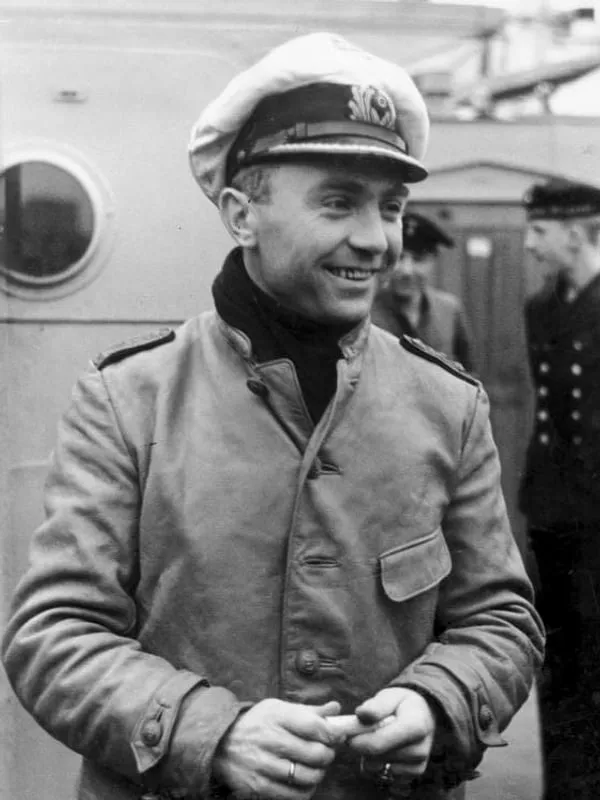
- Born:
- 16 January 1908, Osterfeld (German Empire)
- Died:
- 7 March 1941, North Atlantic
- Author:
- Łukasz
- Photo:
- Schulze, Annelise (Mauritius), CC BY-SA 3.0 DE, Wikimedia Commons

Günther Prien was a German U-boat commander, the most famous of the early years of the Second World War. On the night of 13–14 October 1939 he took his U-47 into the British fleet base at Scapa Flow in the Orkneys and sank the battleship Royal Oak, with the loss of more than 830 sailors. He was the first U-boat commander to receive the Knight’s Cross, and Joseph Goebbels’s propaganda made him the Third Reich’s first war hero: “the Bull of Scapa Flow”, who had avenged the humiliation of the German navy in 1919. For the next year and a half he was one of the most successful aces of the Battle of the Atlantic, until in March 1941 he disappeared with his entire crew. His life shows clearly how the regime built a legend, and how that legend survived in Germany long after the war.
Youth and the merchant navy
He was born on 16 January 1908 in Osterfeld in the Prussian Province of Saxony, one of the three children of a district court judge. From the age of five he lived with relatives in Lübeck, where he attended the renowned Katharineum grammar school. After his parents separated he lived with his mother and siblings in Leipzig, where his mother supported the family by selling lace. During the great inflation of 1923 he left school and joined the merchant navy to ease the burden on his family. After a course at the seamen’s school in Finkenwerder near Hamburg, he started out as a ship’s boy on a sailing ship.
For eight years he sailed on merchant ships and rose through every rank: he learnt navigation, telegraphy and maritime law, served as fourth officer on the passenger liner Hamburg, and in 1931 became a first officer. At the beginning of 1932 he obtained his master’s certificate, but during the Great Depression German shipping was contracting and there was no work for him. He did manual labour in the Voluntary Labour Service, on land drainage and ditch-digging. It was at this time that he joined the NSDAP: in 1932 according to most studies, as early as 1931 according to some German sources. In his 1940 autobiography he wrote that he blamed the Weimar Republic for his unemployment. He had to leave the party when he joined the armed forces, since soldiers were not allowed to belong to political parties.
In the Reichsmarine and the Kriegsmarine
On 16 January 1933, two weeks before Adolf Hitler came to power, he joined the Reichsmarine, which was then taking experienced merchant navy officers for shortened officer training. He was older than his fellow cadets but rose quickly: in March 1933 he became a Fähnrich zur See (midshipman), and after training at the naval school at Mürwik and a year’s service on the cruiser Königsberg he was commissioned Leutnant zur See in April 1935. That same year, when Germany began openly building submarines after the Anglo-German Naval Agreement, he volunteered for the U-boat arm. From May 1936 he was first watch officer on U-26 under Werner Hartmann. In 1937 the boat made patrols in Spanish waters during the Civil War.
Prien was regarded as one of the most able young officers of the U-boat arm. On 17 December 1938 he took command of the new Type VIIB boat U-47, built at the Germaniawerft yard in Kiel, and was soon promoted to Kapitänleutnant. According to some studies he stood out in exercises in the Atlantic in 1939 for his aggressiveness: he attacked at close range and scored the most hits. He was married to Ingeborg, with whom he had children.
The first weeks of the war
On 19 August 1939 U-47 left Kiel for the Atlantic, where the outbreak of war found her. After Fritz-Julius Lemp’s U-30 sank the Athenia, the command ordered strict observance of prize law – stopping ships and allowing their crews to abandon them. Prien complied. He let three neutral ships go, and on 5 September he stopped and sank the British freighter Bosnia, the first merchant ship sunk in the war in accordance with prize procedure. Over the next two days he sank the Rio Claro and the Gartavon in the same way, using his deck gun, which was a rarity. On 15 September he returned to Kiel.
Scapa Flow
On 1 October the commander of U-boats, Karl Dönitz, whose favourite commander Prien was, offered him a mission that many considered suicidal: to get into Scapa Flow, the base of the British Home Fleet, where in 1919 the interned High Seas Fleet had scuttled itself. Two German submarines had tried it in the First World War, and both had been lost. Prien volunteered the next day. U-47 left Kiel on 8 October, surfaced off the Orkneys on the evening of 13 October, squeezed past the sunken blockships in Kirk Sound by the light of the aurora borealis, and was inside the anchorage at 12.27 a.m. Most of the fleet had left earlier, but between 12.58 and 1.16 a.m. Prien torpedoed the battleship Royal Oak in two salvoes; she sank thirteen minutes after the second attack. 833 men were killed – or 835 counting those who later died of their wounds. U-47 slipped out of the anchorage unnoticed.
The raid was a feat of navigation and an act of great courage. Even Winston Churchill called it in the House of Commons “a remarkable exploit of professional skill and daring”. It also had weaknesses that the German command kept secret: of the seven torpedoes fired, only four hit, because the German G7e torpedoes had faulty pistols and depth-keeping gear. Prien also believed he had hit the battlecruiser Repulse, which was not at Scapa Flow at the time. The ship he took for Repulse was in fact the old seaplane carrier Pegasus, and it was not damaged.
Propaganda hero
On 17 October U-47 returned to Wilhelmshaven, where the crew was welcomed by Dönitz and Grand Admiral Erich Raeder. The next day Adolf Hitler’s personal aircraft flew the sailors to Berlin, and at the Reich Chancellery Hitler presented Prien with the Knight’s Cross of the Iron Cross, the first awarded to a U-boat commander. It was the first time the regime had promoted an individual soldier so heavily. The newspapers and radio presented him as the avenger of 1919: at Scapa Flow, where the imperial fleet had gone to the bottom, Prien was said to have wiped out the shame of defeat. The Leipzig grammar school he had never finished was named after him, thousands of cheering people watched his reception at the town hall in Lübeck, and his likeness appeared on postcards, in the “Heroes of the Wehrmacht” picture-card series and even on a board game, “With Prien against England”. The crew painted a snorting bull on U-47’s conning tower, which gave rise to the nickname “the Bull of Scapa Flow”.
The American correspondent William L. Shirer, who saw him at a press conference at the Propaganda Ministry on 18 October, described him as a cocky, “fanatical Nazi”. Historians judge his views differently. Some see him as a convinced National Socialist, others rather as a careerist whose party membership and closeness to the regime helped his advancement. In 1940 his autobiography Mein Weg nach Scapa Flow (“My Road to Scapa Flow”) was published; it was in fact written by the journalist Paul Weymar and revised by the Wehrmacht High Command and the Propaganda Ministry. According to German researchers it reached a print run of about 890,000 copies and was one of the best-selling books of the Third Reich. Prien himself, according to accounts, scribbled angry corrections in the copy he was given.
U-boat ace
His subsequent patrols achieved less than the propaganda claimed. On 28 November 1939 Prien attacked the British cruiser Norfolk, and German radio announced her sinking, although she was not even damaged. In April 1940, during the Norwegian campaign, Prien entered the Vågsfjord, where British transports and cruisers lay at anchor, and fired eight torpedoes at them, none of which either hit or exploded. A few days later he also missed the battleship Warspite. Furious, he reported to Dönitz that he could not be expected to fight with a “wooden rifle”. His report helped to reveal the scale of the torpedo crisis that paralysed the German U-boat arm during the fighting for Norway.
In the summer of 1940, once the torpedoes had been improved, his best period began. In June and early July he sank eight ships, among them, on 2 July, the liner Arandora Star, which was carrying Italian and German internees and prisoners of war to Canada. More than 800 people died, most of them Italian internees, but also many German refugees from Nazism who had earlier found shelter in Britain. From the autumn of 1940 U-47 operated from Lorient in occupied France. Prien was often the first to locate convoys and to guide other boats onto them, which was the basis of wolf-pack tactics. In October 1940 he sank several ships in an attack on convoy HX 79, and on 20 October he was awarded the Oak Leaves to the Knight’s Cross, the fifth member of the Wehrmacht and the first in the Kriegsmarine to receive them. Together with Otto Kretschmer and Joachim Schepke he was the most famous U-boat commander of the period their crews called “the happy time”. According to some accounts Dönitz offered him a move to training young commanders, but Prien preferred to stay with his boat.
Disappearance
On 20 February 1941 U-47 left Lorient on her tenth patrol. A few days later she sank ships from convoy OB 290, and on 7 March she attacked convoy OB 293 in the North Atlantic. From that day on she was never heard from again. For decades it was believed that on the night of 7–8 March she had been sunk with depth charges by the British destroyers Wolverine and Verity. More recent research indicates that Wolverine was in fact attacking another boat, UA, which escaped damaged. The fate of U-47 and her 45 men remains unexplained: she may have struck a mine, suffered a mechanical failure or been hit by one of her own torpedoes running in a circle. Prien was posthumously promoted to Korvettenkapitän. The Propaganda Ministry concealed his death for more than two months, and British broadcasts to Germany taunted listeners by asking where Prien was. On 24 May 1941 a Wehrmacht communiqué admitted that the boat had not returned from patrol, burying the news among reports of successes. According to reports by the Security Service (SD), the news caused widespread sadness in Germany.
According to post-war tallies Prien sank 30 merchant ships totalling about 163,000 GRT, as well as the battleship Royal Oak, and damaged eight more ships. German wartime calculations gave higher figures.
The legend
After the war Prien’s legend lived on in the Federal Republic. Popular pulp novels and books by authors who had written for the propaganda machine during the war appeared about him, and in 1958 the film U 47 – Kapitänleutnant Prien was made, criticised for embellishing his life. There was also a story that Prien had broken with Nazism and had not died at sea but had been held in the military prison at Torgau for insubordination. It turned out to be false. When the West German navy was looking for names for its new destroyers in the 1960s, it also considered his, but chose Admiral Günther Lütjens instead. Members of his crew who had earlier been transferred to other boats survived the war, and some of them later became friends with survivors of the Royal Oak.
Historians today see Prien above all as an example of how Nazi propaganda manufactured heroes: an able and courageous commander was used by the regime to erase the memory of the defeat of 1918 and to mobilise society in the first months of the war. His exploit at Scapa Flow was one of the boldest submarine attacks in history, and it helped persuade Hitler to take seriously Dönitz’s arguments for expanding the U-boat fleet. For the British it was a painful blow, which showed that the war at sea could reach into their own bases.
Sources
Mentioned in battles
(01)Often appears with
People who appear in the same events.