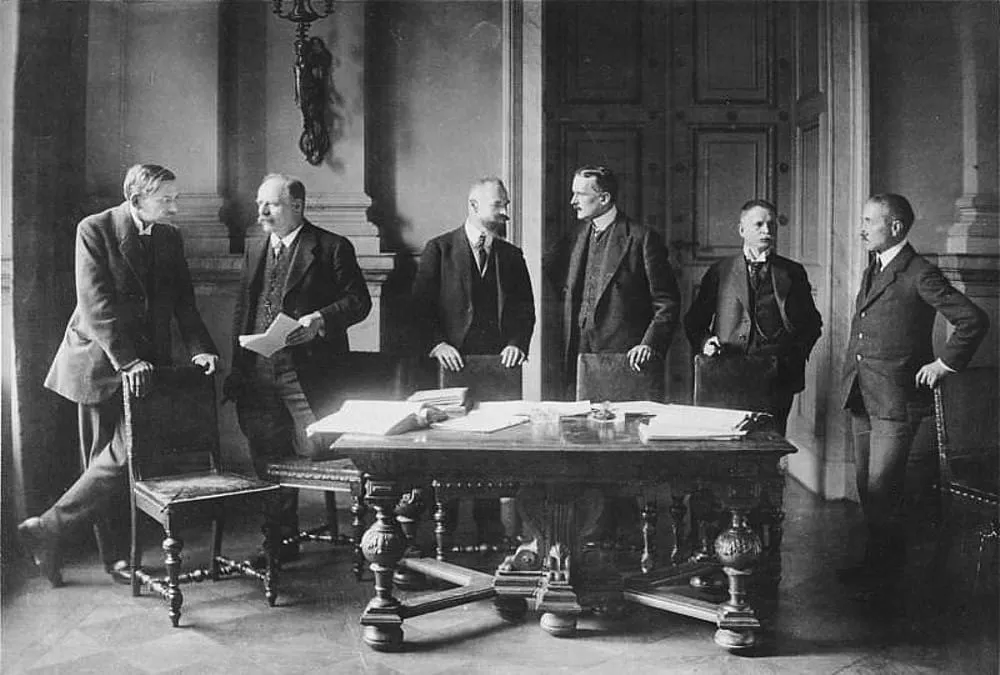
On 28 June 1919, in the Hall of Mirrors of the Palace of Versailles, Germany’s representatives signed the peace treaty with the Allied and Associated Powers. Germany’s signatories were the Foreign Minister, the Social Democrat Hermann Müller, and a minister from the Catholic Centre Party, Johannes Bell. On the other side of the table sat the makers of the peace: the French Prime Minister, Georges Clemenceau, the President of the United States, Woodrow Wilson, and the British Prime Minister, David Lloyd George. It was exactly five years to the day since the assassination at Sarajevo that had started the war, and less than half a century since the German Empire had been proclaimed in the same hall. The treaty, with its 440 articles, formally ended the state of war between Germany and most of its enemies. It took from Germany territory in the east and the west, all its colonies and almost its entire army, imposed on it an obligation to pay reparations, and in Article 231 declared it responsible for the war. For the victors it was an attempt to build a lasting peace; for the Germans it was, from the very first day, a “dictate” that had to be overthrown. For the next twenty years the whole of European politics revolved around the question of whether the Versailles order could be upheld.
A peace without the defeated
More than seven months had passed since the Armistice of Compiègne. On 18 January 1919 the peace conference opened in Paris, but the Germans were not invited. The terms of the peace were settled among the victors themselves: first in the Council of Ten, then among the Big Four – Clemenceau, Wilson, Lloyd George and the Italian Prime Minister, Vittorio Emanuele Orlando. Their aims diverged. France, which had lost nearly one and a half million soldiers and whose northern departments lay in ruins, wanted to weaken Germany permanently and to anchor its frontier on the Rhine. Wilson wanted a peace based on the Fourteen Points, on the right of nations to self-determination and on the League of Nations. Lloyd George, who in the December 1918 election had promised the British that Germany would pay, privately feared that too harsh a peace would drive it into the arms of the Bolsheviks and give France the upper hand on the Continent. The treaty was a compromise between these positions and, as Wilson’s adviser Edward House later admitted, it fully satisfied no one.
The German delegation, headed by the Foreign Minister, Count Ulrich von Brockdorff-Rantzau, arrived at Versailles at the end of April. It was lodged in a hotel surrounded by a fence, under guard, and was not admitted to any talks. On 7 May 1919, the fourth anniversary of the sinking of the Lusitania, Clemenceau handed the Germans a thick volume of terms at the Trianon Palace Hotel and announced that the hour of reckoning had come. Brockdorff-Rantzau replied with a long speech, which he delivered seated. Some took this as a deliberate insult; others put it down to the count’s nerves. He said that he felt “the full force of hatred” confronting him there, and that Germany was being asked to acknowledge itself as solely guilty for the war, a confession that in his mouth would be a lie. He also recalled the hundreds of thousands of civilians who, in his view, had died of hunger because the blockade had been maintained after the armistice. Wilson and Lloyd George found the speech arrogant, and its tone did the Germans no good in the weeks that followed.
Germany faces the terms
The content of the treaty came as a shock in Germany. The government and public opinion had believed that the peace would be concluded on the basis of the Fourteen Points, which Berlin had invoked in the autumn of 1918 when it asked for an armistice. Instead the terms proved far harsher than expected. On 12 May, in the great hall of the University of Berlin, where the National Assembly had gathered, the Chancellor, Philipp Scheidemann, called the treaty unacceptable and asked what hand would not wither that bound itself and the nation in such fetters. Every party, from the far right to the Independent Socialists, protested against the treaty.
The delegation at Versailles could do no more than write notes. On 29 May it submitted extensive counter-proposals: Germany agreed to disarm and to pay high reparations, but demanded plebiscites in the disputed territories, immediate admission to the League of Nations and the deletion of the provisions on war guilt. On 16 June the Allies replied with a note accepting few amendments. The most important for Poland was that the fate of Upper Silesia, which the original draft had awarded to Poland, would be decided by a plebiscite. An ultimatum was attached to the note. If Germany refused to sign, the armistice would expire and the Allied armies, ready on the Rhine, would advance into the interior. The deadline, originally five days, was extended to the evening of 23 June.
In Weimar the government fell apart. Brockdorff-Rantzau advised rejecting the treaty, reckoning that the Allies would not risk a new war. Signing was advocated by the minister without portfolio, Matthias Erzberger, who argued that refusal meant occupation, the break-up of the Reich and starvation. President Friedrich Ebert hesitated. On the night of 19–20 June Scheidemann resigned, and Brockdorff-Rantzau went with him. On 21 June a new government was formed by the Social Democrat Gustav Bauer, previously Minister of Labour, resting only on the Social Democrats and the Centre, because the liberals of the German Democratic Party refused to take part in the signing. That same day the crews of the interned German fleet scuttled their ships at Scapa Flow so that they would not fall into the victors’ hands.
On 22 June the National Assembly, by 237 votes to 138 with five abstentions, authorised the government to sign the treaty, but with the reservation that Germany did not acknowledge sole guilt for the war and would not hand over its citizens to foreign courts. That same day Clemenceau replied that the Allies would accept no reservations. On 23 June the government asked the army command whether resistance was possible. General Wilhelm Groener answered that it was not, and Field Marshal Paul von Hindenburg agreed with him but left it to Groener to convey the answer to the politicians. The Assembly consented to signing without conditions, and Bauer said that the government was accepting the treaty because it was defenceless, but did not concede that Germany had lost its honour. The note of acceptance reached Clemenceau little more than an hour before the deadline expired.
The ceremony in the Hall of Mirrors
None of the existing delegation wanted to sign. So Müller, Foreign Minister in Bauer’s government for only a few days, went, together with Bell, the Minister for the Colonies, representing the coalition’s second party. Clemenceau had prepared the setting with care. In the Hall of Mirrors, where on 18 January 1871 King Wilhelm I of Prussia had been proclaimed German Emperor, a horseshoe-shaped table was set up, and among the invited guests were seated five French soldiers whose faces had been disfigured in the war, the so-called gueules cassées (“broken faces”). The hall was filled with delegates, diplomats, officers and journalists.
The ceremony began shortly after three in the afternoon. The German delegates were brought in to sign first. According to eyewitnesses they were pale but composed. By these accounts they signed at around 3.12 p.m., and after them the representatives of the victors signed: the Americans led by Wilson, the British with Lloyd George and the representatives of the Dominions, the French, the Italians and the Japanese, among them the former Prime Minister Kinmochi Saionji and Nobuaki Makino, and then the other states. Poland’s signatories were the Prime Minister, Ignacy Jan Paderewski, and Roman Dmowski. Only the Chinese delegation did not sign, because the treaty gave Japan Germany’s rights in the province of Shandong, and since the beginning of May China had been convulsed by stormy protests known as the May Fourth Movement. The dispute over Shandong was one of the reasons why, a few months earlier, the Japanese racial equality proposal had become a matter of prestige in Tokyo.
At about 3.50 p.m. Clemenceau closed the session. The Germans were escorted from the hall separately. Outside, cannon salutes thundered, the fountains in the park of Versailles were turned on for the first time since the war, and the crowd cheered Clemenceau, Wilson and Lloyd George. That same day Wilson and Lloyd George signed two separate agreements with France in which the United States and Britain promised to come to its aid in the event of an unprovoked German attack. This was the price for which Clemenceau gave up the idea of detaching the Rhineland from Germany. In the evening Wilson left Paris for home.
What the treaty laid down
The treaty opened with the Covenant of the League of Nations, the new organisation that was to settle disputes between states. A later part established the International Labour Organization. Most of the text, however, concerned Germany.
Frontiers. Germany lost about 13 per cent of its territory and about 10 per cent of its population, counting Alsace and Lorraine, which returned to France. Belgium received the districts of Eupen and Malmedy, Czechoslovakia the small Hlučín Region in Silesia, and northern Schleswig (PL) was to be decided by a plebiscite, in which its northern part chose Denmark in 1920. The Saar Territory passed for 15 years under the administration of the League of Nations, and its coal mines became French property in compensation for the destroyed French mines. After 15 years the inhabitants were to decide its future in a plebiscite. The port of Memel (Klaipėda) and its hinterland were placed at the disposal of the powers. Article 80 required Germany to respect the independence of Austria as inalienable except with the consent of the Council of the League of Nations. This was a ban on the union that the Austrians had been demanding since the autumn of 1918.
The greatest changes came in the east. Germany recognised Poland’s independence and ceded to it almost the whole of the Province of Posen, most of which had already been taken during the Greater Poland Uprising; the greater part of West Prussia with access to the Baltic, that is, Gdańsk Pomerania; and the district of Działdowo with the important Warsaw–Gdańsk railway line. From then on a strip of Polish Pomerania separated East Prussia from the rest of the Reich, and the Germans called it the “Corridor”. Gdańsk (Danzig), an overwhelmingly German city but the only great port at the mouth of the Vistula, was neither given to Poland, as Dmowski had wanted, nor left with Germany. It became a Free City under the protection of the League of Nations, and Poland received customs and port rights there as well as the right to represent it abroad. Plebiscites were to decide the fate of Upper Silesia and of parts of East and West Prussia – Warmia, Masuria and Powiśle.
Colonies. Germany renounced all its overseas possessions. The League of Nations distributed them among the victors as mandates: Kamerun and Togoland were divided between France and Britain, most of German East Africa went to the British and Rwanda and Burundi to Belgium, and South West Africa went to the Union of South Africa. The Pacific islands north of the equator went to Japan, those south of it to Australia and New Zealand.
Disarmament. The German army, the Reichswehr, was limited to 100,000 men, including 4,000 officers. Conscription was abolished; soldiers were to serve 12 years and officers 25, so that Germany could not train reserves. The Great General Staff was dissolved. Tanks, armoured cars, chemical weapons, heavy artillery and military aviation were forbidden. The navy was allowed 15,000 men, six old battleships, six light cruisers, twelve destroyers and twelve torpedo boats, but not a single submarine. The left bank of the Rhine and a strip 50 kilometres wide on the right bank were to be permanently demilitarised. Inter-Allied control commissions supervised compliance with these provisions.
Guarantees. Allied troops were to be stationed for 15 years on the left bank of the Rhine and in the bridgeheads around Cologne, Koblenz and Mainz. The zones were to be evacuated in stages, after 5, 10 and 15 years, provided Germany carried out the treaty.
Guilt and reparations. Article 231 stated that Germany accepted the responsibility of itself and its allies for all the loss and damage suffered by the Allies as a consequence of the war “imposed upon them by the aggression of Germany and her allies”. The authors of this clause wanted above all to create a legal basis for reparations, and the very next article conceded that Germany’s resources were limited. The Germans, however, read it as a moral verdict and called it the “war guilt clause”. The treaty did not fix the amount of reparations. That was left to the Reparations Commission, which was to do so by 1 May 1921; until then Germany was to pay 20 billion gold marks in goods, ships and securities. The figure of 132 billion gold marks was announced only in May 1921 in London, and a considerable part of it was in practice fictitious.
Punishment. Article 227 provided for the arraignment of the former Emperor Wilhelm II before a tribunal for “a supreme offence against international morality and the sanctity of treaties”, and further articles for the surrender to the Allies of persons accused of war crimes. The Netherlands refused to hand over the Kaiser, and instead of international trials, about a dozen trials were held in 1921 before the Reich Court in Leipzig, most of them ending in acquittals or light sentences.
The Little Treaty of Versailles
On the same day at Versailles Poland signed a separate treaty on the protection of minorities with Britain, France, the United States, Italy and Japan, known as the Little Treaty of Versailles. The treaty with Germany itself required Poland to conclude it. Poland undertook to guarantee all its inhabitants equality before the law, freedom of religion and of the use of their language, and to grant minorities the right to their own schools and institutions. Separate articles concerned the Jews, including respect for the Sabbath. Supervision of the treaty’s implementation was entrusted to the League of Nations, to which minorities could submit complaints. Czechoslovakia, Romania, Yugoslavia and Greece later had to sign similar treaties, while Germany did not have to sign any.
In Poland the treaty was regarded as a humiliation and a limitation of sovereignty imposed only on new and smaller states. Paderewski signed it reluctantly. In the years that followed Germany eagerly used the complaints of the German minority before the League of Nations as a weapon against the Versailles frontier. In September 1934 the Foreign Minister, Józef Beck, declared in Geneva that Poland would not co-operate with the international bodies supervising the treaty’s implementation until a similar system covered all states.
Ratification and America’s absence
On 9 July 1919 the National Assembly in Weimar ratified the treaty. It came into force on 10 January 1920, after the exchange of ratifications with France, Britain and Italy. The United States was not among them. Wilson, who had devoted half a year to the work in Paris, had not taken a single prominent Republican to the conference, and the Republicans had a majority in the Senate. A group of senators led by Henry Cabot Lodge demanded reservations, especially to the article of the Covenant that could oblige America to defend other states. Wilson refused to compromise, and during a tour of the country to campaign for the treaty in the autumn of 1919 he suffered a stroke. On 19 November 1919, and again on 19 March 1920, the treaty failed to win the required two-thirds majority in the Senate. The United States did not join the League of Nations, and on 25 August 1921 it concluded a separate Treaty of Berlin with Germany, which secured for it the rights arising from the Treaty of Versailles without its obligations. The American guarantee treaty for France also lapsed, and with it the British one, which depended on it. France was left without its promised allies and without a frontier on the Rhine.
The “Diktat”
In Germany the treaty was from the outset called a dictate (Diktat) or a peace of shame. Almost no one, from the Communists to the nationalists, considered it just. The greatest wrongs were held to be Article 231, which robbed Germany of its honour; the tearing apart of the country by the “Corridor” and the loss of Danzig; the ban on union with Austria, which contradicted the principle of self-determination; and reparations without a fixed sum. Throughout the 1920s the Foreign Ministry ran a wide-ranging campaign against the “war guilt lie” (Kriegsschuldlüge), financing historians’ publications and editions of documents.
The anger was not directed only at the victors. The nationalists blamed the treaty on the same politicians they blamed for the armistice and the revolution – the Social Democrats, the Centre and the Democrats, the “November criminals”. Erzberger, who had persuaded the government to sign, was murdered in 1921. Few remembered that it was the army that had judged resistance hopeless, and the stab-in-the-back legend taught people to believe that soldiers undefeated in the field had been betrayed at home. Doubts grew abroad too. The British economist John Maynard Keynes, a member of the British delegation, in a celebrated book of December 1919 called the treaty a Carthaginian peace that would ruin the economy of Europe. For two decades his arguments shaped the conviction of many Britons and Americans that Germany had been wronged. Marshal Ferdinand Foch, on the contrary, thought the treaty too weak and is said to have remarked that it was not a peace but an armistice for twenty years.
Most historians today judge the treaty more cautiously than Keynes did. Germany lost territory, but it remained the most populous and economically strongest state in Europe west of Russia, and its eastern neighbours were now weak new states instead of the Tsarist empire. The reparations were high, but in practice they were reduced several times and Germany paid only part of them. The treaty was, as is often said, too harsh for Germany to accept and too lenient to prevent it permanently from seeking revenge. And the victors, divided and without America, lacked the will to enforce it.
The long shadow of Versailles
Revision of the treaty became the goal of every government of the Weimar Republic; they differed only in their methods. In 1923, when Germany fell behind with its deliveries, French and Belgian troops occupied the Ruhr, while hyperinflation raged in the country. Then Gustav Stresemann chose the path of understanding: the Dawes Plan of 1924 spread the reparations into instalments; at Locarno in 1925 Germany voluntarily recognised its frontier with France and Belgium, though it refused to guarantee its frontiers with Poland and Czechoslovakia; and in 1926 it joined the League of Nations. The Young Plan of 1929 reduced the payments further, and the last Allied soldiers left the Rhineland on 30 June 1930, five years ahead of schedule. During the Great Depression the Hoover Moratorium suspended payments, and in 1932 at Lausanne reparations were all but abolished. Meanwhile, the Reichswehr’s secret co-operation with the Red Army, conducted by General Hans von Seeckt, made it possible to evade the bans on armament.
Adolf Hitler built his career on hatred of Versailles. His party’s 1920 programme demanded the abrogation of the treaty, and every speech invoked the “dictate” and the “November criminals”. When he came to power in 1933, he dismantled the Versailles order step by step, each time testing whether the powers would react. In October 1933 Germany left the League of Nations. In January 1935 the Saar returned to the Reich by plebiscite, and on 16 March Hitler announced the reintroduction of universal conscription and the building of a large army. In June Britain itself concluded a naval agreement with him, in effect recognising German naval rearmament. On 7 March 1936 the Wehrmacht marched into the demilitarised Rhineland, and France did not respond. In March 1938 Hitler annexed Austria in breach of the ban in Article 80; in September at Munich he obtained the Sudetenland; and in March 1939 he occupied Bohemia and Moravia and took Memel from Lithuania. Each time the British, brought up on Keynes, felt that Germany was merely recovering what had been unjustly taken from it.
At the end of that road lay Poland. In October 1938 the Reich Foreign Minister, Joachim von Ribbentrop, demanded that Poland agree to the incorporation of the Free City of Danzig into the Reich and to an extraterritorial motorway and railway across Pomerania. Poland refused. Danzig and the “Corridor”, the two provisions of Versailles most hated in Germany, became the pretext for war. At dawn on 1 September 1939 the battleship Schleswig-Holstein opened fire on the Polish Military Transit Depot at Westerplatte, and Gauleiter Albert Forster proclaimed the incorporation of Danzig into the Reich. A few weeks later Vyacheslav Molotov called defeated Poland “this ugly offspring of the Versailles Treaty”. Just as the prophecy attributed to Foch had foretold, twenty years and two months passed between the signing of the peace and the outbreak of a new war.
Sources
Related events
(04)The same battle, people or subject.
- 18 January 1919 · DiplomacyThe Paris Peace Conference opensOn 18 January 1919, at the French Foreign Ministry on the Quai d'Orsay, President Poincaré opened the peace conference. The defeated and Russia were absent.
- 11 November 1918 · DiplomacyThe Armistice of 11 November 1918Early on 11 November 1918, in Foch’s carriage in the Forest of Compiègne, Germany signed an armistice with the Entente. At 11 a.m. the guns fell silent.
- 21 January 1920 · DiplomacyThe end of the Paris Peace ConferenceOn 21 January 1920 the peace conference's council met for the last time with Clemenceau. Day-to-day business passed to the Conference of Ambassadors.
- 13 February 1919 · DiplomacyThe Japanese racial equality proposalOn 13 February 1919 Nobuaki Makino proposed adding racial equality to the League of Nations Covenant. Australian and American opposition buried it.