Germany
Reinhard Scheer
Commander of the High Seas Fleet (1916–1918), Chief of the Admiralty Staff and of the Naval Warfare Command (1918), admiral
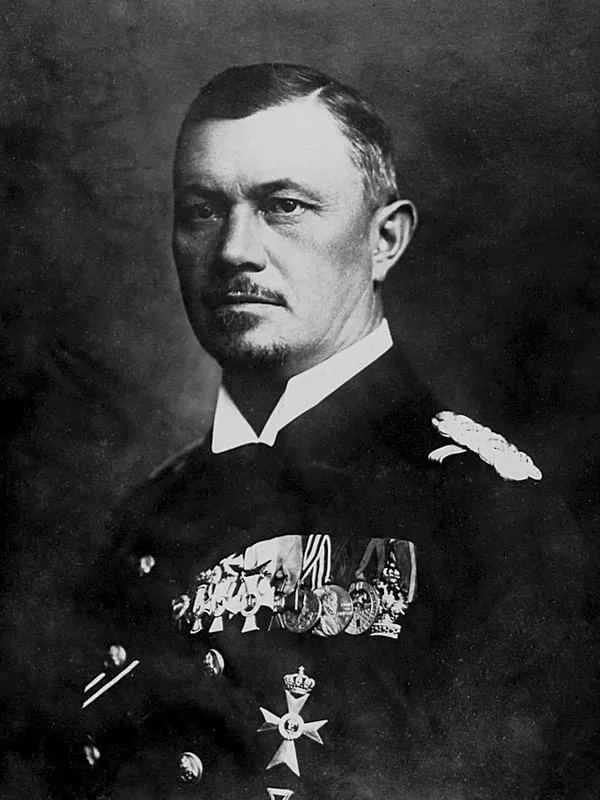
- Born:
- 30 September 1863, Obernkirchen (Hesse-Kassel)
- Died:
- 26 November 1928, Marktredwitz (Bavaria)
- Author:
- Natalia
- Photo:
- The European Library, CC0, Wikimedia Commons

Reinhard Scheer commanded the German High Seas Fleet in the only great clash of battle fleets of the First World War. At Jutland in 1916 his smaller fleet inflicted heavier losses on the British than it suffered itself, and twice broke out of the trap set for it by the Grand Fleet. Scheer soon concluded, however, that even the most successful battle at sea would not force Britain to make peace, and he became one of the loudest advocates of unrestricted submarine warfare, which in 1917 drew the United States into the war. In the last months of the war he directed Germany’s entire naval war. The plan for a final battle of the fleet, prepared by him and Admiral Franz von Hipper in October 1918 behind the government’s back, provoked the sailors’ mutiny with which the revolution in Germany began. Scheer was thus one of the men who unwittingly set in motion the fall of the Empire and the birth of the Weimar Republic, and one of Hitler’s warships later bore his name.
A career in the Imperial Navy
He was born on 30 September 1863 in Obernkirchen, a small town then belonging to Hesse-Kassel, into a middle-class family, and so without the aristocratic background and wealth that eased a career in the navy. On 22 April 1879 he joined the Kaiserliche Marine, the young navy of the newly unified Germany, as a cadet. In the mid-1880s he served on ships sent to Africa, and in December 1884 he took part in an expedition against local chiefs in Kamerun, recently seized by Germany. He also sailed in East Asian waters. In those years he became friends with Henning von Holtzendorff, later commander of the fleet and Chief of the Admiralty Staff, who furthered his career for many years.
In the late 1880s and the 1890s Scheer made a name for himself as a specialist in torpedo weapons and torpedo-boat tactics. He caught the eye of Admiral Alfred von Tirpitz, who from 1897, as State Secretary of the Imperial Naval Office, was building a great battle fleet with the backing of Emperor Wilhelm II. Scheer belonged to the generation of officers who created that fleet. He commanded a torpedo-boat flotilla, headed the central department of the Naval Office, and then commanded the cruiser Gazelle and the battleship Elsass. In 1910 he became chief of staff of the High Seas Fleet under Holtzendorff and was already working on the principles for manoeuvring the whole fleet in battle. That same year he was promoted to rear admiral, at the beginning of 1913 he took over the II Battle Squadron, and in December of that year he became a vice admiral. He was stern and demanding – in the navy he was called “the man with the iron mask” – but he valued initiative and was not afraid of responsibility.
The first years of the war
He began the war in command of the II Battle Squadron, made up of obsolete battleships. At the beginning of 1915 he took over the III Battle Squadron, the newest and most powerful dreadnoughts of the fleet. He was one of the officers who considered the fleet command too passive. He criticised Admiral Friedrich von Ingenohl, who in December 1914, during the battlecruiser raid on the English coast, turned back to port even though he had a chance to destroy an isolated part of the British Grand Fleet. Ingenohl’s successor, Admiral Hugo von Pohl, was even more cautious, and the Emperor was long unwilling to risk the fleet. Throughout 1915 the battleships rarely ventured far from the Heligoland Bight.
Jutland
In January 1916 the gravely ill Pohl stood down and Scheer took command of the High Seas Fleet. He drew up a new plan for the war in the North Sea. The fleet was not to seek battle with the whole Grand Fleet, but to use sorties, airship raids, mines and submarines to lure parts of it out to sea and destroy them with superior forces. The Emperor approved this programme in February. In April the battlecruisers bombarded Lowestoft and Yarmouth, and at the end of May Scheer led the entire fleet out towards the Skagerrak.
He did not know that British codebreakers in Room 40 were reading his signals and that the Grand Fleet had put to sea before his ships had left harbour. On 31 May 1916 the battlecruisers of Vice Admiral Franz von Hipper lured the British battlecruisers under the guns of the German battleships, and two British ships blew up. When Scheer set off in pursuit, however, he himself ran into the battleships of Admiral John Jellicoe. At around 6.30 p.m. he saw that a long line of British dreadnoughts was firing on his ships out of the mist to the north and east. He ordered the simultaneous 180-degree turn of all ships that had been practised for years, and the fleet vanished from British sight. Less than half an hour later he turned east again, and his leading ships once more came under fire. Scheer turned away a third time, throwing his torpedo boats and battlecruisers against the British to cover the manoeuvre. During the night he passed through the British destroyers behind the Grand Fleet, and by the morning of 1 June he was safe.
In the Battle of Jutland the British lost more ships and men, but they retained command of the sea. The Germans proclaimed a great victory “at the Skagerrak”, and Scheer was promoted to admiral and awarded the Pour le Mérite. In his report to the Emperor of 4 July 1916, however, he wrote that even the most successful battle would not force Britain to make peace and that only submarine warfare against its trade, waged without restrictions, could do so.
Submarine warfare and the mutiny of 1917
Scheer was among those who pressed the Chancellor, Theobald von Bethmann Hollweg, and when the decision for unrestricted submarine warfare was taken in January 1917 he welcomed it. In April 1917 that decision brought the United States into the war, and a year later American troops sealed Germany’s defeat. Meanwhile the battleships of the High Seas Fleet lay in port, and their best officers and men were taken away for the U-boats. Idleness, poor food and the gulf between officers and ratings led in the summer of 1917 to the first mutiny in the fleet. Scheer confirmed the death sentences on two of its leaders, Max Reichpietsch and Albin Köbis, who were shot in September 1917. Their memory returned a year later, when the fleet mutinied a second time.
The last plan
In August 1918, after the army’s defeats on the Western Front, Scheer became Chief of the Admiralty Staff and head of the new Naval Warfare Command (Seekriegsleitung), with wide powers. Hipper took over command of the fleet. Scheer agreed with Paul von Hindenburg and Erich Ludendorff that submarine warfare was the last hope of ending the war on favourable terms. The so-called Scheer Programme envisaged a manifold increase in submarine production by 1919. Some historians regard it more as a propaganda gesture than a realistic plan.
In October, as the new government of Prince Max von Baden was asking President Wilson for an armistice, Scheer recalled the U-boats from the war on commerce around 20–21 October, which was one of the American conditions. At the same time, on 22 October, he instructed Hipper to prepare a strike by the surface fleet. Operational Order No. 19, issued on 24 October and approved by Scheer on 27 October, provided for an attack on shipping off the Flanders coast and in the Thames estuary, followed by a battle with the Grand Fleet. The government was not informed. The sailors, convinced that the admirals were sending them to their deaths for the sake of the fleet’s honour and to wreck the peace negotiations, refused to obey orders on the night of 29–30 October. The operation was called off, and within a few days the mutiny in Kiel had turned into the revolution in Germany. On 9 November the monarchy fell, and on 11 November Germany signed the Armistice of Compiègne. The High Seas Fleet that Scheer had led at Jutland sailed into internment at Scapa Flow, where in June 1919 it was scuttled by its own crews.
After the war
In December 1918 Scheer retired. In 1919 he published his memoirs of the High Seas Fleet in the World War, quickly translated into English, and then toured giving lectures on the German fleet’s struggle. Like many officers of the Imperial Navy, he presented its end as the result of disintegration at home and revolutionary agitation rather than of a lost war, and so added his own contribution to the stab-in-the-back myth. He settled in Weimar, the city that gave its name to the new republic. In October 1920 a robber broke into his house, killed the admiral’s wife and a maid, wounded his daughter and then took his own life. After this Scheer withdrew from public life. In 1925 he published an autobiography, Vom Segelschiff zum U-Boot (“From Sailing Ship to U-boat”).
In 1928 he accepted an invitation from his old adversary Jellicoe to visit England, but before he could travel he died suddenly at Marktredwitz on 26 November. He was buried in Weimar. On his gravestone, besides his name and dates, a single word was carved: “Skagerrak”.
The ship that bore his name
On 1 April 1933, two months after Hitler came to power, a heavy cruiser – a so-called pocket battleship – the Admiral Scheer, was launched at Wilhelmshaven. She was commissioned in November 1934. During the Spanish Civil War, on 31 May 1937, she shelled the port of Almería in reprisal for an attack by Republican aircraft on her sister ship Deutschland. In the Second World War she was one of the most successful German raiders. On 5 November 1940 she attacked convoy HX 84 in the Atlantic, sinking the armed merchant cruiser Jervis Bay, which sacrificed herself to allow the merchant ships to escape, and several merchantmen. She sank at Kiel on 9 April 1945 during a British air raid.
Assessment
Most historians regard Scheer as the ablest and most enterprising of the commanders of the High Seas Fleet. He revitalised a passive fleet, and at Jutland, in a position that threatened its destruction, he kept his nerve and led it out of the trap. His critics point out that he twice let himself be surprised by the Grand Fleet, and that after the war he presented his accounts of the battle in a more favourable light than the facts allowed.
The gravest charges, however, concern strategy and politics. Scheer was one of the chief advocates of unrestricted submarine warfare, which did not break Britain but brought the United States into the war. The plan for a final battle of the fleet in October 1918, prepared behind the government’s back while armistice negotiations were under way, is regarded by many historians as an attempt to save the navy’s honour and future at the cost of the sailors’ lives, and by some even as a mutiny of the admirals against the civilian authorities. It led to the fall of the Empire that Scheer had wished to serve and to the revolution from which the Weimar Republic grew. The memory of November 1918 later haunted the navy of the Third Reich, which was led by men brought up in the fleet of Scheer and Hipper.
Sources
Often appears with
People who appear in the same events.