Germany
Prince Max of Baden
Heir to the throne of the Grand Duchy of Baden (from 1907), Reich Chancellor and Prime Minister of Prussia (3 October – 9 November 1918)
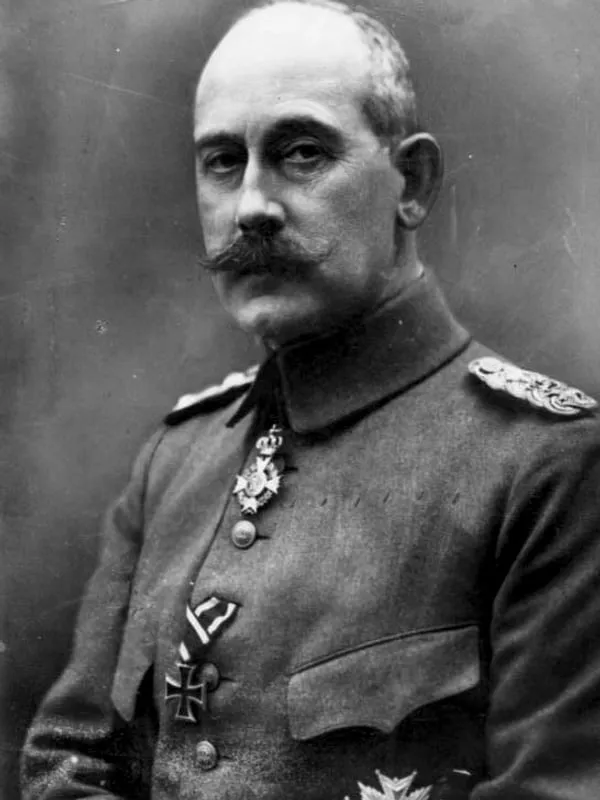
- Born:
- 10 July 1867, Baden-Baden (Grand Duchy of Baden)
- Died:
- 6 November 1929, Konstanz (Baden)
- Author:
- Łukasz
- Photo:
- autor nieznany, CC BY-SA 3.0 DE, Wikimedia Commons

Prince Maximilian of Baden, generally known as Max von Baden, was the last chancellor of the German Empire. He held office for little more than five weeks, from 3 October to 9 November 1918, yet more turning points were packed into that time than into all the preceding years of the war. His government asked the President of the United States for an armistice, brought the Social Democrats into power for the first time, carried out reforms that turned Germany into a parliamentary monarchy and secured the dismissal of General Erich Ludendorff. On 9 November, when the revolution reached Berlin, the prince announced the Kaiser’s abdication on his own authority and handed his office to the leader of the Social Democrats. He wanted to save the monarchy and instead opened the way to the republic. For the history of the road to the Second World War it also matters who asked for the armistice. It was done at the generals’ demand, but the request was made by a civilian, parliamentary government. This made it easier for the Supreme Army Command to shift responsibility for the defeat onto the politicians, and from this the stab-in-the-back myth was born.
Prince and officer
He was born on 10 July 1867 in Baden-Baden, the son of Prince Wilhelm of Baden, a Prussian general, and of Maria, Princess of Leuchtenberg, a granddaughter of Eugène de Beauharnais and a niece of Tsar Alexander II. Through his mother he was related to the Russian court, through his cousin Victoria, wife of the future King Gustaf V of Sweden, to the Swedish court, and Kaiser Wilhelm II was a distant cousin. After a classical gymnasium he studied law and cameralistics, at Leipzig among other places, and then chose a career as an officer in the Prussian army. He served in the cavalry, from 1903 commanded the Baden Life Dragoon Regiment and later a cavalry brigade. In 1911 he retired from active service with the rank of general.
In 1900 he married Marie Louise, Princess of Hanover of the house of Cumberland. They had a daughter, Marie Alexandra, and a son, Berthold. According to his biographer Lothar Machtan and other scholars, the prince was homosexual, which in the Germany of the time threatened scandal and left him open to blackmail. In 1907, on the death of his uncle, Grand Duke Friedrich I, Max became heir to the throne of the Grand Duchy of Baden, because his cousin, the new Grand Duke Friedrich II, was childless. He also became president of the Baden First Chamber. He was interested in philosophy, religion and education, but had practically no political experience.
The prisoners’ prince
When war broke out in 1914, Max joined the staff of XIV Corps, in which the Baden troops were fighting, as the Grand Duke’s representative. By October, however, he was back in Baden. In December 1914 the Kaiser made him a general of cavalry, but the prince did not return to the front, for which military circles mocked him as a “medical-orderly general”. From October 1914 he was honorary president of the Baden Red Cross, and throughout the war he concerned himself with the fate of prisoners of all nationalities. He made use of his family ties with the courts in Petrograd and Stockholm and his acquaintances in Switzerland, and from 1916 he was honorary president of the German-American prisoner relief run by the World Alliance of YMCAs. He gained a reputation as a cultivated and moderate man, far removed from wartime propaganda.
He was no pacifist. He supported a defensive war, but in 1917 he publicly opposed unrestricted submarine warfare, which brought the United States into the war. Moderate opponents of the Supreme Army Command of Paul von Hindenburg and Erich Ludendorff began to gather around him. The most important part was played by the young diplomat Kurt Hahn, who persuaded the prince to enter politics, wrote his speeches and lobbied deputies on his behalf. The prince’s views, however, were more conservative than his supporters believed. In a private letter of early 1918 to his cousin, Prince Alexander zu Hohenlohe-Schillingsfürst, he criticised parliamentarisation and the Reichstag’s Peace Resolution of July 1917. His correspondence with the racist ideologue Houston Stewart Chamberlain, discovered in 2004, also showed that the prince did not object to his friend’s antisemitic arguments, and in 1916 he himself wrote of the “danger of Judaisation”, even though his closest collaborator, Hahn, came from a Jewish family.
The armistice chancellor
At the end of September 1918 Hindenburg and Ludendorff declared that the front might collapse and demanded an immediate request for an armistice. Ludendorff also wanted the request to be made by a new government based on a Reichstag majority. Chancellor Georg von Hertling resigned and himself proposed Prince Max as his successor, a candidacy supported by the liberals and by Ludendorff himself. It was hoped that a prince known for his help to prisoners and his opposition to submarine warfare would make a good impression on President Woodrow Wilson.
Max arrived in Berlin on 1 October and only there learned that the army was demanding an immediate request for an armistice. He was horrified, believing that such a step would reveal to the enemy the scale of the defeat. Hindenburg, however, confirmed the demand in writing and the prince gave way. On 3 October he became chancellor and Prime Minister of Prussia, and during the night of 3–4 October he signed the note to Wilson requesting an armistice and negotiations on the basis of the Fourteen Points. For the first time in the history of the Empire Social Democrats entered the government – Philipp Scheidemann and Gustav Bauer – alongside Centre politicians, among them Matthias Erzberger. The chancellor quickly established a relationship of trust with the leader of the Social Democrats, Friedrich Ebert.
Five weeks of reform
In a few weeks the government did more than earlier cabinets had done in the whole of the war. It declared a broad amnesty for political prisoners, which freed among others Karl Liebknecht, appointed Alsatians to the highest offices in Alsace-Lorraine and settled the introduction of equal suffrage in Prussia. The constitutional amendments passed by the Reichstag came into force on 28 October: from then on the chancellor needed the confidence of parliament, and officers’ appointments required the countersignature of the war minister. Germany had become a parliamentary monarchy. Only a day later a sailors’ mutiny began in the Wilhelmshaven roads, and out of it grew the revolution.
Wilson’s replies to the German notes grew ever harsher. He demanded an end to submarine warfare against passenger ships, and in his note of 23 October he made it clear that with Germany’s “military masters and monarchical autocrats” he could negotiate only a surrender. The chancellor forced the Admiralty to recall the U-boats from the war on commerce. Ludendorff, who a few weeks earlier had himself demanded an armistice, now decided that the army could fight on; on 24 October he issued an order calling Wilson’s note unacceptable and came to Berlin against the chancellor’s wishes. The prince gave the Kaiser an ultimatum. On 26 October Wilhelm II accepted Ludendorff’s resignation, and Wilhelm Groener succeeded him. German historians see this as the restoration of the primacy of politics over the military, lost since 1916.
The Kaiser question and 9 November
After the note of 23 October it was clear that the Kaiser stood in the way of peace. The chancellor did not want the end of the monarchy. He hoped that if Wilhelm II and the Crown Prince renounced the crown, the dynasty could be saved: the throne would pass to the Kaiser’s young grandson, and the regency, historians suppose, to Max himself or to one of the Kaiser’s younger sons. On 29 October, however, Wilhelm II left for headquarters at Spa, out of the government’s reach. At the turn of October and November the prince was out of action for several days. According to some writers he had fallen ill with Spanish flu. Machtan has put forward another hypothesis: on 1 November the Empress is said to have threatened to expose his homosexuality if he forced her husband to abdicate, whereupon Max suffered a nervous breakdown and his doctors sedated him with an opiate. The hypothesis rests partly on circumstantial evidence and not all scholars accept it. The chancellor returned to work on 3 November, the day the first shots were fired in Kiel. On 6 November he sent Erzberger to head the armistice delegation.
On the morning of 9 November a general strike gripped Berlin and the regiments of the garrison were going over to the workers. The chancellor waited in vain for a decision from Spa, where the Kaiser was considering abdicating only as emperor while keeping the Prussian crown, something the constitution did not provide for. Before noon the Wolff news agency issued the chancellor’s statement that the Kaiser and King had decided to renounce the throne and that the Crown Prince was renouncing his rights. Wilhelm II had not authorised this. According to some historians the chancellor acted in the belief, strengthened by reports from headquarters, that a full abdication was only a matter of moments. Machtan called the step a “half coup d’état”.
Around noon Ebert came to the Chancellery and demanded power. The prince handed him the office of chancellor, something the constitution did not empower him to do. Ebert asked him to stay on as regent until the national assembly decided, but Max refused, judging that matters had gone too far. A few hours later Scheidemann proclaimed the republic. That evening the prince left for Baden. To the end of his life Wilhelm II regarded him as an “arch-traitor”, although he signed the formal act of abdication himself, on 28 November in the Netherlands.
Salem and the last years
After the revolution Max withdrew from politics. In December 1918 he declined an offer to stand for the National Assembly on the list of the liberal German Democratic Party, even though it was brought to him by Max Weber himself. Together with Hahn he founded a boarding school in the castle at Salem on Lake Constance, opened in 1920, which was meant to educate a new elite and became one of the best-known schools in Germany. Hahn, driven out by the Nazis in 1933, later founded the famous Gordonstoun school in Scotland. In 1927 the prince published his “Memoirs and Documents”, in which he defended his policy. Part of the aristocracy and the officer corps broke off contact with him. In 1928, on the death of Friedrich II, his son Berthold, whom the childless Grand Duke had earlier adopted, became head of the house of Baden. Max died after several strokes on 6 November 1929 in hospital in Konstanz.
Assessment
Max of Baden has divided historians from the start. For the right and for Wilhelm II he was a traitor who overthrew the monarchy without authority. For many liberals he was a noble but too soft a man, pushed onto the stage when nothing could any longer be saved. Gerhard Schulz stressed that his tolerance and ability to work with the parties helped preserve the unity of the state and prepare the transition to the new system, and that in removing Ludendorff the prince showed firmness. More recent research, especially Lothar Machtan’s, is harsher: it portrays him as a man without a programme or a fallback plan, who overrated the power of his “peace message” and in the decisive days yielded more often to his nerves and his entourage than to his own will.
For German history after 1918 what matters most is what collective memory made of his brief government. The generals who in September had themselves demanded an armistice stayed in the shadows. The request for an armistice was signed by a civilian chancellor, power passed from his hands to the Social Democrats, and the armistice at Compiègne was signed by a Centre politician. This distribution of roles made it easier for the nationalists, and later the Nazis, to tell the story of an army undefeated in the field and betrayed by the politicians. Adolf Hitler made that story one of the pillars of his propaganda.
Sources
Often appears with
People who appear in the same events.