China, Manchukuo
Puyi
Emperor of China (1908–1912, 1917), Chief Executive (1932–1934) and Emperor of Manchukuo (1934–1945)
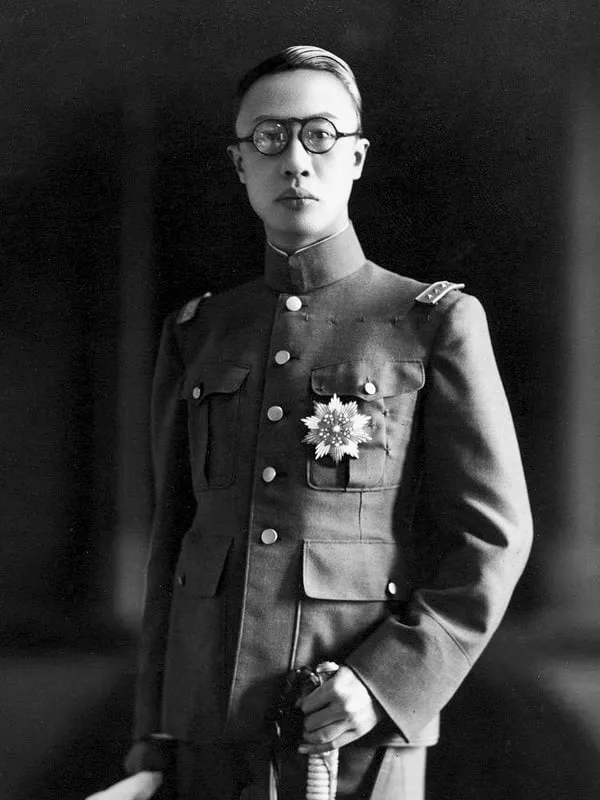
- Born:
- 7 February 1906, Beijing (Chinese Empire)
- Died:
- 17 October 1967, Beijing (People's Republic of China)
- Author:
- Łukasz
- Photo:
- autor nieznany, domena publiczna, Wikimedia Commons

Aisin Gioro Puyi sat on a throne three times and never truly ruled. As a two-year-old child he became the last emperor of China of the Manchu Qing dynasty; at six he lost power to a revolution, and at eleven he regained it for twelve days at the hands of a rebellious general. His greatest, though unfulfilled, ambition was to restore the throne of his ancestors, and that ambition made him a tool of Japan. From 1932 he was the formal head of Manchukuo, a state created by the Japanese army in occupied Manchuria, and from 1934 its emperor. His signature stood on laws that served the Japanese exploitation of north-eastern China and the war against the rest of the country. After 1945 he was a Soviet and then a Chinese prisoner, and the Communist authorities made him a showcase example of the “remoulding” of a human being. He himself later admitted that he had been both a victim and an accomplice.
A child on the Dragon Throne
He was born on 7 February 1906 in Beijing, in the palace of the Princes Chun. His father, Zaifeng, Prince Chun, was the younger brother of the Guangxu Emperor, and his mother, Youlan, was the daughter of Ronglu, one of the closest associates of the Empress Dowager Cixi. In November 1908 the dying Cixi, who had ruled China for half a century, named the two-year-old Puyi as heir to the childless Guangxu. The emperor died on 14 November, Cixi a day later. On 2 December 1908 the boy, crying with fear, was carried onto the Dragon Throne in the Hall of Supreme Harmony. He reigned as the Xuantong Emperor, with his father as regent.
The dynasty was already close to collapse. In October 1911 the Xinhai Revolution broke out, and revolutionaries led by Sun Yat-sen proclaimed a republic. General Yuan Shikai, who commanded the best army in the north, negotiated the abdication. On 12 February 1912 the Empress Dowager Longyu signed, on behalf of the six-year-old Puyi, the edict that ended more than two thousand years of empire in China. Under the “Articles of Favourable Treatment” Puyi kept his imperial title, the palaces in the northern part of the Forbidden City and an annual allowance from the republic, which in any case was rarely paid.
Emperor in the Forbidden City
For the following years Puyi lived in the closed world of the court, surrounded by eunuchs and dignitaries who prostrated themselves before him. No one refused him anything, and, as he admitted years later, he had eunuchs flogged for the slightest offence. He was taught the Confucian classics, but not mathematics or geography. In July 1917 General Zhang Xun, whose soldiers still wore the queue as a sign of loyalty to the dynasty, occupied Beijing and proclaimed the restoration of the empire. The restoration lasted from 1 to 12 July. The republican government sent an aircraft that dropped several bombs on the Forbidden City, and the republic’s troops quickly routed Zhang Xun’s forces. Puyi was once again an emperor without an empire.
In 1919 the Scottish colonial official and sinologist Reginald Johnston became his tutor. He taught him English and European history and gave him an admiration for the West. Puyi took the name Henry, cut off his queue, began wearing spectacles and riding a bicycle. In 1922 he married Wanrong, the daughter of a Manchu aristocrat, and took Wenxiu as a secondary consort. The marriage with Wanrong was unhappy. The empress became addicted to opium, and in 1931 Wenxiu, as the first imperial consort in Chinese history to do so, sued for divorce.
On 5 November 1924 General Feng Yuxiang, who had seized Beijing, unilaterally revised the terms of the abdication. Puyi lost his imperial title and had to leave the Forbidden City within a few hours. On the advice of his counsellors he took refuge in the Japanese legation, and in February 1925 he moved to the Japanese concession in Tianjin.
In Tianjin
In Tianjin Puyi led the life of a wealthy émigré, buying cars, watches and pianos and surrounding himself with courtiers who argued about how to restore the empire. He met warlords, among them Zhang Zuolin, the ruler of Manchuria, and gave money to anyone who promised him the throne. His adviser Zheng Xiaoxu argued that Japan was the only possible source of support. The Japanese took him under their wing, and officers of the Kwantung Army increasingly saw him as a useful figure. In 1928 soldiers of one of the Kuomintang generals plundered the tombs of the Qing emperors near Beijing, including the tomb of Cixi. The perpetrators went unpunished, and Puyi regarded this as a mortal insult and never forgave the Kuomintang.
Chief Executive of Manchukuo
After the Mukden Incident of 18 September 1931 the Kwantung Army began occupying Manchuria, the cradle of the Qing dynasty. Puyi wrote to the Japanese Minister of War, Jirō Minami, that he wished to return to the throne, although after the war he claimed that the letter was a forgery. In November he was visited in Tianjin by Colonel Kenji Doihara, head of Japanese military intelligence in Mukden, who offered him power in a new state. Empress Wanrong and part of the court regarded this as treason. Doihara stirred up riots in Tianjin, and on 10 November 1931 Puyi, hidden in the boot of a car, left his house and then sailed to Manchuria on a Japanese ship. In Lüshun and the other places where he was kept, he soon understood that he was a prisoner.
When the Japanese troops had taken control of Manchuria, Colonel Seishirō Itagaki informed Puyi that the new state would be a republic and that he would receive the title of Chief Executive (zhizheng), not emperor. Puyi protested but gave way when he was promised that the monarchy would be restored later. Manchukuo was proclaimed on 1 March 1932, and on 9 March Puyi took office in Changchun, renamed Xinjing. The next day he signed a letter to the commander of the Kwantung Army handing over to Japan the defence of the state, its railways and ports, and the right to fill posts in the administration. In April he received the League of Nations commission of Lord Victor Bulwer-Lytton. As he later recalled, he wanted to ask the Englishman to help him escape, but Itagaki was sitting next to him, so he assured the commission that he had come to Manchuria of his own free will at the call of the people.
The Kangde Emperor
On 1 March 1934 Puyi was crowned Emperor of Manchukuo and took Kangde as his reign name. The Japanese would not allow him to wear the robes of the Qing emperors at the main ceremony. He was dressed in uniform, and put on the traditional dragon robe only for the sacrifice at the Temple of Heaven. Puyi hoped this was the first step towards regaining the throne in Beijing. In reality he was a prisoner in his palace in Xinjing, housed in the former building of the salt administration. From 1935 he was constantly accompanied by a Kwantung Army officer, Yasunori Yoshioka, who passed on instructions to him and monitored his contacts. All the laws were drafted by Japanese officials and signed by the emperor: on the expropriation of Chinese peasants in favour of Japanese settlers, on harsh penalties for “banditry”, and later on forced labour and deliveries to the army.
In 1935 and 1940 Puyi visited Japan and met Emperor Hirohito. After the second visit the cult of the Japanese goddess Amaterasu, as ancestress of the imperial house, was introduced in Manchukuo, which Puyi took as a humiliation. In 1937 his younger brother Pujie married Hiro Saga, a relative of the Japanese imperial family, and the Japanese pushed through a law under which the throne could pass to Pujie’s son. Puyi, who had no children, suspected that the Japanese wanted to replace him. When the Second Sino-Japanese War broke out in July 1937, Manchukuo became a base for the Japanese army, and Puyi issued declarations of support for the “holy war”. The recognition of his state by Italy in 1937 and by the Third Reich of Joachim von Ribbentrop in 1938 changed little for him. In December 1941 Manchukuo followed Japan and declared war on the United States and Britain.
Witnesses from his court later described him as an increasingly frightened, suspicious man who was cruel to his servants and had them flogged. Empress Wanrong sank into opium addiction and illness. His concubine Tan Yuling died in 1942 in unclear circumstances after treatment by a Japanese doctor, and Puyi was convinced that she had been poisoned.
Fall and captivity
On 9 August 1945 the Red Army attacked Manchukuo. Puyi fled Xinjing with his court and on 13 August reached Dalizigou near the Korean border. There he heard on the radio that Japan was surrendering, and he signed an act of abdication that marked the end of Manchukuo. He tried to fly to Japan, but at the airfield in Mukden – on 19 August, according to most accounts – he was detained by Soviet soldiers. Wanrong died in a Chinese prison in 1946.
For five years Puyi was held in the USSR, in Chita and Khabarovsk, in tolerable conditions, and several times asked Stalin for permission to stay. The government of Chiang Kai-shek, which had charged him with treason, demanded his extradition in vain. In August 1946 Puyi spent eight days giving evidence in Tokyo before the International Military Tribunal for the Far East. He presented himself as a kidnap victim and a hostage of the Japanese, denied that he had ever cooperated with them willingly and incriminated the Japanese generals. Years later he admitted that he had lied to save his life.
A remoulded citizen
On 1 August 1950 the Soviet Union handed Puyi and several hundred other prisoners from Manchukuo over to Communist China. For nine years he was held in the war criminals’ prison at Fushun. For the first time in his life he dressed himself and cleaned up after himself. He underwent “re-education”: he wrote self-criticisms, listened to the testimony of victims of the Japanese occupation and visited the sites of crimes, including the remains of Unit 731 near Harbin. “All these atrocities were committed in my name,” he wrote. On 4 December 1959 he received a special amnesty and returned to Beijing.
He spent the last years of his life as an ordinary citizen. He worked at the botanical garden in Beijing and, from 1964, as an editor of historical materials for the Chinese People’s Political Consultative Conference, of which he became a member. In 1962 he married a nurse, Li Shuxian. Under the supervision of the authorities, and with the help of the editor Li Wenda, he wrote an autobiography, The First Half of My Life, published in 1964 and translated into English as From Emperor to Citizen. The book was both a sincere confession of guilt and a propaganda document, in which some facts were passed over in silence or altered. When the Cultural Revolution broke out in 1966, the former emperor was placed under protection but lost some of his privileges. He died of kidney cancer in Beijing on 17 October 1967. In 1995 his ashes were moved to a cemetery near the Western Qing Tombs.
Significance
Puyi was not the creator of Manchukuo. The state was conceived and built by officers of the Kwantung Army, and he supplied what they could not provide themselves: a semblance of legitimacy. The last emperor of the Manchu dynasty at the head of a state in Manchuria was meant to persuade the world that it was not a Japanese conquest but the rebirth of an old monarchy by the will of the people. Most of the world did not believe it, but the Japanese did not need universal recognition – only a screen. For thirteen years Puyi was the best-known face of Japanese expansion in Asia, a model repeated in successive dependent governments in China and South-East Asia.
Historians disagree about the extent of his guilt. When he became emperor at the age of two he had no choice at all, but in 1931 he chose deliberately. Premier Zhou Enlai is said to have told him after his release that he bore no responsibility for having become emperor as a child, but was fully responsible for what he had done as an adult in accepting Japanese protection and power in Manchukuo. His story is known throughout the world today thanks to Bernardo Bertolucci’s 1987 film The Last Emperor.
Sources
Mentioned in battles
(02)Often appears with
People who appear in the same events.